
Marisol has spent five chapters holding two armies together with food. It’s been working. Nobody’s fighting. The lords would rather talk about siege weapon engineering than use their siege weapons. Thomas from Millbrook is starting to believe he might actually go home.
And then the supply caravan breaks a wheel.
This is the chapter where the plan runs into logistics. Marisol can multiply food. She cannot invent it. So whatever is sitting in that storage tent is what a thousand people are eating, and what’s sitting in that storage tent is onions.
Tibby also has a rough day. I’ll let that one land on its own.
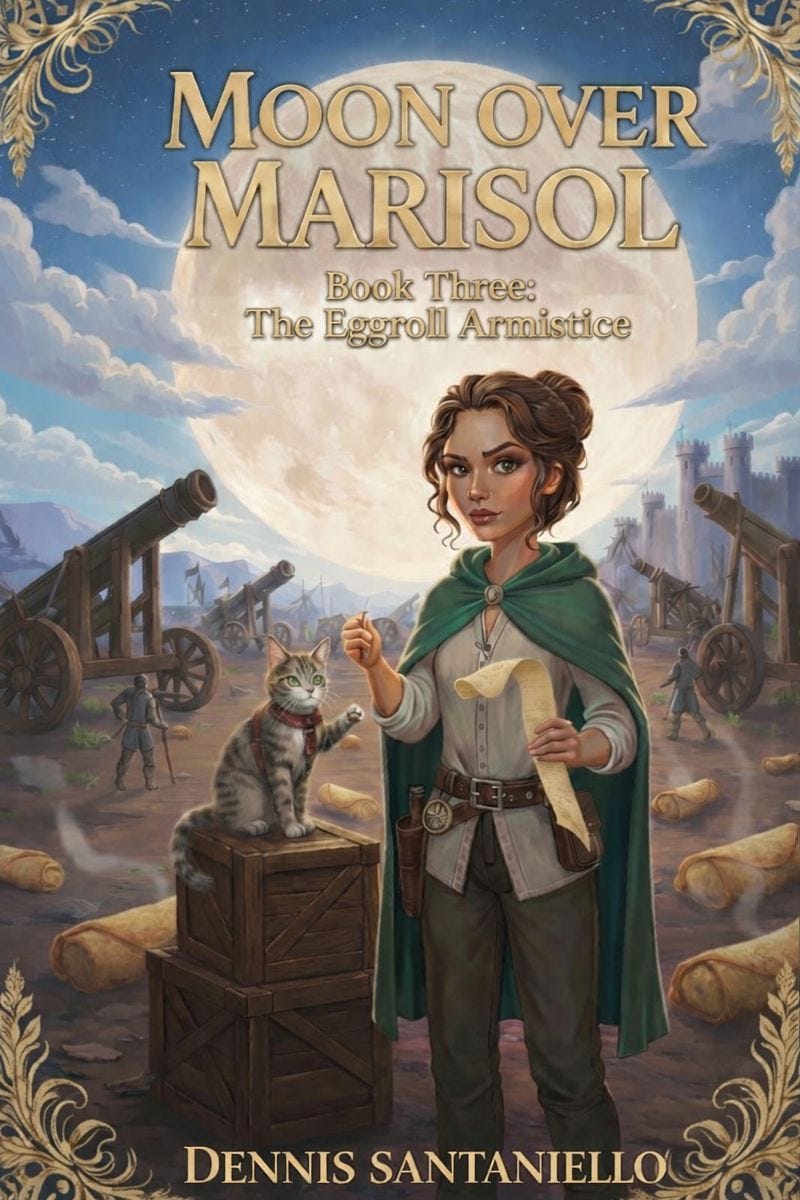
If you’re just joining us, this is Book 3 of the completed 18-book series. You can jump in here and be fine. Marisol is a 900-year-old witch working off cosmic debt one assignment at a time, and this assignment is a war camp.
Let’s go.
The next morning started normally enough. I went to check the supplies, planning to make something special for breakfast—maybe those hand pies again, since everyone had liked them so much.
I opened the storage tent and found onions. Just onions.
Sacks of them. Piles of them. More onions than any reasonable person should ever have to look at.
And nothing else.
“Tibby,” I said, very calmly.
“Yes?”
“Where did all the other food go?”
He padded into the tent, looked around, tail swishing. “Ah.”
“Ah?”
“Remember how I said a supply caravan was coming?”
“Yes.”
“It was supposed to come yesterday.”
“And?”
“It didn’t.”
I closed my eyes. I counted to five. I opened them again. The onions were still there, mocking me with their papery skins and pungent smell.
“Why not?”
“Broken wagon wheel, apparently. They’re delayed by two days. Maybe three.”
“So we have...”
“Onions,” Tibby confirmed. “Lots and lots of onions.”
I picked one up. It was a perfectly good onion—firm, fresh, no signs of rot. Under normal circumstances, I’d be happy to have it.
These were not normal circumstances.
“Of course. Of COURSE it’s onions.”
The onion, unsurprisingly, didn’t answer.
I made onion soup for breakfast.
What else was I going to do with seventeen sacks of onions and nothing else?
I multiplied them—one onion becoming many—and made the best onion soup I could manage. Added the last of the herbs, used up the butter I’d been saving, made it as good as possible given the circumstances.
The soldiers noticed immediately.
“This is... onions,” one said, staring into his bowl.
“Very observant.”
“Just onions.”
“There’s broth too.”
“Onion broth.”
“It’s food,” I said, more sharply than I intended. “Eat it or don’t.”
He ate it. They all ate it. What choice did they have?
By midday, I’d served onion soup to roughly a thousand people. Nobody was happy about it, but nobody was starving either.
“This isn’t going to work for multiple days,” Tibby observed.
“I know.”
“People are already complaining.”
“I know.”
“Gently complaining, but still complaining.”
“I KNOW.” I sat down hard on my stool, exhausted and frustrated and so tired of onions. “What do you want me to do, Tibby? I can’t create food from nothing. I can transform what’s here. And what’s here is onions.”
“I’m not blaming you, baby. Just stating facts.”
I rubbed my face. “How long until the supply caravan?”
“Two days. Maybe three.”
“So I have to make onions interesting for two days. Possibly three.”
“Possibly.”
“Perfect. Just perfect.”
The next day, I got creative.
Breakfast: Onion fritters. Chopped onions mixed with flour and water, fried until crispy. Edible, at least.
Lunch: Caramelized onions on bread. Used the last of my sugar to caramelize them properly, made them sweet and savory at the same time. Actually pretty good.
Dinner: Roasted onions. Whole, with the skins on, cooked in the coals until they were soft and sweet inside. Surprisingly decent.
The soldiers were getting tired of onions, but they appreciated the variety.
“At least she’s trying,” I heard one say. “Yesterday was just soup. Today we got three different onion dishes.”
“Still onions though.”
“Still better than nothing.”
I’d take it.
But my magic was suffering. Multiplying onions took less power than multiplying meat or grain, but doing it constantly—breakfast, lunch, dinner, for a thousand people was draining, not crisis level. Not yet. But getting there.
“You need to rest,” Tibby said that evening.
“Can’t rest. People need to eat.”
“People can skip one meal.”
“Not happening.”
“You’re running yourself into the ground.”
“I’m managing.”
“You’re depleting.”
“I know!” I snapped, then immediately felt bad. “Sorry. I know. But what choice do I have? If I stop feeding them, they’ll remember they’re supposed to be enemies. Everything I’ve built falls apart.”
“Then let me help.”
“You’re a cat.”
“I’m an ancient magical familiar who’s been with you for nine hundred years. Let me help.”
I looked at him—orange fur, amber eyes, small and perfect and completely serious.
“How?”
“I can carry things. I can fetch ingredients. I can scout for edible plants outside the camps. I can do more than just report and die occasionally.”
“You do plenty.”
“I can do more. Let me.”
I held him close, felt him purr against my chest. “Okay. Thank you.”
“That’s what I’m here for, baby.”
The third day of onions was the worst.
The food wasn’t bad—I’d gotten quite good at making onions interesting by this point. Onion tart for breakfast, onion and herb bread for lunch, French onion soup for dinner with the last scraps of cheese I’d been hoarding.
No, it was the worst because of the barrel.
I was carrying a pot of soup across camp—doing it manually to save magic—when someone’s poorly stacked supplies gave way. A barrel rolled off the top of the pile, gained momentum down a slight slope, and headed straight for me.
I saw it coming. Stepped aside.
Tibby, who’d been walking next to me, didn’t see it.
The barrel hit him square on.
There was a wet squelching sound, a brief orange blur, and then... nothing. Just a barrel lying on its side and a distinctly cat-shaped stain on the mud.
I stared.
The soldiers nearby stared.
For about three seconds, nobody moved.
Then Tibby walked out from behind a tent, grooming his paw like nothing had happened.
“That was inconvenient.”
“Tibby. You just got crushed by a barrel.”
“Yes.”
“I saw you get crushed.”
“I’m aware.”
“There’s a stain—”
“I’ll respawn more carefully next time.” He continued grooming, completely unbothered. “The soup’s getting cold.”
I looked at the stain. Looked at him. Looked at the soldiers who were now trying very hard not to stare.
“Right. The soup.”
I picked up the pot and kept walking, because what else was I going to do? Have a breakdown over my immortal cat getting squashed by a runaway barrel?
Nine hundred years of this. You’d think I’d be used to it by now.
That evening, after everyone had been fed their third consecutive day of onion-based meals, after I’d cleaned up and banked the fires and done everything that needed doing, I sat outside my tent and just... stopped.
Tibby climbed into my lap.
“You okay?”
“I’m tired.”
“I know.”
“Really tired.”
“I know.”
“And I’m so sick of onions I could cry.”
“That’s probably the onions themselves. They make everyone cry.”
I laughed despite everything. Held him closer.
“I love you, Tibby. You drive me absolutely nuts. But I love you.”
“I love you too, baby.”
“Even when you get crushed by barrels?”
“Especially when I get crushed by barrels. Gives you something to complain about besides onions.”
“Fair point.”
We sat there in the quiet. The camp was settling down for the night, soldiers full of onion soup, nobody fighting, everyone still safe.
Three days of onions. Three days of frustrated cooking. Three days of depleting magic and exhausting work.
But everyone was alive.
Everyone was still friendly.
And the supply caravan was due tomorrow.
“One more day of this.”
“One more day.”
“Then fresh supplies.”
“Then fresh supplies.”
“And then I start the eggrolls.”
“You’re still planning that?”
“More than ever.” I looked at the field, at the siege weapons standing silent in the moonlight. “The demonstration is in a week. I’m going to make them mama’s eggrolls and nobody’s going to want to fight anymore.”
“You sound certain.”
“I am certain.” I scratched behind his ears. “The gamblers bet on death. They’re going to lose. Pemberton and Corso are going to keep discussing engineering. Thomas from Millbrook is going home. And I’m going to finish this assignment with a green check and everyone alive.”
“Even after onion days?”
“Especially after onion days.” I held him closer. “This is the hard part. Getting through the logistics, the depleting magic, the frustration. But I’m almost through it. Seven more days.”
“Seven more days,” Tibby agreed.
Up on the hill, I could see the silk pavilions glowing with lamplight. The gamblers watching. Waiting. Hoping for blood that would never come.
“They’re running out of time too,” Tibby said, following my gaze.
“Good.”
“Seven days until they lose everything.”
“They already lost everything. They just don’t know it yet.”
When the supply caravan finally arrived, it was the most beautiful sound I’d heard in weeks.
Wagon wheels.
I woke to the creaking, rumbling sound of heavy wagons coming up the road. Stuck my head out of the tent and saw them—three wagons, loaded high with supplies, coming into camp like salvation on wheels.
“Tibby.”
“I hear them.”
“The supply caravan.”
“The blessed, beautiful supply caravan.”
I was at those wagons before they’d even stopped moving, helping unload, taking inventory with hands that shook slightly from relief.
Vegetables. Real vegetables. Carrots, potatoes, turnips, cabbage.
Meat. Actual meat, not dried leather.
Grain. Flour. Salt. Spices.
And—I could’ve cried—fruit. Apples, specifically. A whole crate of them.
“We’re saved.”
“From onions?” one of the wagon drivers asked, amused.
“You have no idea.”
I cooked like a woman possessed that morning.
Made porridge with dried fruit. Made stew with vegetables and meat. Made bread with proper flour. Made everything I hadn’t been able to make for three days.
The soldiers’ reaction was immediate and joyful.
“Real food!”
“Meat! Actual meat!”
“I thought I’d never taste anything but onions again!”
“The cook is a saint!”
“The cook is a miracle worker!”
I wasn’t a saint or a miracle worker. I was just tired and relieved and so, so happy to have ingredients again.
By evening, everyone had eaten well.
Really well. The best meal I’d made in a week.
And my magic had stabilized. Not refilled—I was still depleted—but stable. Not draining further.
I could work with this. I’d worked with worse.
The next day was for recovery.
Both mine and the soldiers’. Everyone was tired of onions, everyone was grateful for real food, and the mood in the camps was better than it had been in days.
I made simple meals—nothing fancy, just good solid food. Let my magic rest as much as possible. Did things manually. Conserved energy.
Tibby scouted the hill.
“The gamblers are getting worse. Panicking. Fighting with each other.”
“How many days do they have left?”
“Five. Five days until the demonstration.”
“Same as me.”
“You’re planning something big.”
“The biggest.” I was already thinking through the menu. The feast. Mama’s eggrolls as the centerpiece. Everything else building around them. “Two days before, I start the eggrolls. The day before, I prepare everything else. Then demonstration day...”
“Demonstration day?”
“I give them something they’ll never forget.”
Tibby purred. “You’ve got that look.”
“What look?”
“The look you get when you’re about to do something impossible.”
“Everything I do is impossible. That’s the job.”
“This feels different.”
“It is different.” I looked at the field, at the soldiers, at the siege weapons. “This is the end. This is where it all comes together. Five more days and everyone goes home.”
“You sound certain.”
“I am certain.”
And I was.
Three days of onions hadn’t broken me. Depleted magic hadn’t stopped me. A barrel crushing Tibby hadn’t even slowed me down.
Five more days of cooking, feeding, caring.
And then demonstration day—when it was all supposed to happen, the day the gamblers were counting on, the day everything was supposed to come apart.
Instead, I was going to make it beautiful.
With mama’s eggrolls.
With a feast.
With everyone alive.
With a green check.
Chapter 7 is next, and the supply caravan is not the last thing to go sideways.
New here? Moon Over Marisol is my completed 18-book fantasy comedy series about a 900-year-old witch, a sarcastic cat, and a truly unreasonable amount of cosmic debt. You can start with Book 1, grab the full bundle, or just keep reading along here.
If you’re reading these chapters and enjoying them, hit reply and tell me. I read every one.
Much Love,
Dennis
P.S.
OUR SPOOKY SEASON KICKSTARTER LAUNCHES SEPT 1 2026!

No posts
Comments
Nothing yet. Say the first thing.
Sign in to join the conversation.