
Dear Moonandmouth:
I am seeking advice and perspective on how to direct my time and energy as an unpopular artist. I’m in my 30s. I have spent a great deal of my free time since I was a teenager on creative endeavors, mainly writing literary fiction, and also writing music and playing in bands and scoring short films. I’ve dabbled in poetry and acting. I tried standup comedy once.
It’s difficult, much of the time, not to feel like a failure, like all of this has been a tremendous waste of time. While I’ve improved in my craft and had a few small successes (publications, minor grants, album release shows attended by dozens - that’s right, dozens), I have yet to cultivate anything that could be reasonably called a fanbase. I don’t draw any consistent income from my creative output. I like the stuff I make but it’s not clear to me that anyone else does. Because I get so little feedback and validation it’s hard to tell when anything is working, and I have a wide range of interests in terms of genre, media, and style, so I often feel like a dilettante, throwing too much at a wall where nothing sticks. I also have a distaste for self-promotion and I am unsure how to market anything I make other than submitting to publishers and posting to social media.
Some of this, I’m aware, is out of my control. I’ve never gone to art school, there are no working artists in my family, and I do not have passive or generational income. At best I can get away with a day job that affords me adequate free time, but I have a family now and so risking it all to become a full-time creative is out of the question. I know these are excuses, but they add to the sense of futility. I don’t actually think I’m a “bad artist” because I like the stuff I make and am fairly confident in my technical skill - but there’s no engine, no unified agenda, no sense of growth, just a recurring cycle of making stuff and sharing it with friends.
I wonder - is this all there is? Is this all there should be? I can’t avoid feeling jealous of more successful artists and I can’t shake the feeling that I’ve wasted my best years on dabbling, flailing, half-hearted execution, when I could have committed fully to something and tried to actually become great at it. Increasingly I feel old and washed up. Increasingly I encounter “new” famous writers and musicians who are much younger than me. None of this has killed my creative drive but I do feel it’s becoming more arbitrary, almost onanistic. More of a giant YOLO than a feeling that I’m actually working towards something worthwhile.
How should I process these feelings? How should I conduct myself as someone with creative ambitions but limited resources, limited focus, and possibly limited talent as well? Do I embrace “art for art’s sake,” or is there something I’m missing, some key to success or at least minor recognition? Do I just need to work harder? Is it even OK to want this kind of validation in the first place?
What, in your experience, is “The Artist’s Way?”
Thank you for running this column, you’re providing a valuable service.
Sincerely,
A Failed and Flailing Author
Dear Failed and Flailing,
I am answering your letter, finally, after months of considering your dilemma, and after reading the first chapter of The Artist’s Way (which I assume you’ve also read, given your reference), and after hand writing three A4 pages for the “morning pages” exercise prescribed therein, during which my tears blotched the papers in a sort of sludgy camouflage, papers on which I jotted such luxurious self-flagellations as: Always the ‘A’ student, the teacher’s pet. This is why you’re not a real artist, Steff, you dumb fucking cunt. You should get a tech sales job, something soul-crushing that ensures you never have time to do your stinky “art” again! And thank GOD—what a relief that would be—your real gift to the world—stopping whatever constipated pen drippings you manage to shit into the world every three weeks or so.
No one can ever be as cruel as we are to ourselves. For that reason, it has been difficult to answer your letter with the generosity it merits, since I see so much of you in myself. Failed and Flailing, meet Moon and Mouth. I am also in my 30s, and, in the not-even-that-grand scheme of things, an unpopular artist.
I know exactly how you feel. I, too, see those young writers with book launches costing more than a wedding, professional publicists attached at the hip like a Glock glinting in a holster. Photoshoots in all the right magazines, reviews in all the right magazines. The whole nine yards, while I’m over here with my yard sale (a sign, in sharpie, reading: Everything—All 25 Author Copies of My Book—Must Go!).
Actually, Failed and Flailing, I’m far worse off than you.
For one, I do think I’m a bad artist, at least when it comes to short fiction, which is what I’ve set my sights on next. I can tell that my concepts are derivative, my thoughts are imprecise, my sentence structure is clunky, and my quality of attention to the details of the external world—the fundamental building blocks of a non-autofictive story—is hot trash.
Moreover, unlike you, I don’t even have a family! If I died tomorrow, I would leave nothing behind (my indie poetry collection being highly unlikely to survive the generation). In my darkest, private moments, I think to myself: “Sheila Heti can get away with not procreating. Mary Gaitskill. Not you.”
Failed and Flailing, I hope this helping, and that I’m not excavating my excruciations for nothing.
I hope this adapted DARVO tactic—a favorite technique of toxic people, such as narcissistic artists: deny, attack, reverse victim and offender—in which I reverse sufferer and solacer, is helping.
Or:
Do you want me to quit whining?
Do you want to retort, “But you have more followers than me?”
Do you want to stop this pissing contest—one in which we compete to see whose stream is weaker, paler, shorter?
If you answered yes to any of the above, that means we’re getting somewhere.
~
And that somewhere is this: everyone loses when we insist on seeing “the artist’s life” this way.
Sure, we can’t stop ourselves from occasionally seeing it this way. As with the rabbit-duck optical illusion—
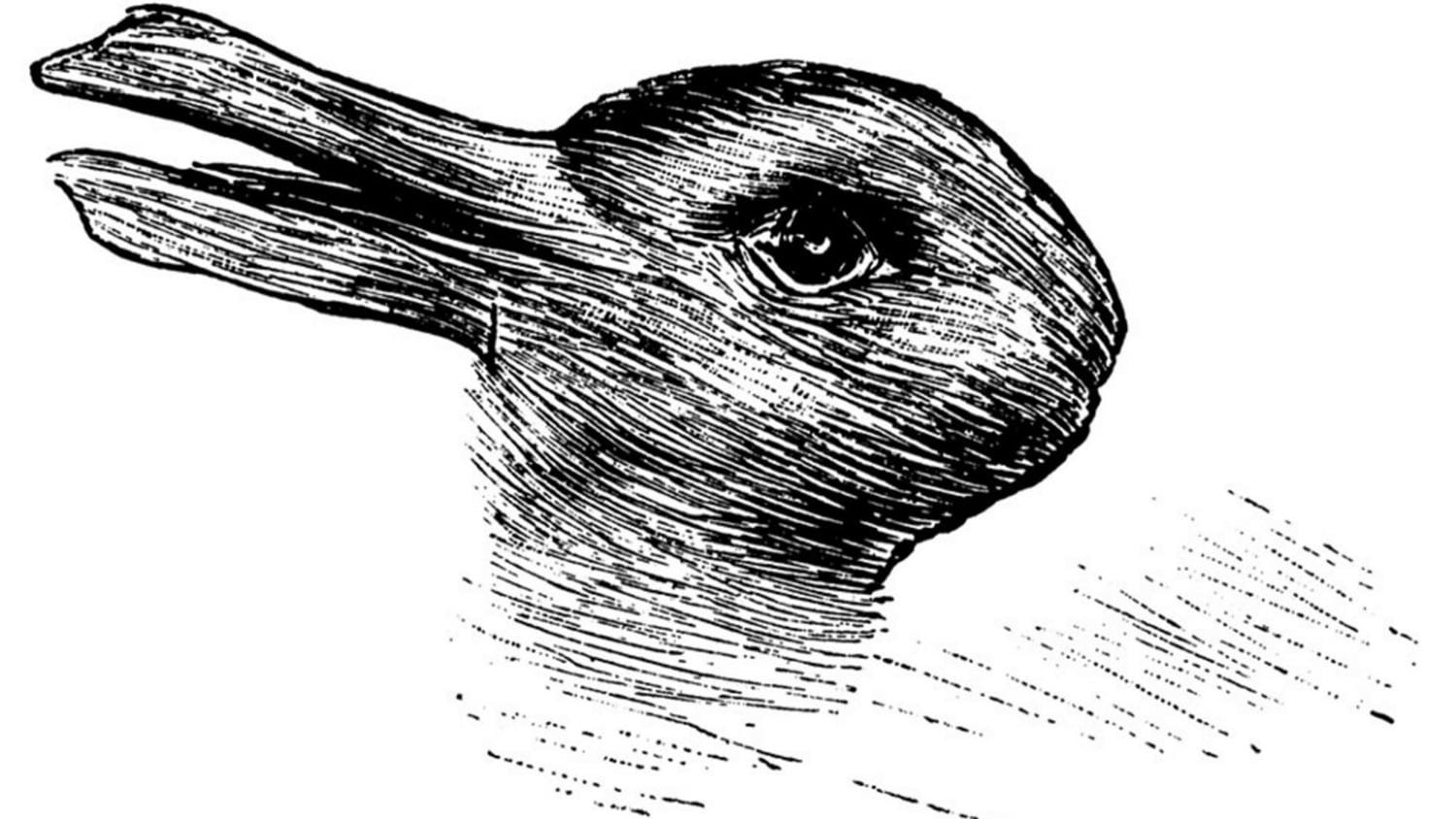
We’re going to occasionally see the duck, even if we’d much rather see the rabbit.
But we don’t have to make the duck’s job easier. Instead, we can predispose ourselves to seeing the rabbit by:
Letting go of our fear and anxiety around ducks.
Focusing our attention on rabbits. Hanging out with rabbits. Celebrating rabbits.
By rabbits, I mean: other artists who are seeking to be in community with skilled artists (regardless of popularity). As opposed to ducks: artists who are seeking—and very likely have accumulated a decent amount of—fame, money, or power.
Failed and Flailing, you mention you’ve had “album release shows attended by dozens - that’s right, dozens.” I think that’s actually quite impressive. In the world of poetry readings, multiple dozens of attendees would constitute a successful turnout.
But I want to ask you something: Who were those attendees? If they were mostly old friends or family, mixed in with some strangers, it makes sense you’d feel some disappointment at not having more of a “fanbase.” But I can tell you from personal experience: when your audience consists of other artists making work you genuinely admire—even if those artists are also unpopular, even if they only number a handful—you will absolutely glow with validation.
Not because they’re your fans, but because they’re your peers.
If there’s one lesson I’ve learned in the seven or so years that I’ve been writing “seriously,” it’s that the rewards of the status game pale in comparison to true artistic camaraderie. To an outside observer, the latter can sometimes resemble the former (are they celebrating a friend on social media, or farming clout?)—but your heart will always know the truth.
Which is not to say that forging such bonds is any easier than the status game. For me, it’s involved:
Reading a lot of almost completely unknown writers that I stumble upon online. Cold-DMing them my thoughts. Hyping them up. Later, publishing them if I can. Connecting them to someone I think they’d be friends with. Watching them be better friends with that person than me. Recommending resources and opportunities I think they’d be eligible for. Writing recommendation letters.
Buying local artists’ chapbooks, riso prints, shirts, ceramics, tapes—whatever work I think is genuinely neat and supports artists in my immediate physical vicinity.
Schlepping myself, when I’m exhausted after a day of work, through the rain and after circling endlessly for parking, to friends’ readings and concerts and performances. Afterwards, having a boot put on my car because I parked in the wrong space after all.
Helping at those readings and concerts and performances. Bringing drinks and snacks. Setting up. Breaking down. Cleaning up. Driving.
Reposting flyers. Reacting and commenting. Mailing postcards, books, and other physical correspondence, just because.
Whew.
All of this started when I had fewer than 300 followers on any platform. Truthfully, as my circles have grown larger, I’ve had to step away from saying “yes” to everything. But my circles grew larger because I said “yes” at first. 33% out of a sense of obligation—66% out of a sense of curiosity about other talented artists and a desire to make them feel good about their work, no matter how many followers they had.
Sometimes it came back to me. Sometimes it didn’t (many, many DMs went unanswered).
Failed and Flailing, you say you get “so little feedback and validation.” But how much feedback and validation do you give? Could you try doing just one or two things on that list, and seeing how it goes? My wager is that you’ll eventually come to find what I did: friendship feels better than fandom.
I don’t know about “the” artist’s way—but this is my way. When I’m at a dive bar after a reading attended by a couple dozen people, hanging out with other unpopular poets whose work I find hilarious, heartbreaking, and incisive … Well. That’s when I feel like I’ve really, truly made it.
Want to submit your own question? Read this first.
No posts
Comments
Nothing yet. Say the first thing.
Sign in to join the conversation.