
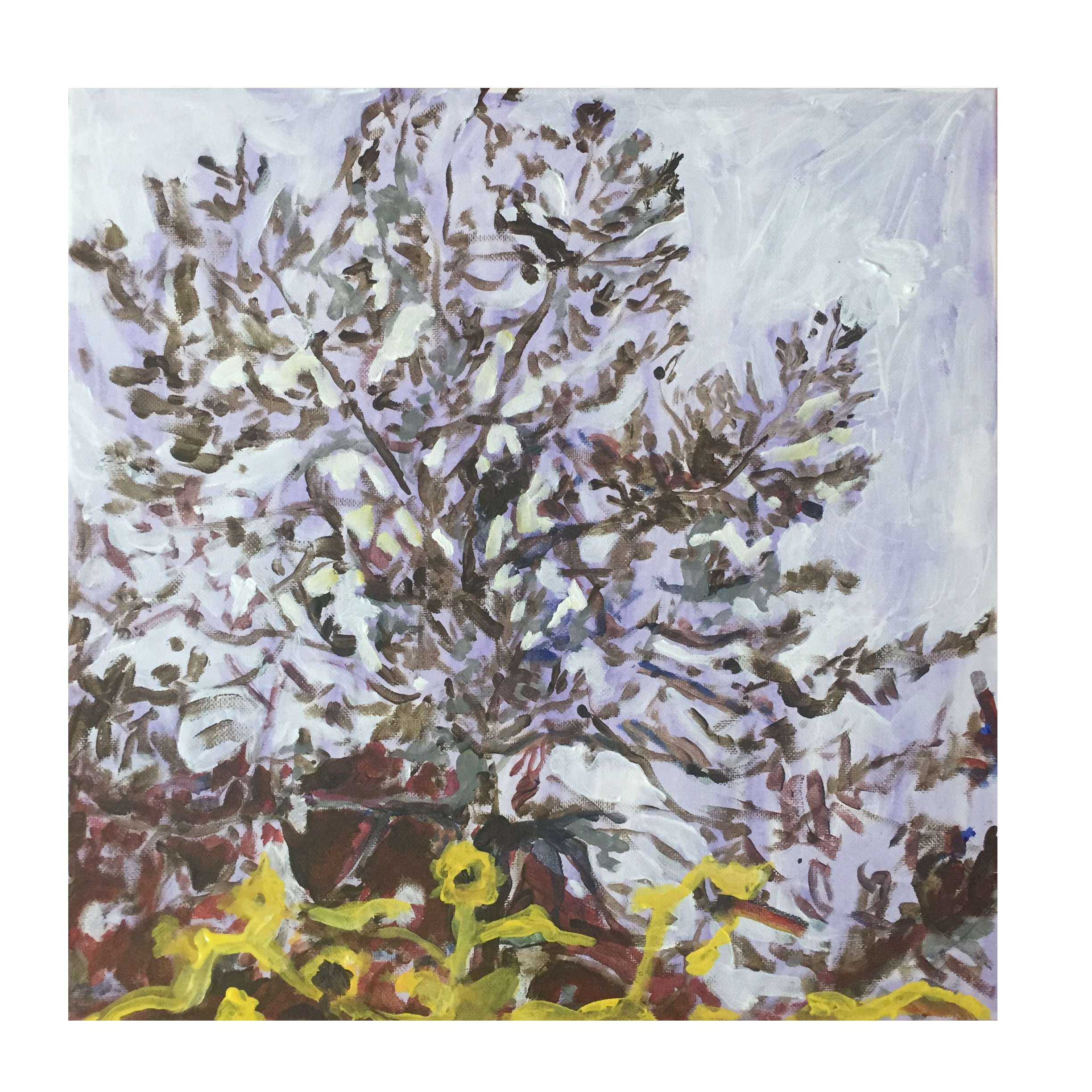
I took a walk down Labor in Vain Road. At the end of the road there’s a sort of shack or garage with salt-weathered shingles and sky-colored doors. Across from this, there’s a short bridge that crosses over a creek in a marsh. I stood on the bridge and watched. Below the bridge the ice was rough and yellow, exposed pools of water were black. In these dark spaces of circular water, I saw pairs of loons. Then like white lines in the purple sky, a sandpiper. I closed my eyes and heard the loons’ wings on the water and I heard the sandpiper’s flight. I prefer the sound of birds to the sight of them. Like staring at the storage closet inside some opulent building. Birds are famous for the beauty of their songs and their bodies, but the unintentional, unavoidable sound of wings, all it does is make me notice that we are together in the same place and time.
I heard a bird and then I saw it. I repeat these words in my mind somewhat randomly, as if they were lyrics to a song I had stuck in my head. They were written in the diary of a gravedigger, David, about 170 years ago, a mile and a half from this bridge. David dug graves, wove cloth in factories, built objects from wood. His census information changed every few years, which I think is sort of a portrait of precarity.
Walking back into town at dusk, I heard moaning from the woods. I looked up to the source of the sound and saw a massive bird perched in the canopy of a tree. It was a turkey. Then I looked and noticed there was a turkey in the tree beside that one. And then suddenly I noticed that there was a turkey at the top of seemingly every tree. Ahead of me, two turkeys walking down the road. We were walking the same pace in the same direction. I imagined how I might go about passing them without startling them. We continued this way for maybe two minutes until a car came. The car was driving in our direction which naturally frightened the turkeys. Quickly, quick as the car, they flew towards me. Barrels of their chests moving towards my face. I gasped, I could see that the driver gasped also. I’ve never been so close to a turkey. Like basketball stars propelling themselves upwards while already in the air, the turkeys flew over me and up to an empty tree.
I was flustered when I walked into the library. I walked past the children’s room on the left and the archives on the right. On the landing of the stairwell, two young mothers were having a conversation. History sits in places. Upstairs, on the far wall of the computer room atrium, I saw a painting I’d never seen before. I walked up to the person at the desk and asked, excuse me, who made this painting?
Oh this painting? Let me check, I know he was painting at the same time as Arthur Wesley Dow.
And she pointed to Dow’s paintings, four large framed landscapes against a brick wall. The one I like most is a view of the beach turned away from the ocean, a small boat on the sand, and footprints.
Yes, I love his paintings, this one here on the wall I didn’t recognize.
She said: you are talking to the right person, I’m the archivist.
Oh really? I just sent you an email!
Are you Page? I remember your question.
It’s as if the document has vanished into thin air.
It was a diary?
Yes, Arthur Dow’s father wrote a diary while he worked as a sexton at the Old North Burial Ground.
You don’t have to tell me, but what is the nature of your research?
The nature of my research?
I used to regularly ask new acquaintances if they grew a garden. I did this because it was an efficient way to learn someone’s unique relationship to land, finances, leisure, passion, pace, focus. For example, once I met a woman who had an incredibly small garden plot outside her apartment, around the size of a mattress. Late in life one day she realized she had never eaten okra, so she dedicated her whole garden to growing okra. I extrapolated that her lust for life was strong.
History is like sitting in someone’s garden after they left. Looking around, trying to understand what they did. Living is like trying to figure out what to do with the land now, now that the gardener (or indentured servant, enslaved laborer, landowner, farmer, anyone who has ever worked this earth) is gone.
The nature of my research is that once I inherited a garden plot from a man named Ricky. He didn’t own the land the garden plot was on, he rented it. I didn’t own the land either, we were similar in that way. When he was alive, he grew a massive vegetable garden, it was beautiful, I remember it. I didn’t ever know the man, I knew the garden. But after he died, when my hands were coated in the dark soil, I thought about him. I thought about him so much. It’s as if something rose from the earth at all times to remind me of him. The thoughts came like sensations, aromas, colors, I can’t explain.
He died by suicide in the Old North Burial ground across the street. He had also spent his life working as a steward of the same burial ground, taking care of the graves that David once dug. They worked the same land, as Ricky and I worked the same garden, and in this way the three of us are united by the simple, horrible, gross precarity of living in the same American town.
-
In The Hour of the Star, Clarice Lispector writes a biography of a strange girl, Macabeá. Throughout the novel, the narrator makes it clear that of everyone in the world, the only person who loves the girl is the author writing her story. But even the author can’t figure out why they love Macabeá, and the whole fictional biography is enmeshed with this mystery.
One of my favorite lines of the novel comes at the end, when Macabeá meets with a fortune teller. En route to understanding her destiny, the narrator explains the time of day by saying that “dusk is no one’s hour.”
David’s son Arthur was obsessed with dusk, he painted it obsessively. He painted houses and marshes and tombstones and boats touched by dusk. When he was young he explained: Mystery has an important place in art, and my ambition is to paint natural objects and to throw over them the air of mystery that they have.
I can’t find David’s journals anymore. It’s possible I guess that I only dreamt them, and this is why I was talking to the archivist in the first place. If the document is real, I remember it as a poetic description of what life was like working in the graveyard.
Well I can’t find that but what I did find
said the archivist
is this:
and she showed me a newspaper clipping that detailed David’s tragic death, a missed step on a ladder.
Life,
the archivist said,
feels very short when you start to learn about history.
History, let me give you proof that anyone ever loved the world. History, a thousand pointed star. Reading a long book for a long time. A misremembered sentence from a journal that maybe never even existed. Misremembered and oft repeated, mysteriously, like an anonymous pilgrim’s ceaseless prayer.
-
In the graveyard that was Ricky and David’s lies mass graves of colonizers. Before the 1940’s, the ground was too frozen to dig in the winter, so everyone who died over the winter was buried together in the spring, in piles, and the ground is bumpy for this reason. Sheep once “bleated mournfully among the tombs.” The town planted maple trees in David’s time, and 70 years later planted honeysuckle to prevent soil erosion. In my lifetime, one tree has fallen, no more sheep graze, garlic mustard frames the edges of the yard. It also strikes me that David and Ricky lived in walking distance to their work, this place of rest. Ricky lived at the bottom of the hill and David at the top.
Important to no one besides myself, I once walked up the hill beside David’s house backwards, listening Sara by Fleetwood Mac. When I think of him, I also think of this moment. Simultaneously I think of the very very top of the hill, once it was clear of all these young trees and there was a long view to the marsh.
In the foreground the marshes offered a rich pattern with Blue and Silver Dragons, their carpet of multicolored softness changing from season to season. On the hill of bayberries, facing this pattern of loveliness, Dow built his studio in 1900 and it was a work of love. For the chimney he went to the local brickyard and from the heap of rejections he gathered bricks. Each had its own character gained from its very irregularities and some of them had a rich patina and some an accidental glaze. Under his direction they were worked into a tapestry of brick. (Arthur Warren Johnson)
The studio has since burned down but if you wanted to you could still go into the woods up there, as I sometimes do.
I asked the archivist, at the top of Bayberry Hill behind the graveyard, there’s a circle of redwoods, do you know anything about that?
What about the abandoned shipyard, where an heiress nursed her broken heart when her lover sailed away? And now crabs dot the dry seagrass, the tide comes in and out, and a piping plover protects her nest.
I’m not a historian, I’m just someone who has taken many walks. At this, the archivist took me down to the archives and showed photographs of places and people.
-
You know, I think I asked people whether or not they grew a garden as a proxy to see what they cared about. Because in a garden, one gets on their knees in a sort of prayer position. From a distance, it feels delusional to care about anything as much as a gardener cares about a late frost.
When I planted that garden, I thought about Ricky every day. I cared about him so much even though he was a stranger. And because I cared about Ricky, I cared about David. And because I cared about David, I cared about his son Arthur. And because I cared about Arthur, I cared about all of Arthur’s friends whom he loved extremely dearly. For example I love Arthur’s friend Mr. Smith who involved Arthur in various schemes to gain permission from farmers to paint their cows just because he loved cows. And because I cared about them, I cared about, oh god it’s starting to feel like quite a lot of people…
History is like caring. Like digging first and then planting. Tactile, mysterious, epistolary. History is like a phone call where neither participant remembers who called who or why. After a while the confusion becomes irrelevant when one person asks the other, oh whatever, how are you doing? Like the smell of the soil in spring, learning this smell for the first time again and again. Going about and loving the world. Many intricate and secret parts of life. Walking from wood floors to tile floors without shoes on. A chip in a tooth, a knot in a neck. Sitting in a pizzeria and seeing a man sitting alone in a red booth. And then someone asks how was your day and you could say something like, I heard a bird and then I saw it. A massive turkey in a tree. There were two turkeys in the road, they got startled and flew towards me. Their chests near my face, I’ve never been so close to a turkey. And I looked up I saw that there was a Turkey in every leafless tree.
free from corroding
cares and inordinate ambition,
or grasping greed, truthfully,
faithfully, lovingly.
David’s Obituary, October 1891
·
October 19, 2022
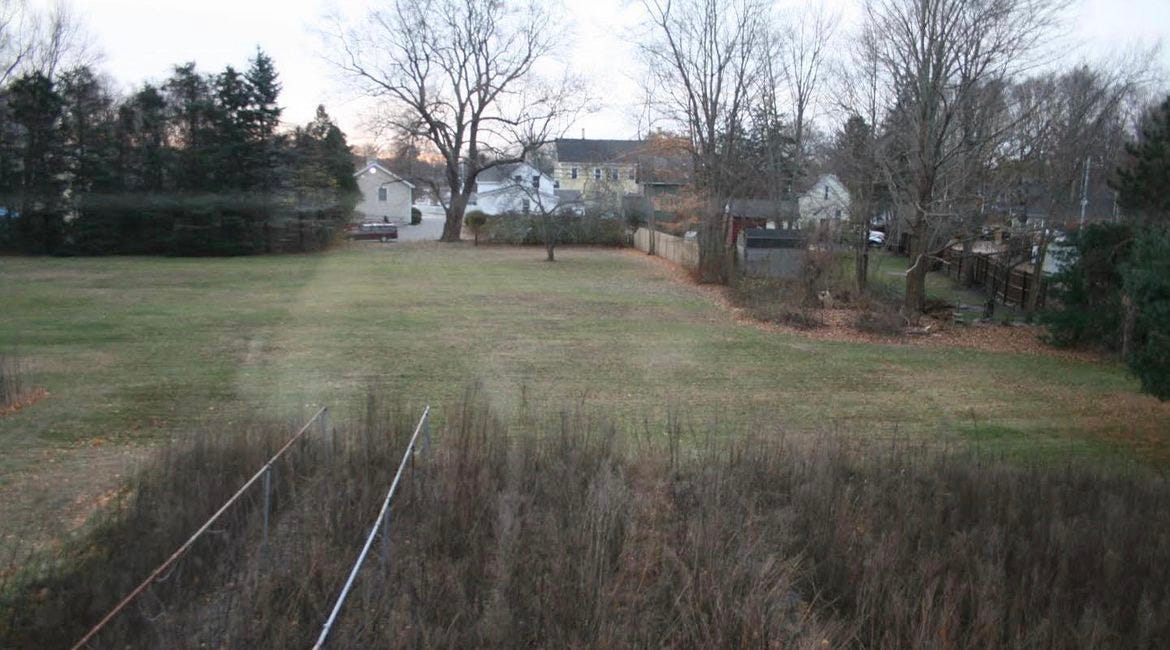
If you ask me about Ricky’s garden, I’d tell you about the smell of Vinnie’s lobster traps, right over the wooden fence. I’d tell you the shape of them. Interlocking neon yellow grid. Stacked so high, and weeping with seaweed. How it’s like Vinnie carries the ocean eight miles inland. Not the marsh, not the bay, but the biggest, clearest expanses. The s…
No posts
Comments
Nothing yet. Say the first thing.
Sign in to join the conversation.