
The AI buildout has quietly reshuffled the semiconductor pecking order — and memory chips are emerging as the scarcest, most consequential input in the stack. DRAM and NAND prices are in the midst of one of the steepest upcycles in market history. What’s different this time is the demand profile: a single layer of HBM3E consumes roughly 16x the bit capacity of a standard DDR5 server chip, and when stacked eight to twelve layers deep per GPU, the math behind the supply constraint becomes self-evident. With fabrication timelines spanning four to seven years and new capacity not expected before 2027, we believe pricing power for memory chip fabricators will remain intact well into the back half of the decade. Tema Memory ETF (DISK) — launched June 30, 2026 on NYSE Arca — was built to capture exactly that thesis.
This piece was sponsored by Tema ETFs. As always, all views are my own.

The memory chip market has become the next leg for growth in the broader AI investment theme. With memory chip demand outstripping supply, DRAM and NAND prices have experienced one of the largest price runs with little relief expected in the coming years. With the once cyclical market positioned as a major growth market as memory and storage become a more critical components for AI training and inference, memory chip fabricators may be positioned to continue their growth path over the coming years.
To understand why memory chip prices are rising, we must understand the background of the memory chip market.
Economics of the Memory Chip Market
The memory chip market has historically been a cyclical market.
Memory chips are generally considered a commoditized component in the semiconductor market with many producers and distributors.
Memory chip fabricators have historically sold chips through short-term supply agreements.
Bear cycles have historically led to significant margin compression and net losses depending on the severity of the cycle.
There are two primary types of memory chips:
NAND Flash Memory Chips: non-volatile memory used for storing data, meaning that data can remain stored on these chips when power is removed. NAND chips are primarily used in solid-state drives [SSDs], smartphones and tablets for internal storage, SD cards, and enterprise storage arrays like all-flash arrays.
DRAM Chips: volatile memory used for storing data within an integrated circuit. Unlike non-volatile memory, volatile means that data will be lost when power is removed. DRAM is primarily used in servers, graphics processing units [GPUs], and networking equipment.
Today’s memory chip supply constraint is largely underpinned by these factors paired with the sharp increase in demand for AI accelerators. High-bandwidth Memory [HBM] is a specialized DRAM architecture designed to accelerate memory bandwidth by being placed directly next to the processor. HBM chips are typically stacked 8-12 high in order to enhance the capacity of the host GPU. HBM chips are packaged using a technique called Chip on Wafer on Substrate [CoWoS], which effectively houses the GPU and HBM chips on a silicon layer called the interposer, which creates what is known as a a 2.5D package.
The growing demand for HBM chips has, in part, led to a significant production shortage of DRAM chips given the production trade-offs and bit requirements. A single layer of HBM3E requires approximately 16x the bits of DDR5 DRAM server chips. When compounded by 8-12 layers in a stack, it should be obvious as to why these constraints exist.
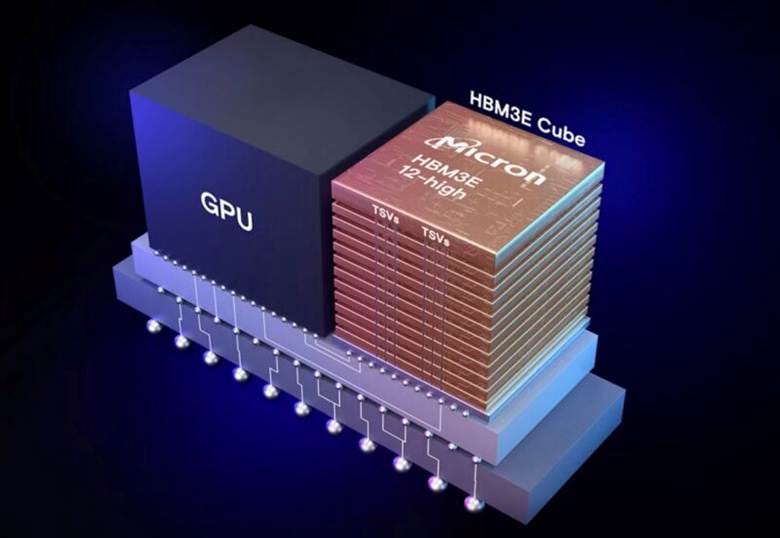
The three major memory chip fabricators are Micron, SK hynix, and Samsung Electronics. These chip fabricators work closely with Nvidia and Advanced Micro Devices to develop the requirements for every generation of HBM chip to be paired with the next generation of GPU. While each memory chip fabricator independently develops the architecture for the chips, they are generally purpose-built to function within their customers’ GPU architectures. This means that Nvidia should be able to apply HBM3E chips to its Blackwell GPUs, whether manufactured by Micron, SK hynix, or Samsung. This effectively makes memory chips a commoditized product as they should be fundamentally interchangeable, no matter the fabricator.
The commoditization of memory chips applies to most NAND and DRAM chips, meaning that all fabricators will be impacted by the same economic influences in the market, leading to boom and bust cycles throughout the years. Given the cyclical history, fabricators have been hesitant to add production capacity as uncertainty has remained prevalent in the AI infrastructure growth theme.
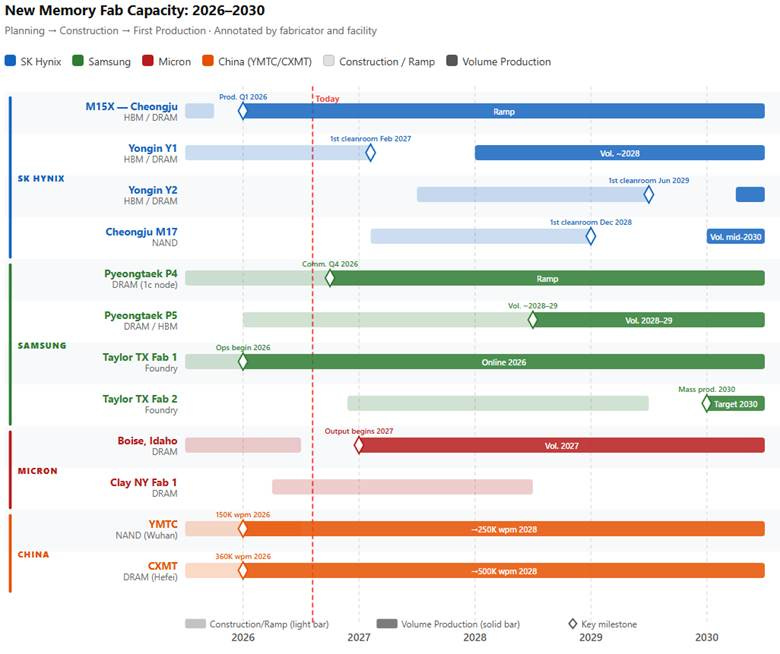
To help create more certainty in the market, memory chip fabricators have begun to address the mismatch between the time in bringing new capacity online and the length of a supply agreement. Fabrication facilities can take anywhere from 4-7 years from conception to commencement and may cost anywhere between $15-30b.
Supply agreements have historically been on an as-needed basis or upwards of a 1-year supply agreement. The challenge faced by memory chip fabricators is that customers may go through cycles of inventory builds, buying up capacity before working inventories down. This, in part, has led to the cyclical nature of the memory chip market. Rather than planning for long-term structural growth, memory chip fabricators were required to plan for the next upcycle while anticipating the required capacity to fulfill demand. Once inventory levels began to build, a downcycle was likely to follow.
As a result of the long-term planning involved in bringing online new capacity, memory fabricators have been slow to react in order to ensure that demand was structural and not just a short-term problem seeking an immediate solution. In order to provide greater certainty, memory fabricators have turned to long-term strategic agreements in the range of approximately 5 years with a take-or-pay structure. This means that the timing better aligns with memory chip fabricators’ ability to bring new capacity online and ensures that there will be a buyer once production commences. This is primarily why new capacity isn’t expected to come online until 2027-2028.
The market is currently signaling an extended upcycle following a sharp increase in demand for DRAM and NAND chips. The first leg of the upcycle was for DRAM chips as AI training required a significant amount of GPU capacity. Given the bit requirements and the production trade-off between DRAM and HBM chips, memory chip fabricators have more heavily favored HBM production as a high-growth, high-margin opportunity.
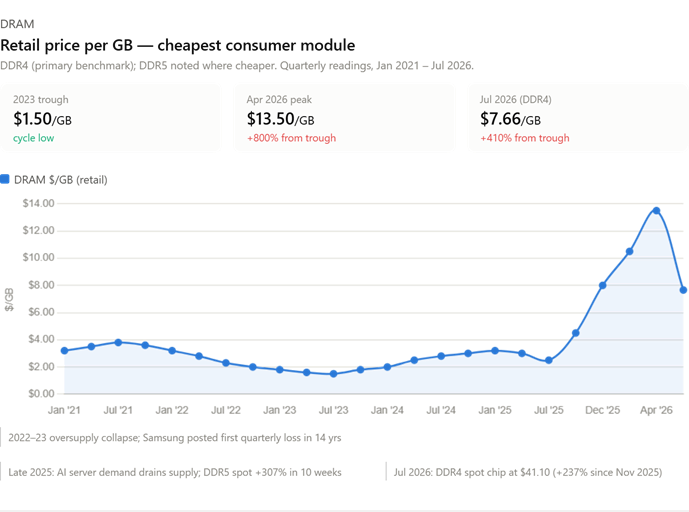
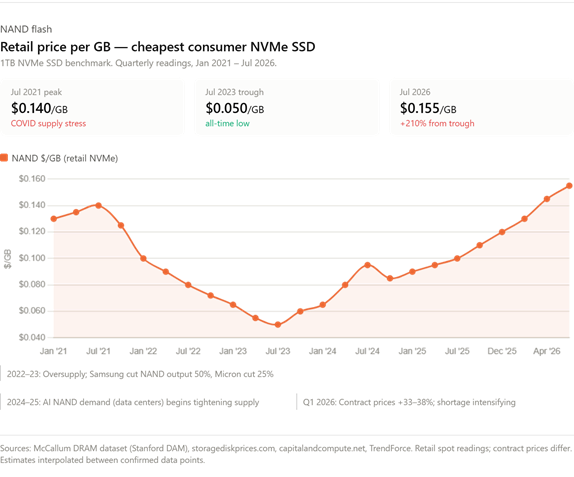
More recently, the NAND chip shortage began to push prices higher as a function of demand for AI inference. Micron notoriously cut back on NAND production in recent years in an attempt to balance the market price. Given that AI inference requires substantially greater storage capacity when compared to model training, NAND demand has gradually expanded, turning the downcycle into a sharp upcycle.
With long-term demand creating more certainty in the memory chip market, along with gaining support from the US Federal Government through the CHIPS Act, new capacity is expected to come online from 2027 through the end of the decade.
With new capacity comes market risks. As with any supply & demand function, memory chip supply could once again outpace capacity demand, sending prices back down to pre-2025 levels. As for demand, the risk of enterprise AI adoption remains prevalent, particularly if the cost of renting compute capacity continues to rise. SemiAnalysis outlined a 38% price increase for a 1-year contract to rent Nvidia B200 GPU capacity. While AI developers have generally ignored the cost of renting compute capacity as the cost of missing out on gaining market share far outweighs the rental rates, enterprises may be more cost-sensitive when considering the trade-off between automation and the status quo.
Offsetting GPU rental rates is the lower-cost server architecture for running agentic AI tasks. Rather than GPU-heavy server racks, agentic AI will require a more balanced CPU-to-GPU ratio. Leaders in the industry expect the ratio to drastically shift from 10:1 GPU:CPU to 1-2 CPUs for every GPU. While we do not anticipate a drop-off of GPU demand as new models will need to be trained, the broader market may become more balanced towards general compute server capacity, which may drive more value to NAND and DRAM. As a result, memory and storage capacity demand for NAND, DRAM, and HBM will continue to grow through at least the end of the decade, supporting new production capacity being brought to the market.
While demand is expected to remain durable for the coming years, we’re expecting that the market will push memory chip prices higher through 2028 before normalizing down as more capacity comes online. We believe that this must happen to keep agentic AI adoption accessible to most enterprises as the cost of ownership cannot outweigh the expected benefits of automation.

DISK was launched by Tema ETFs on June 30, 2026 and was listed on the NYSE Arca Exchange. The strategy has a total expense ratio of 75bps, aligned with peer sector-focused strategies on the market. For pure equity exposure, the only true competitor to DISK is the Roundhill Memory ETF (DRAM), whereas the DRMP and KMEM utilize both equities and options derivatives to gain exposure to the market.
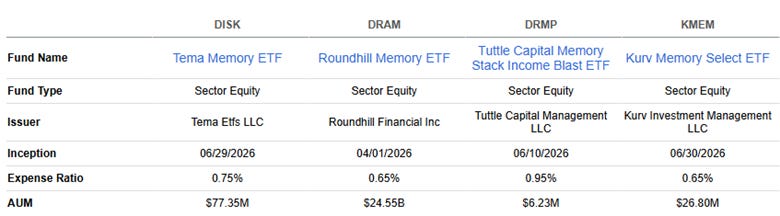
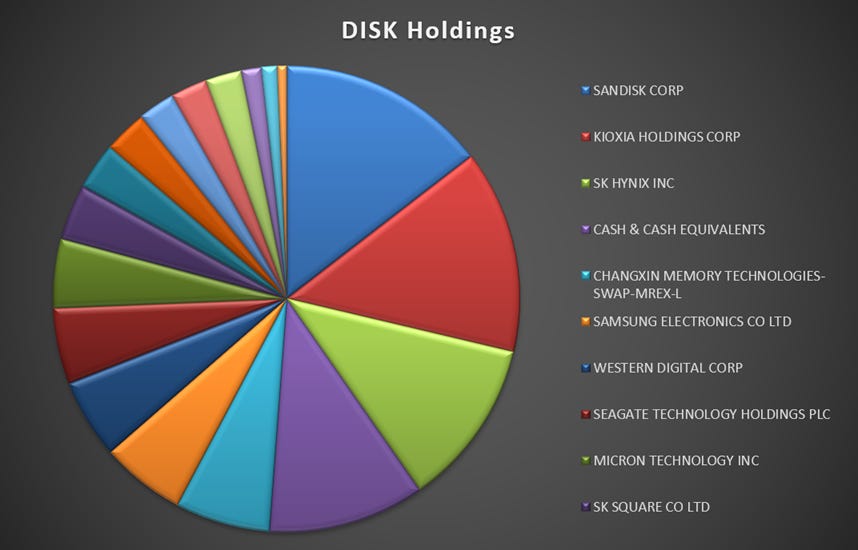
DISK is an actively managed strategy designed to provide investors with strategic positions across the memory chip and storage markets. DISK is a highly concentrated portfolio strategy with a total of 16 holdings, overweighting the highest conviction stocks.
As of August 2026, top holdings within the strategy include SanDisk Corp (SNDK) at 14.54%, Kioxia Holdings at 14.14%, and SK hynix (SKHY) at 12.25% [combined position on the Korean Stock Exchange and NASDAQ].
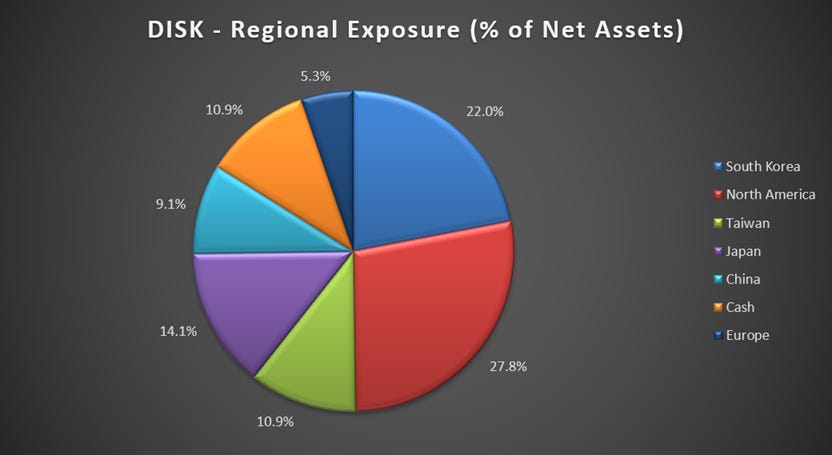
One of the values brought forth by the strategy is its regional exposure, allowing investors to invest in foreign stocks that may not be offered on major US exchanges, such as ChangXin Memory Technologies or BIWIN Storage Technology. This can be a significant benefit for portfolio allocation as DISK provides 70%+ exposure to international equities.
While DISK can be considered for regional diversification, the fund is highly concentrated in a single subsector and will need to be considered a component of a diversified portfolio strategy rather than a complete portfolio. Given the concentration risk, DISK may exhibit greater volatility when compared to diversified technology sector funds. Nonetheless, DISK can be best utilized to gain more depth across the memory chip market that may not be offered by diversified ETFs or index funds.
While DISK is considered an actively managed fund, the strategy will largely operate with a buy-and-hold approach, meaning that the stock and weight selection will remain relatively stagnant under normal circumstances. Cause for adjustments will include substantial multiple expansion or a new entrant into the public or private markets. Otherwise, the fund will operate in accordance with the selected stocks and weights.
DISK can be utilized by both active and passive investors seeking to capture upside potential from exposure to the global memory chip market.
DISK can be utilized as a component of an investor’s technology sector exposure given that diversified funds generally underweight this subsector. For example, the Nasdaq-100 weights memory and storage companies at approximately 3.58% and only provides access to US-listed stocks like Micron (MU), Seagate (STX), SanDisk (SNDK), and Western Digital (WDC).
A major risk to consider as an active trader is the relatively low liquidity of the fund. As of August 2026, DISK had approximately $83mm in net assets with an average of $16.28mm in share value changing hands on a daily basis. DISK exhibits a relatively wide 30-day average bid/ask spread of 0.57%, potentially exposing traders to a higher round trip cost of ownership. That being said, liquidity may become less of a risk over time if Tema can effectively grow the asset base of the fund.
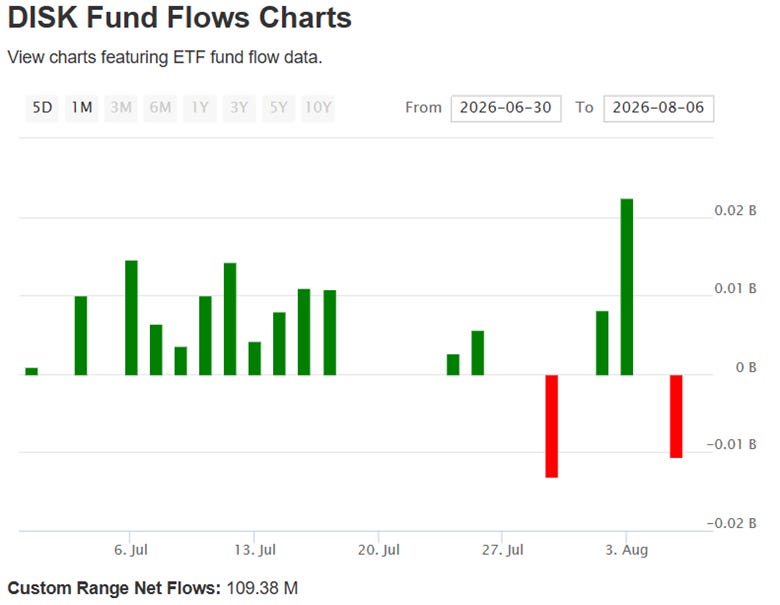
As a long-term investor, the bid/ask spread may be less meaningful as the expected return over the next 3-5 years far outweighs the spread risk. While we do not capture the entirety of the memory chip and storage market in our research, we have covered a number of the domestic holdings in recent months with an optimistic outlook across the spectrum. What we have observed is that investors are becoming more comfortable investing in these stocks at a higher multiple today with the expectation that future operations will support a higher market capitalization.
DISK is highly concentrated across 16 individual holdings, exposing investors to significant concentration risk and potential volatility.
DISK provides international exposure to the memory chip market, exposing investors to trade risk, interest rate risk, and inflation risk.
The memory chip market may be highly dependent on the success of a few market participants in the AI development arena, such as OpenAI and Anthropic. If investments in new compute capacity were to slowdown or stall, the market for memory chips may falter.
Demand for NAND and DRAM may be heavily dependent on enterprise adoption of agentic AI. If enterprises were to remain cautious in transitioning to AI applications, demand for memory and storage capacity may not support the expected growth rates for these memory chip and storage companies.
The memory chip market is positioned for significant expansion into the next cycle, presenting a durable case for substantial growth across subsector equities. With demand for memory chip capacity outstripping supply, DRAM, NAND, and HBM fabricators have realized substantial pricing power that has driven significant margin expansions, supporting the case for adding new fabrication capacity through the end of the decade. With enterprise adoption expected to gradually taking shape over the coming years, demand may remain heightened, delivering value to the bottom line. Investors should take some precautions when investing in this market as it has historically exhibited cyclicality. With enterprises still in the early stages of AI adoption, investors must consider the risks associated with a slower adoption process along with the risk associated with new capacity additions.
This report has been prepared for informational purposes only and is sponsored by Tema ETFs. The preparation and distribution of this report may have been funded, directly or indirectly, by the subject fund or its affiliates. This constitutes a material conflict of interest that readers should consider when evaluating the contents herein.
This report does not constitute investment advice, a solicitation, or an offer to buy or sell any securities. The information contained herein is based on sources believed to be reliable; however, no representation or warranty, express or implied, is made as to its accuracy, completeness, or timeliness. Past performance is not indicative of future results.
The views and opinions expressed in this report reflect the author’s analysis as of the date of publication and are subject to change without notice. Recipients should conduct their own independent due diligence and consult with a qualified financial advisor, legal counsel, or tax professional before making any investment decision.
This report is intended solely for the use of the recipient to whom it is addressed and may not be reproduced, redistributed, or transmitted in whole or in part without prior written consent. Monte Independent Investment Research and its affiliates, officers, directors, and employees may hold positions in the securities discussed herein.
Comments
Nothing yet. Say the first thing.
Sign in to join the conversation.