
In 1968 a Dallas ad-man director made a television movie in two weeks, and called it Mars Needs Women. Five Martians come to Earth to collect wives, because their species produces only sons. Everybody remembers the title. Almost nobody remembers the ending.
The mission fails because the Martian leader falls in love a scientist and starts caring what she wants.
That is where this deep dive starts, because it questions assumptions we might hold about alien romance. The premise did not travel from horror motif to wish fulfillment. The framework was ready for Romance anyway. But who got to decide it was a Romance changed over the decades.
Included in this deep dive:
Pulp’s first big human-alien romance in 1912 featured a human male as the suitor and the alien woman as the prize. Also, she lays an egg.
The most famous alien-seduction story of the pulp era was written by a woman working at a bank, and the initials on the byline were to hide her second career from her employer.
“Bug-eyed monster” was coined in 1939 by a reader campaigning to get the covers abolished, before becoming one of the most famous sci-fi pulp fiction motifs to be painted.
A Vulcan mating cycle put involuntary, biological, lethal-if-denied desire on network television in 1967, forty-eight years before Ice Planet Barbarians did the same thing with a khui.
The first Star Trek fanzine ran 250 copies and became required reading for the show’s own writing staff.
Ice Planet Barbarians published in April 2015 and did essentially nothing for six years, until a furloughed twenty-two-year-old made one video.
The genre’s most interesting offering isn’t the one everyone talks about: it treats “who is valued” as a variable and flips it in both directions.
Treat your nerdy Romance obsession to the deep dive it deserves 👽💙
I did not discover Romance or even recognize my ability to enjoy Romance through a book. I’ve mentioned this story before but you bet I’ll tell it again.^1
I was pregnant. There was a pandemic raging with a vaccine just barely in sight.
In a fit of curiosity and boredom, I reopened Tumblr for the first time in years, wondering what I was missing out on while hunkered down in my house.
That is where I saw some of the most unexpected fan art up to that point in my life: a bunch of handsome blue aliens on a snowy tundra. That was my introduction to Ruby Dixon and Ice Planet Barbarians.
My brain grabbed the nearest available category, which happened to be Dungeons & Dragons, because the picture arrived with its context stripped off. Was I looking at someone doing some sort of Tiefling redesign?
In actuality, I was looking at the current state of a century-old argument about what aliens want with human women, one that had been running in pulp magazines, on drive-in screens, in mimeographed fanzines, and on a video game disc long before it reached Not-Hoth.
There’s a phrase a lot of reviews use to describe a key trope in contemporary alien Romance.
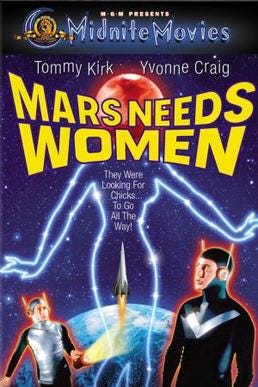
Mars Needs Women was written, produced, and directed by Larry Buchanan for Azalea Pictures, and went out through American International’s television syndication arm with no theatrical release at all. First broadcast in 1968, shot sometime in the mid-1960s, for a reported twenty thousand dollars, over roughly two weeks, in Dallas, Texas, standing in for Houston where the story was set.^2 The premise would be very, very familiar to many Romance readers: the Martians suffer from a genetic defect producing only male offspring, so five of them come to Earth to recruit women.
Here is something about the story that I think is both key to remember and bittersweet: the mission fails.
Dop, the Martian leader, falls in love with Dr. Marjorie Bolen, a Pulitzer Prize-winning scientist and an expert in what the movie calls “space genetics.” The abduction plot is defeated by the alien’s attachment to a woman smarter than he is, whose consent he realizes he cares about. This gives the military enough time to close in and the Martians go home. With nobody.^3
So from the start, this trope was not a clean fit into sci-fi horror. It was already sitting halfway on the Romance shelf.
That finding drives everything else in this dive. The trope framework, Mars Needs Women, has been malleable from the start. All contemporary authors like Ruby Dixon did was remind us there is more than one way for it to turn out.
The phrase outlived the film, though not the way one might assume. There are no documented “Mars Needs Women” memes, no Know Your Meme entry, no dated viral moment. What exists instead is a fifty-year chain of obscure title quotations: MARRS sampled the vocal line off the film’s trailer for “Pump Up the Volume” in 1987, and Rob Zombie put a song called “Mars Needs Women” on Hellbilly Deluxe 2 in 2010.^4 It survived as a phrase people reach for when they need a title, which is odder, but evidently more durable than surviving as a basic joke.
It seemed to naturally become a trope tag. I’ve used the phrase myself when assigning tropes in my own Alien Romance reviews.^5 I know I’m not alone. Romance readers, even if they don’t fully grasp the pop culture history behind it, now use this 1968 B-movie title as a proper shelving category, and they are not being ironic.
Science Fiction has a history longer than some might guess. Brian Aldiss crowned Mary Shelley’s 1818 novel Frankenstein its founding text based on the assertion: “Science fiction is the search for a definition of man and his status in the universe which will stand in our advanced but confused state of knowledge (science), and is characteristically cast in the Gothic or post-Gothic mould.”^6 His fellow scholars, however, would nominate Johannes Kepler’s Somnium, which he wrote in 1608 but which was not published until after his death, or Margaret Cavendish’s The Blazing World (1666); Aldiss did not mention the latter until his 1986 revision.^7 Kepler and Cavendish both play with characters that could be read as proto-aliens, which makes their origins a slightly straighter line to trace for the focus of Sci-Fi aliens. Kepler aside, Science Fiction has been, one could say, from the start, expertly wielded by women.
Sci-fi swung away from its feminine arrival eighty years after Frankenstein. H. G. Wells serialized The War of the Worlds through 1897, with the Heinemann book following in 1898. His Martians do not want our women. They want our blood: they take the living blood of other creatures and inject it into their own veins through a small pipette.^8 A vampiric creature with no interior life—that’s our introduction to contemporary alien fiction.
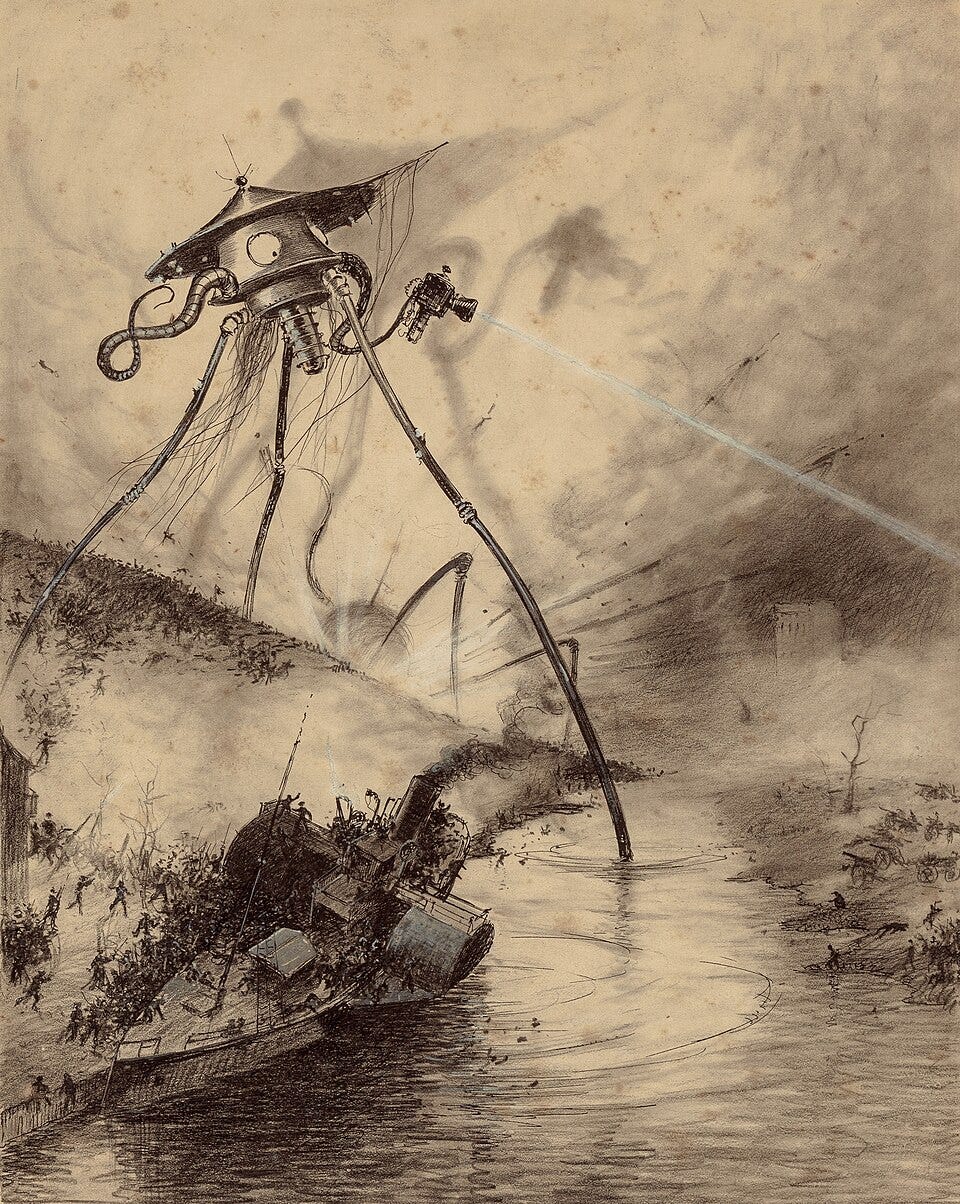
But in the first chapter, before any of that happens, Wells makes a deliberate point of turning the telescope around (albeit in a blatantly racist way, regardless of his intentions):
“And before we judge of them too harshly we must remember what ruthless and utter destruction our own species has wrought, not only upon animals, such as the vanished bison and the dodo, but upon its inferior races. The Tasmanians, in spite of their human likeness, were entirely swept out of existence in a war of extermination waged by European immigrants, in the space of fifty years. Are we such apostles of mercy as to complain if the Martians warred in the same spirit?”^9
Even with the racism, John Rieder argues Wells is demanding that colonizers imagine themselves as the colonized. Then he complicates the takeaway because the novel frames the invasion as driven by survival necessity. Its own critique is partly undercut by the social-Darwinist logic that drives the plot and implicitly legitimates colonial violence.^10
That is what Alien Romance novelists have ultimately inherited: a pop culture legacy confused by its own self-proclaimed wisdom because it remains blindly rooted to white patriarchal values which uphold might being right.
How do you write great Romance out of that?
Comments
Nothing yet. Say the first thing.
Sign in to join the conversation.