
I’ve been trying to get off my phone this week.
Part of that, for sure, is the start of the second Trump administration and all that goes along with it (not getting sucked into the “shock and awe” news cycle, thinking long and hard about how much time I’m spending on Meta products, etc.). But if I’m honest with myself, it’s been a goal I’ve been procrastinating on for a while. Just like everybody else.
I’ve avoided some of the time suck aspects of a smartphone because there are apps I just don’t use: I’ve never gotten into Instagram or TikTok, I don’t have the Facebook app on my phone, and my Twitter account has been dormant for a long, long time (long enough that I don’t feel bad calling it Twitter). My major time suck most weeks is Messenger, where I can spend an embarrassing number of hours chitchatting with creative partners about characters and plot. Chat apps have always been my Achilles heel, since before there were smartphones (back in the day, I was the person who’d gleefully spend three hours roleplaying over AIM, which was how one of my story worlds was first drafted). But I don’t *write* on my phone; never have. Messenger is just the reason I’ve gotten used to carrying it around the house with me, in case my current collaborator happens to be around to gleefully deep dive on our shared special interest. And since I carry it around, it’s gotten very easy for it to be the thing I turn to in an empty moment. Reading The New York Times on the toilet. Checking my email in line at the grocery store. Scrolling Substack Notes while my kid steps away to get another book.
I didn’t like that habit. I wanted to change it. And this weekend, instead of watching inauguration coverage, I read this essay by Anne Helen Peterson about how she’s taken all the interesting apps off her phone, and I took the plunge.
Because I’m me, this isn’t the first time I’ve thought about doing this. I’ve read a fair bit about “digital detoxes” as well as Cal Newport’s book Digital Minimalism, and I know the most important thing about changing any habit is to find something to replace it with, because virtue will only get you so far.
So here are some of the things I’m trying:
Putting my phone on DND, and turning off notifications on almost everything. I still get Messenger notifications, because if someone IS around for me to special-interest at when I’m free, I want to know that—but they don’t make a noise. And I don’t get push notifications from email or Substack or most anything else.
Rearranging my phone desktop. First: I took all of my auto-scroll apps (Messenger, Gmail, Substack, and my web browser) and removed them from easy access. They’re still on my phone, but to get to them I have to open the long app list and dig around. Takes just long enough to make me stop and go “wait. Why am I checking my email right now?” In their place, I put the apps that actually serve my goals a little more. Music, podcasts, and audiobooks are still on the homepage: if I’m looking for a little dopamine while I do the dishes, I’ve got a way to get it.
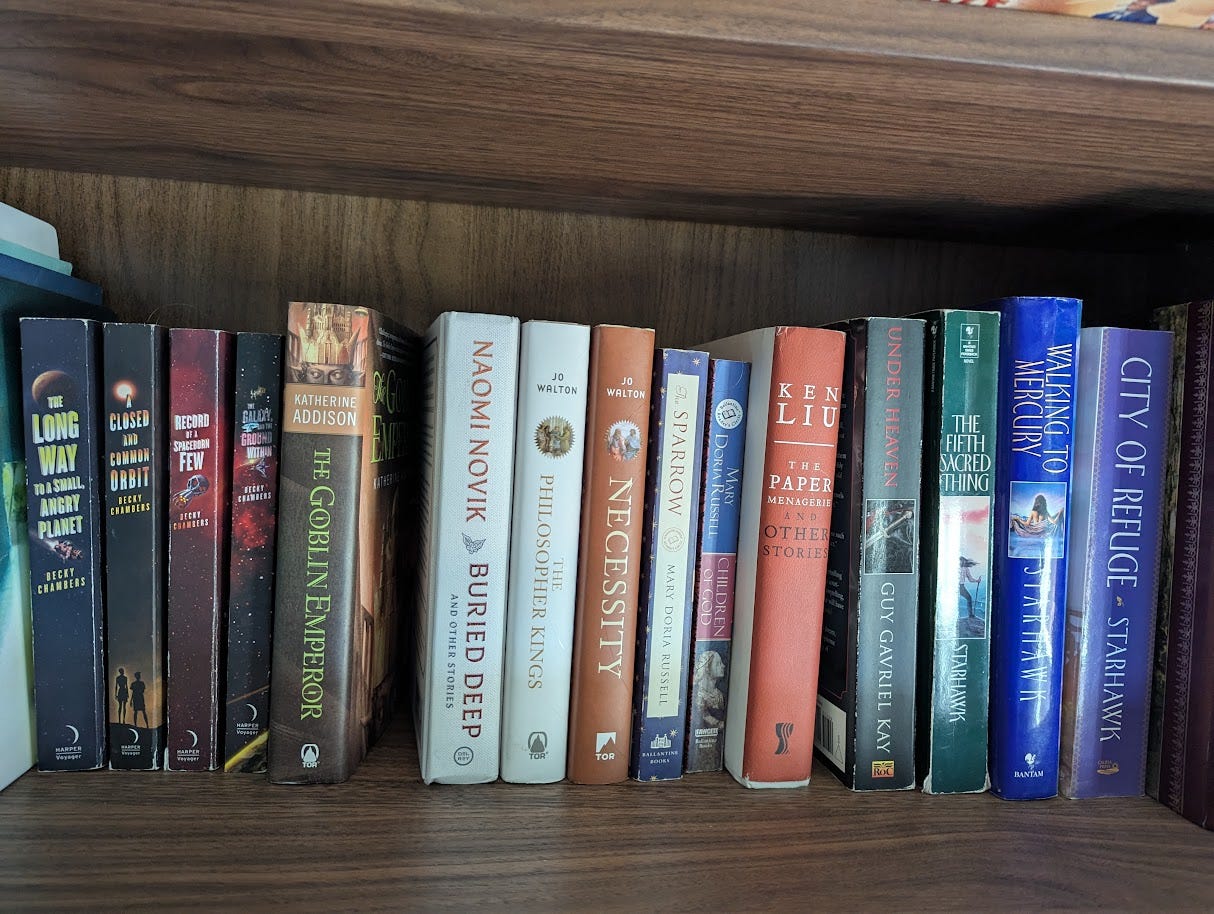
Having alternatives ready to hand. Your mileage will vary on this one, but for me, first and foremost this is paper books. We did a big reshuffle of our house over the winter holidays and one of the steps I took was putting some of my favorite fiction on a single, easily-accessible shelf so that I can always have something handy. I’ve got a new tarot deck I’m playing with; I’ve got a new journal I’m excited about. I’m trying to start an evening routine of 20-30 minutes of screen-free time before bed. I’m trying to write Morning Pages for the first time in years, and if they’re Evening Pages right now, well, that’s a great start.
Like changing any habit, it feels important to remember the why’s. I want my kids to see me reading books and taking walks and doing silly little sketches and all the other stuff that doesn’t necessarily occur to me to do when I’ve got a smartphone in my hand. I want to be intentional about how I consume the news, because I notice myself getting spun up and I don’t want to give the people who are trying to “own the libs” the satisfaction of owning me. I want to be a more present parent. I want to have time to clean my house because I noticed my house was dirty. I want to reclaim some ownership of my own thoughts.
Obviously, this is a big, messy, complicated issue, and everybody’s going to have their own ways of working through it. But if you’re looking for a place to start, here’s some resources I’ve found helpful in thinking about ways to conserve and focus my attention, for parenting and for creative projects and for getting through this week and the next 30 days and the next 4 years.
On reaching out to your community and building your village. One of those essays that I wanted to restack basically in its entirety. Rosie Spinks talks about the difference between “having friends” and “having people.” "
Every person I make an effort to get to know doesn’t have to tick every friendship box of my twenties: cool job, nice style, listens to the same podcasts, shares the same politics etc. I already have those friends. It’s okay if the only thing I have in common with a new person is the proximity of where we live, and the age of our child, and the fact that we both don’t work on Fridays. I’m looking for people, not friends. If they turn into the latter, then great.
On escapist reading. By Margaret Killjoy, talking about Tolkien and LeGuin and the role fiction plays in social change. (And she was penpals with Ursula LeGuin! Can you imagine being penpals with Ursula LeGuin?)
And if there’s one thing I’ve learned these past few years, it’s that the world of our dreams does not inherently have less value than the waking world. We can enjoy fiction for its own sake. Art ought not be in service of the revolution, that is entirely backwards. The revolution should be in service of art.
On quick focused self-care. By Kelsie Olds, an AuDHD occupational therapist whose work has definitely been implemented in my house (and waved under various noses at my kids’ school). Their random brain-dump list which they posted in hopes of people finding some of it useful, or maybe being able to use it as a starting point.
16. Set a reminder for every hour of the day to take a deep breath.
And an audiobook I started after the election, that I (full disclosure) haven’t finished yet, but that makes me feel a little better every time I listen to it: Hope in the Dark, by Rebecca Solnit.
“Hope locates itself in the premises that we don’t know what will happen and that in the spaciousness of uncertainty is room to act. When you recognize uncertainty, you recognize that you may be able to influence the outcomes–you alone or you in concert with a few dozen or several million others. Hope is an embrace of the unknown and knowable, a alternative to the certainty of both optimists and pessimists. Optimists think it will all be fine without our involvement; pessimists take the opposite position; both excuse themselves from acting. It’s the belief that what we do matters even though how and when it may matter, who and what it may impact, are not things we can know beforehand. We may not, in fact, know them afterward either, but they matter all the same, and history is full of people whose influence was most powerful after they were gone.”
Hang in there, friends. One day at a time.
No posts
Comments
Nothing yet. Say the first thing.
Sign in to join the conversation.