
Ask a child to draw a forest and you’ll get a picture of lots of trees, big bushy crowns, perhaps a bird or two.
But forests are not just trees. They are systems — living machines made up of interacting parts that work together to produce what scientists call ecosystem services: water regulation, carbon storage, biodiversity — the full web of life.
And like any machine, it will only works when its parts are in balance.
Right now, many of our forests are not.
If a tree doesn’t fall in the forest…
When a forest falls out of balance, the symptoms aren’t always obvious. In fact, to the casual observer, things can look perfectly fine — even healthy. Green, dense, full of trees.
But inside the system, something very different can be happening.
Across much of south-eastern Australia, many forests are now overstocked — too many trees competing for limited water, light and nutrients. The causes are complex: altered fire regimes, past management decisions, changing climate conditions. But the outcome is consistent.
Tree growth is stunted as competition intensifies. Water stress increases, particularly in drier years. The forest floor is choked of light, suppressing the plants that many species rely on. Structural diversity declines, with forests becoming more uniform and less resilient.
We’ve known for decades that dense forests can significantly reduce water yield — and that reducing stand density can increase it.
But perhaps the most misunderstood consequence is what this means for carbon.
We’ve been sold a very simple idea: more trees equals more carbon.
It sounds right — but ignores how the system actually works.
Overstocked forests grow more slowly. Slower growth means lower rates of carbon sequestration. At the same time, dense forests are more vulnerable to drought and high-severity fire — and when those fires occur, they release enormous amounts of stored carbon back into the atmosphere.
A forest that is functioning well — with trees that have access to water, light and space — can grow faster, store carbon more effectively, and withstand disturbance more successfully.
The question is not how many trees we have.
It’s whether the system is working.
This is where the idea of simply “leaving forests alone” begins to unravel.
That instinct didn’t come from nowhere. It emerged, in part, as a reaction to genuinely poor forestry practices in the past — overharvesting, inadequate regeneration, and a failure to account for ecological complexity. Those concerns were valid, and they drove important reforms.
In fact, the concept of sustainability itself comes from forestry. In 1713, German forester Hans Carl von Carlowitz argued that forests should be managed so that harvest never exceeds regrowth — a principle born from the recognition that unmanaged use leads to collapse.
Sustainability was never about doing nothing.
It was about managing systems so they continue to function over time.
But somewhere along the way, that idea has been simplified — and in some cases distorted — into an argument for non-intervention.
And that’s a problem.
Killing with kindness
In many Australian forests, particularly after major disturbance like fire, regeneration can be dense and aggressive. Species such as Silvertop Ash can re-establish so quickly and densely they form even-aged stands that verge on monocultures.
To the untrained eye, this looks like recovery.
But inside the system, competition is intense, light is limited, and diversity is reduced.
Even some of our most celebrated forests are not immune to this.
It will be surprising to many, but some of the Mountain Ash forests of Victoria and Tasmania — often described romantically as “cathedrals of the forest” — are, in ecological terms, even-aged stands with relatively limited structural diversity, particularly where they have regenerated after stand-replacing fire.
They are visually spectacular.
But ecological function is not determined by appearance.
Arboreal species like the Leadbeater’s possum and Greater Gliders depend on a combination of elements: large, old hollow-bearing trees for nesting, and dense midstory vegetation for movement and feeding. Research shows that these elements don’t always occur together in dense, uniform stands.
The loss of old trees is rightly recognised as a critical issue. But focusing on that alone risks missing something equally important: the structure around them.
In many cases, regenerating forests — particularly where old trees remain within them — provide the dense understorey that supports movement, feeding and connectivity.
That’s the nuance.
Old growth matters.
Regrowth matters.
But what matters most is how the pieces fit together.
It’s no coincidence that many observations of threatened species occur in mixed or regenerating landscapes shaped by disturbance — whether from fire or past timber harvesting.
This doesn’t mean disturbance is always beneficial.
But it does mean that not all untouched forests are optimal habitat, and not all disturbance is inherently harmful.
Too many trees is a problem
This is where ecological thinning comes in.
Ecological thinning is not about extracting timber. It’s about restoring balance to an overloaded system.
By selectively removing some trees, we reduce competition, improve access to water and light, and allow the remaining trees to grow more strongly. We open the canopy so the forest floor can recover. We reintroduce diversity into a system that has become too uniform.
Done well, it is a way of tuning the machine.
But it’s important to be clear about what it is not.
It is not “logging by stealth”.
It is not appropriate everywhere.
And it is not the same as thinning in commercial forestry, which is designed to optimise future timber production — even if the mechanics can look similar.
And, like any tool, it can be misused.
But when applied appropriately, it is one of the few tools we have to actively restore function in forests that have fallen out of balance.
There are few large-scale examples of ecological thinning in Australia as forestry, particularly on public land, has been almost entirely focussed on thinning for commercial crop purposes.
But ecological thinning isn’t new. Globally, the benefits of thinning are well established — and its inclusion in the EU Forest Strategy reflects a growing recognition of its role in restoring forest function.
So why is this controversial in Australia?
One of the more persistent arguments against ecological thinning is that Australian forests will thin themselves over time.
And that’s generally true — but misses the point.
Natural thinning often occurs through stress, dieback, insect attack, or high-severity fire. In other words, the system corrects itself — slowly, inefficiently, or catastrophically.
Forestry allows us to accelerate that process in a controlled way.
Instead of waiting decades for trees to struggle or die, we can reduce competition earlier, helping the remaining trees grow faster and move more quickly beyond vulnerable stages.
In a stable climate, perhaps we could afford to wait. But we are no longer in that world.
We are well past the point of crossing our fingers and hoping for the best. And we’re on a clock now.
And yet, much of the public conversation has moved in the opposite direction.
I’ve been watching the latest campaigns from high profile environmental advocacy groups. The messaging is familiar: “get your hands off our forests”, “worth more standing”, “save [insert name] forest”.
They are effective slogans fine-tuned over decades.
But they reduce a complex system to a simple moral position.
To be fair, many of the people drawn to these campaigns are not acting in bad faith. They care deeply about forests and the species that depend on them. They are responding to messages that feel intuitive — that removing trees must be harmful, and leaving nature alone must be better.
Those instincts are understandable.
But good intentions don’t always lead to good outcomes, particularly when the information shaping those instincts is incomplete, overly simplified or misleading.
Part of the challenge is that many organisations have built their identity around opposing intervention. When that’s the only framework you operate within, every form of management starts to look like a threat — even when it’s designed to restore ecological balance.
I see it close to home as well.
A neighbour has a sign out the front: “Don’t bulldoze the bush.”
I’m still resisting the urge to knock on their door and point out that the people who live in or near the bush are often relieved when the dozers come in — not to destroy forests, but to defend them, and us, when fire is bearing down.
In places where wildfire hasn’t been experienced firsthand, it may be easy to misunderstand what’s at stake.
It’s certainly the case that if you spend any time reading the comments on activist social media campaigns you’ll see how quickly nuance disappears.
If someone raises the need for active management, or ecological thinning, the response is immediate and declaratory: “[my favourite scientist] says it’s bad so it is”, “you’re just a mouthpiece for an evil industry”.
And that’s where the conversation ends.
No curiosity. No engagement with evidence.
Somewhere along the way, this stopped being about how forests function — and became something closer to a fixed matter of faith.
Which is, ironically, the opposite of science.
Breaking the cycle
If we genuinely care about forests, we need to shift the conversation back to function — and ask: what does the system need to work properly?
In many cases, the answer includes active management: pest control to reduce browsing pressure, weed management to restore native understorey, fire breaks and fuel reduction to protect both ecosystems and communities.
And — where appropriate — ecological thinning to reduce competition and restore balance.
Not everywhere. Not blindly.
But where the forest system is out of balance.
Because ultimately, the choice we face is not between forests and forestry.
It is between active stewardship and passive decline.
“Hands off” is not a neutral position when a system is already under stress.
It is a decision — whether we acknowledge it or not.
A forest is not defined by how many trees it contains.
It is defined by how well the system works.
And right now, too many of our forests are telling us — very clearly — that it isn’t.
If the trees could talk
On one of the message threads for a current campaign, I saw a suggestion that trees should be granted personhood. It received many thumbs up and heart emojis.
Well, if the trees could actually talk, I reckon they’d say something like:
Help us! Please!
Apply those opposable thumbs and big brains to fixing the things that are killing us.
We are jammed in here like sardines — give us room to grow, and the water and light we need, and in turn we’ll give you clean water and air.
For all the generations to come.
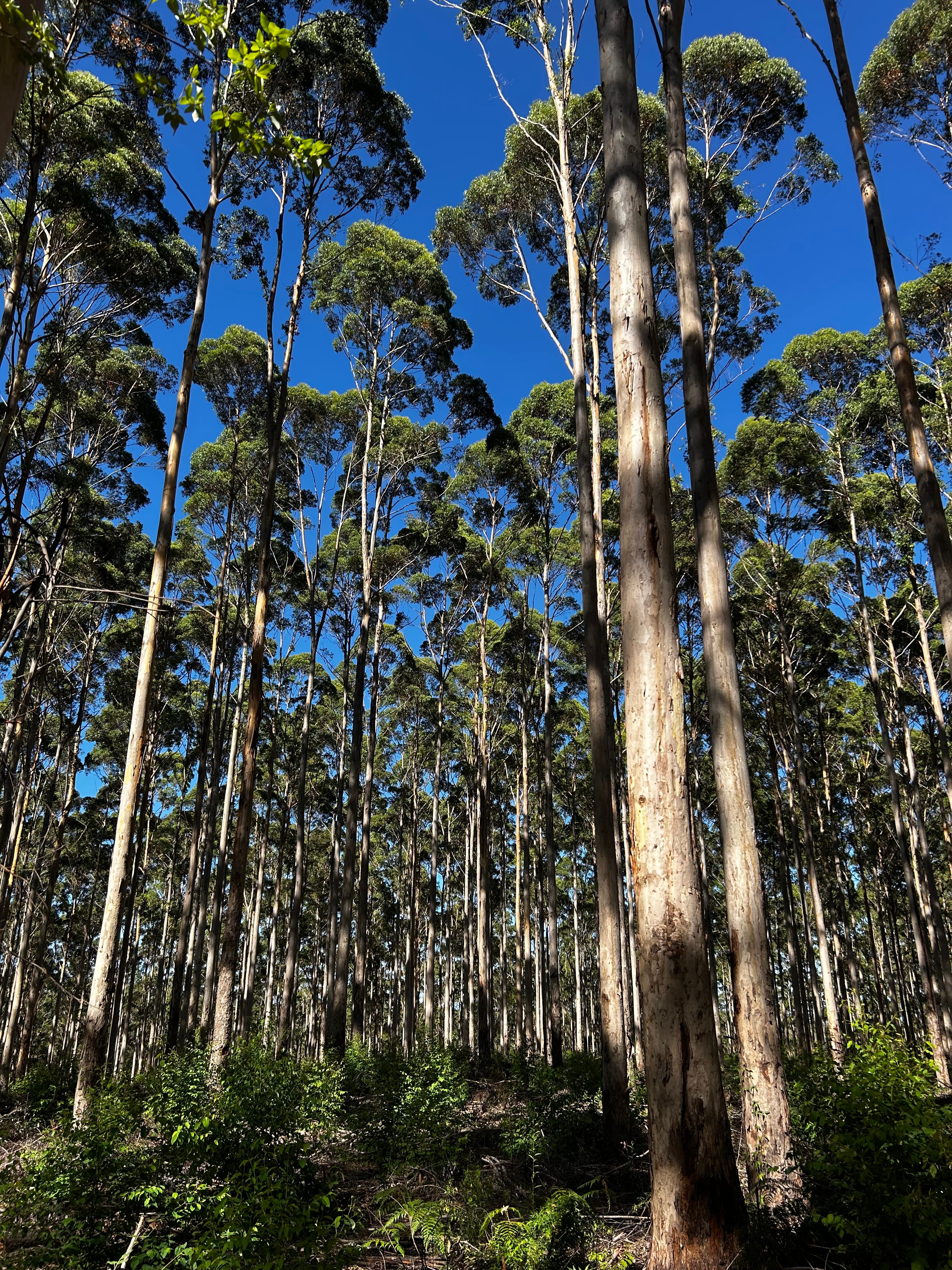
A photo I took of ecological thinning in Western Australia February 2025: selectively reducing tree density to improve forest health, water availability and resilience. This is the AFTER photo.
No posts
Comments
Nothing yet. Say the first thing.
Sign in to join the conversation.