
Those who control the fantasy, control the future.
There is no such thing as an “inevitable” future. Future possibility space is shaped every day by what receives power, resources, belief, and protection. We are capable of prototyping futures that both address the broken status quo, and reach past its boundaries. Those who redesign the fantasy, can redesign the future.
The previous two essays mapped the problem: futures get captured by inherited mythologies, by institutions that mistake technical power for wisdom, by stories that begin as warnings and end as product roadmaps. Critique clears space, but refusal without credible alternative becomes its own dead end. Identifying clearly what we say NO to is necessary, but it is never sufficient.
Hope can open a door, but without method it remains aesthetic. Vision can orient people, but without testing it stays closer to theatre than strategy. The harder task is: futures that survive contact with bodies, ecologies, publics, and institutions that rarely change because a better idea was explained to them. How do we design more inspired blueprints that actually lead towards tangible change? What are the tools to begin constructing shared YES visions?
Protopia World Stack begins from a simple premise: imagination matters only when it can be directed into decisions, practices, and worlds people can enter. It brings together three frameworks I have developed through work across entertainment, technology, science, cities, culture, and strategic foresight. They are three lenses on one methodological challenge.
Protopia Futures examines the direction: of all possible futures, which ones deserve commitment?
Embodied Futures tests consequences: what does this future actually do to bodies, ecologies, and the conditions life depends on?
Storyworld Design charts adoption: can people recognize themselves inside this future, and feel inspired enough to take part?
Values without embodied testing drift into abstraction. Embodied insight without shared world logic stays local. Worldbuilding without cultural anchoring becomes a spectacle.
The essay maps the field this work grows from, the traditions it departs from, and the method that results — and closes with an invitation to develop it further.
Strategic foresight helped institutions manage uncertainty. It was less equipped to examine the assumptions that made some futures desirable, profitable, or thinkable in the first place.
Strategic foresight and futures studies deserve a more serious account than either worship or dismissal. Strategic foresight is the practice of mapping multiple possible futures to improve present decisions. Its academic counterpart, futures studies, is concerned with long-range analysis of social, technological, economic, and ecological change. Futures studies developed largely through universities, think tanks, and intellectual networks; strategic foresight took root more visibly in corporations, governments, and advisory settings. Between them, they established that the future was not a single line extending from the present, and that strategy could not be reduced to quarterly extrapolation. At best, they gave organizations structured ways to engage with uncertainty.
La Prospective, developed in the 1950s and 60s by Gaston Berger and Bertrand de Jouvenel, insisted that futures work is about clarifying what should be aimed toward, not just what might happen. Its most important idea remains the field’s least adopted: that futures work is about values, not merely prediction.
Shell Scenario Planning made scenarios central to corporate strategy by treating them as tools for shifting how decision-makers think. As Pierre Wack (1922-1997) put it: “Scenarios deal with two worlds: the world of facts and the world of perceptions. They explore for facts but they aim at perceptions inside the heads of decision makers.” Shell’s preparation for the 1973 oil shock demonstrated what this could do: the point was a shift in how leadership recognized risk before it became a crisis.
Limits to Growth brought planetary systems into the center of futures thinking. Its importance was not that it “predicted the future,” but that it refused to treat population, industrial output, food, pollution, and nonrenewable resources as separate stories. The weakness was translation: a systems warning can be accurate and still fail politically if it cannot move the people and institutions with the power to act.
Jim Dator and the Manoa School made plural futures thinking into a discipline. Their four generic futures — continuation, collapse, discipline, and transformation — gave practitioners a way to move beyond linear extrapolation. The limitation is familiar: imagining alternatives does not by itself tell institutions which future deserves commitment, who pays for it, or what must be refused along the way.
Horizon scanning and weak-signal work made early detection more systematic. This remains useful, but it is also the part of foresight most vulnerable to automation. Machines can summarize signals faster than humans. The bigger challenge is judgment: which signals matter, which are noise, which futures they serve, and what decisions should change because of them.
Causal Layered Analysis, developed by Sohail Inayatullah (b.1958), went deeper by examining futures at four levels simultaneously: surface trends, systemic causes, underlying worldviews, and the myths that determine what feels thinkable in a given context.
Each of these methods gave institutions something they had not previously had. None of them resolved the field’s central tension — and that tension, named plainly, is this: most foresight tends to stay within the assumptions of whoever is paying for it. Shell documents later showed that the company understood the climate risks of fossil-fuel combustion decades ago. The fossil-fuel business model continued.
RAND nuclear strategy showed both the power and danger of making catastrophic futures analytically manageable: once mass death can be modeled in millions, such practice without an ethical anchor becomes its own risk. Causal Layered Analysis reaches where foundational assumptions live, yet most clients discover those assumptions and stop there. Government foresight programs operate closest to actual decision-makers, but are often calibrated to what is politically digestible within current cycles of power.
Peter Schwartz’s Global Business Network commercialized scenario planning across the corporate world in the 1980s and 90s, making it the dominant foresight approach — and further embedding the same limit. Ramírez and Wilkinson’s Oxford Scenario Planning work names this dynamic ‘frame rigidity’ — when decision-makers’ mental models are not wide enough to take seriously the alternatives that matter most. Scenarios gaining institutional traction are overwhelmingly those that confirm rather than challenge existing thinking. The most rigorous analytical work tends to be the most politically indigestible.
Anand Giridharadas, in The Persuaders (2022) — a study of political organizers rather than foresight practitioners — identifies a gap the futures field has been slow to acknowledge: what shifts deeply held positions is sustained, patient engagement with the concerns people actually hold, not analysis delivered from Outside. The gap between a rigorous futures report and a changed institutional decision is a gap of relationship, trust, and accumulated persuasion the foresight industry has rarely treated as its problem to solve.
The futures produced by institutional foresight have been shaped overwhelmingly by the Western assumptions, even as the demographic, urban, and ecological weight of the coming century sits increasingly across the Global Majority. Mumbai, Lagos, Jakarta, Chengdu, Kinshasa, São Paulo, and Dhaka and their inhabitants, knowledge traditions, and ecological realities have been treated as emerging market context rather than primary design terrrain.
Foresight calibrated to a minority fraction of the world’s population is parochial navel-gazing cosplaying as global strategy.
The next stage of futures work has to extend the field rather than discard it altogether. Scenarios, signals, and uncertainty maps are useful parts of the process, but they are no longer enough alone. A signal is not a strategy. A scenario is not a commitment. A map is not a territory.
Countercultural strands of foresight and futurism need tools to engage with institutional structures to have impact at scale.
The limits of institutional foresight did not go unnoticed — what emerged in response produced some of the most original futures thinking of the past half-century.
Solarpunk is a literary, artistic, and design movement. It rejects the stale choice between collapse and escape, offering images of regenerative food systems, repair cultures, care infrastructure, community, and ecological beauty. In a climate conversation too often framed through sacrifice or apocalypse, this is vital. Its weakness is the passage from present conditions to the world it imagines. Too often, solarpunk “magically” begins after the hardest fights have already been won: fossil fuel interests weakened, militarised borders softened, land use transformed, extractive systems defanged, and public life restored. The destination is inspiring but the route through regulatory capture, adversarial geopolitics, and incumbent economic interests is largely assumed away. In my work with Climate Spring, I see this often in script submissions: richly imagined late-21st-century worlds where the most difficult political, economic, and infrastructural struggles have somehow been resolved before the story begins.
At its weakest, solarpunk reads as revolutionary wishful thinking — anticipating arrival without the unglamorous work of getting there.
Speculative Design was pioneered by Anthony Dunne and Fiona Raby and formalized in Speculative Everything (2013). It uses artifacts, prototypes, and propositions to question inherited assumptions rather than simply fulfill a given design task. Speculative design circulates predominantly within design education, museums, and festivals — spaces already sympathetic to the questions being raised. The concrete challenges of healthcare infrastructure, transportation, housing, and climate adaptation — where the futures most people actually live get built — have been less directly engaged. While leading the jury for the Core77 speculative design awards in 2024, I saw that the most conceptually elaborate submissions were significantly disconnected from the most urgent material and economic reality.
Afrofuturism is a movement reclaiming the future for Black and diasporic imagination — from Sun Ra and Octavia Butler to Ryan Coogler’s Wakanda and Janelle Monáe’s concept albums. Kodwo Eshun’s foundational essay on Afrofuturism argued that the powerful draw authority from the futures they endorse, leaving the disempowered trapped in someone else’s time. Afrofuturism exists to reclaim that territory, and it is shaped predominantly by diasporic experience in the Americas and Europe.. Black Panther (2018) alone shifted what global audiences believe is possible to imagine in the sci-fi realm and beyond. The scope limit is that Afrofuturism is primarily a cultural movement whose power lies in narrative and visual arts rather than methodological tools that institutions can apply immediately and systemically to infrastructural challenges.
Africanfuturism is rooted in the actual political, urban, technological, and ecological conditions of the African continent — anchored in specific African realities. Nigerian author Nnedi Okorafor (b. 1974) coined the term “Africanfuturism” to mark the distinction: where Afrofuturism draws on diasporic experience and cultural reclamation, Africanfuturism starts from African present — the urban trajectories of Nairobi, Lagos, Accra, and Johannesburg, their governance and infrastructure realities, and the technological leapfrogging patterns already producing futures with no equivalent in the Global North.
African Life-Centric Design, developed through the work of Pumla Maswanganyi, in partnership with Amukelani Muyanga, and myself, takes this further by anchoring foresight in the multiple endogenous African knowledge systems and concepts of futurity, building an executable reality informed by relationality and stewardship. It has the combination of visionary scope and rigorous contextual grounding — yet is the least represented in the rooms where global futures get imagined. When African perspectives do appear in institutional foresight, they arrive as case studies or emerging market context — supporting material rather than primary ground. Given what African futurism brings methodologically, that absence is the field’s clearest missed opportunity.
Solarpunk brought eco-visions. Speculative design brought critique. Afrofuturism brought reclamation. Africanfuturism brought majority context. Protopia World Stack draws on what each tradition makes visible and asks how these insights can be integrated into a method that institutions can use without flattening their depth.
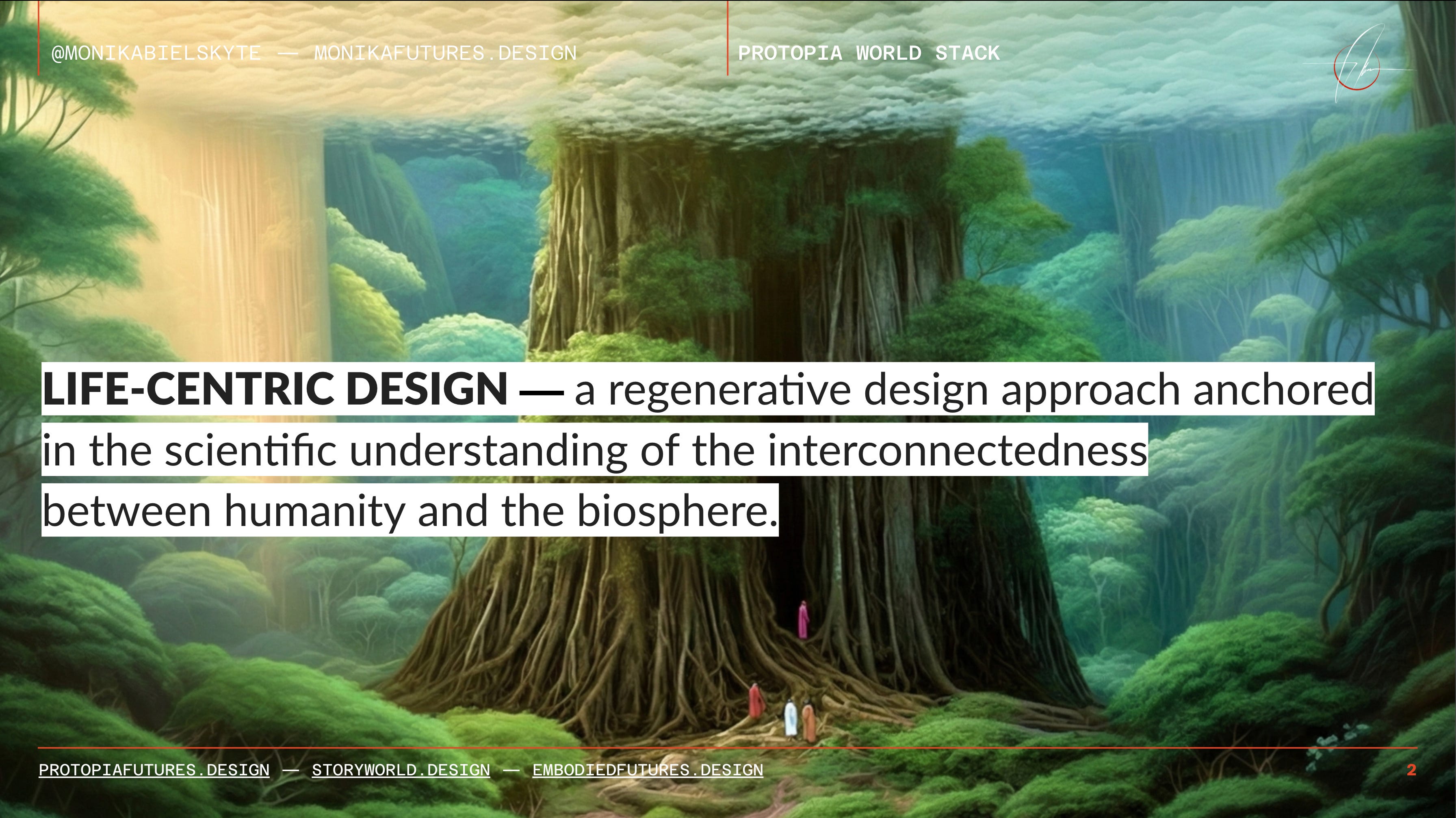
Life-Centric Design — a regenerative design approach anchored in the scientific understanding of the interconnectedness between humanity and the biosphere.
Protopia World Stack is anchored in Life-Centric Design because a system that damages the conditions life depends on will eventually damage the people it claims to serve. Current estimates suggest the reference 70kg male adult body contains roughly 38 trillion bacteria and 30 trillion human cells — a figure derived from a specific body type, which is itself a reminder of what design defaults to when it does not ask harder questions. A body is not a sealed unit. Design that treats the biosphere as backdrop begins from a faulty scientific model of what a human being actually is. Life-centric design repositions humans within the ecology they cannot be separated from.
When Don Norman (b. 1935) formalized user-centered design in The Design of Everyday Things (1988), he challenged the discipline away from engineering-only thinking toward the human experience of objects and systems. But the default “user” Norman centered was neurotypical, able-bodied, operating in stable conditions, and predominantly in what researchers later termed the WEIRD world (Western, Educated, Industrialized, Rich, and Democratic). Disability, neurodivergence, aging, sensory difference, and environmental constraint were handled as an afterthought, if at all. His 2023 book, Design for a Better World, moved toward acknowledging broader environmental and social systems — yet the deeper reckoning with what the earlier framework left remained poorly addressed.
Human-centred design doesn’t actually center humans — it centers a fiction of what a human is. A body is an ecology. We are not separate from living systems — we are composed of them.
Life-Centric Design widens the frame by returning the human to the living systems that make human life possible. A body is not a sealed unit. It is a living system inside larger living systems. Kate Raworth (b.1970), in Doughnut Economics (2017) proposes that human thriving sits between a social foundation and ecological limits. The safe and just space for humanity cannot be produced by treating the living world as an externality. Life-Centric Design turns this understanding into a design condition. Good design cannot stop at the isolated user; it has to account for the life systems that humanity depends on.
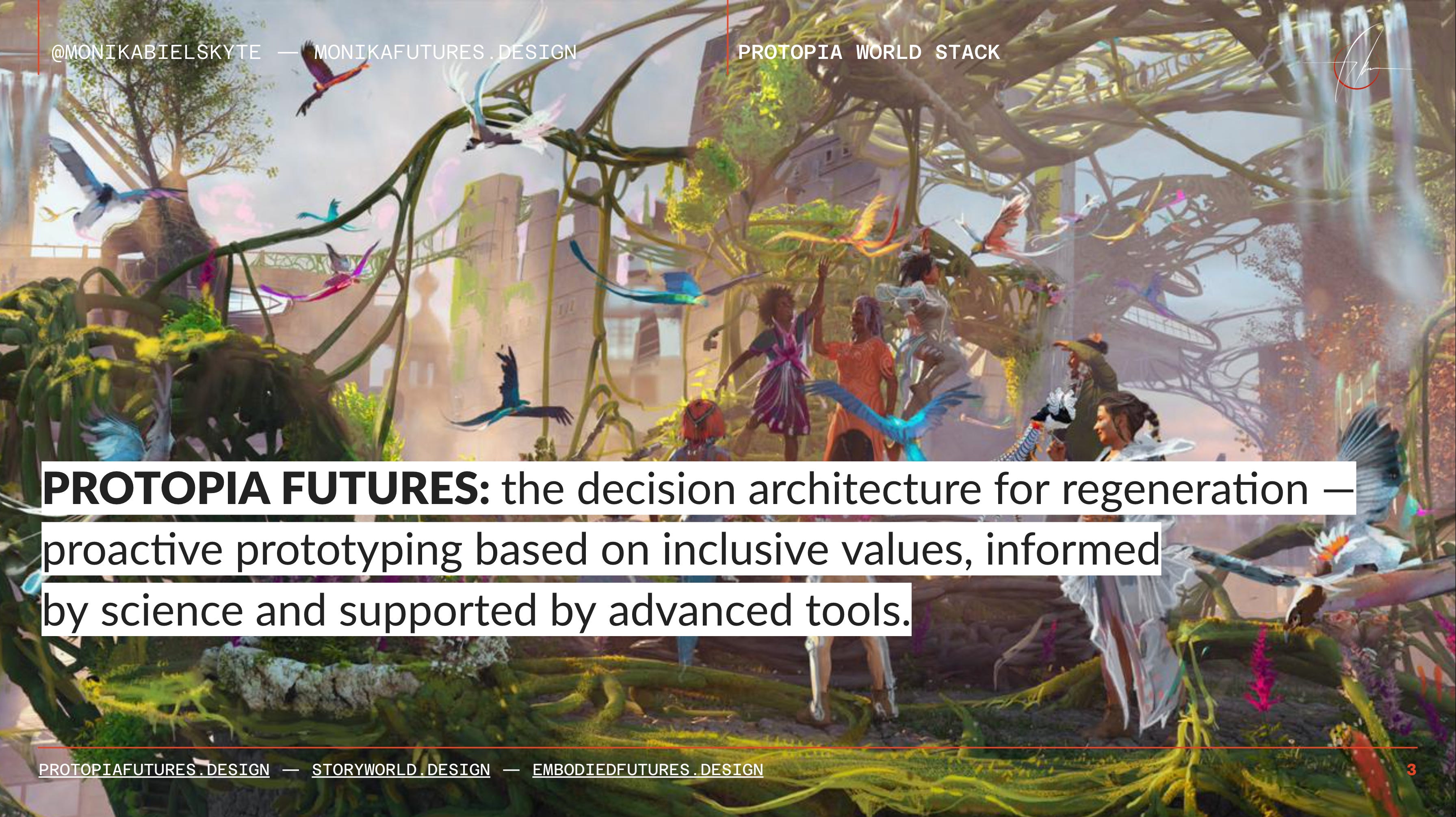
Protopia Futures Design Framework is the decision architecture for regeneration — proactive prototyping based on inclusive values, informed by science and supported by advanced tools.
As noted in the New York Times article on the protopia movement, Kevin Kelly (b. 1952) introduced the concept of “protopia” in What Technology Wants (2010), describing a future that moves by incremental progress rather than utopian arrival or dystopian collapse. In a 2011 essay on The Technium, he sharpened the definition: “Protopia is a state that is better than yesterday, although it might be only a little better. Protopia is much much harder to visualize. Because a protopia contains as many new problems as new benefits, this complex interaction of working and broken is very hard to predict.”
In the real world, progress does not move in a straight line: civilisations collapse, democracies decay, public health gains can reverse, technologies can widen the damage they were supposed to solve. The future does not automatically improve with passage of time. It improves when enough people, institutions, resources, and stories are organised toward something better.
My reframing of Protopia Futures is not anchored in tech-optimism, but in human agency to decide what forms of improvement deserve effort, investment, and imagination. It is about proactive prototyping: not adaptation to technological trajectories, but informed choices about futures worth moving toward.
Both utopia and dystopia fail as design frameworks for the same structural reason: they remove agency. Utopia has already decided which future is perfect — the task is to conform. Dystopia trains despair — if the collapse is inevitable, what is the point of doing anything about it? Protopia Futures is not the centrist compromise, it steps out of this false binary. It is iterative, adaptive, regenerative — a future that could be everything we hoped for, but not what sci-fi conditioned us to expect. It is anchored in science, not venture capital speculation and hype cycles.
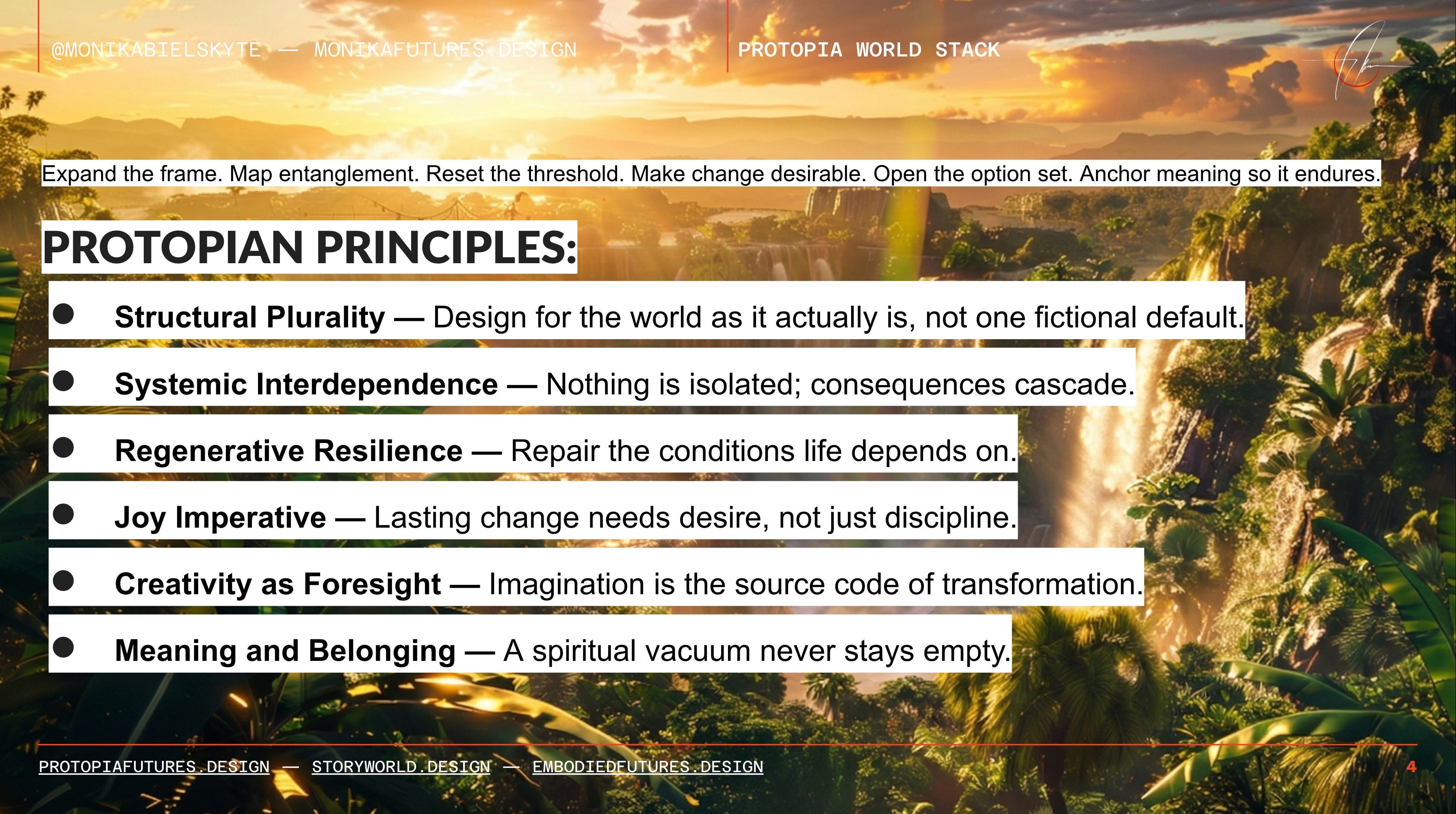
Protopia Futures Framework is Stack’s decision architecture. The process runs through six phases: expand the frame, map entanglement, reset the threshold, make change desirable, open the option set, and anchor meaning. The framework is organized around six principles, used to examine long term resiliency of the strategy, product, policy, or narrative before it is built:
Structural Plurality — Design for the world as it actually is, not one fictional default.
A strategy built around a median user, citizen, or market may perform well in testing but fail in deployment. The more plural the design ground, the less fragile the future becomes.
Systemic Interdependence — Nothing is isolated; consequences cascade.
A decision optimised for one variable — cost, speed, engagement — tends to shift the burden elsewhere. Connections should be mapped before they become externalities.
Regenerative Resilience — Repair the conditions life depends on.
Sustainability is no longer an adequate threshold where damage has already accumulated. Successful strategy does not merely stall decline, it restores capacity: social, biological, cultural, and economic.
Joy Imperative — Lasting change needs desire, not just discipline.
Compliance-based adoption drops as soon as incentives or enforcement soften. The futures that maintain traction are those that create emotional attachment.
Creativity as Foresight — Imagination is the source code of transformation.
No hard problem gets solved until a better option can first be imagined. Creativity is not the sparkly packaging added after strategy — it is what allows to escape inherited assumptions.
Meaning and Belonging — A spiritual vacuum never stays empty.
When institutions fail to offer credible frameworks for shared purpose, more destructive ones fill the space. Reversing that is significantly harder than preventing it.
Protopia Futures Design Framework gives institutions a way to choose direction before they start projecting futures onto the world.
Direction is the first commitment. But the future worth choosing has to work in bodies, and this is what Embodied Futures Design Framework was developed to address.
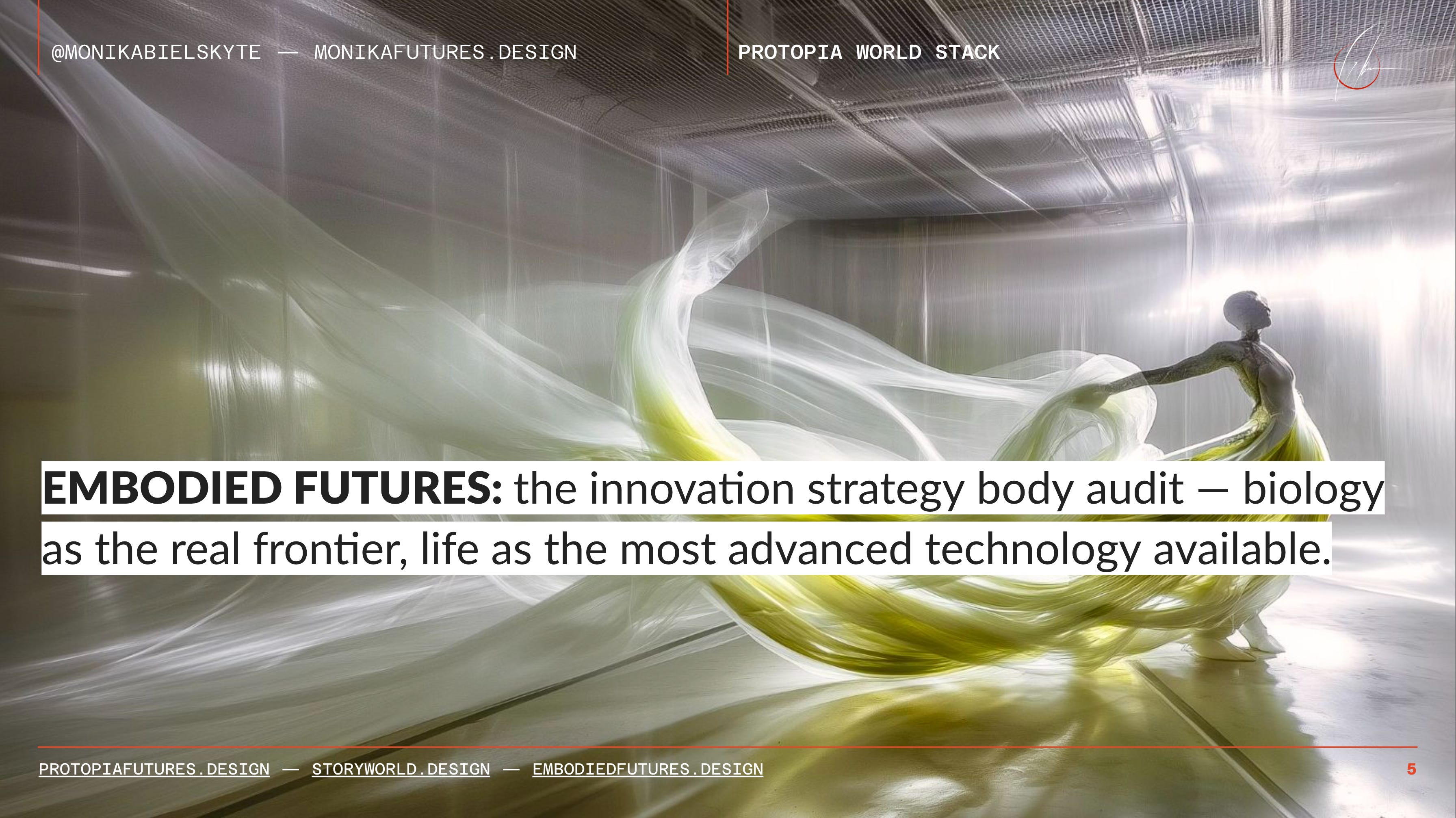
Embodied Futures is the innovation strategy body audit — biology as the real frontier, life as the most advanced technology available.
Biology is the organizing filter for Embodied Futures Framework rather than technology because the body is where the future stops being theoretical. Lungs, joints, eyes, nervous systems, immune systems, hormones, skin, sleep, hunger, memory, attention, grief, pleasure, and pain are where futures actually land. Devices, interfaces, strategy presentations, and the cloud only matter in how they impact biology.
Too often the product only works in the demo, the policy only works in the model, the campus only works in the render, and the interface only works for the assumed user. The future unfolds in bodies processing worlds that were never designed with them in mind. “The future is disabled for most of us” is a specification about where design failure surfaces first. Biology is not a constraint on innovation. It is its most advanced technology — and the only true measure of whether innovation is working.
Any innovation strategy that cannot account for what it does to real bodies — all bodies, especially the bodies that systems decide are inconvenient — is incomplete and unreliable.
Designing from edge conditions — from disability, neurodivergence, aging, ecological constraint — produces solutions that work better for everyone, because those conditions reveal failure modes that mainstream averages conceal. Disability and neurodivergence are the highest-yield innovation frontiers we have — because the edge detects reality before the centre does.
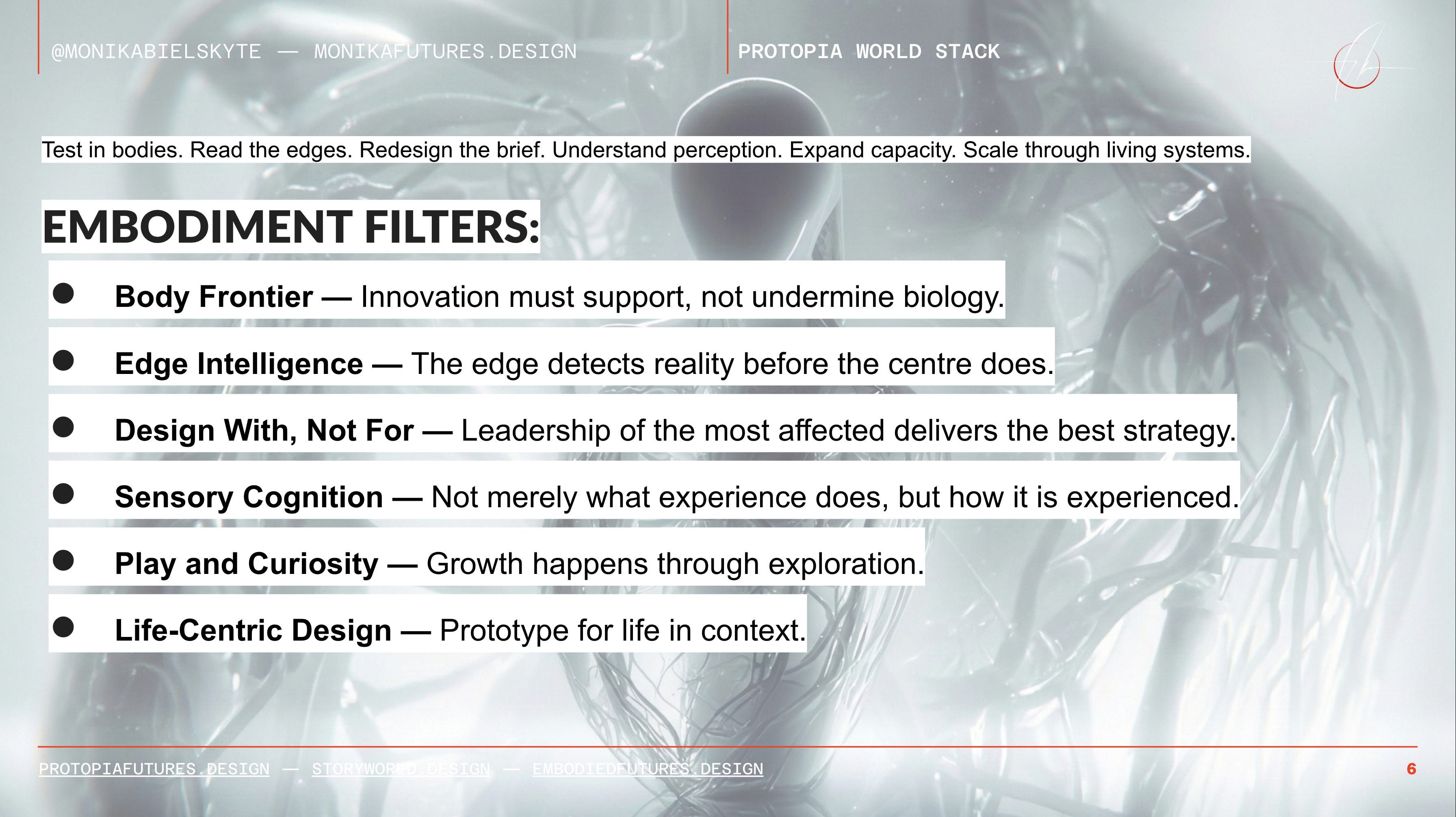
Embodied Futures is Stack’s reality audit. The process runs through six phases: test in bodies, read the edges, redefine the problem, understand perception, expand capacity, and scale through living systems. The framework is organized around six filters, used to stress-test futures against lived reality rather than idealized personas:
Body Frontier: Innovation must support, not undermine biology.
The body is not a constraint to overcome or an inconvenience to optimize around. Innovation is measured by how it impacts bodies and the broader ecosystem of life.
Edge Intelligence: The edge detects reality before the centre does.
The clearest design signals come from the people treated as exceptions — they reveal failures the mainstream will experience later. Accessibility is an innovation engine.
Design With, Not For: Leadership of the most impacted delivers the best strategy.
The most affected people need power at the problem-definition stage, not symbolic consultation after the key decisions have been made. Co-authorship produces better intelligence than downstream feedback.
Sensory Cognition: Not merely what experience does, but how it is experienced.
An interface that functions correctly can still fail through sensory overload or cognitive load — experience quality is determined by its perception.
Play and Curiosity: Growth happens through exploration.
Systems organized only around compliance produce brittle engagement. Play, experimentation, and curiosity help people learn, adapt, trust, and develop confidence in unfamiliar futures.
Life-Centric Design: Prototype for life in context, not isolated users.
A product, policy, or service that temporarily functions for isolated users while degrading the ecological or social systems they depend is a cost transfer. Life-Centric Design keeps the wider conditions of life inside the design frame.
Embodied Futures changes the measure of success: innovation has to give more to life than it takes, however advanced it looks.
The body test changes what you know. It does not, by itself, change what people want. Storyworld Design was developed for exactly that distance — between a future that is sound and a future that people feel drawn toward.
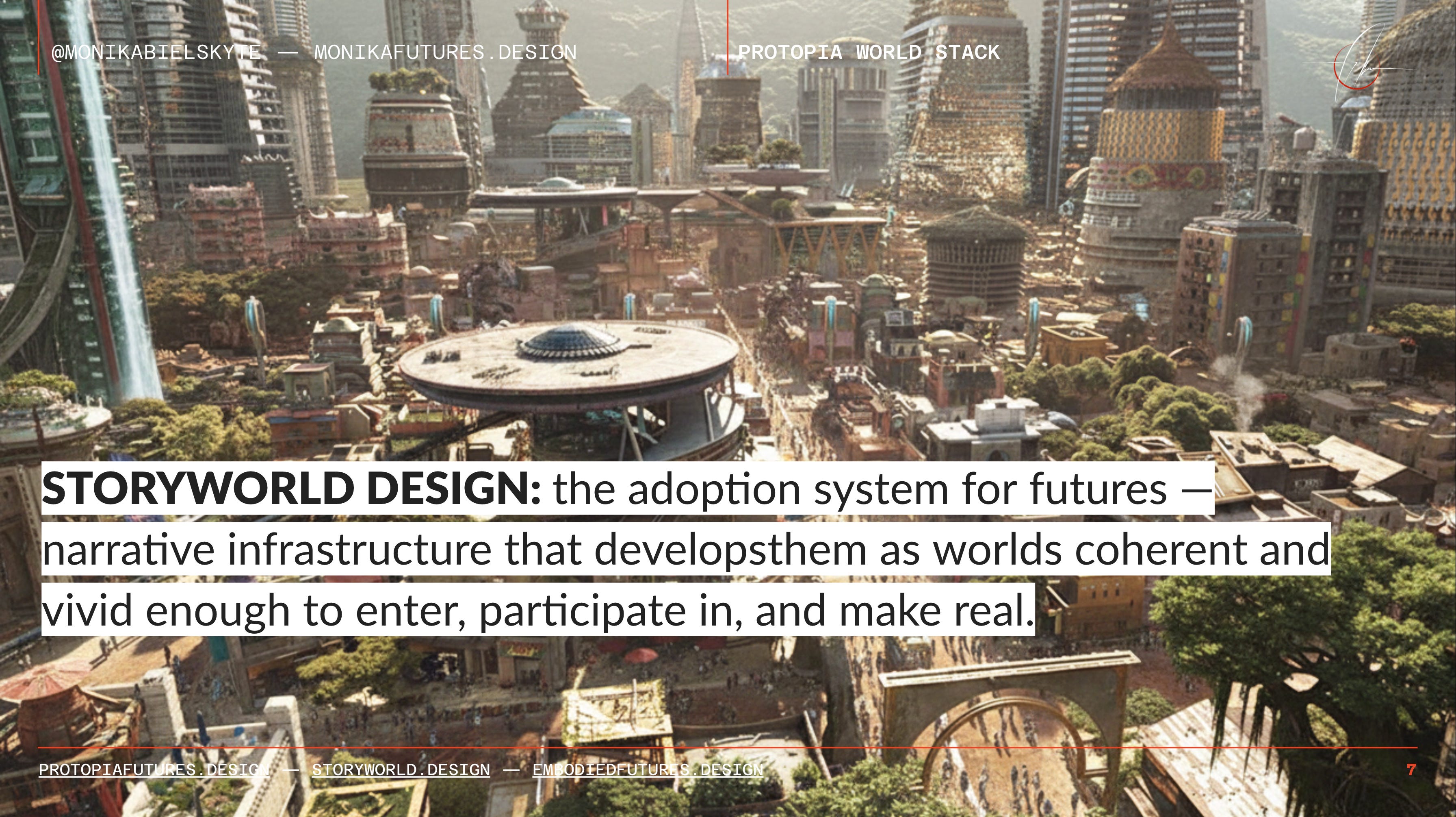
Storyworld Design is the adoption system for futures — narrative infrastructure that develops them as worlds coherent and vivid enough to inhabit, participate in, and make real.
When Ryan Coogler and production designer Hannah Beachler brought Wakanda to life for Black Panther (2018), audiences didn’t just watch it — they wanted to live there. The world of Wakanda continues to exist in our imaginations even when the movie stops. People wept at screenings, because they felt the specific grief of finally seeing what had been for so long withheld from the cultural imagination. The pull of a world exceeds the narrative that introduces it.
People adopt future trajectories as their own only when they can recognise themselves inside them, when the world makes sense, when the symbols, spaces, products, rituals, images, interfaces, and stories point in the same direction. Participation becomes possible when people can feel the shape of a future before it fully exists. The greatest impact of Science Fiction media is its capacity to seed future possibilities in our imagination — it makes an imagined future feel real enough to inhabit emotionally, not just process intellectually.
Naomi Klein, in Doppelganger (2023), documents what happens when narrative power is weaponized in the opposite direction: mirror-world disinformation producing parallel realities, fragmenting shared ground, closing off the futures people can organize toward. Storyworld Design is, among other things, a response to that challenge — developing worlds coherent and rooted enough to anchor people in shared reality rather than scatter them across competing fictions.
World logic is what strategy documents cannot produce. A document can describe a future, but a world allows a future to be felt.
Worldbuilding is not communications overhead. It gives leaders, teams, publics, audiences, and communities a shared reality to enter, question, and develop from. It translates ideas into felt, visceral understanding. It reveals where the proposed future breaks its own logic or what of its elements, characters, narratives are ill-fit for the purpose.
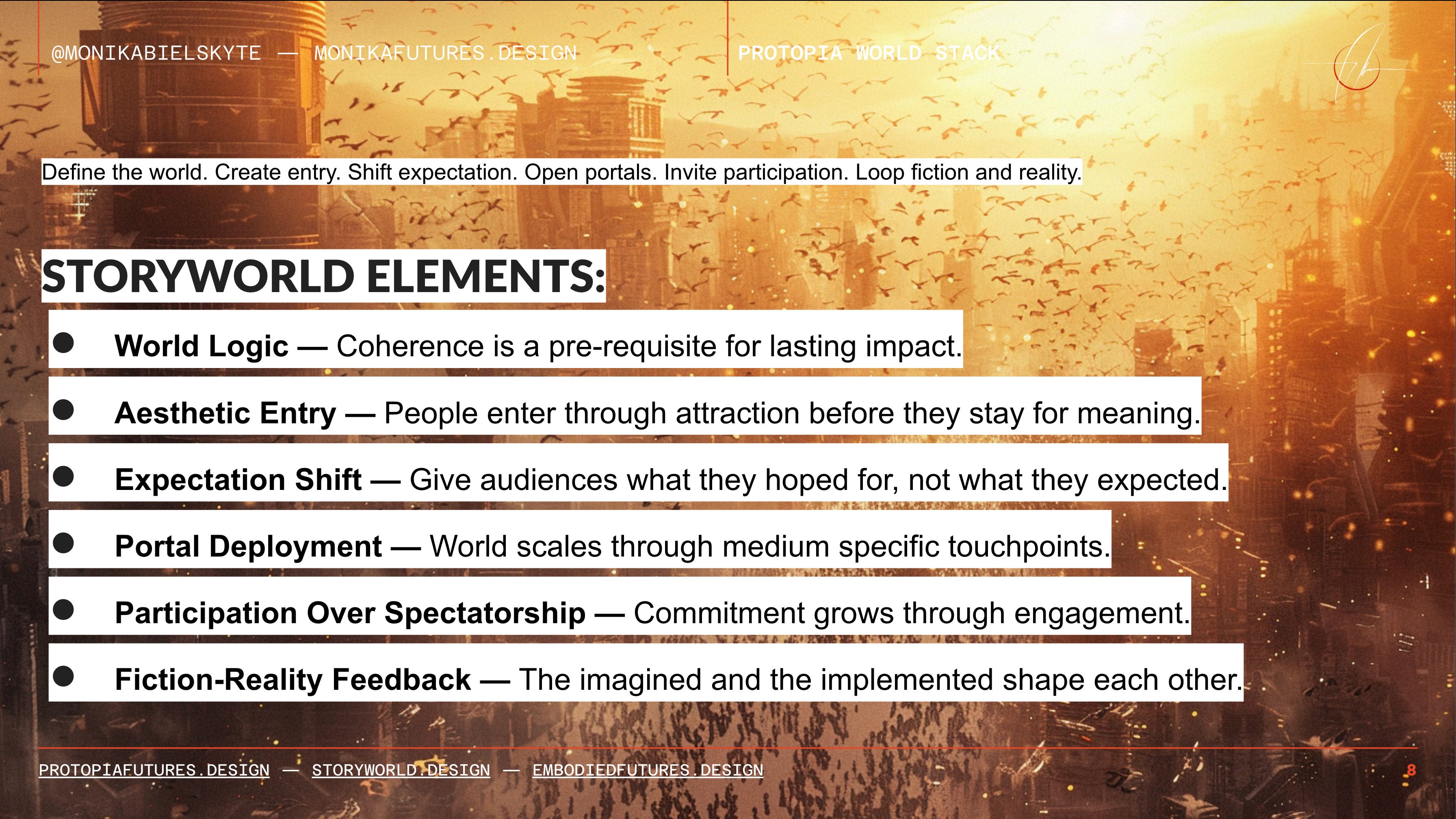
Storyworld Design is the participation architecture of Protopia World Stack. It brings the tools of science-fiction worldbuilding into institutional futures work. The process runs through six phases: define the world, create entry, shift expectation, open portals, invite participation, and loop fiction and reality. The framework is organized around six structural elements, used to translate strategic vision into culture and real-world deployment:
World Logic: Coherence is a pre-requisite for lasting impact.
The proposed future must be internally consistent. When products, spaces, policies, language, behaviors, rituals, and images belong to the same world, they can be understood faster and carried further.
Aesthetic Entry: People enter through attraction before they stay for meaning.
Beauty and design appeal are the front door into more complex insights. Without it, the ideas remain insulated within “expert circles” and might never reach the people who would benefit from them the most.
Expectation Shift: Give audiences what they hoped for, not what they expected.
The element of wonder is vital: fulfilling an emotional promise while expanding the range of what was thought possible — rather than just delivering what was assumed.
Portal Deployment: World scales through medium-specific touchpoints.
A vision scales when it is adapted across platforms in a way that holds together — each encounter reinforcing and building on another, rather than repeating or scattering its meaning.
Participation Over Spectatorship: Commitment grows through engagement.
A future observed from outside is more fragile than a strategy people can practise and trust. Roles, rituals, and tools give people ways to rehearse the future before it fully exists.
Fiction—Reality Feedback: The imagined and the implemented in a virtuous loop.
The goal is to positively reshape what reality is expected to become. Narratives change desire. Desire changes demand. Demand changes investment. Investment changes infrastructure. Infrastructure changes what narratives feel plausible next.
Storyworld Design helps institutions move from “we have a vision” to “people understand the world this vision belongs to, and know how to participate in making it real.”
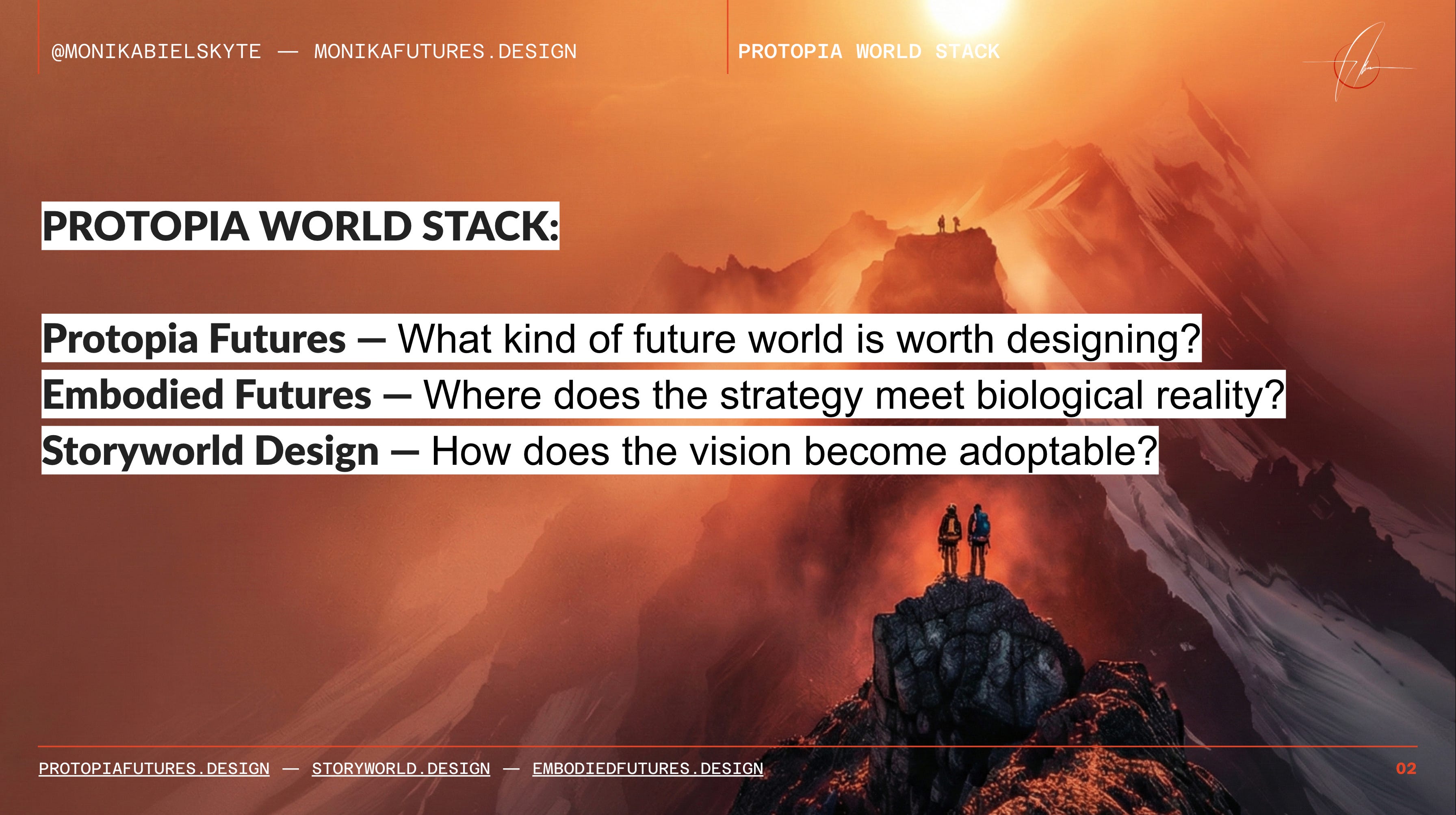
Protopia World Stack takes futures from values, through bodies, into shared worlds — three frameworks, one methodology for prototyping, testing, and realizing futures worth designing.
The three frameworks are strongest when treated as one process rather than three adjacent options. Protopia Futures sets direction. Embodied Futures tests that direction against bodies, ecologies, and lived conditions. Storyworld Design turns what survives into a world people can recognize, question, and help make real.
A full Protopia World Stack engagement begins with clarifying the stakes: What future is being imagined? What assumptions are considered as default?
Protopia Futures opens the field. It examines possible futures, preferable futures, rejected futures, and neglected futures, then asks which directions are scientifically grounded to guide decisions.
Embodied Futures audits how the future strategy lands in bodies and ecologies. It asks where the future breaks, who feels the break first, and what the break reveals. The failure points are treated as insights to redesign from.
Storyworld Design develops the narrative into a cross-platform world, making the strategy clear without reducing it to messaging, creating the conditions through which people can understand what kind of world is being offered and what role they might play inside it.
Unlike Solarpunk’s gap — which imagines a destination after the hardest fights have been won — Protopia World Stack does not leapfrog from the present complexity into utopian resolution.
Its unit of operation is today’s broken institutions, incumbent interests, and adversarial conditions. The frameworks are designed to work in context of existing systems, stress-testing futures against present-tense constraints rather than projecting past them.
Protopia World Stack process is iterative because life is iterative. Institutions drift. Technologies mutate. Public trust rises and falls. Ecologies push back. Stories escape their makers. If the world becomes seductive but drifts from its values, return to Protopia Futures. If the strategy sounds strong but fails in bodies, return to Embodied Futures. If the work is sound but no one understands or desires it, return to Storyworld Design.
Protopia World Stack helps institutions move beyond risk management without falling for hype, giving teams a clearer way to decide what is actually worth designing, developing, and making real.
Different sectors need different emphasis on its constituent frameworks. A media company may lead with Storyworld Design. A healthcare institution may lead with Embodied Futures. A city may lead with Life-Centric Design. A corporation may lead with Protopia Futures to examine whether its innovation pipeline is building relevance or future liability. The complete process engages all of the frameworks in a sequence adapted for the challenge at hand.
Most consumer companies already have trend reports, audience data, segmentation, and innovation pipelines. What often remains untested is whether the future they are developing deserves loyalty. Protopia Futures brings direction into the process before strategy commits: what kind of world is this brand helping normalize - disposability or repair, anxiety or confidence, extraction or regeneration? Embodied Futures tests how the innovation lands in bodies, habits, senses, and everyday use, beyond the assumed customer profile. Storyworld Design develops something no campaign budget can manufacture: a world coherent enough to accumulate cultural value over time, and resilient enough to outlast the news cycle. The Stack helps corporations avoid the familiar trap: short-term novelty that accumulates long-term distrust.
The gap between what policy proposes and what people recognise as their own is where civic futures break down or become easy targets for actors invested in public distrust. Protopia Futures helps policy teams make values clear before policy becomes infrastructure: what does this future protect, what does it repair, what does it ask people to give up? Embodied Futures tests whether the policy reaches the people it claims to serve, from mobility and heat exposure to disability access, cost, time, safety, and trust. Storyworld Design helps public institutions make futures legible without reducing them to slogans. People need to understand the world a policy is trying to build, and where they fit inside it. Participation never works if it is demanded at the end of a process that excluded people at the start.
Every commissioned world carries a message — what is inevitable, heroic, disposable. Storyworld Design is the natural entry point here: it helps cultural institutions develop worlds with enough internal coherence to shift what audiences believe can exist, rather than only what they fear or escape into. That work becomes most powerful when grounded in Protopia Futures — asking not only whether a world is compelling but what it is teaching audiences to desire. Embodied Futures asks whose bodies carry the future onscreen, and what those depictions normalize in the wider culture. The Stack helps media move beyond dystopia as default, and toward stories that make learning, agency, and collective imagination feel captivating. The opportunity to shift entertainment as something that drains us, to something that supports us — bridging it with education to a hybrid format of edutainment — making learning more addictive than distraction.
Education is one of the main places where societies decide what forms of intelligence they will reward. Protopia Futures asks what world a curriculum is preparing students to enter or change. Is education training compliance with systems that are already broken, or cultivating the capacity to redesign them? Institutions producing graduates for a future that no longer exists are failing them. Embodied Futures surfaces a structural mismatch: education designed for the neurotypical student has squandered the extraordinary potential of so many others. Storyworld Design addresses the translation problem: researchers already hold knowledge that would change decisions if it could cross disciplinary boundaries. That shift — from insular knowledge delivery to public reach — becomes more urgent as AI-powered disinformation erodes the shared ground between what science knows and what the public trusts.
Healthcare innovation has to widen its frame: improving the treatment pipeline matters, but so does the health future being developed around it. Protopia Futures addresses the upstream problem: a system organised around acute intervention produces different infrastructure, different research priorities, and different patient relationships than one organised around regenerative capacity — and the infrastructure choices being made now lock one or the other in for decades. Embodied Futures revises whether the intervention gives more to the bodies it serves than it asks of them. Storyworld Design addresses one of healthcare’s most persistent failures: the distance between what science knows and what the public understands and practices. The Stack as a whole helps healthcare institutions design systems people can value.
Buildings and cities are futures made physical. Once developed, they commit populations to particular conditions for decades, sometimes generations. Protopia Futures examines what kind of life a place is designed to support before ground is broken: extraction and speed, or care, safety, repair, memory, and public joy. Embodied Futures tests visions through the bodies that will actually use them. Can people move safely, rest, enter without humiliation, navigate without sensory overload? Storyworld Design gives the place a future identity that communities can connect with and shape. The built environment has to move beyond polished “smart city” renders toward places people can feel attached to, trust, maintain, and inhabit with dignity. That is the architectural future worth funding.
Rebecca Solnit writes in The Beginning Comes After the End (2026) that the changes underway amount to “dismantling an old civilization and building a new one,” even when the scale of that transformation is difficult to see from inside the disorder of the present. The futures work begins in that disorder — when the old tools still function well enough to be defended, but not well enough to meet the world that is arriving.
Protopia World Stack was developed for precisely this terrain. It is not a finished doctrine, and it should not become one. A method for the future has to keep learning from the futures it helps design. It has to be porous enough to adapt across sectors and geographies, rigorous enough to resist hype, and grounded enough to be corrected by the people and places most affected by the work.
The next three essays in this series will go deeper into each framework individually. Protopia Futures will examine how we choose direction. Embodied Futures will examine how futures are tested in bodies and living systems. Storyworld Design will examine how strategy becomes culture, and how worlds become real enough for people to enter.
The future is shaped by what we design, but also by our apathy — what we allow to be considered “normal”. It is shaped by the assumptions we inherit without testing, the stories we repeat without questioning, and the bodies we ignore.
Protopia World Stack is one attempt to intervene earlier: before dystopian stories become strategy, and the most life-giving options are dismissed as unrealistic simply because they were not seriously considered. The work is not to predict the future more effectively extrapolating from the status quo, but to design futures worth inhabiting — and to make them real enough that others can join in.
This is an invitation.
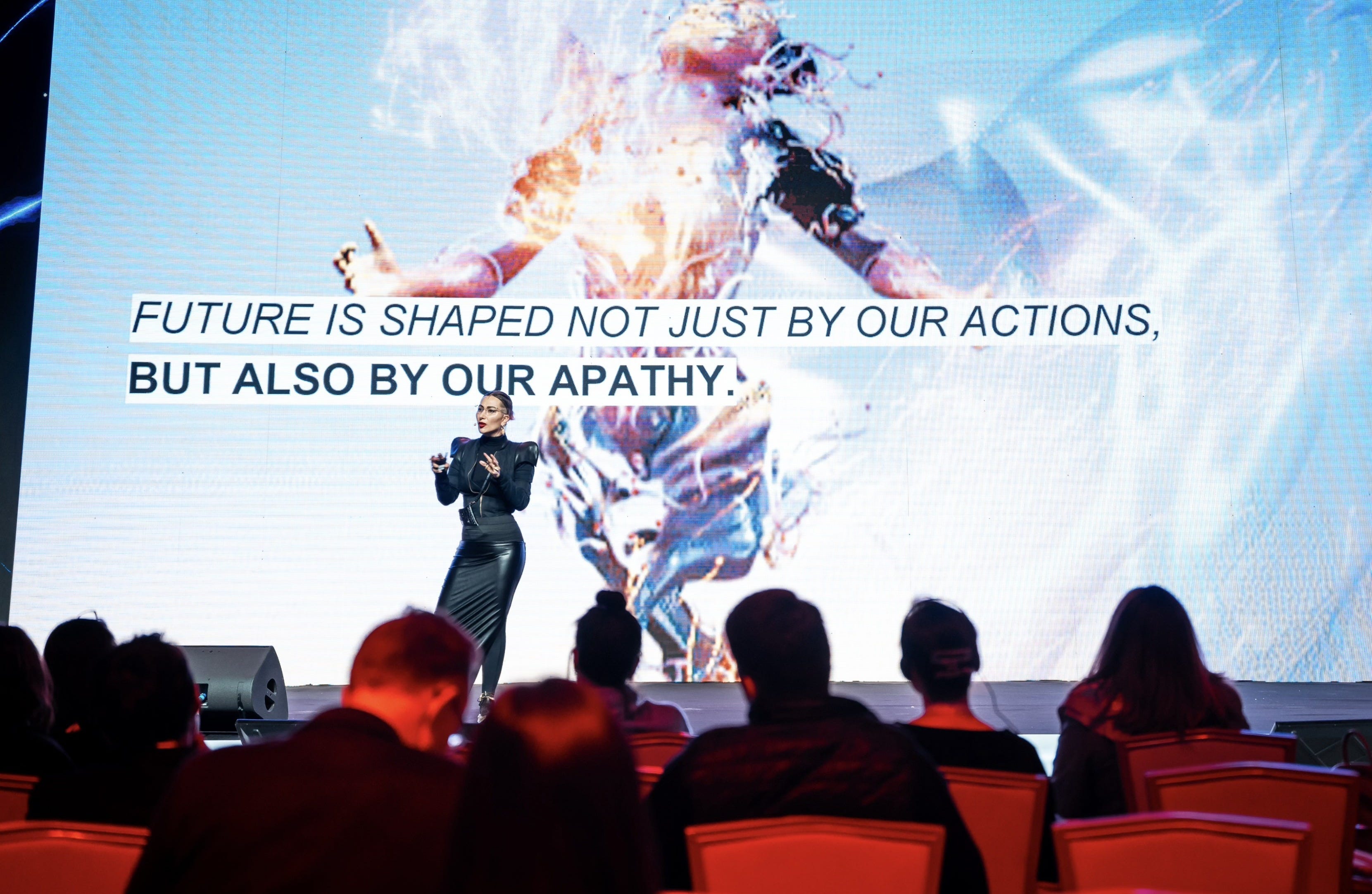
Monika Bielskyte is the founder of Protopia Futures and Nike’s first Futurist in Residence.
As a foresight practitioner she develops resilient future strategies informed not only by emerging science and technologies, but by embodiment, lived reality, and narrative systems. Her field research spans more than 100 countries, with a deliberate focus on Global Majority realities and disability and neurodivergence as the highest-yield innovation frontiers.
Monika’s clients include Disney/Marvel’s Black Panther, BBC, McKinsey, Google, Microsoft, Huawei, WEF, Universal and L’Oreal. She has also lectured at scientific and academic bodies including CERN, Royal Society and Rockefeller University. Alongside Protopia Futures, her other roles include Luminary at EY, futurist advisor to Climate Spring and the Inclusive AI Lab and founding partner of African Life-Centric Design.
The methodology introduced in this series was developed over a decade through work across entertainment, technology, consumer innovation, government, and science — and continues to evolve through active practice across these domains.
For enquiries reach out via Linkedin.
Gustavo Montes de Oca, Pierce Edward Cornelius Otlhogile-Gordon, Pumla Maswanganyi
.
No posts
Comments
Nothing yet. Say the first thing.
Sign in to join the conversation.