
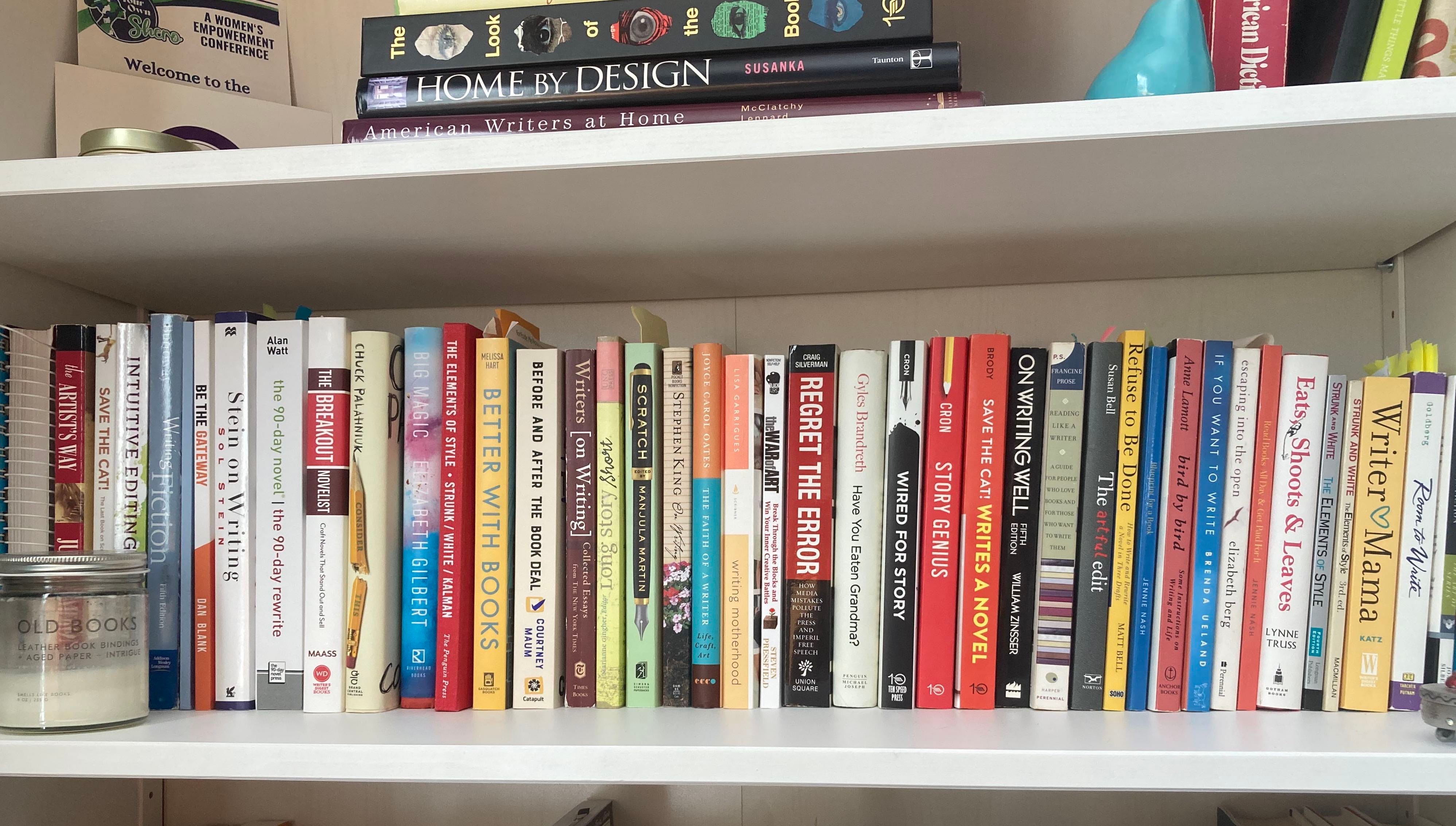
I have a shelf+ of craft books. Granted three of them are different copies of The Elements of Style and no, I can’t part with any of them, thank you very much.
Chances are you have a similar shelf.
I LOVE books on craft. They get me thinking in different ways. Spark inspiration. Stimulate new routines. Explain concepts in new ways that may resonate more than the previous book I read on the same topic. Some even remind me why I’m writing in the first place.
Or help you understand how what book A said is the same as book B described just differently enough to confuse you, or how book C completely contradicts book D.
And if you’re a relatively newbie writer, you may be trying to do ALL. THE. THINGS. the way ALL. THE. EXPERTS. are describing and then confused as to why your manuscript is a hot mess.
Your own voice gets lost as you try to earn an A+ in craft advice execution.
Nine times out of ten, those writers need to take a step away from the craft shelf and remember the story they set out to tell.
I know it may seem contradictory for a book coach to say stop listening to outside advice, but that’s exactly what I’m going to say.
And I don’t mean don’t read these books (see said shelf of same book coach above) or articles or (ahem, adjusts collar) Substacks on craft. What I do mean is:
Read, digest, practice with the tips and tricks OUTSIDE OF YOUR MANUSCRIPT PAGES, then see what resonates with you and your writing process.
For example, early on in my writing learning journey, I read and fell in love with Story Genius by Lisa Cron. The concepts in that book really spoke to me and I eagerly used the drafting of my next manuscript as an excuse to start building her suggested scene cards. Cards created, I jumped into drafting. About halfway through the draft of that manuscript, I hated it. Didn’t want to write it. Something wasn’t working and I had lost the joy of the idea.It was those damn cards.
I don’t know why. They’ve worked for plenty of other writers I know with great effect (which is why I still recommend this book). But for me and that story, it put me months off track and I ended up scrapping it and starting over.
Ouch.
But I realized that the new draft I wrote still employed her concepts, the ideas behind the cards, the character misbelief and story trajectory. I was able to take a step back from the prescriptive advice that didn’t work for me and implement her big ideas in ways that did work for my story.
A runner does some interesting things during practice – a sprinter might run with a parachute attached to their back to create resistance. They’d never run the race with it. It’s a tool to make them stronger and then when it’s race time, they put all the tools their coaches and trainers gave them to the side, employ that muscle memory, and run their race.
Craft books are the same. They are a resource, or training, that allow you to strengthen your skills so when the time comes, you can write your book.
There is no rule that says you have to follow these books to the letter. I would advise, in fact, that you shouldn’t.
As a writer, you have to learn to trust your own story instincts again. Believe me, you have them. And they are stronger than you think.
If you find yourself relying too much on your craft books to tell you what to do, as opposed to going to your craft books to answer a specific question or hone a particular skill, here are three quick tips to help you find the heart of your story again:
Remind yourself where the idea came from for this story? What was that kernel of an idea, a what if, a snippet of overheard conversation that sparked an idea in you?
Why must YOU write this story? What speaks to you specifically about this idea? Anyone could have had this idea float into their lives, why are you the one to write it?
Who needs this story in their life? What kind of person does this story speak to? What are they doing right now? What will your book offer them?
This trio of the what, the why, and the who will keep you grounded in this story so that when the next bit of trendy advice (my own included) flitters past, you’ll know whether you need it or can let it pass by for now.
Learn, practice, and then let it all go and see what your writer’s mind does with all this new knowledge.
Need help synthesizing all that knowledge and filtering out the noise? Coaching might be right for you.
Sign up for my waitlist and let’s find you in your writing again.
Comments
Nothing yet. Say the first thing.
Sign in to join the conversation.