
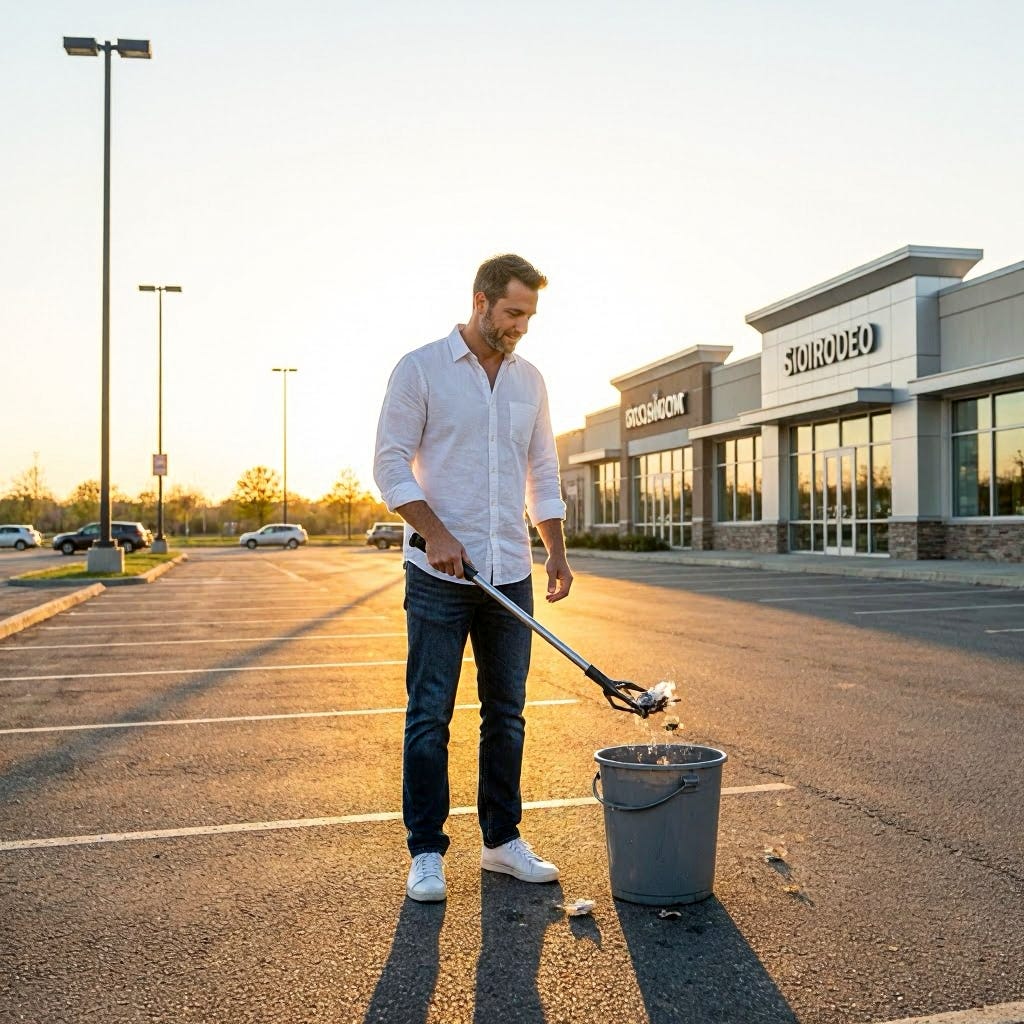
There’s a guy who walks parking lots before the sun comes up, picking up cigarette butts and paper cups.
He’s been doing it since 1981.
His business brings in around $650,000 a year.
You could start the same business this Saturday, with almost no startup cost, no degree, and no special skills. The work takes 2 to 3 hours a day.
So why haven’t you heard more people doing this?
That’s what this email is about.
His name is Brian Winch. He runs a parking lot litter cleanup business called Cleanlots.
Nick Loper at Side Hustle Nation interviewed him, and Brian explained how he turned litter pickup into a $650k operation that anyone can start and earn $30 to $50 an hour doing.
Before that number gets too big in your head, two things worth knowing.
$650k is revenue, not take-home. That’s the total the business collects, not what Brian keeps after expenses and help.
Brian sells a book teaching this business. That doesn’t make him dishonest, but it does mean you should treat his number as a claim, not a verified income statement.
So look at the other person in the same article.
Blademir Hernandez heard Brian’s episode and started his own lot cleaning business in New York City.
His goal was an extra $1,000 a month.
Four summers later, Nick reported it as a six-figure business, and Blademir was still working his regular day job.
That’s the version most of us could actually copy.
Before we get into how to start this, it helps to understand why most of us haven’t already.
The work itself is not hard, and the money is real.
The problem is that your brain tends to filter out opportunities based on how the work looks, before it ever stops to check what the job actually pays.
Researchers at the University of Chicago and the Wharton School ran a study on this.
They offered 511 high school students a free SAT prep package worth over $100: an app, a practice test, and a one-on-one tutoring session.
Some students were told their choice would stay private. Others were told their classmates would see who signed up.
Their results ran in the Review of Economic Studies. When the decision was private, about 80% of students took the free package. When classmates could see who signed up, it dropped to 53%.
Same package. Same value. Same students. The only thing that changed was who was watching.
About 1 in 4 students walked away from something they wanted, for free, because of how it would look to others. Nobody told them not to take it. The watching was enough.
Your brain does the same thing with money.
When you see “parking lot litter cleanup,” your brain does a quick check: would I want someone to see me doing this? If the answer is no, the idea gets dropped. You don’t even get to the part where you look at what it pays.
I call this The Seen Test: your brain checks who might see you doing a job before it checks what the job pays, and removes anything that looks bad before you can weigh the money.
Here’s where this gets useful:
If your brain runs the Seen Test, so does everyone else’s.
That means any work that looks bad in public has fewer people willing to do it, which means less competition, which usually means better pay and easier clients to land.
Think about it from a property manager’s point of view.
He manages 8 strip mall locations.
The parking lots get littered every single day. He needs someone to clean them before the stores open.
He can’t get a tenant to do it anymore.
He’s posted the job on his own, and nobody’s called.
Then Blademir called.
That manager signed Blademir’s first proposal and handed him 8 more potential locations in the same conversation.
That’s what low competition looks like. Not because the opportunity was hidden. Because most of us crossed it off before we looked at the numbers.
Here’s a way to use all of this to find better opportunities…
Comments
Nothing yet. Say the first thing.
Sign in to join the conversation.