
As well as meeting friends, colleagues, and clients, one week ago the Exante 10th Anniversary conference brought together insightful speakers to reflect on the past decade and contemplate structural themes that may drive the decade ahead. Naturally, it is impossible to escape the here-and-now, especially given developments in the Middle East. So we were often brought back to immediate policy challenges and investment themes.
Summaries of the sessions follow below, we will follow up with pieces covering some of these sessions in more detail later. Those interested in videos of the Bessent and Taylor sessions can email anniversary@exantedata.com
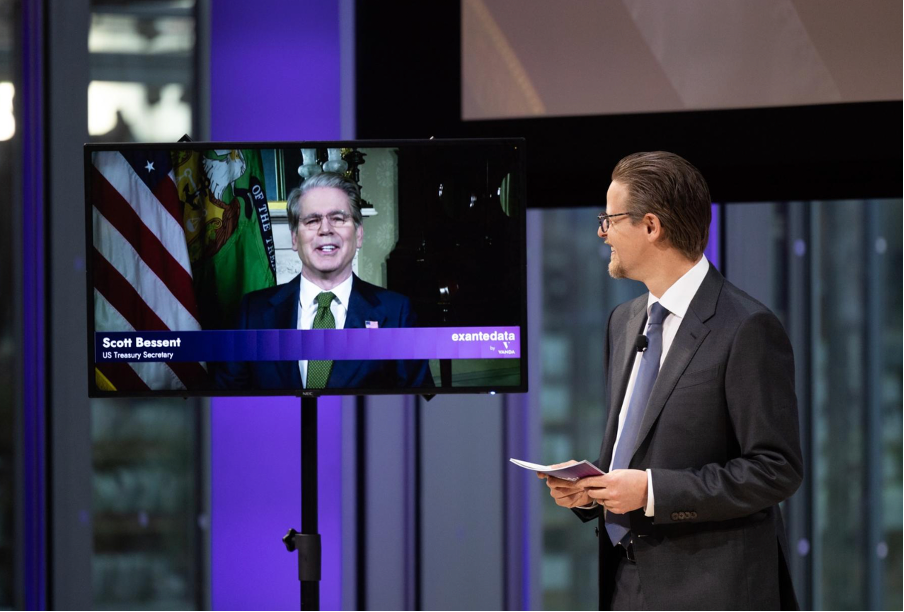
Secretary Bessent joined Jens Nordvig in conversation to open the conference. Bessent covered a wide range of issues, including: tax refunds; AI-related job losses (doesn’t see large job losses but restructurings;) the possibility the US Treasury would intervene in crude oil futures markets (the market is ‘too big;’) as well as CNY valuation and stories of tighter Fed oversight. The video of the session is available on request.
Andreas Schrimpf (BIS, standing in last-minute for Hyun Shin who became Governor-elect at the Bank of Korea), Steve Saldanha (OTPP), Brad Setser (CFR) joined Alex Etra for a discussion of the dollar. The discussion revolved around BIS data that show how FX derivatives markets have grown dramatically in recent years driven in particular by non-bank financial intermediaries. FX market volumes were particularly elevated around the April 2025 market turmoil induced by tariff related news, with FX turnover setting a new record at $9.5 trillion. This surge was largely due to investors adjusting their hedging strategies after a period when USD exposures had reached elevated levels (e.g. under-hedging due to higher hedging costs amid high/rising US interest rates from 2022-2024). Notably, FX forwards and options saw abnormal increases in transaction volumes in April 2025 amid a decoupling of traditional correlations given concern about the medium-term safe haven role of the USD and UST.
Marcel Kasumovich (Pure Macro) supported by pre-recorded observations by Isabelle Mateos y Lago (BNP Paribas) joined me to discuss the use-case for Stablecoins, the emerging European approach to digital ledger technology (DLT), and the potential impact on the global financial architecture.
We will write a future post elaborating the discussion, but Marcel explained how the main power of Stablecoins is their velocity in facilitating financial transactions, enabling them to turnover many more times than traditional base money. As they enter the mainstream, they can play an important role in the portfolio management within the US. In Europe, the approach is instead to leverage DLT within the domestic banking system cleared by central bank digital currency.
Implications for the global financial architecture? Possibly profound, particularly if there is large retail demand for Stablecoins outside the United States. There could bring another savings glut due to retail dollar demand. But we are in the very early days of Stablecoin adoption.
Grant Wilson (Tivan) joined Wouter Jongbloed to discuss supply chain challenges and the geopolitical outlook. A renewed focus on supply chains is needed as a rare earth mining and processing-risk combines with conflict-risk. China has developed a very sophisticated system of export controls that allows it to throttle supplies down to the product (and company) level. As such, the US and Japan are increasingly working together in rare earth mining and processing enterprises to address vulnerabilities. A recent treaty between Japan and the US complements earlier efforts by the US to leverage its position in high-end semiconductors. The panel also discussed the outlook due to the war in the Middle East (where Wouter was expecting fork in the road over the next ten days.)
JJ Kinahan (IG US Holdings), Steve Quirk (Robinhood) joined Eric Liu of Vanda to discuss the emergence of retail investors in driving US markets in recent years. Retail activity is rapidly spreading beyond traditional stocks and options, increasingly getting involved (and courted by companies) in IPO allocation, prediction markets, private investments, futures etc. While still actively buying the dip, the panel discussed how retail behavior has changed over the last 16 months, in terms of single stocks was well as more ETFs purchases. Retail also buying a lot more silver and gold ETFs. And prediction market activity is exploding, more than doubling vs last year. New investors are entering the space.
Ben Samild (ADIC), Karen Karniol-Tambour (Bridgewater) joined Jens Nordvig to reflect on the role of AI in macroeconomics. We will summarise the main themes in another post in the coming week. But the incredible capex boom in the US continues to drive macro outcome while expectations for this capex boom move higher. This is impacting monetary policy as there is a drift higher in ‘long-term dots’ within the Summary of Economic Projections, and certain FOMC participants are starting to attribute some of the drift in r* to AI effects. But there are two phases to the AI revolution: the capex phase and the adoption phase. Each has different investment implications.
Professor Alan Taylor of Colombia University and the Bank of England’s Monetary Policy Committee gave an important speech on how policy should respond to the emerging energy shock. Taylor’s speech is available here. The video including the Q&A can be requested at: anniversary@exantedata.com
Consistent with his paragraph in the latest monetary policy statement, Taylor cautioned that, for him, there is a high bar to hiking at this time. The Bank cannot control global energy prices but can avoid overreacting to short-term shocks while watching for “second-round effects.”
In the Q&A Taylor explained the process for gathering individual MPC member paragraphs and how much they will know at the April meeting to inform their policy decision.
Finally, Anna Wong (Bloomberg) and Richard Clarida (PIMCO) joined me to reflect on the challenges facing central banks globally. Anna Wong explained the rare divergence between PCE and CPI in the US. It is not about tariffs. Rather, PCE inflation is being driven mainly by financial services (linked to equity strength) and healthcare costs (linked to employer premiums.) This suggests that core PCE could weaken in the event of continued oil price stress and equity correction. If oil reaches $200/bbl could see inflation peak at 6% but there will also be second round effects that could extend the inflation shock. Turning to policy, Clarida explained that if he was at the Fed, he would not be pushing for a hike. His base case is that the Fed remains on hold at least until Warsh arrives. Eventually he expects the Fed to bring Fed Funds to a low 3% handle. Other central banks may be more hawkish.
Of course, scanning a decade ahead in the middle of an energy shock is a difficult ask.
We hope we managed to bridge the medium-term themes (Stablecoins, critical minerals and supply chains, the growing important of retail flows, the implications of AI) with the themes of the hour (how should monetary policy respond to this energy shock, dollar hedging, and US fiscal policy.)
In any case, we are enormously grateful to speakers and participants for their contributions. Until the 20-year anniversary conference in 2036?
The content in this piece is partly based on proprietary analysis that Exante Data does for institutional clients as part of its full macro strategy and flow analytics services. The content offered here differs significantly from Exante Data’s full service and is less technical as it aims to provide a more medium-term policy relevant perspective. The opinions and analytics expressed in this piece are those of the author alone and may not be those of Exante Data Inc. or Exante Advisors LLC. The content of this piece and the opinions expressed herein are independent of any work Exante Data Inc. or Exante Advisors LLC does and communicates to its clients.
Exante Advisors, LLC & Exante Data, Inc. Disclaimer
Exante Data delivers proprietary data and innovative analytics to investors globally. The vision of exante data is to improve markets strategy via new technologies. We provide reasoned answers to the most difficult markets questions, before the consensus.
This communication is provided for your informational purposes only. In making any investment decision, you must rely on your own examination of the securities and the terms of the offering. The contents of this communication does not constitute legal, tax, investment or other advice, or a recommendation to purchase or sell any particular security. Exante Advisors, LLC, Exante Data, Inc. and their affiliates (together, “Exante”) do not warrant that information provided herein is correct, accurate, timely, error-free, or otherwise reliable. EXANTE HEREBY DISCLAIMS ANY WARRANTIES, EXPRESS OR IMPLIED.
Exante Data is a trading name of Vanda Research Limited which is an appointed representative of Messels Limited which is authorised and regulated by the Financial Conduct Authority.
No posts
Comments
Nothing yet. Say the first thing.
Sign in to join the conversation.