
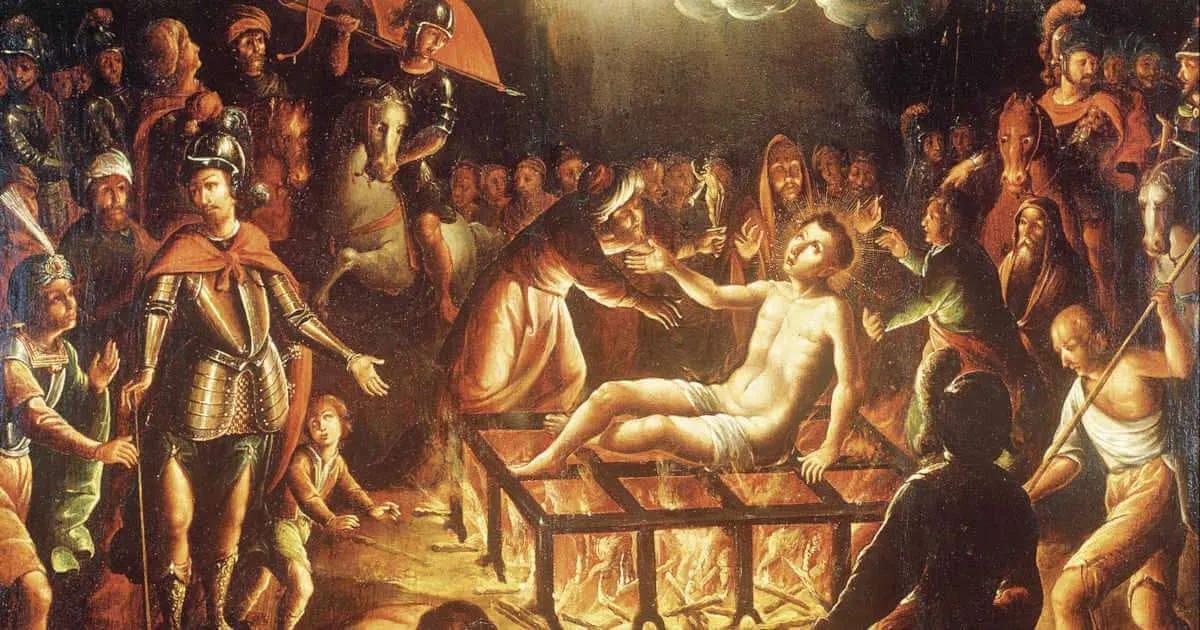
Today’s Catholic patron saint is Saint Lawrence (c. 225 – August 10, 258). He was a Roman deacon under Pope Saint Sixtus II, who was executed by Emperor Valerian when he refused to perform sacrifices to the Roman gods. The Emperor demanded that Lawrence turn over all the Church’s property to the Empire.1
St Lawrence asked for three days to gather the wealth. During that time, he gave Rome’s poor, widowed, and orphaned everything the Church owned. He then gathered the poor, crippled, blind and suffering and sent them to the Emperor as “the true treasures of the Church.”
You see, the man had a sense of humor.
The Emperor was not amused. Lawrence was seized and placed on a gridiron and burned alive. As he was dying, he uttered his famous last punch line: “Turn me over! I’m done on this side!”2
Because of this, St Lawrence is recognized as the Patron Saint of comedians and, wait for it….chefs.
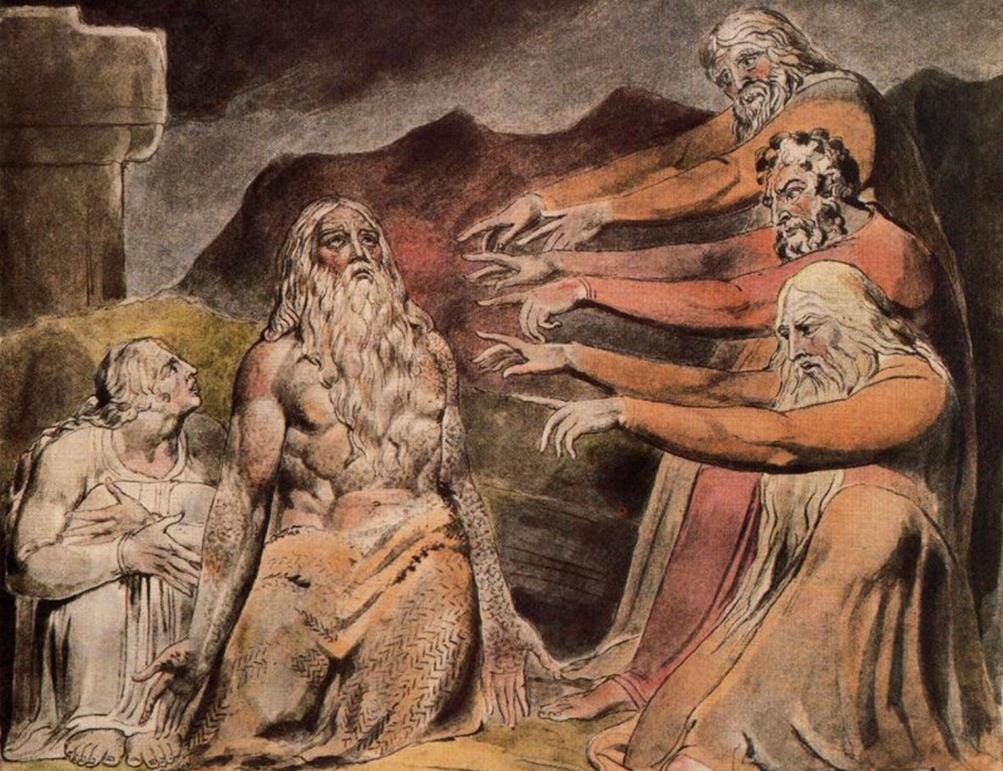
In the Old Testament, Job is “blameless, upright, fearing God and turning away from evil” (Job 1:1). He has wealth, a large family, and health. Then Satan and God make a bet to see if he’s really a good and faithful person, or simply good and faithful because he’s been rewarded for being so. So in rapid succession, God3 takes Job’s livestock and servants (wealth). His 10 children all die (family). Then God sends severe, painful boils and loathsome sores from the soles of his feet to the crown of his head (health). Job suffers.
Three of his closest friends go to him. They weep, rend their garments and sit on the ground with him for seven whole days (could you do this?). The very definition of compassion, to suffer with. But then, seven whole days later, they make the mistake we all make: they start giving advice. They giving reasons for Job’s losses, offering solutions to get out of the suffering, which in the inimitable words of Father Richard Rohr, “turn out to be little more than pious platitudes. In fact, entire chapters of the book of Job, are filled with their misguided justifications for Job’s sufferings.”
Finally, God arrives as a storm, and instead of giving Job answers, God demands Job answer a long list of questions,4 all along the basic lines of: Who the fuck are you to question me, the Universe? 5
4 “Where were you when I laid the earth’s foundation?
Tell me, if you understand.
5 Who marked off its dimensions? Surely you know!
Who stretched a measuring line across it?
6 On what were its footings set,
or who laid its cornerstone—
7 while the morning stars sang together
and all the angels shouted for joy?
— Job 38 4:7
After being at the receiving end of this long grilling, Job offers remorse, telling God/Universe that he understands It is all-powerful, that he had knew nothing about God/Universe before and did not understand anything:
“I had heard about you before, but now I have seen you, and I repent in dust and ashes.”
Perhaps you know the Serenity Prayer:
God, grant me the serenity
to accept the things I cannot change
the courage to change the things I can
and the wisdom to know the difference.
Living one day at a time,
enjoying one moment at a time.
Accepting hardships as the pathway to peace.
Taking, as he did, the sinful world as it is,
not as I would have it.
Trusting that he will make all things right
if I surrender to His will;
that I may be reasonably happy in this life,
and supremely happy with Him forever.
—Reinhold Niebuhr, 1892-1971
Accept the things you cannot change. The courage to change what you can.6 Accepting hardship as a pathway to inner peace. Having the wisdom to know that by surrendering one’s ego, you may be reasonably happy in this life, and maybe even attain enlightenment.
I’ve been teaching FF1 for 10 years now. One of the central tensions I can see now, hundreds of students later, is what is possible to change about ourselves (and thus our finances) and what cannot be changed? For some, change happens, and quickly, and they come back to me, saying FF1 has transformed their life. For others, not so much, and they come back to me, years later, feeling stuck in the same place. Was it lack of courage, or was it simply karma? I don’t have the wisdom to know.
But I’ve learned most of the time people don’t want your advice, reasons, or solutions. They just want you to sit on the ground with them, weep, and rend your garments. They’re just asking for compassion. Because who the fuck are we to understand the nature of suffering?
Not easy for my ego, who wants to be the “smart personal finance mentor” with all the answers.
Are you someone who can sit with someone’s suffering, and not offer advice? Sometimes what people want is your compassion, not your pious platitudes.
We live in a culture where there’s always a solution for your internal anxiety. not looking good enough, not being loved enough, not being healthy enough. The solution is self-improvement, mostly by achieving something or buying something. The material to replace something spiritual. But the ideology of solutions creates more internal anxiety because implicitly, you’re to blame. Whatever you’re currently doing is not-enough and you could also do more.
How exhausting.
The secret lie of American culture is the assumption that getting everything you want is the pathway to peace. But if Reinhold Niebuhr is correct, it’s the opposite: peace is accepting hardship, accepting that things won’t, and can’t, go your way.
In other words, accepting karma. St. Catherine of Siena said, “All the way to heaven is heaven.” So…. this, right here, right now, is heaven? You might not have do to anything, everything? It’s already here for you, if you can accept it?
That’s the distance between me and St Lawrence; I don’t want to be cooked on a gridiron and think it’s heaven on earth. That’s the distance between me and Job; I don’t want painful boils from the soles of my feet to the top of my head and gratefully bow and kiss the ground. Hell, do you? But all Job got was a concentrated blast of Buddha’s original insight: the inevitability of old age, sickness, and death. In other words, accepting what cannot be changed: suffering. Our moneyed youth-worshipping, longevity-obsessed culture denies it. The avoidance of old age, sickness, and death is the underlying drive of much of our economy.7 So much hiding in shadow.
Now in my 50s, I’ve got health problems, as do many friends my age. We’re all going to be Job, facing old age, sickness, and death.
I grieve about it.
How could I not?
From here until the end, I’ll have to figure out what is possible to change about myself and accept what I cannot. And the difficult part: knowing the difference.
All the way to grace is grace. Where was I when the Universe laid the earth’s foundation?
Having the courage to change, accepting what cannot be changed, heaven all the way. Let’s sit on the ground together, rend our garments, and wail until we can only laugh about it. Is this, right here, right now, heaven?
No advice please!
Spirituality is the process of becoming friends with reality.
Spirituality is the process of becoming friends with suffering.
Grace everywhere, all around. May we greet our friends with lightness and a sense of humor.
Say a prayer of thanks today to St Lawrence Day, patron saint of comedians and, wait for it …. chefs.
Turn me over, I’m done on this side!
Out of shadow, into the Light.
FF1 starting in September. Join up and feel the heat.
A side interest, Japanese death poems. One of them: ““Locked in my room, my dream goes, wandering over brothels.””
For those of you who, like me, have trouble with the connotations of “God,” use “The Universe”
Which is harder for you? Mine is the courage.
In good ways too: medicine, science, and technology!
Comments
Nothing yet. Say the first thing.
Sign in to join the conversation.