
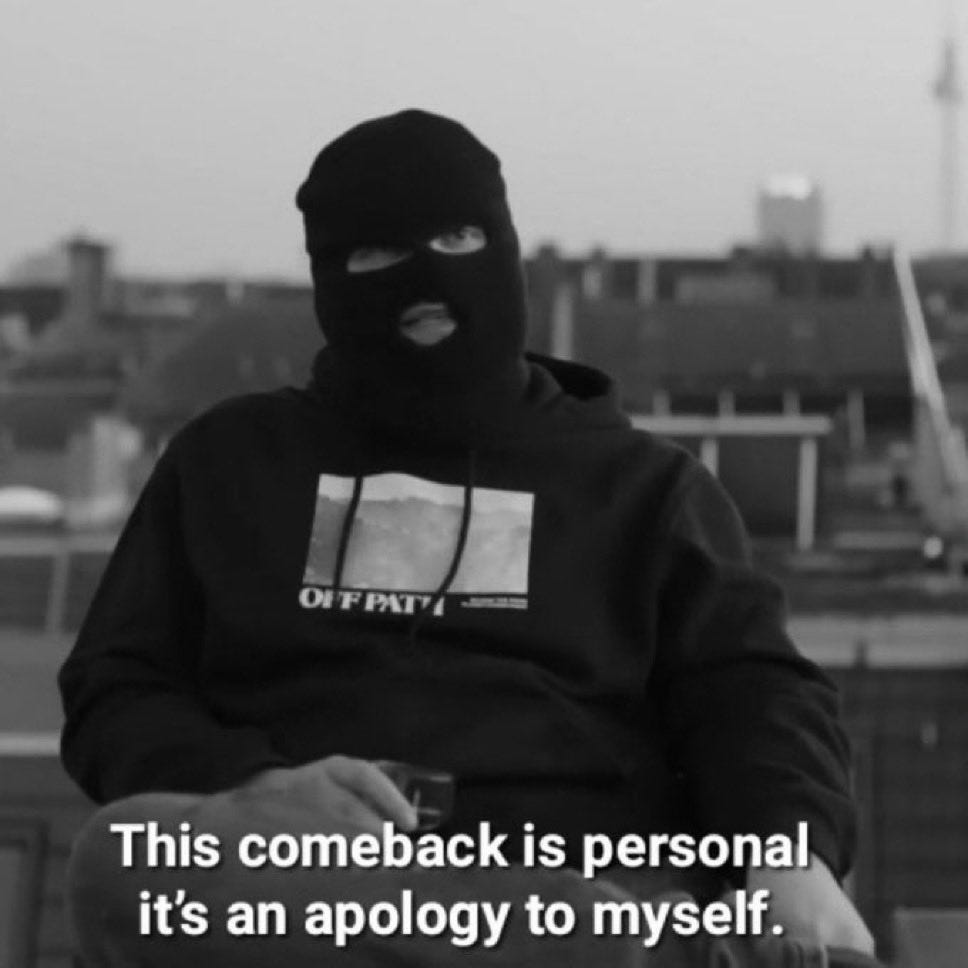
“I have led a toothless life, he thought. A toothless life. I have never bitten into anything. I was waiting. I was reserving myself for later on—and I have just noticed that my teeth have gone.” - Jean Paul Sartre
You’ve been living the same six months over and over again for years.
You want to change your life in some meaningful way — starting a business, making a career pivot, getting in shape, putting yourself out there, taking more time to adventure, hell, just trying to be happy and enjoy your life.
You keep thinking one day, you are going to make this big comeback and finally make up for lost time.
The thought crosses your mind on New Year’s, your birthday, the winter arc, or one of those random days where you ponder the totality of your inaction and decide now is the time to lock in.
You get motivated, and you start doing the work for a week, a couple of weeks, or maybe a few months.
But then you revert back to baseline because part of you just doesn’t feel ready.
There’s always a plausible reason why, isn’t there?
It’s busy season at work or school, you’re waiting for your last kid to graduate and go to college, it’s summer and you’re traveling too much, it’s fall and now work and school are back in full swing, whatever it may be, there’s always a justifiable reason to keep waiting to take that bite.
You wonder if it’s even possible to change at all.
Some people go into full resignation mode where they throw in the towel and accept their life as is, which at least comes with some measure of peace — if ‘desire is the root of all suffering,’ eliminating it is an option.
But we humans, especially in the West, have a hard time being Zen, so we live in mental limbo — that constant tension between where we are and where we know we could be.
It creates a 'refrigerator hum of anxiety that quietly runs in the background of your life — a worse kind of stress than the stress of change because it doesn’t seem to have a point to it.
How do you break the loop of living the same six months over and over and over again?
“We are not determined by our experiences, but are self-determined by the meaning we give to them; and when we take particular experiences as the basis for our future life, we are almost certain to be misguided to some degree.” - Alfred Adler
I think the difference between people who break the loop and those who stay in it forever is the way they see the past.
The person who can’t change believes that the past has predictive power.
The person who changes comes to the belief that the past doesn’t exist at all.
I don't know you. I don't know what you've been through. I can imagine that whatever has happened in the past probably carries a lot of weight. This is in no way an attempt to discount or delete what has happened to you, but to provide a way that might be able to change what it means to you.
One of the most fatal beliefs to your future is the idea that, because of what happened in the past, you are now a certain type of person.
The type of person who starts projects and never finishes them.
The type of person who doesn’t put themselves out there.
The type of person who’s not good at business and marketing.
But, let me ask you a question: at what specific point did you become this type of person?
You can’t answer that question because there was no specific point when this happened.
Who you are in any given moment is a choice. It’s not a choice that’s always operating at the conscious level. But it’s a choice nonetheless.
I’ve always felt this way, but the idea crystallized for me when I read two books — The Courage to Be Disliked and The Courage to Be Happy, both of which are based on the philosophy of Dr. Alfred Adler.
He was president of the Vienna Psychoanalytic Society before he broke with Freud in 1911, walked out with a handful of colleagues, and spent the rest of his life building a rival school.
The break was philosophical. Freud looked backward — you are what happened to you, pushed by drives you can’t see. Jung looked inward and downward, into archetypes and the collective unconscious.
Adler looked forward. He claimed that human beings aren’t pushed by their history — they’re pulled by a goal, usually one they’ve never admitted to themselves.
It was his belief, and now mine, that the past doesn’t actually exist in some concrete and objective way.
That, instead, we re-write our past in an attempt to justify the way we feel about ourselves in the present moment.
You’re choosing to be the way you are because you are trying to accomplish a goal in the present and you’re creating a state of being to accomplish it.
Your goal is not to talk to anyone, so you manufacture a state of social anxiety to accomplish it.
Your goal is to not grow your business, so you procrastinate your marketing.
Your goal is to stay stuck at the job you don’t love, so you decide the market is bad right now.
Your goal is to stay stuck in the same situation, so you self-sabotage when making attempts to change your life.
Why would you have goals that seem antithetical to what you say you want?
Most of your present goals are designed to keep you the same because there’s a reward, or a payoff, for staying the same.
The person who has social anxiety has the goal of not talking to people because that way they never have to face rejection.
The person who says the market is bad has the goal of not applying, because that way they never have to find out what they’re actually worth in a competitive market.
The person who sabotages their business does it because it keeps them from having to feel the weight of being responsible for clients.
I’ve said this for a decade. The key to changing is understanding that you don’t want to change at all. We crave familiarity, even if it hurts us.
When you find yourself in some self-sabotaging pattern, stop thinking it’s some curse you’re trying to get rid of and start consciously wondering what you’re getting out of it.
Do this often enough, and you can make a decision to change your goals.
Two things that may sound absurd, you might completely disagree with, but I also happen to believe.
You are under no obligation to be who you were yesterday, a month ago, the past 10 years, what seems like the totality of your life, or even who you were 5 minutes ago
At any given moment, you can decide to be happy. You can make a conscious decision to re-write your entire life story in an instant.
Trust me. I believe those two things, but not wholeheartedly, all the time, or in some unbroken chain of momentum. Nowhere near close.
Happiness is both a choice you can make in a single instant and a skill you’ll have to work at for the rest of your life, but it starts with the belief.
You can decide your goal is to talk to people, put yourself out there, and meet new people, which means you accept that rejection is simply part of the process.
You can decide your goal is to publish your work, so you accept that some people might not like it.
You can decide your goal is to build your business, so you accept that obstacles and uncertainty will come with it.
When you take a look at these goals, what do you notice?
The goals are not based on outcomes you can’t control. They’re based on actions you can control.
Your goal isn’t to get people to like you, but to talk to them.
Your goal isn’t to get views or likes, but to write.
Your goal isn’t to get every client to say yes, but to build your product, sell it as best you can to the right people, and try your hardest to get your clients great results.
As soon as you start measuring success by the input of setting an intention and trying your best, regardless of the scoreboard, you start living a version of your life that not only feels better in the moment, but almost always produces the outcome in the end.
But how can you actually decide this after what seems like an endless number of times when you made promises to yourself and broke them?
Well, if the old version of you always makes the same choices and repeats the same patterns, then it’s time for the old version of you to die.
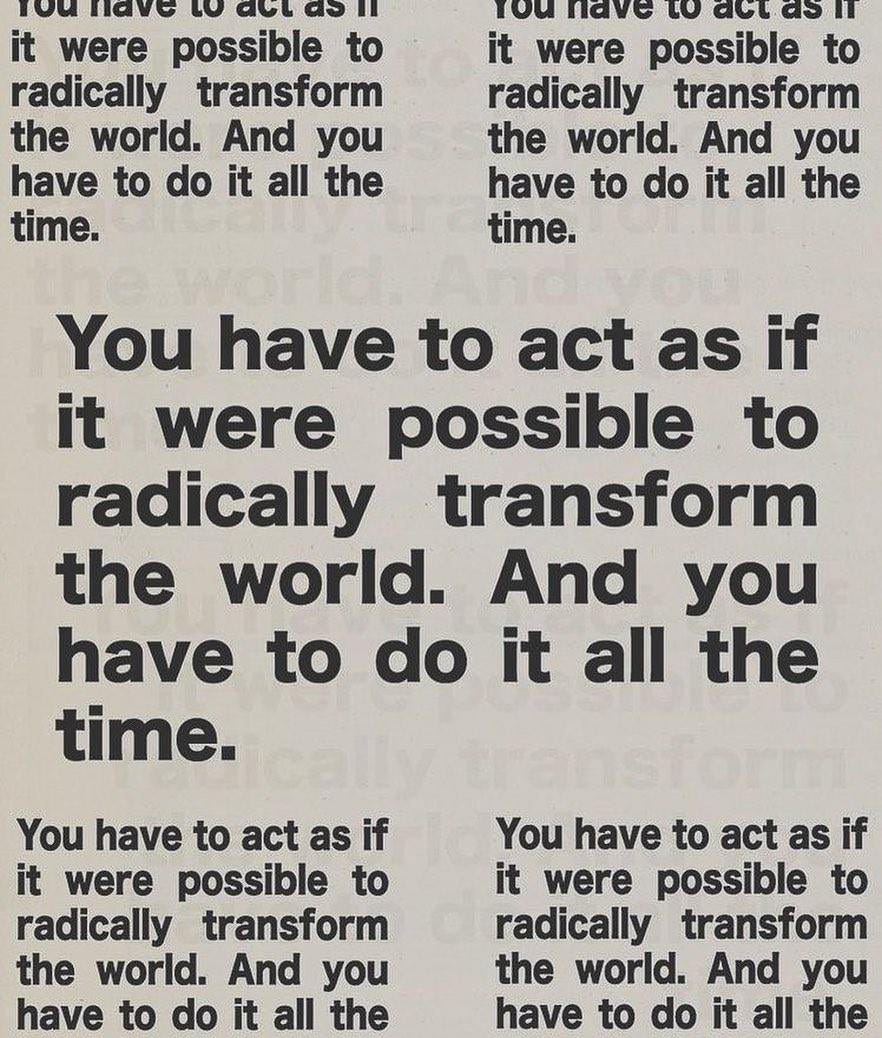
Before you think I'm being dramatic — the word decide comes from the Latin dēcīdere, from de- ("off") and caedere ("to cut"). The same caedere gives us the -cide in homicide and suicide. To decide is to cut something off and let it die.
This means that this is the intentional act of not just choosing who you want to be, but choosing what parts of yourself you’re willing to let go of.
Look at all of the goals above, to have the goal of talking to people, you need to let go of the need to be liked.
To put your writing out there, you need to let go of perfectionism.
To build your business, you need to let go of the need for it to work.
To live the new life you want, you must sacrifice the one you have.
What are you clinging to? And how can you let go of it?
This is where the idea of awareness, embodiment, and release all come into play.
Dr. David Hawkins wrote a book called Letting Go, where he talks about the process of releasing negative emotions.
Often, what you think you are experiencing as emotions is actually you trying to suppress your emotions.
You’re not angry. You’re trying not to be angry, and you’re exerting all of this energy into suppressing your anger, when simply being angry would release the emotion.
That’s what his entire methodology is about. To release an emotion, actually feel and experience it without trying to do anything about it. Do this long enough, and it will dissipate.
You can’t let go of anything you never actually make yourself aware of, allow yourself to feel, and actually bathe in instead of trying to suppress it.
If this emotional technique can be used in moments, why can’t it be used for your past as a whole?
I think what happens is, we don’t ever want to admit we feel like fucked up, that we feel like we wasted years of our lives, that we continually made and broke promises to ourselves.
That’s where that attempt to justify ourselves comes in, we begin weaving this story about the past that helps us to feel OK in the moment because we don’t want to face the past in a way that allows those feelings to bubble up to the surface.
Well, what if you just felt bad for once?
What if, instead of trying to rationalize your way out of everything, you just sat with it?
What if you need to embrace the weight of the totality of your inaction so you can finally let go of it?
What if you can let your old self not just die, but actually grieve for that person?
To grieve means to feel or show deep sadness, often because someone has died or because of a big loss. It is a natural human response to pain, change, or sorrow.
Grieving is a natural human response to not just pain and sorrow, but change.
It’s a response to a big loss. Maybe instead of trying to downplay how big of a loss it is to change your life, you honor it.
Think about it this way.
If the prospect of changing our lives seems so terrifying that we will spend years and decades in states of mental limbo instead of just doing the thing, perhaps viewing change as letting the old self die is a proportional response.
If you’ve spent years or even decades of your life constructing a mental architecture that has kept you safe psychologically, perhaps letting go and grieving its loss is a proportional response.
It’s a lot.
It’s like climbing up two-thirds of a mountain only to find that the way to reaching the summit means you have to go back down to the bottom to take a different route.
I remember one time I was on Zoom with one of my clients. She’s a psychotherapist who lived with monks in Tibet for six years and studied under the Dalai Lama.
She told me the reason why people find it so hard to change is that, to let go of the old self, to let it die, you have to let go of some of the good, too.
Some of the same exact qualities that got you here will be the same things that will prevent you from getting there.
The same aspect that helped you build pieces of your life you're proud of will have to be relinquished, and it won’t feel good. There’s a real loss there. Maybe it’s better to honor it than attempt to downplay it.
As much as you’re excited to live this new lifestyle, letting go of the old one involves pain. Maybe accepting this less than rosy picture of what it takes to change might be the thing that finally helps you do it.
The rebirth starts with taking the time to articulate what you want because it primes your mind to spot opportunities that will help ‘manifest’ your desires. Manifestation isn’t magic. It’s just selective attention at work.
Your brain discards most of what reaches it before you ever have a say in the matter.
In 1999, two Harvard psychologists — Daniel Simons and Christopher Chabris — filmed two teams in different colored shirts passing a basketball. Observers were asked to count the passes. [https://journals.sagepub.com/doi/10.1068/p281059]
During the video, a man in a gorilla suit walked through the court beating his chest.
When several participants were asked if they saw the gorilla, about half of them didn't see it didn’t see it because their attention was tuned into the players passing the ball.
So if the mind works like this, where what you attend to isn't just amplified but constitutes the field — and everything outside it may as well not exist — then changing what you pay attention to matters.
I remember when I started to take writing seriously. All of a sudden, these seemingly serendipitous moments started happening.
One day, when I was on Facebook, I saw an acquaintance of mine post that she went viral on Thought Catalog. I applied to write there, an editor took me under his wing and mentored me, and it was a massive springboard for my career.
Fast forward a year, and one day I saw this woman post about how her article went viral on a website called Medium. I started writing over there, and that website became the reason I was able to quit my job and become a six-figure writer.
Chance events? Manifestation? Or selective attention priming my mind to spot opportunities because I was focused on what I desired. I think genuine desire was also key.
I really wanted to be a writer. It was always a dream lingering in the back of my mind. It felt like I bent the universe to my will. What actually happened is that desire tuned my attention until I couldn't stop seeing doors.
Have you ever sat down for an extended period of time with your full attention to design your desired life?
What if, instead of imagining your desired future every once in a while, you took deep and serious time into articulating exactly what you want so that you can train your attention to focus on it?
Vision boarding and mapping out your desires is like the bell curve meme. On the left-hand side there’s the dumb guy who says you can manifest your dreams, and on the right-hand side there’s the Jedi saying you can manifest your dreams.
I don’t look at manifestation as you generating reality per se, it’s more like you tapped into what God already had in store for you and finally paid attention to all the signs He’s been giving you your entire life.
There are certain places He speaks to you.
Your tastes and interests: Your tastes and interests are not random. They are assigned to you at birth. I can’t explain why I was drawn to writing. It’s not something I consciously chose to be interested in. I was equipped with a desire to express myself with words.
Your gifts and abilities: There are certain things you’re just naturally good at. Stuff that feels like play to you and seems like work to others. These gifts were given to you. I believe everybody has one, but I think we spend too much time focusing on what we lack (negatively tuned attention) that we don’t see what has been given to us in abundance.
Your conscience: Your sense of what you ought to do and ought not do. The gut feeling that pulls you in a certain direction regardless of whether or not you actually listen to it. That sense of whether or not you should be on the path you’re currently pursuing.
What a lot of people experience as stress and burnout is coming from misalignment.
You’re ignoring your assigned path, of course you’re going to be stressed and anxious.
This is why maybe sometimes in the past you have tried to paint a vision for your future, and it didn’t work, or it did work, and when you got it you felt confined to it like a prison.
You based your goals on the things you think you should want, not the things you actually desired.
So throw the words ‘should,’ ‘realistic,’ and ‘pragmatic,’ out of your vocabulary. Don’t judge it based on whether other people will like it or think it’s cool.
“Following your genuine intellectual curiosity is a better foundation for a career than following whatever is making money right now.” - Naval Ravikant
What do you like?
What do you think is cool?
What kind of business do you want to build?
What type of career do you want to have?
When I say you, I mean the voice inside you that’s pulling you in a certain direction, the one that the conscious you keeps trying to shove down because it’s not quite what conscious, logical, cautious, timid, reluctant you wants to hear.
Sit down and write the unfiltered version of your desired life and think about it in the finest detail with your full attention — do it on a level that’s 10X as earnest as the times you’ve tried in the past — and watch what happens.

“Spend at least an hour today giving your fullest gift, whatever that is for today, so that when you go to sleep at night you know you couldn’t have lived your day with more courage, creativity, and giving.” - David Deida
You can’t change the circumstances of your life all at once. You still have obligations. You can’t quit your job and become an artist overnight.
Don’t try. Instead, carve out space for the life you love, right now, in the margins of time you have available to you.
That’s how I got here — from working a job at a marketing agency that I enjoyed, but wasn’t my life’s calling, to making a living doing what I love. I spent each day giving my fullest gift in the form of writing before I had the perfect circumstances to do so.
Deida argues that there’s no such moment in time when things are going to quiet down, so do what you can with what you have right now.
For me? That was writing in the A.M. before work. It started with an hour, maybe two, per day in the morning.
As things started to pick up, I got traction, and then it came time to build a little business in the margins I had.
When I developed a coaching program to support the work, I would take calls when I had time, sometimes on lunch break or after hours. And yes, I worked on weekends.
But I was able to do that because of that one-hour pocket of time I devoted just to doing something I cared about. It created a positive feedback loop that inspired me to do more.
Whatever that is for you doesn’t have to be writing and starting a business, it could be an hour a day studying for that certification or degree to pivot careers, or refining your skills and interests, or volunteering, something that requires giving your gift.
Whatever this new version of you is trying to embody, you can devote an hour per day to stepping into that reality right now. Repeated long enough over time, and not only will your life change, but you will become someone else.
Fake it till you make it is the wrong name for what's actually happening.
There's nothing fake about a behavior you're unaccustomed to. It's just unfamiliar.
Say you’re normally meek and quiet. One day you decide to speak loudly and project your voice because that is the type of behavior a socially confident person might exhibit. You’re trying on a behavior for size.
Do this often enough and people respond differently, because tone and projection are what everyone reads as confidence in the first place
You notice their response, and it creates a reference experience, a little piece of proof to your brain that says when you project yourself in a certain way, people respond positively. The threat prediction stops getting confirmed, and eventually your body stops making it.
As you stack more and more of these reference experiences, your sense of self, your personality, the meaning you ascribe to the words “I am,” begin to change until one day you perceive yourself as much more socially confident than you were.
I’ve seen this happen in real life. I’ve been in Toastmasters clubs where I’ve seen people go from visibly shaking and terrified to talk to looking confident on stage through nothing more than repeating a new behavior in an environment that made them feel safe to do so, repeatedly, until the foundation of the way they saw themselves changed.
This isn’t fake. This is just a practiced behavior done repeatedly. That’s the same way you got to the place you’re trying to escape from, by the way.
You don't have to feel like it first.
You can feel the tension of perfectionism, but still hit publish.
You can be terrified, but still get on the Zoom call and pitch your offer.
You can do the things your ideal self would do in a given situation without yet thinking you are that person.
What if the fake version is the one you’ve been being this whole time?
The one who suppressed your desires in lieu of what society assigned you.
The one who felt like doing something scary but didn’t do it.
The one who was handed an opportunity to change and called it unrealistic.
Can’t think of anything more fake than pretending not to want what you really want just because you don’t think it’s realistic.
You’re not faking it until you make it. You're embodying who you already are.
I couldn’t have imagined what I’ve accomplished ten years ago, but it happened, not because of a grand proclamation, per se, but because of a series of micro-decisions to spend a little bit of time each day chipping away at becoming that person.
What’s wild? Over time, I’ve felt aspects of my personality change completely.
Not only would I not behave in a lot of the ways my past self would, but it also doesn’t even seem like the same person because…it isn’t.
Some comforting words I will leave you with.
Things can suddenly click one day after what seems like a lifetime inside of that loop.
It will one day hit you that you are under no obligation to be who you ever were.
I’ve worked with clients who started businesses in their 30’s, 40’s, 50’s, 60’s, heck, I remember one of my oldest students was in his eightys and he did accomplish his goal of being a known writer in the mindfulness space.
Never doom.
Never resign yourself to your fate.
Never shut the door to your dreams permanently.
I don’t care if you’ve missed 999 times before.
Send one ball out of the park, and it’ll erase the stains of past failures like they never even happened.
Your comeback tour starts now.
No posts
Comments
Nothing yet. Say the first thing.
Sign in to join the conversation.