
Before we start today, I just wanted to let you know that I have paused all Paid Subscriptions (thank you to those who have been faithfully supporting). I am not offering anything extra right now so it seems the right thing to do. I am happily working on a proposal with my agent for a book that I hope it going to be a huge help to you!! Okay, onto the newsletter…
“There’s a particular kind of tired that comes from always wondering if everyone you love is okay.” (Esther Joy Goetz)

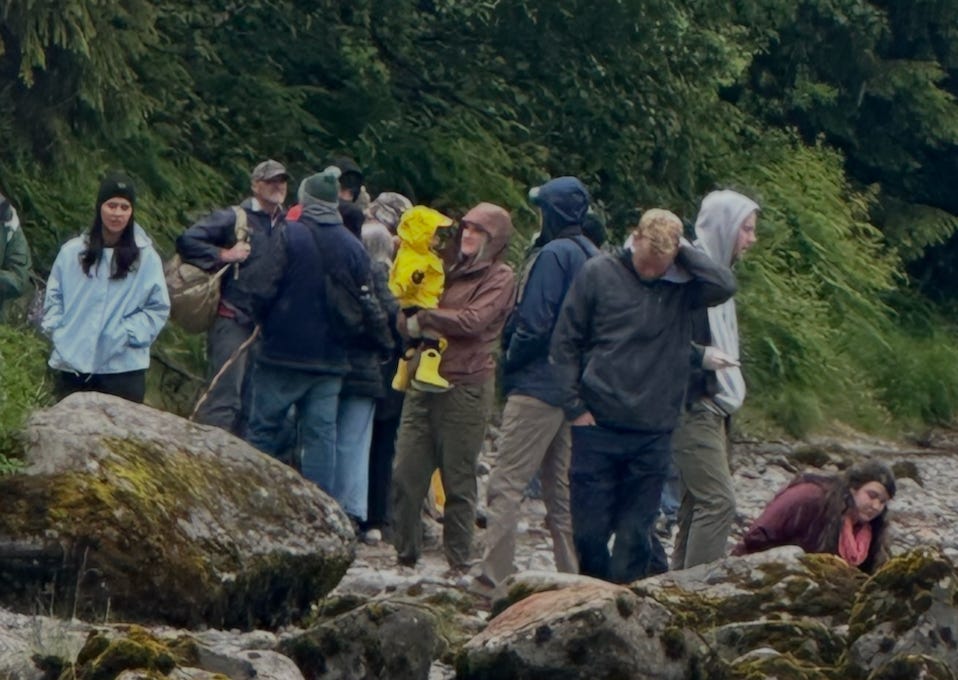
This summer, our whole family went on vacation together. All four of our grown kids and their people, my husband and me, under one roof (it was a giant boat roof, but still) for seven days.
These kinds of reunions feel increasingly precious to me. Because my kids are grown and live in four different areas of the country, getting everyone in the same place and the same time takes some doing - a lot of doing, if I’m honest. There are work schedules and plane tickets and all the ordinary complications of life. I had looked forward to it for months, mostly because I wanted the simplest thing: to have everybody together.
And they were. Everyone’s plane landed in time for us to get onto the boat. Phew. We ate together and hung out and saw icebergs and whales breaching (we were in Alaska) and talked and laughed and did all the things I had hoped we would do.
But somewhere in the middle of the week, I noticed that I was exhausted in a way that didn’t make sense. Sure, the time zone played a part, but that wasn’t it. And it wasn’t because we were doing too much, because we had lots of down time. It wasn’t even the normal tired that comes from being around people all day when you’re used to a quieter house.
I was tired from paying attention.
I was paying attention to who was quiet at breakfast and who seemed a little off. I noticed when someone disappeared for a while or when the energy between two people felt a little strained. I wondered if everybody was getting enough time or too much time together, if someone was feeling left out, if someone wanted to do something different but didn’t want to say so. I noticed a look across the room and wondered what it meant. I replayed a comment that had been made earlier and wondered if it had landed wrong.
Nobody had asked me to do any of this. There wasn’t even necessarily anything wrong. My big kids were simply being people together, each with their own moods and needs and relationships and ways of moving through the day.
But there I was, constantly taking the emotional temperature of the room.
I’ve been thinking about that ever since.
As moms, paying attention is part of the job. We know our kids so thoroughly that we can often tell what they need before they can tell us themselves. We know which one needs a little more encouragement walking into a new situation and which one needs us to “Back off, Mom.” We know when the shut bedroom door means, “Leave me alone,” and when it means, “Please come find me.” We know their faces. We know that particular kind of silence. Sometimes we can hear something in the way they say “fine” that tells us they are definitely NOT fine.
That kind of attentiveness or attunement is one of the ways we love them.
The trouble is, nobody really tells us what to do with that as our children get bigger.
Because we don’t stop knowing their faces. We don’t lose our ability to hear the slight change in a voice or sense when something feels off. In some ways, it becomes even more complicated because now we can notice that something is going on without always knowing whether we should step in.
That’s a strange place to find yourself as a mom (at least, it has been for me).
When our kids were little, if we sensed something was wrong, it usually belonged to us in some way. At the very least, we felt comfortable asking questions, investigating, stepping in and helping. But as they get older, those lines become way less clear.
Our 16 year old may still need us to step in sometimes, but also needs room to begin figuring things out for themselves. A baby adult may be sitting across the table from us and we know almost immediately that something has shifted, while also knowing that whatever is happening may not be ours to know about, much less ours to fix.
And I think that’s where the exhaustion can creep in.
Because I may understand intellectually that my big kids are increasingly responsible for their own emotional lives, but there is still some deeply practiced part of me that is standing at the thermostat, wondering if it’s too hot or people need a “blanket.”
If somebody seems uncomfortable, I want to make things more comfortable. If the conversation gets tense, I feel the urge to ease it. If one of my kids gets quiet, I wonder if I should check in. If there’s friction between siblings, I can feel myself wanting to smooth the edges, act as a buffer so no one leaves mad and holds a grudge and then doesn’t want to come home for Christmas (okay, I know my brain goes off to the races - does yours?). If someone doesn’t seem to be having a particularly good time, I start wondering what might make things better.
It’s not that I think my kids should be happy all the time. Of course I don’t. It’s that somewhere along the way, their emotional temperature became information my body learned to respond to.
Lonely? Let’s watch a movie. I’ll make popcorn.
Upset? Need to vent?
Sad? I got some Chunky Monkey for you. It’s in the freezer (puts “I love you” note with it).
And maybe that’s why this is harder than simply telling ourselves, “They’re getting older. Let them handle it.”
We know they’re getting older. That is NOT the problem.

The problem is that we spent years learning to pay attention, and we got very, very good at it.
We learned that noticing mattered. Sometimes noticing kept our kids safe. Sometimes it helped us catch something they couldn’t yet put into words and we eased what was bothering them. Sometimes our ability to sense that something wasn’t right was exactly what they needed from us.
And then, gradually, the same instinct that made us a good mom can interfere with our ability to simply be with them, right where they are.
I think that’s what I bumped into on vacation.
I wanted so badly to enjoy having everyone together, but I was also quietly working to make sure everyone was enjoying being together. Those are not the same thing.
The first is presence. The second is management, and management is exhausting.
There is something else underneath it for me, too, and I’m hazarding a guess I’m not alone in this. As our kids get older and older (how dare they?), time with them begins to feel different.
Teenagers start choosing being with their friends more than staying in for family movie night. They close their bedroom doors. They drive themselves places (what is this nonsense?). They have whole conversations and relationships and parts of their lives we know less about and sometimes nothing about.
Then they leave for college or work or move across the country, and getting everyone together becomes something that has to be planned instead of something that simply happens at the end of every day. I felt the loosening long before anyone actually left.
And because of that, when we do have them with us, we want it to be good, five stars. We want them to enjoy us. We want home and family to continue to be something they want to keep coming back to, whether they’re pulling in the driveway after a Friday night with friends, a semester at that college that’s just a little too far away for our liking, or a life being built somewhere else.
There’s nothing wrong with wanting that. But if I’m not careful, that desire can quietly turn into a sense of responsibility. If everyone has a good time, maybe they’ll want to do this again. If nobody gets hurt or irritated or disappointed, maybe they’ll keep wanting to be here. If I can just keep the emotional temperature comfortable enough, maybe I can preserve and protect this family I love so much.
And there it is.

The thermostat isn’t really about the temperature. It’s about what I fear the temperature might mean.
A quiet kid can become, Something is wrong.
A closed bedroom door can become, They’re pulling away from me.
A tense conversation can become, They aren’t getting along.
Someone wanting more space can become, They don’t want to be with us.
A bad day can become, Something is changing between us.
And suddenly I’m not responding to what is actually happening. I’m responding to the very unhelpful and perhaps completely wrong story I’ve attached to it.
I think this is one of the invitations of momming big kids that I’m still learning to accept.
I can notice without assuming responsibility for it all.
I can know my kid’s faces and not pester them to share what they aren’t ready to.
I can sense tension without always moving in to fix it.
I can let my introverts be quiet without rushing in to fill the silence.
I can allow brothers and sisters to have a relationship that belongs to them, including the parts that make my mind go off to the races.
I can even let one of my children be unhappy with me without immediately trying to get us back to okay.
I can be like the Little Engine that Could heading up the mountain, “I think I can. I think I can.”
Of course, this looks different with a fifteen-year-old than it does with a twenty-five-year-old. Our teens still need our parenting, our boundaries, our guidance and sometimes our intervention. But even then, I think we’re beginning the slow work of figuring out the difference between what truly needs us to step in and what simply makes us uncomfortable to watch.
Maybe that’s the shift, maybe we’re onto something: we don’t have to be less attentive, but we can be less responsible for every little thing our attentiveness picks up.
Because I don’t actually want my big kids to feel as though they need to be okay in order for me to be okay. I don’t want them walking into a room and realizing Mom has already noticed their mood and is now adjusting herself around it. I don’t want them carrying the additional burden of reassuring me when they’re already carrying something of their own.
I want to be steadier than that.
I want them to know they can come to me when something is wrong, but that they don’t always owe me an explanation simply because I’ve noticed it. I want to care deeply about what they’re carrying without assuming I should carry it too. And this is the hardest part for me: I want to increasingly trust them to navigate disappointment and conflict and awkwardness and bad moods and complicated relationships without me standing in the middle of all of it adjusting the temperature.
And I want something for myself, too.
I want to be IN the room. Not above it, monitoring it. Not three steps ahead of it, anticipating what might happen next. Not studying everybody’s faces for evidence that we’re all still okay. Actually IN it.

Because that week on vacation, the thing I had wanted for months was happening right in front of me. My kids were together. They were talking and laughing and occasionally getting irritated and needing space and changing plans and being tired and being themselves. In other words, they were being a family. We were being a family.
Maybe I had been confusing a peaceful family with a family in which everyone was happy at the same time.
I’m not sure that family exists.
What I do think can exist is a family with enough room for everyone to have their own experience. One person can be in a crappy mood without all of us having to do something about it. Someone can be uncomfortable and we don’t have to treat it like an emergency. My kids can work out their own relationships with each other, even when I don’t particularly love watching the process (this one scares me, to be honest).
I will probably always notice. I don’t think years of being a mom disappear because our kids get bigger. In fact, I don’t want them to. That deep knowing of our kids is part of the beauty of having loved them for so long. Sigh.
But I am learning that noticing the temperature and being responsible for changing it are not the same thing.
And I’m going to have plenty of opportunities to practice, one coming right up. In six weeks, my son is getting married which means all of us being together for several days again. And if I know anything about weddings, they have a way of stirring all the things. Someone will be tired or overtired. Someone will get overwhelmed. Somebody may need space. There will probably be conversations happening that I know nothing about, which, if you know me, is already asking a lot. 😂
And maybe I can let all of that be true without deciding I need to do something about it.
I’ll let you know how it goes.
From my noticing mama heart to yours,
Esther
Mom Coach and Author
💬 Mom-to-Mom Reflection:
Are you the emotional temperature taker and regulator? How does it play out for you? I’d love to hear all about it. Or anything else you want to share, because I love comments!!


I’m now offering Mom-to-Mom Coaching (and it’s not crazy expensive like so many coaching spaces) — a simple, honest, judgment-free space to talk about big kids, changing roles, boundaries, worry, pride, grief, and everything in between.
If you’ve been thinking, “I wish I had someone to talk this through with,” this is for you.
FIND OUT ALL THE DETAILS HERE!
👉 Book a FREE 15-minute consult to see if it’s a good fit. No pressure, no commitment — just a real conversation.
💌 If this made you feel seen, share it with another mom who might be struggling and she isn’t quite sure what to do about it.
No posts
Comments
Nothing yet. Say the first thing.
Sign in to join the conversation.