
Here’s a question you shouldn’t try to answer, so completely ignore it:
What do you think defines your life?
Standing bare breasted in front of the open fridge?
Really, don’t think about it, that question.
The reality, where your desires and likes meet what’s happened to you or not happened to you. Or might.
It’s a stoopid demand for a narrative arc, like your life needs a movie poster. It doesn’t; you’d never live up to the Photoshopping.
Even movie posters these days are… meh. I get why Supergirl is so very cool in hers this week, covering up her silly bright superpower costume colours with a rainy trench coat and a disinterested look to one side – cool. Like, disinterested with big disillusioned vibes, right? Relatable. But I’m assuming she whoops ass and flies at some point otherwise… y’know. Why?
We all dreaming of being cool this week. And ain’t nobody wearing a trench coat, amirite?
From deep within the heat dome on Wednesday in London, Kiren Dhadwal said something that I hope seeps into you with some relief about the whole movie tagline/life definition thing – as much else continues to leak out of you in the temperatures:
A lot of storytellers readily talk about The Hero’s Journey but people from the global majority, especially indigenous groups, know there is no such thing as ultimate completion – life is cyclical.
Huh. Changes your place in history completely that, doesn’t it?
Hero is singular. But when we think of the cycles of life on Earth, it’s hard to picture anything moving through the cosmos alone.
She was speaking at an event that was part of London Climate Action Week on the hottest day of the year in the UK so far. So hot, one speaker explained that her shoes had melted on the pavement during the walk in, even first thing, and this explained the Gaffer tape round her ankles. I’d had to drive into the capital for the first time in six or seven years to attend this because trains across the country were melting to the rails or evaporating. Public transport passengers had been advised nationally to only travel if absolutely necessary, so severe would be the weather. The irony that public transport is one of the first things to pack up because of climate change won’t be lost on delighted billionaire fossils, I’m sure.
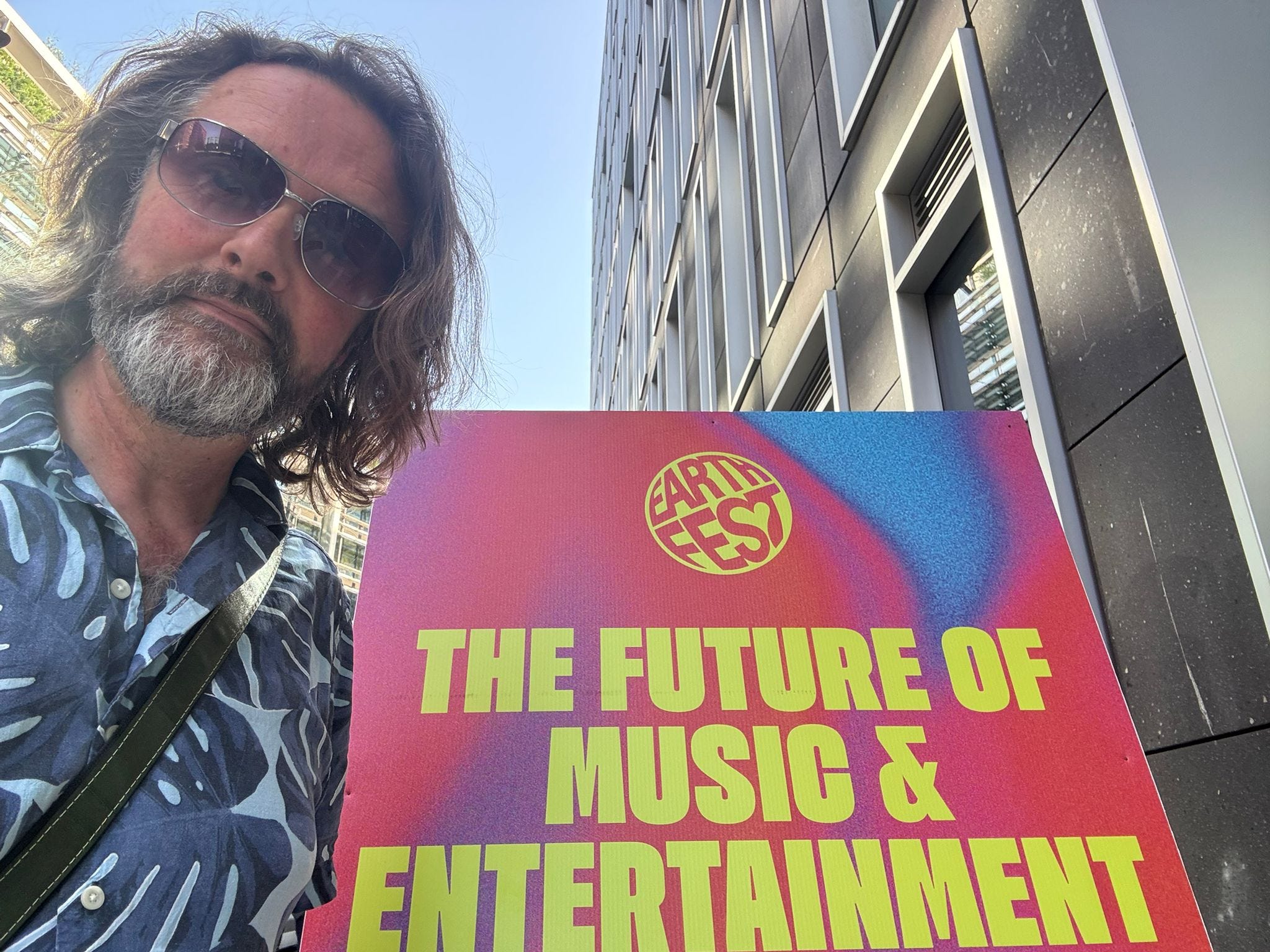
Kiren, a TV and film development consultant working with the brilliant Climate Spring, and Will Attenborough, co-founder of Green Rider, were co-hosting a panel at Earthfest’s The Future of Music & Entertainment day, at Sony’s UK headquarters in Kings Cross.
You know I think all this is cultural. Our pretty polypickle – it’s all outputs of a crisis of culture that can’t see futures that aren’t on fire. All thanks to a lot of money and practice being pumped into things that combust. You know that thing I am always saying:
We need the new songs and stories of us.
These guys were talking about it. About worlding with writers, to create scenarios for characters that don’t only show hellscape futures but still manage to connect us to emotional truth. That’s not easy, but good writing never is. So I think we need to be practicing it way the hell more. The session even threw up a word that made me chew my knuckle with regret at not having come up with it – throughtopias. Bastard genius for the era of transition – what does a city, a country, a world daring to shift its worldview look like?
It was a subtle theme across sessions in Sony’s pleasantly air-conditioned lecture theatre which also covered gaming and live events production as well as, yes, music.
Ruth Dancer, founder of cultural sustainability initiatives White Griffin and Hope Solutions, hosted the day inclusively. She made it feel more like an active community than I was expecting from an event about music at which I was almost the only person attending as a music artist. I so often am, for some reason. As Tony Wilson said doing his 09:30 keynote at one I attended twenty years ago: “What the hell are you doing here?!” when he asked if there were any musicians at the vaguely strategic event and mine had been the sole hand raised at 09:31.
“I wish people could hear how much work is going on, what a mature group of changemakers this is” Ruth said.
I was for damn-certain not the only creative there. But this was a room of people also committed to tackling practical and systemic problems with the planet being on fire. Which Glastonbury surely would have been this weekend, if it weren’t a fallow year.
Ross Patel is part of the senior team at Live Green, and gave away how experienced sustainably-minded producers now are out in the festival fields, figuring out more Earth-friendly ways of delivering events.
“Moving best practice into contracts changed the live production landscape” they said. “Our festivals also act as labs, test beds and showgrounds…”
That’s knowing. That’s not music artist cool, it’s getting shit done cool.
But the end result of all this work certainly is emotional. All the advocacy, policy development, lobbying, researching when people just want to be at gigs, develop awesome shows, realise joyful shared experiences. With the climate we all grew up in part of becoming irreversibly more hostile to us, it takes work like this to get the live stages to stand up in extreme weathers. And most people can’t see it. How much is being done, understood, pressured into changing.
When Icelandic singer Valdis performed at the end of the day, just one song, representing the inspiring Earthsonic collective, it suddenly got to me.
The artists on that project alone, creating work crying out to “protect those who cause the least harm and suffer the most from its consequences” or the increasing numbers of musicians connecting with Earthpercent, wanting to make our planet a royalties recipient from their work… more musical creatives are finding their voices in the darkness. The blackout of the culture wars against living communities.
Speaking with Karen Edwards from Murmur, it’s clear that more of them want support to develop their outward confidence to do so. Fostering “arts leadership for the crisis of our times”, like a great therapist, she is, I think, loved for connecting with artists in this way. Helping them not feel alone. Find the creative confidence for change I talk to corporate leaders about. We all need it.
Where are the spaces incubating futures? Networks and projects forming communities who get it and are responding already in some way, learning, building and testing. They’re all over the place around the world, kept out of the centre of most of our attentions.
And a big reason why music labels, even big ones like Sony, are paying attention is because music artists come with communities and build platforms to grow them. The fans.
Any experienced artist knows that it doesn’t matter the medium, you have to meet the audience where they are with authenticity. The story has to be truthful, especially if hoping to sow seeds of thought – and that kind of storytelling is especially tricky. If you want to do more than testify but communicate a bigger message with your creativity, the spectre of Christian Rock looms large – preaching is the cardinal sin of storytelling anywhere. We can all smell when something feels smuggled in, disingenuous, as it is the opposite of the honest vulnerability of truth bearing. Even master storyteller Steven Spielberg may have fumbled the ball on that one with Disclosure Day.
The community of changemakers at this event seem convinced that there IS appetite for more meaning but it can’t be performative. So many people among fans do care, especially creative makers. So the uncomfortable question for people trying to deconstruct top-down dictats in our societies is: how do we influence this well? Cos… don’t we kinda have to?
Right-wing foghorns and content farms alike may be unsqueamish about manipulating people but, as far as large numbers of us are concerned, the lefty-doogooders have squeams and do it anyway, try to manipulate. As soon as any of us go at those public foghorns with facts, we’ve lost – because facty truth is the language of the high aboves, of knowishness, not the down in the shared shit of understanding.
Facts will out. Foghorns get silenced, eventually. But the human cost gets higher and higher, the longer we don’t know how to culturally unstrand those assets of frightening data sets facing us all, undoing our infrastructure, our food supplies, our communities our mental health.
How do we find a cut-through creative response?
“We have to allow people to be imperfect” said Kiren Dhadwal. It’s not simply writing alive-seeming characters that demands this, it has to be our attitude to each other.
We are all overly sensitive to bullshit at this point, aren’t we? Vulnerability ain’t that.
Hyekyeong Kim, from Kpop4planet, then said something learned deeply in the very particular fan clans of South Korean pop, and it rang like a bell through me.
“Learning the language is not enough, it’s solidarity.”
DO we really mean it? All this love talk?
Standing in the dark middle of the ring of fire, backlighting the world, are millions of us. Gaslit to ignore what’s happening. But our nervous systems are picking up plenty, our senses bombarded and weary. And music can reconnect us to life itself.
What does solidarity look like?
What does solidarity sound like?
Music cuts through. It transcends. It can be very manipulative, done well, but when it communicates something authentic, some spirit of a moment an artist has channelled and crafted well enough to land, it unites. At least for a moment.
What of this moment?
“Climate grief is real but when you’re working with the music and artists you love, there is little room for depression” she went on. “Joy sustains our community.”
Joy. It sustains our community. It has to. It seems like the most natural overspill of creation energy itself to me.
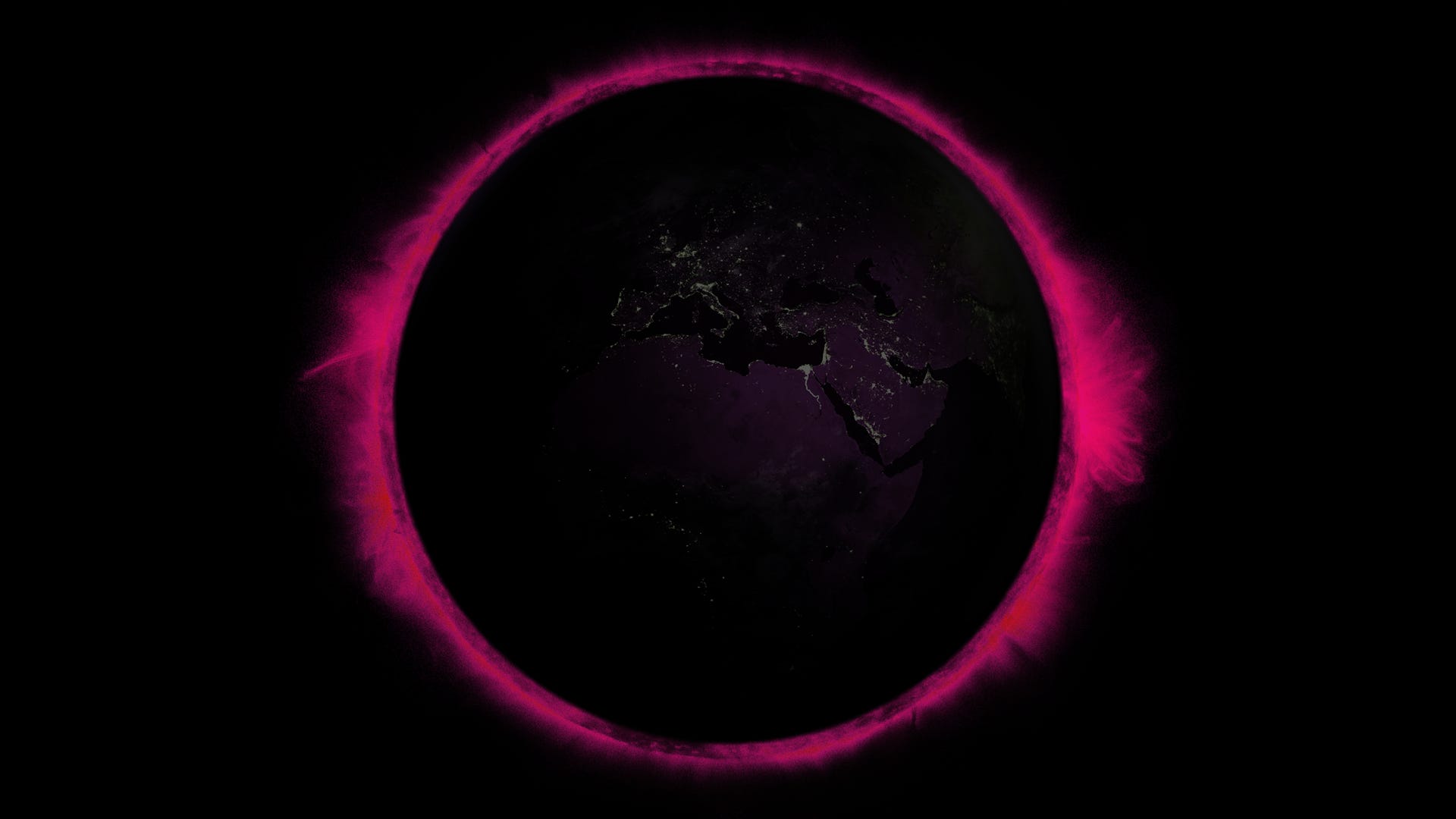
This moment on Earth may not be the apocalypse. It may be a cultural eclipse – and if the planets have aligned, maybe we will begin to hear each other’s voices in this dark moment, because the light has dimmed so much we are having to rest our eyes. Feel something else vibrating into us.
The thing that will undoubtedly define our lives – us lot, Generation Now – is how we respond to the breakdown of our climate. A global catastrophe of inequality, violence against female, queer and all natural life systems and connections of all kinds and a deliberate hollowing out of hope. An entirely cultural security threat.
Global leaders could change the story at a stroke if they stepped up to their podia and said: “It is time to build a new world, it is time to form a new relationship with our futures, with our living planet, with our family, with ourselves. With the riches of life at our disposal. For we are one.”
This work is deeply systemic, consistent, nerdy. But artists are already understanding it, on top of what they know more instinctively – embodying creativity changes your world, how you feel, what you think is possible. And big, long-term justice engineering doesn’t get seen or funded without cultural energy.
Where does that start?
You know what I want to tell you.
Take the hand of the person next to you, picture the future you want, and start to sing.
You are not alone. x
What will define us as Generation Now will be how we respond to the climate crisis, but the weather impacts were sixth or seventh on the BBC news yesterday morning on very conservative Radio 3, and segued into the actual weather forecast which was described as “warm and sunny”. Ahead of it were various international things all to do with white global leaders or natural disasters in brown countries. Our politicians were mentioned only in relation to the possible new Chancellor. No one from our political leadership was at any time quoted as saying: “Large parts of our national transport infrastructure are fucked this week because the harmful effects of our fuel needs have changed the fucking weather.” It would be encouraging to hear the country’s likely new Prime Minister say this on GBNews.
Reports said thousands of schools shut early or completely, hospital operations were cancelled. Warm and sunny. The tyre of our wheelbarrow suddenly exploded on Tuesday outside the studio, like a blunderbuss going off in the heat. Warm and sunny. For freak’s sake, we’ve had an image of a fire truck ON FIRE in our local news. Warm and sunny.
I began writing a Carbon Literacy course for creatives a couple of years ago, partly so I could spend most of the course telling people this crisis is not about carbon. I won’t go into a true traumagasm of facts here, nor kill your libido completely by saying phrases like Net Zero, but I do think we need to grab some basics of what is happening around us, made more obvious in a particular way this week.
Wet Bulb Load temperature. There’s a phrase to confuse your libido, but its one of the major reasons why this is not 1976 all over again. That year, which I just remember, was dry – drought conditions. Our weather this week is very humid. This hinders our bodies’ ability to sweat safely and so regulate their temperature safely. We’re also we’re having these far too sexy sounding tropical nights, which the UK defines as temperature not dropping below 20° overnight, so we can’t recover properly from overheating in the day.
The hot air is staying stuck in the moment of high pressure, so it sort of builds up. Over 1,000 schools were closed early or completely on Wednesday and hundreds of trains were cancelled and seriously delayed. We’re not equipped to deal with this because our infrastructure is designed for a climate that no longer exists in the UK. Heating and cooling – insulation and air conditioning, we could invest in these and make like much safer when the wobbling weather norms hit different peaks of extreme. Which are becoming the norms.
France and other parts of Europe has been melting in 40° heat all this time too. This is not normal by even 20th century experiences growing up, because the recorded heatwaves and floods are growing in frequency and severity. It is a bloody obvious trend on a graph. On so many graphs, in fact. Things are changing in the climate of the planet.
The evidence for human-caused climate change from the cumulative effects of fossil fuel emissions and agriculture in particular seems like a fucking tsunami of observation and collated data over generations at this point, when you dig into it. It is not the language of most of us, but in an age demanding we rediscover empathy, science still has its own duty of care to show us what facts it can confirm about our circumstances. Anyone of us not concerned with risk assessment clearly hasn’t had many leadership responsibilities – scenario planning is the work of sober grown-ups who want to protect the spaces we can play in. And scientists are increasinly traumatised by what they are seeing.
The cultural question to train ourselves to ask always at this point is: Who is telling you the stories you are hearing, and who profits from you acting on it?
Agendas abound. Practices make everything more cartoonish and self serving over time. And I’m with Captain Kirk and Mr Spock still on this – I don’t believe in the no-win scenario, and I think there are always possibilities. ”Life is not about ultimate conclusions, it’s about cycles.”
So I see this as a phenomenally sobering but exciting era to be here. Whatever I can or cannot hang on to, will have to let go of, can or cannot do in my very not very together beliefs and responses. We literally cannot afford shame.
I do think Andy Burnham could change the story at a stroke if he declared some version of a revolutionary war effort focussing on building a new climate-responding United Kingdom. Food, our diet, is a third of the climate emissions that lead to climate change. Destroying trees and natural habitat is a bloody disaster for planetary wellbeing. We have to make it easier to make all round better choices ourselves – but the real work is structural, massive, corporate.
Our personal work if we feel any of this is to lobby the living shitballs out of our public representatives where we can, but creatively play with and practice up the worlds we really want as much as we can. Be in creation energy, it will root you into yourself and something much biggeer than your fears.
A few weeks back I reluctantly went along to a small upstairs room in a town centre pub to watch an awkwardly intimate screening of the National Emergency Briefing on the Climate and Nature Crisis. Long time elder of the Association of Sustainability Practitioners, Gwyn Jones, had gone to the actual presentation, the full thing, live up in Westminster back in November and come out of it a bit traumatised. Him, after years of staring climate breakdown in the face and helping others find fortifying wise ways to live into it. I, however, came away with two oddly fortifying feelings.
One: The facts, voices, testimonies and potential solutions were so clear, I was reminded that this problem will indeed define us as a generation – and could redefine everything incredibly if we went for it.
Two: The finest leaders in climate politics still don’t see this as a cultural emergency.
The only security we ever have, in the end, is our relationships. It’s not defence tools and tactics, it’s understanding what’s driving your neighbour and connecting with them. You can blow things up for a bit, it’s reassuring to carry a big stick, but after any destruction has to come facing the thing you were putting off or wasn’t convenient for politics in the first place.
Safety is a state of mind practiced in community.
Our relationship with nature is appalling, we aren’t listening to her at all and our relationship with each other leaves so little room for imperfection, inconsistency or cycles of learning.
There are things that need urgent improvement, aren’t they? And who of us is qualified to intervene? As Susan Sontag suggested in a philosophical book from half a century ago, if we are holding a camera up to something without also helping, we are essentially giving whatever it is our approval. We are already involved – we are interventionary animals.
But as I found again on Wednesday, conversations about sustainable approaches to life quickly become the opposite of all that shame. They become exciting, because they so immediately pull in interconnected possibilities. It’s a mindset that flips a sense of isolation into a sense of community purpose and belonging.
For our interest, and hands up, I’ve not read this yet, the report by Thomas Pickety has been out for a little while and builds evidence for why to take a much bigger economic interventionary swing in a healthy direction.
Now, this may or may not be easy for me to type in a cool corner of my own home that the story driving the planet’s degradation is a world founded on violence and theft. And so inevitably the psychology that grows out of such practices – nihilism, self destruction, disconnection. But whatever my own ignorances, sillinesses, privileges, ineffectivenesses and daily hypocrisies, I also know my own instincts and what I’ve learned by doing and where these things intersect. I know perhaps above everything that we need each other in various ways, and I know that in the long slog of system change work, art and its practices keep lifting me back up, getting me re-excited. Even after all these years of no impact at scale with it personally. Even as little more than an observer. It’s impacted me and my attitude every day I’ve been alive.
The new songs and stories of us will surely be about… us. Not you alone. Not me alone. But how we help each other find who we are in a whole new world. One we must write, practice, perform and test ourselves.
So I should share at the foot of this footnote that in my private composing, recording, writing and filming, trying to finish a particular unified work after ten years this summer, with trusted clever friends and a certain personal mindset, it feels to me now that I can’t get to the work of turning what I have learned to any obvious encouragement of others properly until I have finished building the bridge to reach whomever I can – and no bridge stands up without a keystone. I suspect this work, which I am about to start sharing, will be that .
I can’t wait to let you into what I have been cooking up in the heat. Thank you for considering all this with me.
Comments
Nothing yet. Say the first thing.
Sign in to join the conversation.