
I hate being on Instagram, so I am very sorry to admit that without it, I might never have learned of one of my favorite books of 2026. The algorithm knows that I like horses, so it makes sure I see plenty of them, and one day this spring it presented me with a photo of a woman standing in a field between two furry black-and-white horses. When I clicked through to her profile, because of course I did, I learned that her name was Emily Haworth-Booth, and that she was the author of a then-soon-to-be-released novel called Mare.
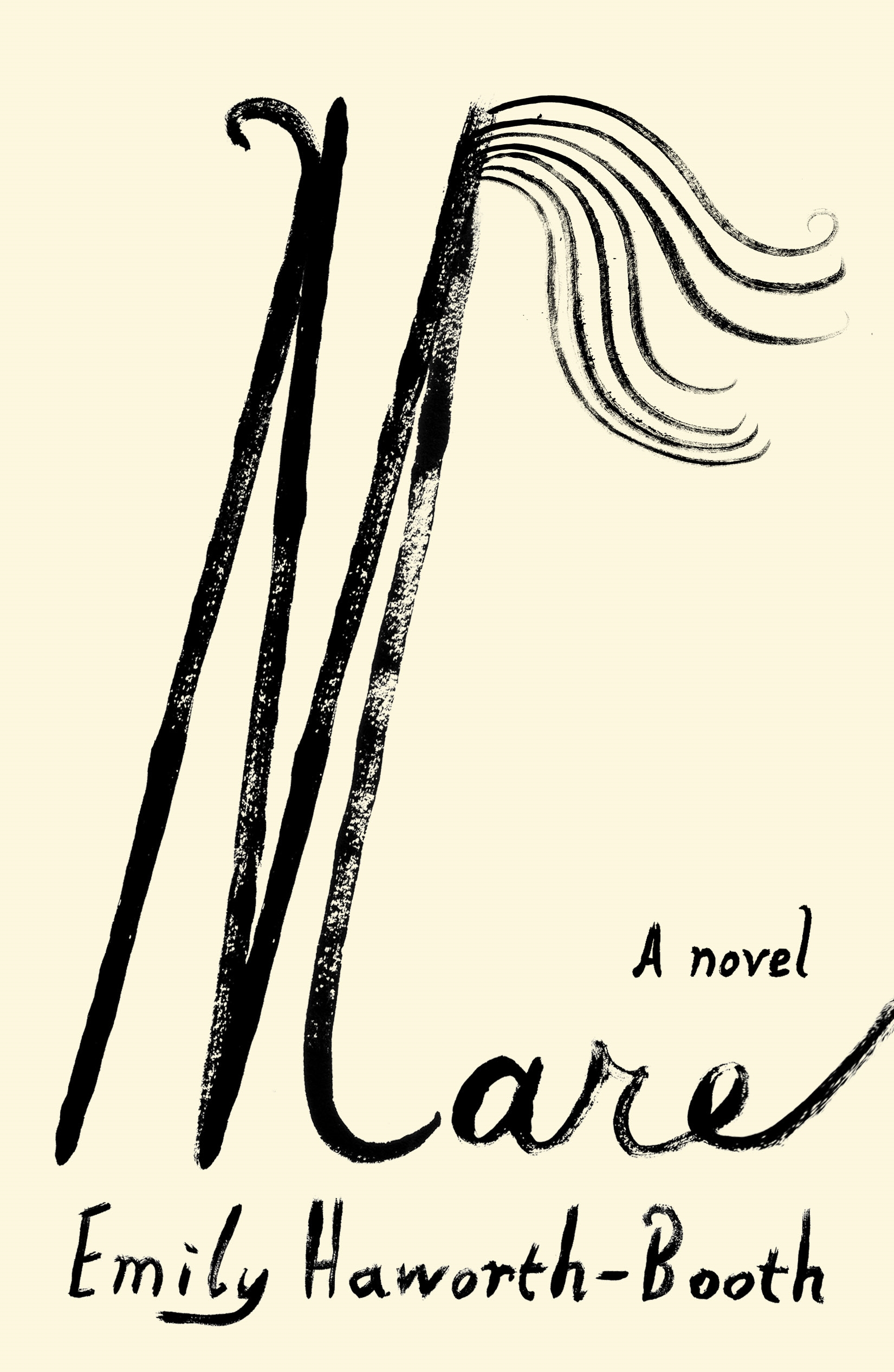
For the un-horsey: a mare is a female horse. The title alone had plenty to lure me, and then there’s the story, which follows a writer whose central preoccupation — the question of whether or not to have children — is suddenly curtailed by early menopause. And weirdly, at the same time that her body is becoming a mystery, the narrator begins to think semi-obsessively about horses:
It happened like something galloping from far away and getting nearer, the way one can suddenly become conscious of a noise long after that noise has begun to sound. By the time a siren reaches the pitch and volume at which your ears can grasp it and your brain can name it, it has already been going on for some time. Horses moved into my consciousness slowly and then quickly, gathering pace and rhythm and volume, just how Patti Smith sang it. Horses, horses, horses, horses, horses, horses, horses horses horses horses horses horses horses HORSES HORSES HORSES HORSES HORSES HORSEHORSESHORSESHORSESHORSES HORSESHORSES
As Kirkus puts it in a starred(!) review, “Haworth-Booth’s book is a marvelous exploration of what it means to be a woman, to live in a woman’s body, to contemplate motherhood—and it is equally about the relationships between people and animals, women and girls and horses. Every step of the way, she resists easy answers. A lyrical, exquisitely detailed account of one woman’s inner and outer worlds.”
Could there be a book more perfectly aimed at me??? You know — me, your old writer-friend Molly, a perimenopausal, onetime-horse-girl-y, 47-year-old mother of two who spends a not-insignificant amount of time anguishing over how to both write and parent to her own brutally high standards, and who loathes selfies except when there’s a horse involved?
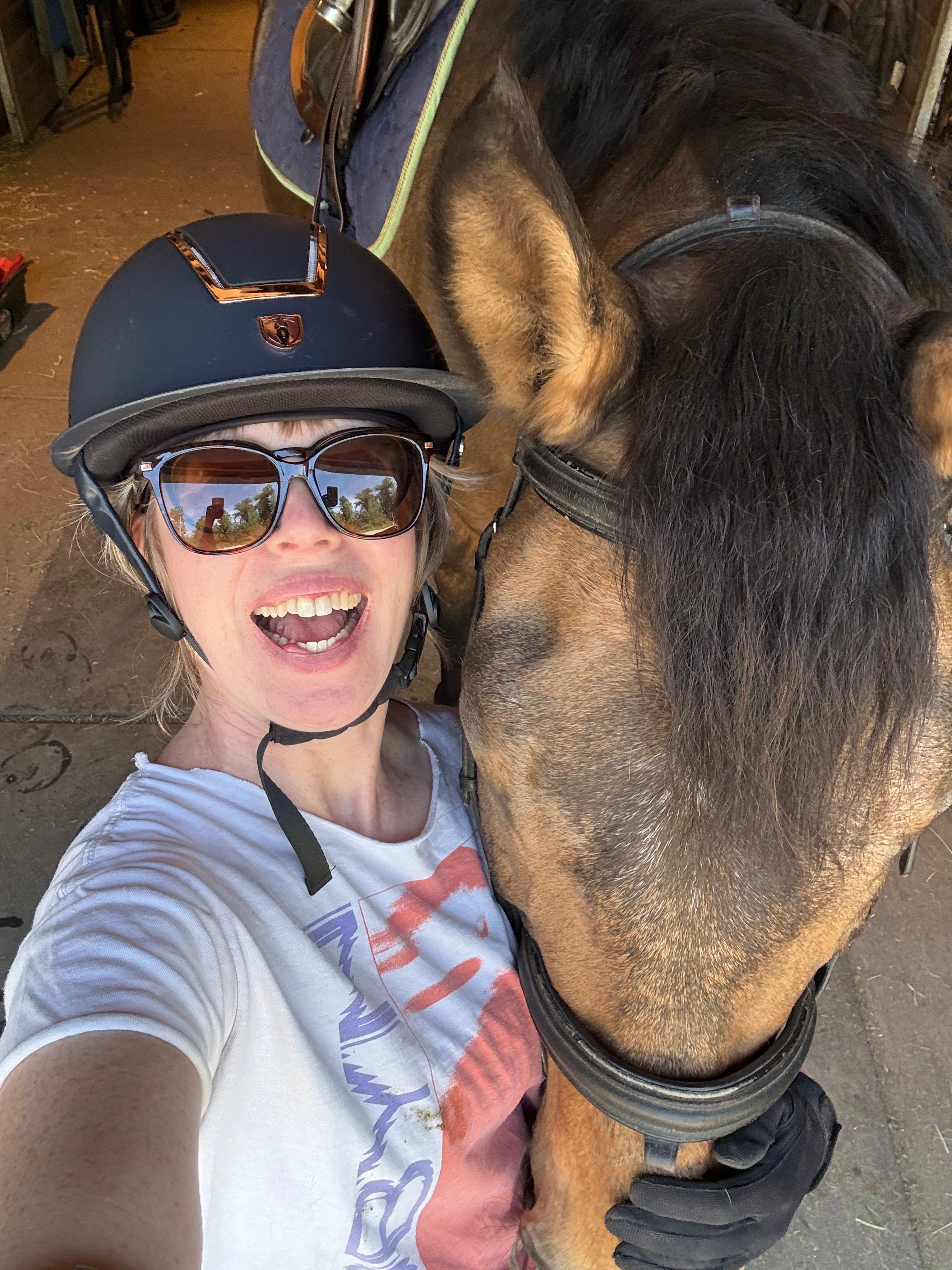
Anyway, I love this book.
Emily Haworth-Booth is an illustrator, a graphic novelist, and a children’s author based in Devon, England. She won the Observer/Cape/Comica graphic short-story prize, and her debut picture book was shortlisted for the Waterstones Children’s Book Prize and the Klaus Flugge Prize. Mare is her first novel for adults.
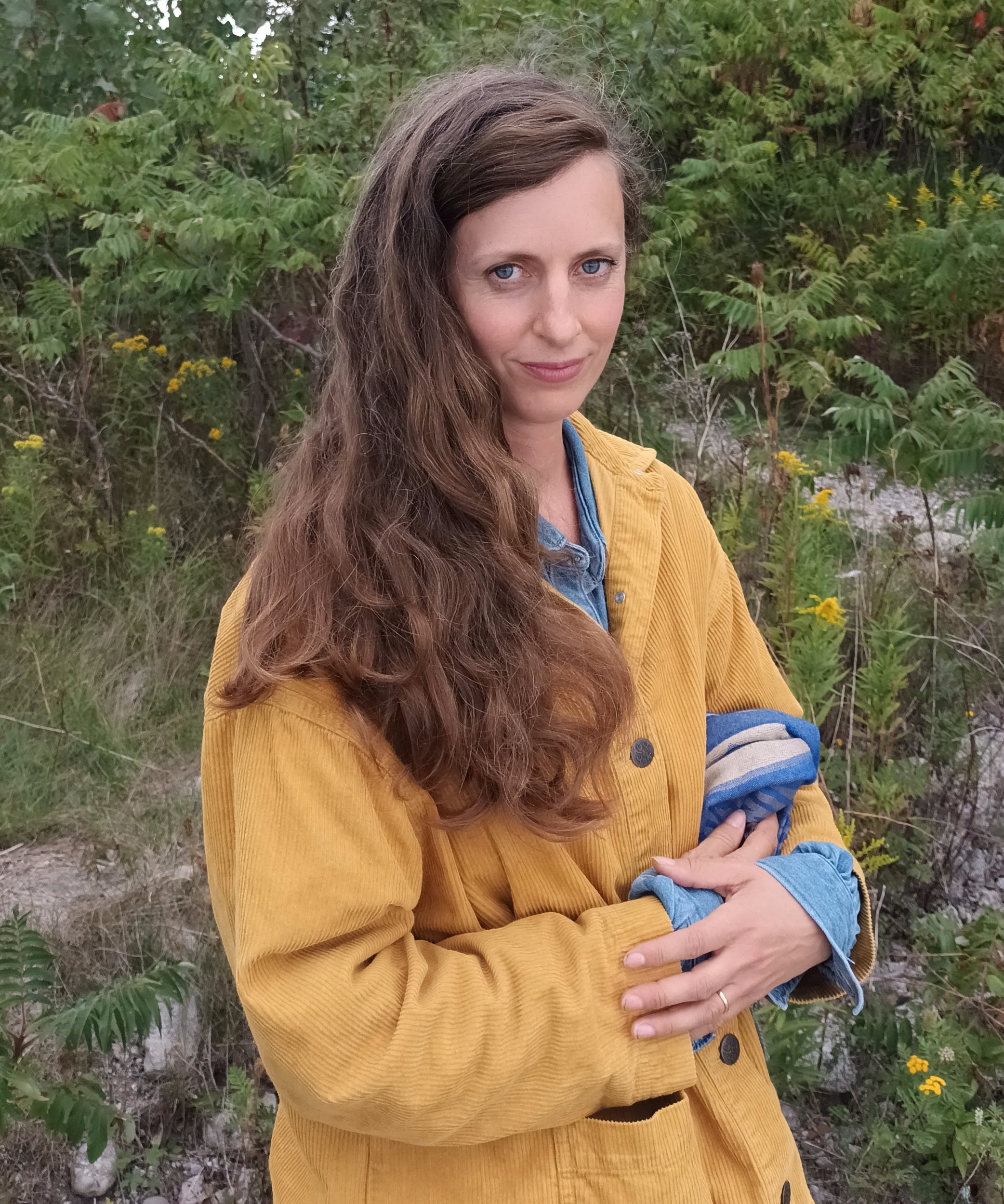
The conversation that follows took place on Zoom on May 8, 2026. I loved it, and I hope you will too.

Molly Wizenberg
Mare is fiction, but there are a lot of parallels between you and the book’s narrator — one of them being that you both rode as children and returned to it as adults. That’s also my story: I rode competitively as a teen, stopped for 25 years, and then returned to it a few years ago. Has it been different, your relationship to horses and riding, this second time around?
Emily Haworth-Booth
I’ve been thinking about that a lot lately. I really came back to riding with a beginner’s mind, and yeah, it feels so different.
I rode much more as a child than the narrator did. I was really lucky. My mum had been quite horsey as a child, and when I was nine or 10 and I said I was interested, she just kind of got it. She went with it so kindly, even though we lived in the city and there weren’t many horses around. She found ways for me to do it. She made quite a lot of sacrifices of time and money so that I could have access to horses.
I had an uncle and aunt in the country, on a huge farm with cows and sheep, and they kept two ponies. My aunt’s previous husband had been a race jockey who had died tragically in a race, and my aunt always kept horses in her life, even after she remarried. I used to go stay with them and ride. I’ve always been a kind of anxious person, but I was a fearless rider. I was constantly being bucked off by this pony and getting back on. We would build jumps out of ladders and old dust bins and jump over them in the field with just a head collar and no saddle. I would never do that now, but it all felt very natural, like an obvious thing to do. I was completely obsessed with it. I didn’t want to talk about anything else for eight, maybe ten, years.
Coming back to it as an adult, you’re much more aware of how unlikely an obsession it is. Or perhaps it’s likely when you’re twelve, but when you’re forty, it’s quite unlikely. I had a lot fewer people to talk to about it, and I think that’s one reason I wrote the book — because I needed a space to go and talk about my obsession. The page was the only place that would hold that level of intensity, that kind of monotropism. This book is a work of autofiction that definitely began as a memoir — a kind of lyric essay, really. Then it grew into a novel.
There was so much to write and think about. I felt so aware of the oddness of the relationship between human and horse. Horses somehow allow us to be in their lives, to work with them and sit on them. As a child, that seemed natural. Maybe it’s that way for children because they’re more connected to the natural world. As a child, I was always thinking about animals. I was always outside, even in the city. I was always digging holes in the garden. But as an adult, I had spent twenty years just being inside, sitting at a desk and staring at screens. The aliveness of these huge creatures was a real shock, an astonishment, in a way that it hadn’t been to me as a child. And then there are all the rules and tasks you have to pay attention to, to keep a horse alive. It was bewildering and overwhelming.
MW
After I finished your book, I went to your Instagram to look for pictures of the horse, to see if she was real. And I found myself so moved by her face, by [your horse] Domino’s face. I feel emotional now, thinking about it. This is so silly! God.
I think that, as a kid, I loved horses — I loved the horses I rode — but I don’t think I ever thought of them as living beings who had choices, who chose to allow us to do what we did with them. That’s something you convey and explore beautifully in the novel — these moments when the narrator longs for the horse to choose to come toward her, when we can see the relationship between them begin to grow. I wondered: is there a relationship, for you, between your writing and your return to horses? Has having horses back in your life changed your writing?
EHB
I think so. It’s difficult to pinpoint the moment of change, because I think there’s a sort of sea change that menopause brings as well. I’ve heard lots of people mention a return to pre-adolescent passions [during or after menopause].
I was really into poetry as a teenager. I took myself quite as seriously as a poet. I won a competition, and that meant I got to go to Arvon. It’s a big British institution for creative writing, and they do residential courses, and I got to go on one of those as an 18-year-old with a bunch of other teenagers. We were really treated like writers. And it was a really big part of my identity, on a similar level to horse riding. And then both of these things sort of disappeared. Neither poetry nor horses them accompanied me into my adult life, maybe because they’re seen as indulgent or luxurious or financially negative. They’re not sort of helpful to becoming ‘an adult to contributes to the economy.’
So they both fell out of my life — and then they both came back at a similar time. Writing came back first, as I was going through menopause, and poetry was hot on its heels, and I think it was all part of return to joy and pleasure and play. The riding — finding Domino and riding her, she gave me this kind of confidence in my own body. I could really enjoy myself as a body in a way I hadn’t for years. I felt kind of graceful. That’s a different way of feeling artistic, isn’t it? It’s a kind of dance with a horse, if it goes well. And that made me feel that it was perhaps okay to return to poetry too. I don’t think the link was conscious at first, but it’s quite conscious now for me.
I started to look up online poetry courses, and this was during the pandemic, so there was a lot on offer. I was finishing up a very intense children’s book on the history of protest, which had been very facty and sad. In lots of ways, that history is a very emotional history. So I wanted a place where I could go and play with language. It felt similar to brushing a horse — you know, there’s sort of no point to it. And also, it’s all the point. It means everything. And yet, why would you spend your time doing that as an adult? It felt similarly pointless, in a beautiful way, to play around with line breaks. So it was a sort of escape to take these poetry courses.
Mare was a secret project for a while. It was the book I kept referring to as “the weird book,” because I was just sure that no one would want to read it, because it’s about a horse and a lot of it was in kind of poem form. But leaning into it, and being encouraged toward it by writing friends, going through it and persevering, and coming out the other side and finding a readership — it’s given me a completely new understanding of what’s possible as a person. And that’s opened up so much for me as a horsewoman as well. There’s been a symbiotic relationship between writing this book and horses, in that I got a bit of financial freedom from selling the novel and was able to acquire a few more horses. Now I have five horses. But that’s really come from giving everything to those feelings, giving myself over to those feelings, and putting them into writing.
MW
And — I mean this as a compliment — it is a weird little book. It’s a love story on one level, but it’s also wonderfully strange. It makes leaps the way poetry does. Will you tell me about how you knew the story needed to escape the constraints of memoir?
EHB
It was tricky for a while. I was about 40,000 words in, and the draft was a collection of little bits. I sent it to my agent and my developmental editor and my sister, who’s my best reader. My editor and my sister, completely independently, both said, “I think this could be a novel.” My agent said, “Just write it and see where it goes.” And I kept saying, “But I can’t write it unless I know what it is.” And he’d say, “Just write it.”
I wasn’t convinced I was allowed to write a novel, you know? I remember, as an undergrad reading English literature, I sort of decided that novels could only be written by certain types of people, people with very capacious brains — a Zadie Smith or a Dickens, a brain that can hold multiple narratives and chronologies and interwoven storylines. I didn’t have that kind of brain. But as soon as my sister and my editor said it could be a novel, I thought, Oh, this is an excuse to start reading loads more novels for work! That’s what got me excited. I took it as a challenge. And as soon as I did that, it was so freeing. I took on the possibility, and it freed the project.
It got more and more fictional as it went on. That was really confidence-building for me as a writer, to just write scenes that hadn’t happened. But I needed that memoir base to work from. At heart, I’m someone who loves to write from observation. I think that’s connected to my drawing training as well. I love to look and eavesdrop. I’m so nosy. That will always be part of my writing, but it’s wonderful to know that there are other things that one can do as well.
MW
That’s funny — I would have thought, Oh, Emily must be very comfortable making up stories, since she writes children’s books!
EHB
But in a children’s book, it’s all structure. There’s almost nothing else. It’s super clean in a way. You don’t really have to write scenes — or you might draw them, if you’re an illustrator like I am. You come up with a scaffolding and tell it in very few words. The telling happens in the pictures.
Really, I think my children’s books are written for me, or my inner child. They’re just concise ways of thinking about ideas that I’m interested in.
MW
You mentioned a sort of fear you had to overcome to write a novel, and it makes me think about the fearlessness you referred to earlier, your fearlessness as a young rider. How much fear do you feel now with horses, as an adult?
I should add that I ask because I’m feeling this out myself. As a kid, I was very fearful in general. I was not a fearless rider. Still, I did things on horseback that now seem bold to me, and I never got hurt badly. But as an adult, just four months into returning to riding, I fell off and got a concussion, my first concussion! I feel very confident in my riding — I have all this muscle memory — but now I know that I can really get hurt. And my body has so many more aches and pains, too.
EHB
It’s a daily battle for me. I’m kind of known at my barn as as a nervous rider. Everyone knows that I’m inclined that way. I’m surrounded by more confident riders.
I’ve made a very good friend who’s a similar age to me, who’s much more fearless than me, but she’s happy to take things at my pace. If I’m having a confident day, we’ll do a bit more. And if I’m not, we’ll do our very safe route — Emily’s comfort zone route, with the minimal amount of traffic and hazards. I’ve learned that I need to be really connected how I’m feeling that day, and that I need to surround myself with people who support that.
And then sometimes I’ll bring friends to the barn who aren’t horsey, and it makes me realize that I do have a lot of innate knowledge about horses, how they move and how I should move around them.
It’s all connected to your awareness, I think. When I was a child, riding at riding schools, those horses were all a bit deadened by necessity to the behavior of humans. But the horses I’ve been riding as an adult are very different, very sensitive, and it makes me much more aware of them as sentient beings. I know my horses so well. I’ve built those relationships over time. One of my mares is super safe in most situations, but then occasionally she has an explosive kind of sensitivity. I love that about her. It inspires me, and I relate to it. But it also means that I always have that in the back of my mind. What if? But that’s what makes it interesting, too. Somehow, knowing that every time you ride, you’ve survived something together — it’s so bonding, isn’t it? And yet I love it when it’s slow and safe as well…
MW
Speaking of awareness, I’m thinking about all the little details your narrator notices or contemplates. I love her mind. There’s this passage about the field where the horse, the mare, grazes:
Once in the field I got down on my knees to try to see the field the way she does — it was almost midsummer and the field was brimming — grass, and grass, but also clover with its rounded leaves and purple heads, sticky chickweed, blue speedwell. In a book I read that she can read the field with her mouth, distinguish twenty-seven grasses, flowers, herbs — it’s her lips that tell her good/good/poison, stop/good/good.
To write this book, I imagine you must have had to really tune into your own mind. You had to take your own mind, your own noticings, very seriously.
EHB
Yeah, thank you. It takes me back to your first question, about what it was like to return to horses as an adult. I was so aware of everything. I was seeing it all as though it were new. Now I’m blasé in some ways. I’ve got five horses! I’m spoiled for horses. I’m kind of a manager now, making sure they get enough exercise, that they get their feet done, their vaccinations. I’m no longer so enthralled [as the narrator is] with everything. That was a really special time, and I think part of me knew that I would never have that time again. I’d never again have that first falling in love with a horse as an adult. I looked at [the mare] at first because I wanted to look at her, and I started to write things down because I wanted to record them. And then after a while, I started to look at her more intensely, to find things to write about. And so it kind of fed the obsession. The writing fed the love, as well as the other way around. The book became this huge bucket that I could put all my feelings about her into, but also that held our relationship in this special time and place.
MW
What are three books, or who are three authors, that mean something to you?
EHB
I’m glad you said three and not just one, because that’s impossible.
Deborah Levy is a huge one for me. Whenever I was stuck, I turned to her and immediately wanted to write and knew how to write. If you haven’t read her, I’d start with her trilogy of memoirs: Things I Don’t Want to Know, The Cost of Living, and then Real Estate. She’s very good at being mean and generous at the same time. I don’t know how else to put it. She’s got a very clear gaze when she looks at people, but she also gives people a lot of space to be themselves on the page.
Maggie Nelson was also huge for me, writing this book. The prompt that Mare grew out of was a Bluets sort of exercise.
MW
Will you tell me about it?
EHB
It was in a course I did with the poet Rachel Long, on the poetry of desire. The exercise was to write a Bluets-style prose poem, a kind of numbered prose poem relating to a color that, for you, connects to desire. I just, I couldn’t connect to any color. I was really stumped. I remembered the horse I used to ride as a teenager had this dark bay coat, and I thought maybe I could pick that color. Then, as soon as I sat down to write, of course it was the black and white of Domino’s coat. I submitted about three pages, much more than I was supposed to. I’d suddenly hit something that was working.
Maggie Nelson does it so well, that mix of minute observations and anecdotes and facts and reflections. That was a kind of backbone for Mare at the beginning.
And Sigrid Nunez, The Friend. That book is so special to me. It’s a really literary book about a relationship between a woman and an animal within a period of grief. The woman doesn’t quite understand who this animal is to her and why it’s in her life, but slowly there’s this opening in her to this creature who she realizes she can’t live without.
MW
I can see all three of those writers in your novel. Thank you so much for taking the time to talk with me, Emily.
EBH
Thank you, Molly. And will you please edit this a bit to make me sound as clever as possible? [Laughs.]
MW
Absolutely. I’ll make us both sound brilliant.
Comments
Nothing yet. Say the first thing.
Sign in to join the conversation.