
First, there will be two Write-Alongs in August and one in September:
✍️
Wednesday, August 5, at 9:30am Pacific
Thursday, August 20, at 9:30am Pacific
Sunday, September 13, at 9:00am Pacific
✍️
As a reminder, Write-Alongs happen on Zoom, and they’re open to all paid subscribers, no need to RSVP. All participants will be muted, though the chat feature will be available. I’ll give you a prompt at the start of the hour, but you’re not obligated to use it. You can write, or work on, whatever you like. The idea is just to do it together. We’ll use the same Zoom link for all three sessions, and you can find it at the bottom of the page, below the paywall. ⬇️
I believe there’s just one room left at this October’s Bland Badger writing retreat with Felicity Cloake, in Sommières, France. It’s a twin room, and if you have questions about how that might work, I bet Charlotte Bland can ably field them: cbrb@blandbadger.com. Our first iteration of this retreat last fall in Italy was a total dream, and I’m happily losing hours of my life to daydreaming about this go-round.
Newly scheduled! My first workshop since 2014 in my home state of Oklahoma! I’ll be teaching for my beloved alma mater, the Oklahoma Arts Institute, from October 8 to 11 at Quartz Mountain. The day I got the email inviting me to do it, I was so excited I couldn’t sleep. Registration opens on August 1, and if you’re an Oklahoma public school teacher or administrator, you can apply for a full scholarship, whoa.
Also booking: an online workshop in January 2027, and an October 2027 retreat in the French Pyrenees at Clos Mirabel, for which a number of spots have been claimed already. There’s more to come, too — and thank you to all who invest in learning with me. I truly love to teach.

If summer were an eight-piece pie chart, mine thus far would be five parts child-rearing and three parts watermelon, with paid work sort of oozing out the sides, scorched. On a good day, I feel well used; on a less-good day, used up. That said, I think it’s just what summer in the Pacific Northwest feels like, whether you have kids, watermelon, or neither. The season is so short, and typically so temperate, no one goes inside for most of two months. You cross the finish line of Labor Day winded and parched, impatient for the rains to start.
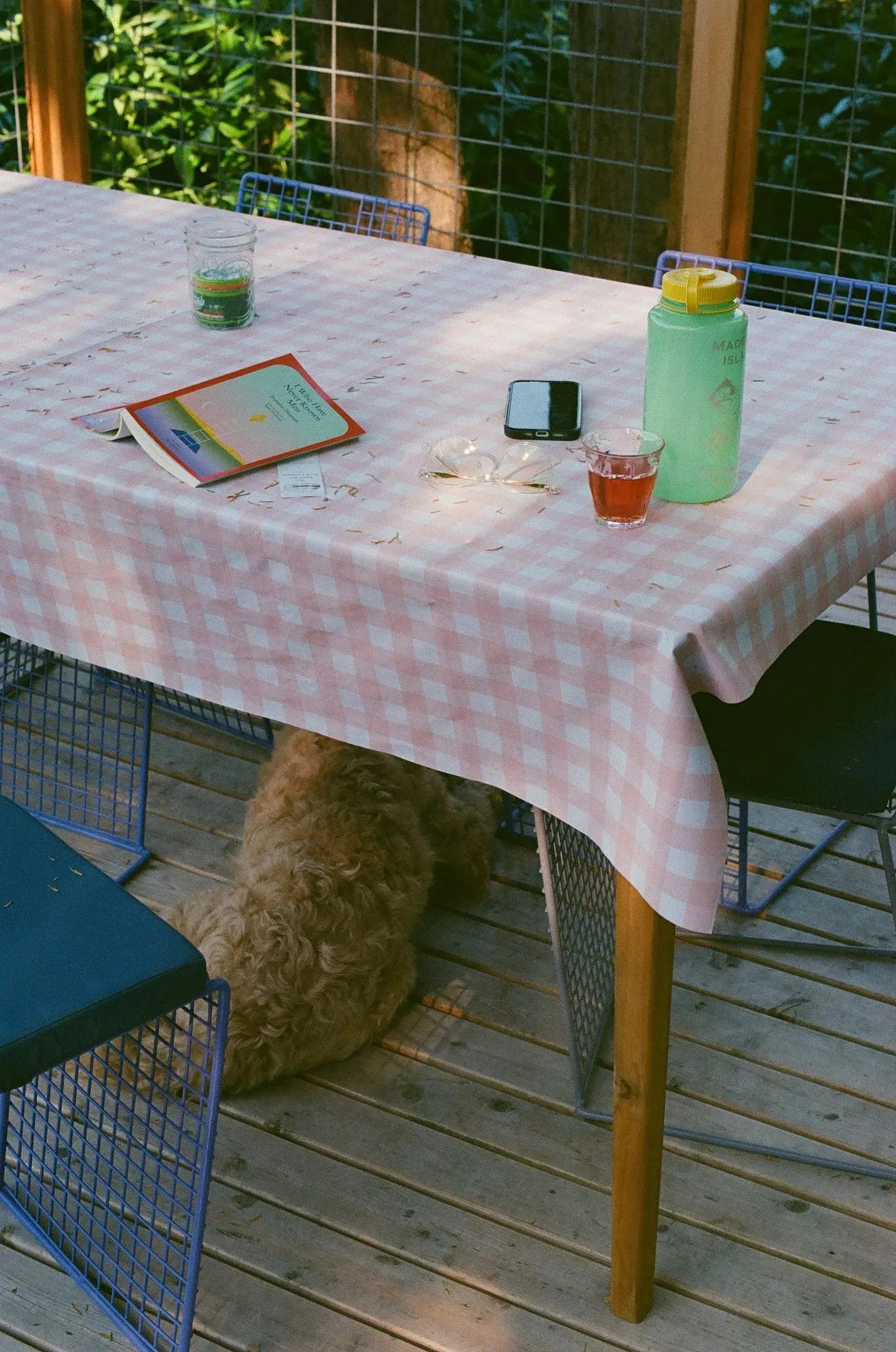
On the watermelon front, I’m pleased to report that I’ve cracked the code. I can pick a good watermelon. But my mother confessed just yesterday that she doesn’t know how, so I’ll tell you: the fruit’s field spot, that pale patch on one side, should be more yellow than white. Ideally, your melon will also have some webbing — that network of scabby grayish veins — on the skin. And I bet you already know that a watermelon should give a resonant thump when you slap it. Mostly I buy those cheap ‘personal’ watermelons at the supermarket, but if you cough up $1.49 per pound at the farmers’ market — as I did last week from Alvarez Farms — you can get the goddamned watermelon of a lifetime: extra sweet and almost rich, saturated with flavor. Were I pinky-sized, I would have put myself in it.
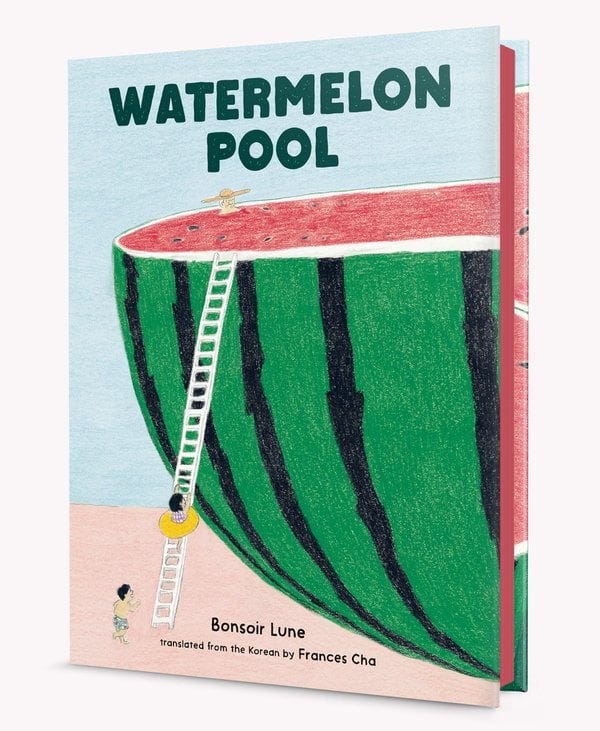
At the cheaper end of the spending spectrum, last month I bought a steno pad at a grocery store in Billings, Montana. Why don’t people talk about steno pads anymore?1 Did anyone ever talk about steno pads? Let’s talk about steno pads. They’re always six by nine inches, small enough to shove in a bag, and they’re thin, too, typically eighty pages. The best part: the spiral binding is on top, where it won’t interfere with the movement of your hand across the page. And both covers are cardboard, so you’re never without a sturdy surface to write on. The pages are lined and Gregg ruled, which means there’s a vertical line down the center. Apparently Gregg ruled paper was designed to be more efficient for quick writing: you can write in two columns within a single page, and your hand has less distance to travel, left to right, to reach the end of the line.
For my purposes, a steno pad is ideal for a type of journaling I started playing with last fall. I adapted it from Lynda Barry’s Syllabus, a book-slash-visual-carnival that offers its readers the experience of a semester-long workshop with the legendary Barry herself. I feel confident in saying that Syllabus is like literally nothing else on Earth: smart and wacky, both rigorous and reassuring, and so visually overstimulating I can only tolerate a few pages at a time. It took me a good year to get to page sixty, where Barry presents a particular format of daily diary that she requires her students to keep.
You begin by dividing your page into quadrants. (Lynda Barry calls for a composition notebook, but here’s where I like the steno pad: it’s smaller without being small, and with that vertical line down the center, the page comes already half-ready.) Once the quadrants are in place, you label them: DID on the top left, SAW/NOTICED on the top right, HEARD on the lower left. You leave the lower right blank. Then, in each of the labeled quadrants, you jot down daily noticings. I like to go clockwise from top left, filling each quadrant in turn: first, DID; then SAW/NOTICED; and then HEARD.
“Start by noticing what you notice,” Barry explains:
As you go about your day, you do2 things — sometimes intentionally and other times by accident. Both sorts of events should be welcome in your list of things you did.
You may find yourself staring at something for “no reason,” a label on a bottle of juice, a pigeon, a wisp of hair on the nape of someone’s neck — or you may see something spectacular: a fight or a fire or an accident. All are welcome on your list of things you saw.
And listen to what people are saying — overheard conversations are full of good lines. Pay attention to how people really speak. Write down what they say.
Finally, in the blank lower-right quadrant, you make a drawing. Barry says you should draw something from your SAW/NOTICED list, but I prefer to draw something within my field of vision right then, as I’m journaling. Because I’m usually at my desk or dining table — environments as familiar to me as the inside of my eyelids — the options are pretty boring. But Barry foresaw this: she urges her students to avoid picking the easy thing, to look for a challenge. Here I try to slow my brain down: whatever I’ve decided to draw, I focus on only a small portion at a time, crawling my eyes along the thing, then pausing to draw, then crawling some more, drawing some more, trying to really see it.
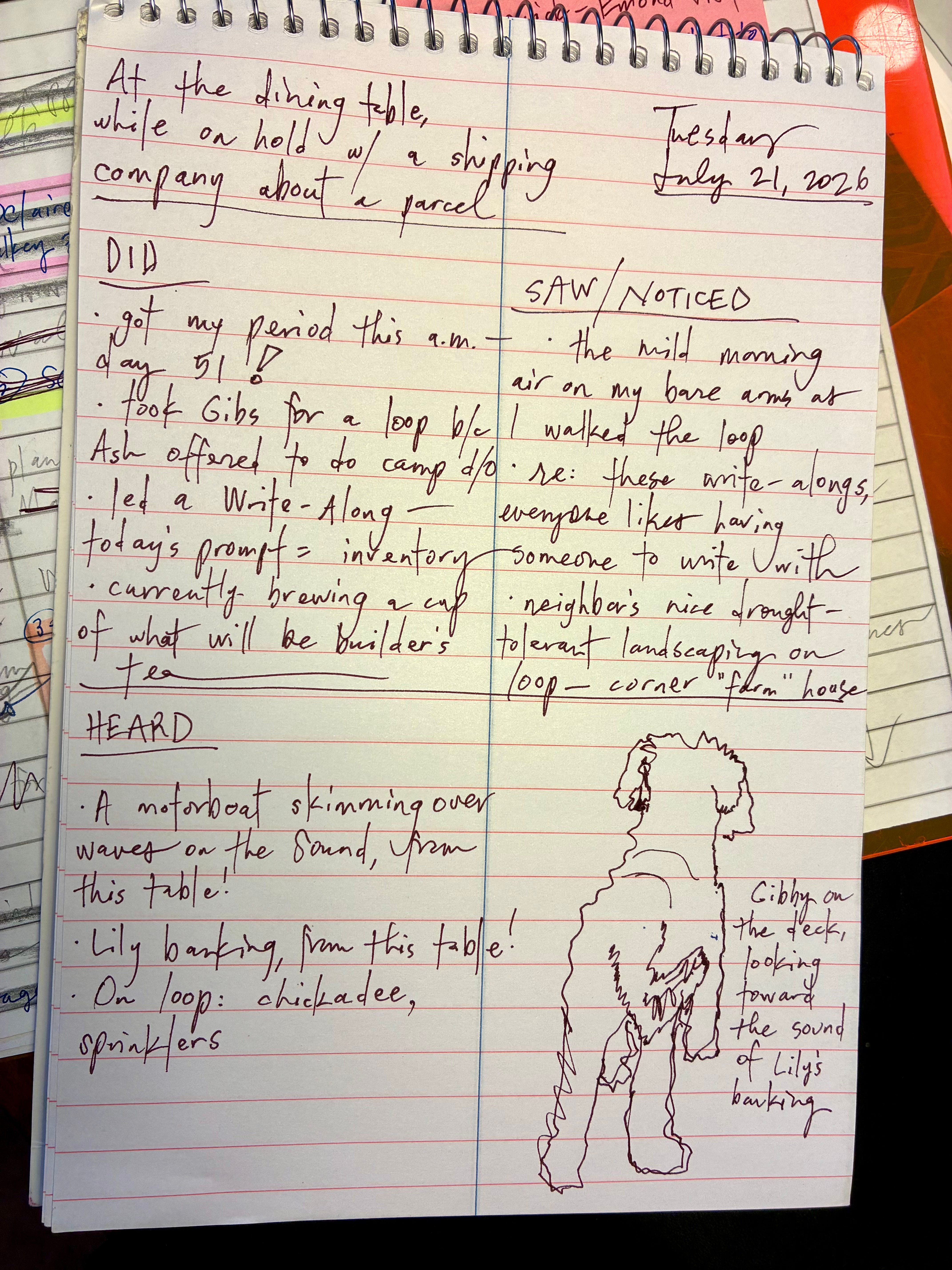
I do all my journaling in pen, which I guess ups the sketching ante, but I’m just having a moment with Le Pens. Below, for instance, is my journal from Tuesday, July 21. I decided to try to sketch Gilbert as he stood at attention on the deck, though I knew he could move at any second. Fun!
For obvious reasons I call this “Lynda Barry Journaling,” and I’ve noticed that it’s especially well suited to summer. Because the days are more varied and my schedule more erratic than in other seasons, it’s nice to journal in short phrases and quick impressions, no expectation of full sentences. I can keep up the habit without a lot of effort in a few stolen minutes on the bus or over breakfast. More than any single event, summer to me is an onslaught — a parade? a stampede? — of sensory information. Like: it’s on us! It’s all over us! And then it’s over. Recording it this way — in (mostly) specific details, in small and concentrated parcels of information — makes me feel like I can actually capture it, even hold it in my hand for a second, as it barrels past.
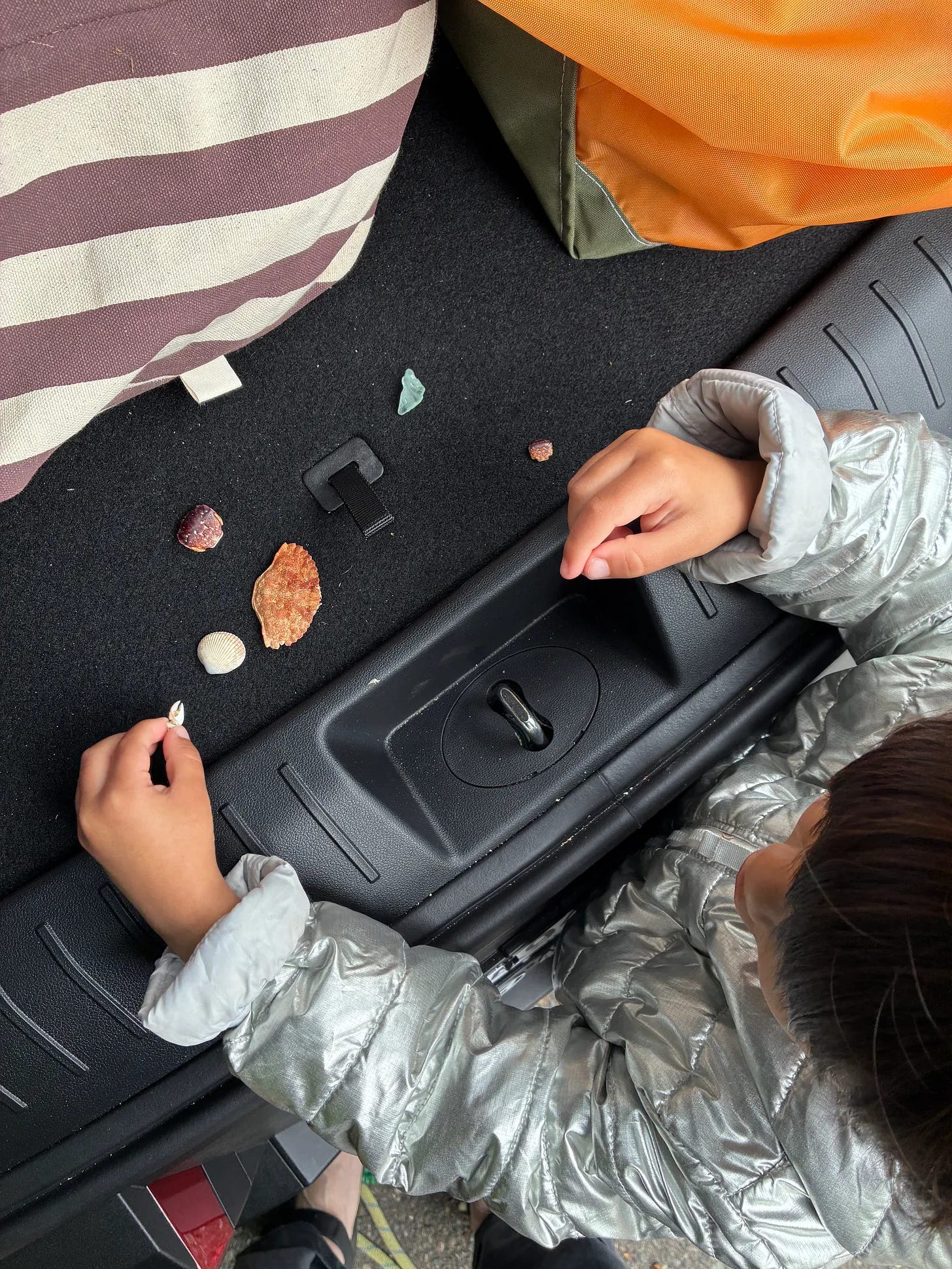
Flipping through this summer’s steno pad, I can see that on July 4, I got Ames out of the house early so Ash could sleep in. We went to the neighborhood beach, even though he’s (rightly) scared of the (deafening) trains that pummel down the tracks right beside it. To keep us focused, I set a scavenger hunt3: our task was to find a purple-colored shell, a crab shell, and a feather. Because it was a holiday, it turned out that not a single train passed during our visit. And only one of the shells — OUR TREASURES, breathed Ames — broke before we could get it home. As Hallie says, 100% of dreams come true! I’ve got the journal entry to prove it!
My Lynda Barry Journal is also there to remind me that this was the summer when Ames pretty much only ate Ritz crackers. And at a bar on July 19, I overheard a guy say to his tablemates, “She had a falling-over dancing style.” On June 25, I notably did not gag on my iron pill.
Ash has taken up the Lynda Barry Journal, too. I love seeing what they draw: their own leg, pulled from under the covers; me, asleep, with a pillow over my face; faces in a Zoom meeting at work. I’ve been making my students do the Lynda Barry Journal, too. Sometimes at the start of class we share snippets from our journals, a shorthand way of catching up. To get them started in the practice, I made them a template, a basic visual guide to the format. I’m putting it here for you, too:
If you try it, I’d love to hear what you notice. Tell me in the comments? And paid subscribers, don’t forget the Write-Along link below.
Thanks, always —
M.
Comments
Nothing yet. Say the first thing.
Sign in to join the conversation.