
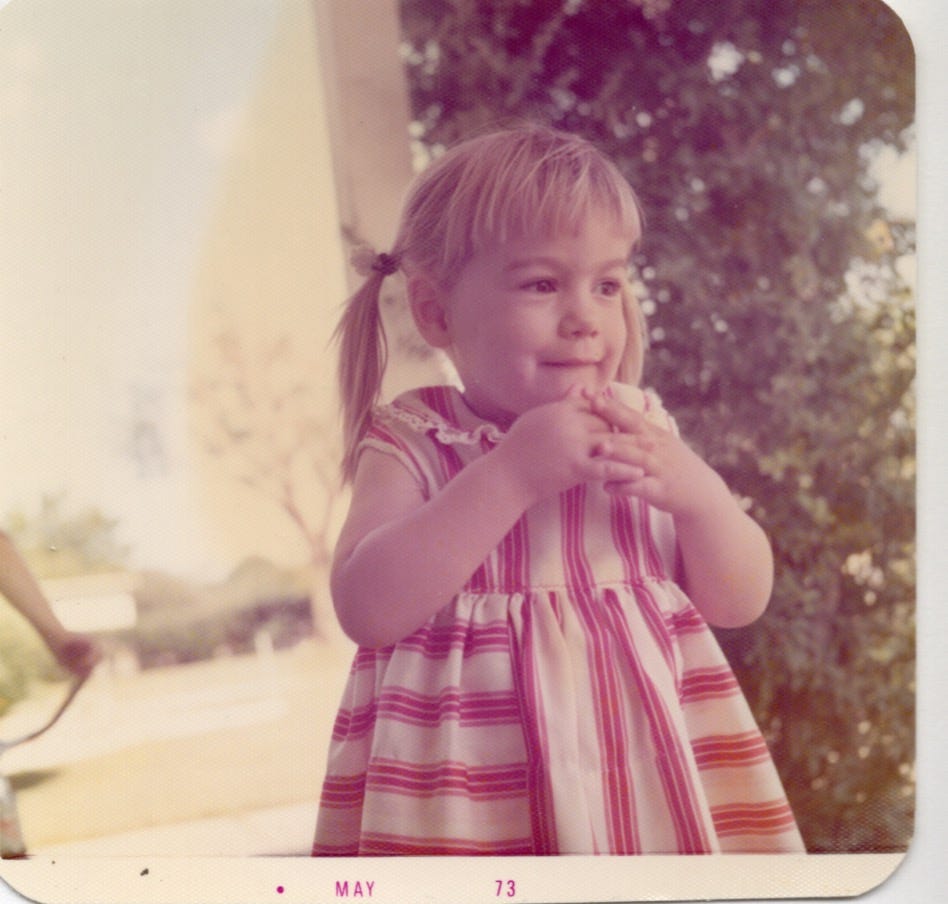
Greetings, loyal readers. This 1973 photograph of two-year-old me wearing a striped dress plays a prominent part in the “Assassin’s Book Report” chapter of Nine Grudges, excerpted below. At the beginning of the story, set during my senior year in high school, my older brother comes home and says, ““Hey Molly, I dropped acid last weekend, saw this cute hallucination of you as a little kid, and decided to stop being a dick.”
At the time I knew it was this image of me that my brother had seen while tripping, because he told me, “You know, you in that little striped dress.” The photo had been a staple of our family album because it had been paired with an angry photo of me also in the striped dress, dubbed the Jeckyl/Hyde series by my brothers. So, we both knew exactly what he was talking about. And here it is for you.
Please find the full text of “The Assassin’s Book Report” below. If you like it, please share it.
Meanwhile, if you’d like to read my whole memoir Nine Grudges: The Spiteful Origins of the Happiest Dyke on Earth you can pre-order it here:
https://bookshop.org/p/books/nine-grudges-the-spiteful-origins-of-the-happiest-dyke-on-earth-molly-mccloy/79532e2d89f58b50?ean=9781636284880&next=t
If you’re in Tucson and would like to see me tell a story about sneaking into concerts in Seattle in the 1990s, please come to Brickbox Brewery (220 E. Broadway) on Wed. April 8, 6:30 doors, 7pm stories: https://downtowntucson.org/do/rex-manning-day-who-is-your-kurt-cobain-at-brick-box-brewery The theme is how music promotes mental health and the show is free and over 21 with drink sales donated to The Stigma Free Initiative which raises “awareness for erasing the stigma around mental health.”
Speaking of mental health, I’m very proud of this interview I did with Sam Dingman of KJZZ’s The Show on using agency and humor to address childhood trauma in stories: https://www.kjzz.org/the-show/2026-03-05/tucson-storyteller-molly-mccloys-sense-of-humor-gave-her-power-over-childhood-trauma Please pass it around and let me know what you think.
Finally, I hope to be in the FST storytelling show on April 14 at 7pm at The Rock. The theme is Mistakes Were Made and I hope to tell the story of my family’s failed attempt at family therapy. Even if I’m not in the show, FST is always great and you should check it out.
Alright, here’s the excerpt. Special thanks to FST and Amy Silverman at Bar Flies for allowing me to perform early versions of this story on stage.
The Assassin’s Book Report
1988. Sunnyslope Suburb, Phoenix
Tom came home one day and said, “Hey Molly, I dropped acid last weekend, saw this cute hallucination of you as a little kid, and decided to stop being a dick.”
Tom had been a dick to me for years. He called me “fat girl” and “lard ass.” He called me Ooteeny, my “Pygmy name,” for a full year after I made the whole family watch that PBS documentary on Pygmies.
Now Tom stood there in his New Order t-shirt, his long skater bangs in his eyes as he smiled warmly at me.
Was this a trick?
Maybe not.
I had just finished a phone conversation with a friend, and this time Tom had not picked up the other line to ask her whether she was an “anal virgin.”
I waited for my brother to break character as he stood there in our living room, to howl “just kidding!” and insult me as usual, but instead he smiled at me.
This LSD must be a miracle drug, I decided.
Then Tom asked me if I wanted to trip with him.
I did have my weekend free.
Except for that essay due on Monday.
My topic was Catcher in the Rye thanks to an article in my mom’s People Magazine. According to People, promoting the book Catcher in the Rye had been the primary motive of John Lennon’s assassin. My English teacher recommended plenty of books, but compared to this guy, she had no skin in the game. She hadn’t killed the world’s favorite Beatle to make her point. I liked having this oddball sinister reason for choosing Catcher in the Rye, and wished someone would ask me about it, but no one did.
My plan was to read as little of the book as possible.
I’d already skimmed the first three pages and worked up a thesis about Caulfield’s “alienation.” On Monday morning I’d flip through the paperback, pull some quotes, and collect my usual B-.
Life was meaningless.
Nothing mattered.
When the Space Shuttle Challenger exploded, I didn’t even notice.
I was about to graduate from Sunnyslope High School in Phoenix, Arizona.
My life’s ambition was to sell car insurance.
My friend Suzy Novick’s dad sold car insurance, and her parents seemed happier than mine. Mr. Novick had a red sports car, and he and Mrs. Novick drank margaritas and laughed at my jokes. Mrs. Novick would throw her head back with this big toothy smile. She had long dark hair and long legs. Years later I would realize that I never really wanted to sell car insurance. I just wanted to fuck Mrs. Novick.
My own parents were never home back then. Work was all they did, my mom as a nurse on a substance abuse unit at the hospital, my dad as a reporter for The Arizona Republic. Meanwhile, my teenage bullies parked their BMWs in the school lot, intimidated full-grown adults for sport, and broke every expensive toy their parents bought them. One time I stood there dressed in my brown polyester Taco Bell uniform and watched from behind the counter as a pack of the rich kids hammered taco-sauce packets onto a table with their fists, spelling “fuck you” with the burst packets, just because the assistant manager had asked them to clean up after themselves. Another time, a girl whose parents had bought her a brand-new Cabriolet convertible drove drunk and rammed the car into a neighbor’s block wall, toppling the wall and totaling the car. Two months later she showed up in a shiny new perfect version of the car.
I was jealous of the rich kids’ freedom. They didn’t have to work. They wouldn’t be caught dead wearing a polyester outfit and serving other kids tacos. But even they didn’t have the freedom to be queer and out in 1988. One goth girl kissed another goth girl at a party and was the subject of rumors for two full years. There were these identical twin guys, one who dressed butch in plaid and Levi’s and one who had a Flock-of-Seagulls haircut, his shiny shirt buttoned up to his throat and topped off with a fake-gem broach. Both of the twins were harassed daily and beaten up quarterly, the straight one and the gay one. I felt lucky to be attracted to guys and girls, because I could string along a cute boyfriend. I figured I’d hide my queerness as much as possible until college. If I went to college.
Drugs were the only bright spot during this stifling time in my life.
Drugs gave me a sense of community.
Adults forget that sometimes a circle of kids smoking pot is a teenager’s only chance to duck out of their Lord of the Flies hell pit and find some Goddamned civility. For all you Moms and Dads out there who make their kids write thank-you letters to grandma, please know that those etiquette lessons do pay off when it’s your kid who offers up the green hit. My fellow metalheads were the nicest kids around, and they were at their nicest when we were getting high.
“Yeah,” I told Tom, “let’s do it. Why not?”
Weed had made me much less fearful of walking past the clump of football players in letterman jackets each morning at school, and clearly this LSD had somehow turned my brother into a decent human being. I was excited by the sense of possibility. Maybe I’d finally become friends with my own brother. Maybe I’d find my way back to the little girl my brother had seen in the hallucination, pigtails and red-striped dress, her fists held up to her chin in anticipation and excitement, a huge smile filled with certainty that whatever came next would be full of the goodness she deserved.
That Saturday afternoon, Tom and I jumped in my car and picked up his friend Jeff who looked like Pony Boy from that movie The Outsiders but was really a ruthless bill collector.
We popped the tabs onto our tongues, and soon I was driving into the woods north of Phoenix, as my brother and his friend showered me with their wisdom.
“To drop acid, you don’t want to be in some crowded place, like some stupid fuckin’ arena concert.”
“You don’t want to be in a city. You could get jumped or worse yet—cops.”
“Ugh Cops.”
“Yeah, it’s safer out here in nature,” Tom said. I considered this last point as I steered the car around corkscrew mountain curves on a single-lane dirt road with a steep drop-off and no shoulder.
The sky was getting dark. All I could see was the dirt road illuminated by my headlights and the shadowy clumps of pine trees on the right-hand side. The LSD was kicking in. I kept one eye on the road while I tried to get my Echo and The Bunnymen cassette to play, but the stereo buttons were starting to look like they were made of wet wax.
Then I wondered if maybe I wasn’t actually driving.
Maybe none of this was real.
“We aren’t moving, are we?” I asked Tom. “You two are just pretending that we’re driving down the road, but we are parked,” I said.
“No,” Tom said. He put his hand on the steering wheel. “And you should stop the car right now.”
We pulled over and built a fire. Those two started talking about their Cub Scout days, how they stole Jeff’s dad’s weed and rolled it into a Cheech and Chong size joint with phonebook paper and ditched the other scouts at camp.
The flame caught the pine needles and some wadded-up Kleenex first, and then the small sticks that were propped up teepee style started burning too. “You guys were only 10 years old,” I said.
Tom dragged a large branch close to the fire, propped one end of it on a rock, and then stomped down on it, breaking it in half with a loud crack. “Hunh?” he said. Jeff looked up from his task of loading medium-sized sticks onto the fire.
“Cub Scouts. You guys were in fourth grade the first time you got high.”
“Yeah, we really didn’t know what we were doing. That phone book paper. That huge joint.”
“Yeah, that big joint just fell apart, but it worked.”
“It was great getting high for the first time, sitting on that hill and watching all those scout pricks doing the dishes and all the chores. I hated Cub Scouts.”
I tried several times to break into the conversation, but they were talking about all these boys I didn’t know well. Then Jeff told a story about how Billy Idol had pulled up in a limo and tried to pick up both Jeff and his girlfriend at a gas station after his concert. Tom and Jeff started to argue, Jeff insisting that his point was only that Billy Idol was gay or bi. Tom’s argument was that, no, wait a minute here, Jeff himself must be trying to come out right now with this story, and was totally gay.
“I could see it,” Tom said. “I could see Billy Idol fucking you.”
Now, thanks to Tom, I was seeing it too.
I imagined Billy Idol with that classic snarl on his face, giving it to C. Thomas Howell, a.k.a. Jeff, on his hands and knees with a startled look on his face. Pony Boy. The Billy Idol song “Mony Mony” came into my head.
So far this acid trip was a bust.
I wasn’t bonding with my brother. I could never come out to him. Or to anyone. Even in those civil circles of kids smoking pot, I couldn’t talk about the time I ran into one of the girls from our high school basketball team when she was working at the gas station. Looking unbearably sexy in her mechanic coveralls, she asked, “were you just running or something?” because the sight of her caused my heart to pound. I didn’t dare tell anyone about that. It wasn’t safe.
Yes, my brothers and I listened kindly when my mom talked about two of the gay male nurses at her hospital who had contracted HIV, but we high school kids wrapped our own fears of the virus in cruel gay jokes. Most kids were mean enough to me already because my hair was never right and I was boyish and didn’t wear makeup. Since my brother was finally being kind to me, I didn’t want to give him any new ammunition to restart his animosity. I wasn’t even out to myself. I figured I’d marry some guy, and have a drunken threesome once in a while so I could have sex with women, and maybe my fill-in-the-blank husband and I would own a house with a swimming pool and drink lots of margaritas. I hadn’t fallen in love with anyone yet and didn’t think I ever would.
As Tom and Jeff ridiculed each other, I decided to concentrate on my own drug experience.
I looked at my hands first, waved them in the air to watch the tracers, the perfect trailing slices of light. I watched the embers fly from the fire and turn into inchworms doing somersaults. I watched the sky, which looked like a pachinko game full of spinning ammonites. I stepped back and forth, attempting to stand under just one star.
What happened next was not an earned rite of passage. I didn’t let a leather strap rip through my chest in a Sun Dance. I didn’t fast in the desert for days. I didn’t even endure a sweat lodge. All I did was pay my brother 10 bucks, put a small tab of paper on my tongue, and drive north to the woods. I was doing this dance next to the campfire, shuffling back and forth with my head thrown all the way back so I wouldn’t lose sight of my star. I knew it was impossible and silly to stand under one star, but I didn’t care.
Somehow, I moved in the right way at the right time and it all clicked into place. All of the other stars faded to black and my chosen star spotlighted me, its fuzzy beam of dust motes connecting me to the cosmos. That’s when the big thoughts started coming.
I had the realization that this beam of light was packed with my ideas and my dreams and my observations, my insecurities, my subjective experience. At that point in my life I could define the word “subjective,” but I had no real independent sense of self, just constant fear. Now I could see my own thoughts, words inside cartoon bubbles floating up to the star in that beam of light. “Fear,” and “Mom,” and “Dad,” and “Risk,” all kited into the sky.
For years I had been so cowed by insults that I’d hidden any uniquely identifying features that would make me vulnerable to attack. I’d stopped wearing the Judas Priest and Iron Maiden concert shirts and even stopped going to the concerts, though I loved the music. I chose the simplest nondescript outfits I could find, collared shirts and Levi’s that helped me blend in.
One day during sophomore year, these girls who had picked on me in junior high gathered around me to copy my biology answers while our teacher took a smoke break in his office. The girls asked me what my favorite band was. They looked sincere and friendly, but I knew that a common mean-kid tactic was to fake interest in some lonely kid and then pounce as soon as the kid mistakenly opened up.
To any outsider the moment would have looked innocent enough, but I was locked in a state of terror. My hands shook. I shrank away from the shell of my body which I left abandoned at the lab table with these girls and their bobbed hair and bangle bracelets and squeaky voices. I shrank into a dark safe place somewhere in my own gut where I fretted and shivered and obsessed over my reply: I count four years since Wendy here called me unpretty and unpopular and since her friend put Vaseline in my hair on the school bus and her other friend told me I needed to lose some weight and cut in front of me in the cafeteria line and her pack of friends pelted my brother with grapefruit from the window of their Blazer and then blasted him with a fire extinguisher, but it’s only been a month since that night her other friends threw full beer cans at my car because I had a long-haired guy in the passenger seat, and it’s only been a month since I got called a rocker, and even though some of the preppy girl posers now wear fringed Motley Crue shirts since the band started writing sell-out pop tunes, and that guy still did the little bull-horn thing with his hand and stuck his fingers in my face and yelled “rocker” at me, so I’m not going to say AC/DC. The Eurythmics—too gay. What should I say?
“ZZ Top,” I said finally, carefully. The other girls nodded. They didn’t pounce. The shaking of my hands slowed a bit. I breathed a sigh of relief.
Maybe they were actually being friendly?
I was completely unable to assess a threat, so I would shut down protectively during any interaction. I picked ZZ Top because those girls probably couldn’t make easy jokes about a bunch of crusty Texas roadhouse guys with long beards.
Do I even like ZZ Top?
I had learned to hide so well that I’d hidden my self from myself.
Now as I stood in that star beam in the woods, I realized that all those rich kids who ruled the social order were also walking around with their own star beams of insecurities and fears. Maybe they were as scared as I was. Maybe they were not such perfect gods. Sure, they could control a high school courtyard or intimidate a Taco Bell manager, but they ruled only these tiny fiefdoms on a vast expansive planet. I had, for too long, bought into this idea that the rich kids were special and I was not. Now I wasn’t scared of them. I wanted to hold onto that fearlessness.
I decided to stop hiding. I decided that I would wear red sweatpants to school every day after that. I wouldn’t give a damn about what anyone thought or said about me or what I wore. Words couldn’t kill me, and what couldn’t kill me didn’t matter anymore.
I felt powerful.
Years later, in my late twenties, I would use yoga and meditation to find perspective. I would breathe and stretch and find a similar feeling of connection and peace and power. However, since no one was offering Eastern spirituality to teenage dyke metalheads in the desert wasteland of 1980s Phoenix, it was L.S.D. that saved my life that night.
I stood there under my star feeling unterrified for the first time in years. Maybe it was time to start taking some risks. I thought about my parents. They’d both been born into poor families. My dad spent his toddler years in a trailer and my mom and her three siblings grew up fatherless, their mom working as a maid. My parents had worked their asses off to get me to this high school full of rich kids. And here I was shooting for a B minus. What the hell had happened?
During my freshman year, back when I wanted to study genetics, my science teacher was shipped to the mental hospital because he thought he was Elvis with God in his knee. My sophomore year English teacher was a P.E. instructor who never cracked a book and just played Trivial Pursuit with us. Junior Year, when my friend Anna’s biker mom ran the car into their apartment wall and left a Cadillac size hole, Anna and I did cocaine and went to a Dio concert. When that huge hole in the wall wasn’t fixed for weeks, we tried crystal meth.
I dragged my ass home from the crystal meth debacle and picked up a phone call from the editor of the school’s literary magazine, who wanted to publish one of my poems.
When I tried to pitch a new piece I’d written about how the rich should just eat the poor, she said, “Wait, haven’t you read ‘A Modest Proposal’?”
“No. I’ve been snorting meth and playing Trivial Pursuit,” I said.
When I went to the magazine’s meeting, the faculty advisor, Mr. M., said, “Have you heard of the Manson Family? I was Squeaky Fromme’s high school teacher back in California.”
He handed me a staple journal with Fromme’s poem bookmarked, a piece about watching little kids play in the grass.
As I read the poem, I thought, I miss being a kid.
I could see how a desperate girl might move straight from poem to murder.
I thought, Yeah, Me too, Squeaky, me too.
A few weeks after that, my old freshman science teacher was finally released from the mental hospital just long enough to don a white fringed jumpsuit and sing “Hound Dog” for the school talent show. After the show, I complimented him on his performance. He told me, “I never wanted to be a science teacher. I always wanted to be a singer.”
Now as I stood in the star beam, tripping in the woods, I asked myself this question: Will I one day regret my career in car insurance?
My next thought was: I should try. I should try harder. A lot harder.
Later that morning, I made my way home and I cracked the paperback again.
I read the whole book.
I loved the whole book.
Salinger’s protagonist Holden Caulfield spoke to my grief over growing up too fast. Caulfield mourns the death of his younger brother and he mourns the loss of childhood purity and innocence. I started smoking pot when I was 12, unwinding with a bong hit after a long, hard day at junior high. I was getting high specifically to feel a pure gleeful state of id, unworried by social pressures. I was nostalgic for the good ol’ grade school days. Salinger was the first writer I’d read who spoke to that longing, that grieving of childhood that teenagers do.
Holden Caulfield called out one phony after another and heaped praise on nice nuns and a sweet kid who digressed about his family farm instead of staying on topic for an oral report, which was my favorite part of the book. I decided there must be other people out there like Holden Caulfield and me. I needed to leave home.
That Monday, since I wasn’t above critiquing my new hero, I turned in an essay on how Holden Caulfield’s judgment of everyone else’s hypocrisy was just another form of hypocrisy.
For a long time, Catcher in the Rye was the best book I ever read.
I graduated in the top 11 percent of my class and went to college, where I kept meeting girls who had experienced horrible acid trips at big arena concerts.
Thank you, Tom, who never finished high school.
You’ve turned out to be one of my best teachers ever.
And to the guy who killed John Lennon just so he could publish a book review, I’m not going to name you, because I won’t hype a murderer. I’ll say that as a community college teacher for the last 20 years, I’ve tried to carry on your initial good intention.
Here, I say, read these stories. One of them might change your life.
No posts
Comments
Nothing yet. Say the first thing.
Sign in to join the conversation.