
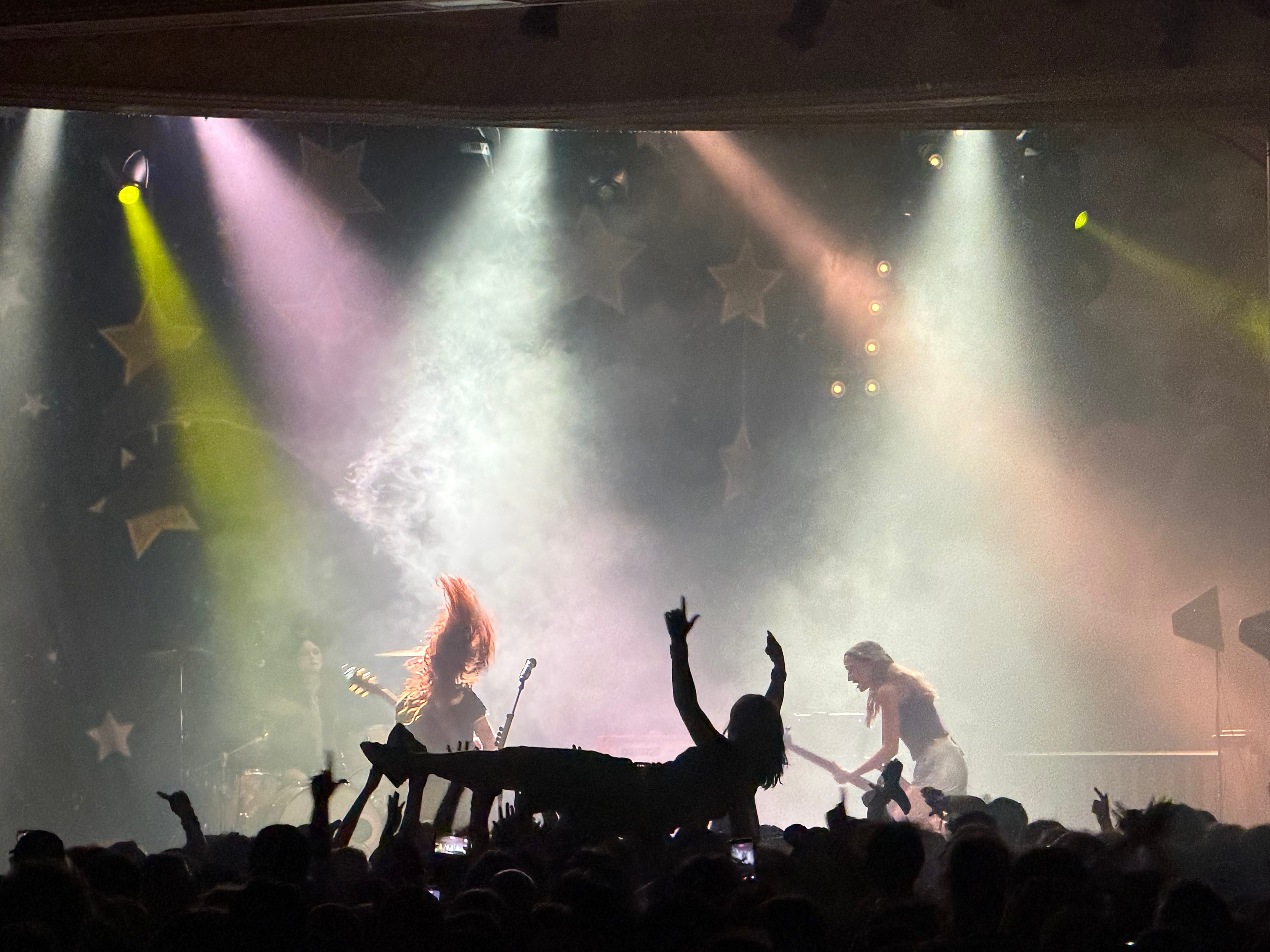
So, my wife Rebecca and I went to a Die Spitz show (photo cred. Rebecca Curtiss) at the Crystal Ballroom last Monday night in Portland, OR. The brawny energy of the crowd and the music, the band’s instruction for all women and queers to push their way through that crowd to the front (which we followed), and the spontaneous all-crowd after-show sing-along to a recording of Creed’s “Higher” which was somehow ironic/earnest/wistful at the same time—all of this made me want to write about being a fan in the crowd at live music shows, which I’ve been doing since I was twelve in the 80s when my mom would drop me off at heavy metal shows like Judas Priest and Motley Crue. Eventually I was lucky enough to land in Seattle when I was nineteen in the summer of ‘89, so I’ve seen some great shows and I can tell you what it was like to be a dyke in those historic mosh pits.
Before I get into it, I need to let you know that I’ve got ten dates lined up for the book tour in NYC, L.A., Phoenix, Tucson, etc… for my award-winning memoir Nine Grudges: The Spiteful Origins of the Happiest Dyke on Earth… so, for those following this newsletter to track my book events, please scroll down to the bottom for details.
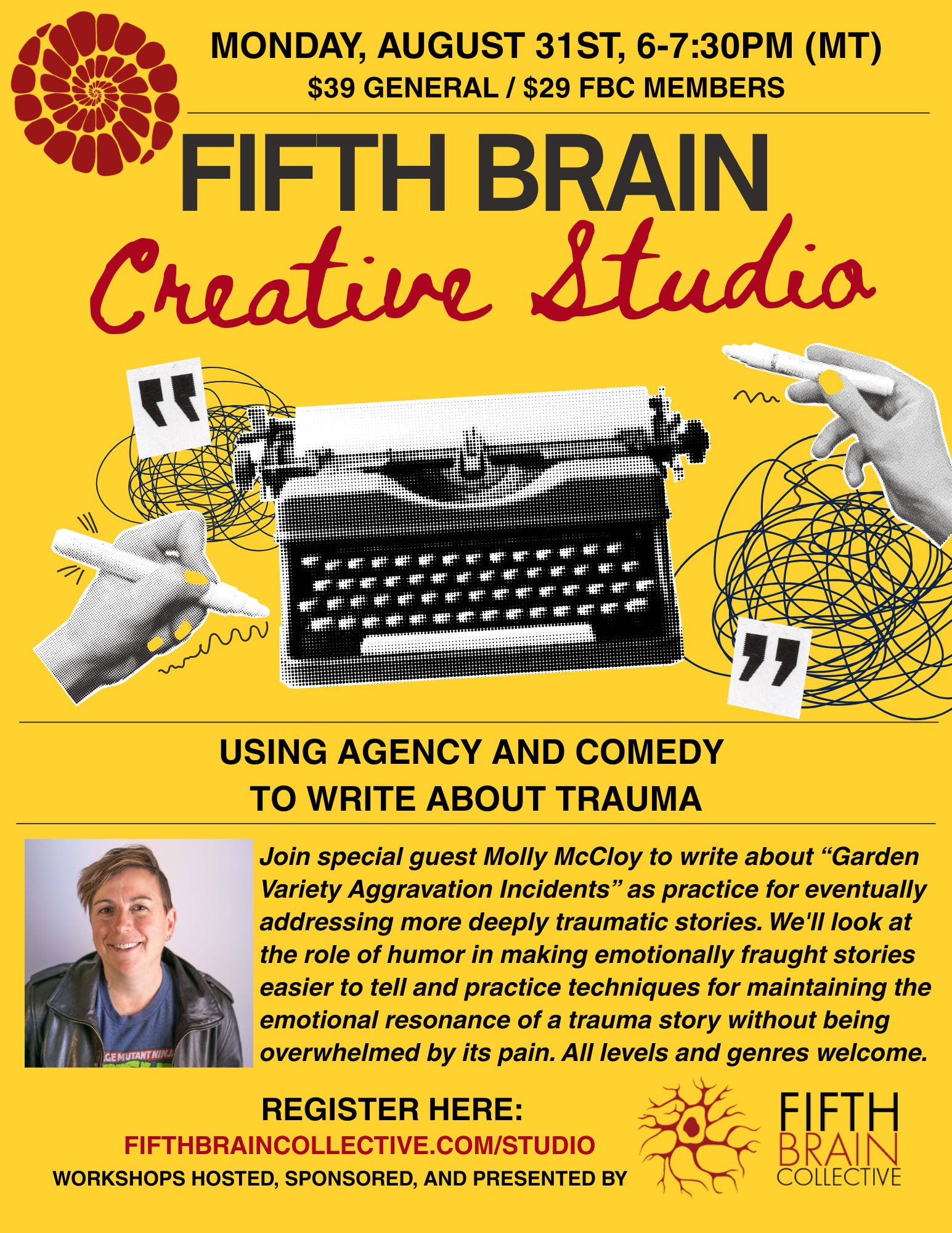
Also, I will be leading an online workshop on how to use agency and comedy to write about trauma for Frankie Rollins’s Fifth Brain Collective on Monday August 31, 6-7:30pm Arizona time/so that’s also Pacific Time/CA time this time of year too. Here’s the link to register: https://www.fifthbraincollective.com/store/p/fbc-creative-studio-agency-comedy
(The workshop is $39/$29 for Fifth Brain Members. Participants for the UA and Changing Hands workshops found the experience to be inspiring and empowering. This version of the workshop will be online… so anyone can attend! Please let your friends know about this one!)
Alright, so back to…shows. Calling them “concerts” just doesn’t seem right, though I did so in the early days. Technically, my first “concert” was Alice Cooper at the Arizona State fair in 1980. I was ten and went with my whole family, so I really pissed off my older brother Tom when I complained about getting smoke in my eyes and we all went home early. Two years my senior, Tom was the fourth-grade trailblazer who convinced my mom to take him to see KISS at Phoenix’s Veteran’s Memorial Colluseum in 1978, when he was only ten. Mom’s review of the show? “It was very theatrical. Lots of lights and smoke. I was afraid we would be trampled.”
I’m not sure how to explain my mom’s rather loose grip on the parental reins. Why was she willing to drop my younger brother Jake and I off at Legend City for Def Leppard’s Pyromania tour when we were twelve and eleven? Well, kids back then were more independent than they are now. Feral and free to roam. And, hey, mom grew up in Davenport, Iowa where she’d take the Greyhound by herself at age 10 to visit relatives in Dubuque, so she always assumed that 1980s Phoenix was as safe as 1950s Iowa. My brothers and I took full advantage of her free-spirited innocence.
In Nine Grudges (and in my actual life, since my book is a memoir), when other kids find out my mom is willing to drop me off at heavy metal shows, I start getting free tickets in exchange for rides. Which is how I bellied up to the stage at Motley Crue and Judas Priest in ‘83. I made two thrilling discoveries when I was packed into the crowds of those shows: 1. expression of an anger-tinged intensity was accepted and even encouraged as part of this communal music experience, and 2. for the first time in my gender-queer, low-income life, I felt a sense of belonging.
Up until that point, I’d been pretty depressed as a result of the constant harassment from adults and other kids for my twelve years of gender-queer life. How many times a day did I have to explain to some dumbass that pink was NOT my favorite color? Why did nosy full-grown adults care so much about my personal choices like this? None of it made any sense. And that made me angry. But I wasn’t allowed to be angry. Because that wasn’t ladylike. Which felt like a trap too.
And then came heavy metal. Head-banging made so much more sense to me than dancing to some pop tune ever did. I wanted to be able to feel angry and wild and out of control and heavy metal shows were the only places I could find that.
It took me a little longer to come around to punk. Until my first Fugazi show in Seattle in 1990. Then I was hooked. Because that scene had even more belonging. The first time I fell in a mosh pit and someone else picked me up and pushed me back in, I understood that moshing is aggression expressed without malice. This was the fun I used to have playing tackle football before they took that away from Gen X girls in junior high and high school. Or rather, 99 percent of girls never had a chance to play full-contact sports ever, and me, the 1% , the future dyke, well, I let my sporty urges get funneled into the only team sports I was allowed to play, basketball and softball, and forgot how fun it is to roughhouse. Until Fugazi. And Mudhoney. And Soundgarden.
What I remember most about the Nirvana Motorsports show was the glass. The venue was a former car dealership that for some reason had all these 8.5 by 11 inch windows, so fans who wanted to sneak into the show tried to smash them out, which was futile, because the window frames held, so there were all these kids without tickets stuck outside the show and all this shattered glass on the floor inside.
Now there’s nothing to mark that site of that show. It’s Youthcare’s Orion Center now, a nondescript windowless building. The flyer for the Motorsports show displayed in the little punk rock museum at Seattle Center these days seems to read “Vale Street,” but for those who were there, we presume the bottom of the “Y” was cut off during some photo-copying process because the address for that show was really Yale Street.
Meanwhile, there is now a little shopping mall in the Capitol Hill neighborhood of Seattle called Motorsports, which just might be a tribute to that historic concert, because…it has the little windows, same size, with the black window frames. Were the windows repurposed from the venue? Or are they just replicas? If you know, please find a way to tell me.
Most of my beloved Seattle from the 90s is gone now, so I nearly cried in 2026 when I saw that the Comet Bar still has the same carved-up wooden tables. I wept full- on grown-up tears when I finally watched part of the movie Singles, which we all mocked back when this sell-out farce was being filmed in our neighborhoods, but which, despite its cheesiness, has scenes filmed inside the OK Hotel, a music venue and daytime cafe that I truly loved and thought I would never be able to see again after it was converted to luxury condos. So, the idea that maybe someone memorialized the window frames from the Motorsports show, well…I just really like that notion.
So, here’s where Hugh Ryan comes in. The plan is to review his book My Bad: A Personal History of the Queer Nineties and Beyond as the first in a series I’ll call “Mildly Narcissistic Book Reviews.” For this series I will write book reviews that somehow always find their way back to my favorite topic: me, me, me and my incredible memoir Nine Grudges: The Spiteful Origins of The Happiest Dyke on Earth (Quill Prose Award, Red Hen Press, Pub Date Sept. 8, 2026).
However, at this point in my own grueling book promo, I might have to call my forthcoming series “Partially-Complete Mildly-Narcissistic Book Reviews.”
I’m struggling to finish reading any of the books I’ve started. Yet I can tell you that my wife Rebecca and I have been listening to Ryan’s audiobook version on our drives from Olympia to Portland and then Portland to Eugene…and we love it. Ryan’s a bit younger than me and from a different part of the country, so he starts his story in 1994, the year when what was the best about the 90s died along with Kurt Cobain.
1994 is also the year Seattle’s late night diner and bar The Dog House closed. I’d call ‘94 the line between classic, gritty Seattle and the Seattle that came to be shaped by outsider tech money. There was a sweet point, pre-1994, at which Seattle wasn’t yet called “grunge” by some culture critic from New York, and I was there, in my late teens and early twenties, to watch Seattle cross that line into national recognition. The Dog House was where my college buddy Lee and I went, after Nirvana went on Saturday Night Live in 1992 and the music scene became nationally overhyped. Lee and I were sick of the hipsters already, and didn’t care anymore about the newest band, because we could plop a $1.50 cocktail on the orange-hued formica tabletop of Dick Dickerson’s Hammond spinet organ and then sing along to 1940’s tunes with a crew of rumpled octogenarian Dog House regulars.
The German dude in suit and tie would grip his wife’s shoulder and belt out, “For Once in My Life.” The senior lady with pigtails and a pink cardigan would apply lip balm before embarking upon long whistling solos. “Clancy Lowered the Boom” was a favorite. Then the very politically incorrect and shocking to even my sensibility, “Old Gray Bustle” parody. We sang the same songs each night, and my personal favorite was the moment when we closed out at 1:30 am with a feel-good communal sing-along to “Those Were The Days.” I’d sling one arm around Lee and the other around some stranger at next to me and we’d all sway as we sang, “Those were the days my friends, I thought they’d never end, we used to sing and dance forever and a day.”
Again, like the mosh pits, belonging was the point.
The high point of that belonging was, for me, the 1990 Motorsports show, when Dave Grohl was in the audience watching Nirvana play and deciding if he wanted to join the band as the drummer from Mudhoney sat in for the night, and the band wasn’t even headlining. A lot of us left before The Melvins came on. The Nirvana set was glorious and energizing, and yes, I felt belonging in that mosh pit. But when Cobain smashed his guitar at the end of Nirvana’s set, my friends and I laughed at the band: who did they think they were? The Who? I had a good fake i.d. and a crew of four friends who, though straight, accepted my queerness, so, as a misanthrope who has never been cool, I can claim exactly four seconds of coolness in my entire life and it was that moment after the Motorsports show. Still high on the show’s energy, I bought us all a twelve pack and carried it up the hill a few blocks to my friend Mary’s place on Boyleston, the small group of us laughing and joking and just…being young. Everything felt right with the world for the first time in my life.
Ryan does a great job addressing the central question about belonging that young 90s queers had to answer: would we be lonely after we came out? Because this was the lie that the straight world loved to tell us about ourselves to keep us sad and controlled in their world. The life of a queer teen in the 80s and early 90s was already analogue and isolated, which was regrettable in many ways but came with a kind of privacy and adjacent freedom that, as Ryan notes, has since been lost. My mosh pits are Ryan’s late 90s and early 2000s’ club kids’ dance floors in NYC, a place where you are autonomous and integrated as part of the communal human organism at the same time. We both found a kind of belonging in a tightly packed mass of people worshipping music.
Ryan is right that today’s 90s nostalgia misses how incredibly homophobic the time period was. He writes about not being able to find any queer stories or queer writers in his local library. In 1994. Soon the internet would change queer visibility and connection forever, and what I am loving so far about My Bad is the way that Ryan is tracking that radical change and documenting a story of 90s queerness that never would have been heard in real time, back in the day, when it was happening. 90s queer stories were aggressively silenced and never widely published, and now is the time to bring them back, as we witness the fascist ant-queer—and especially anti-trans—backlash that we all fear will take us somewhere even darker than the 90s. I’m excited to keep listening to My Bad as we drive from Eugene to various stops on our way home to Tucson. Listening to Ryan’s queer story is a perfect way to leave my 90s stomping grounds and return home to 2026, feeling optimistic and heartened by a random Die Spitz show in Portland that felt like the good ol’ days again to me. Actually it reminds me of the time L7 played the Offramp in ‘91 and I saw stage diving for my first time, but that’s another story for another day…
NINE GRUDGES FALL BOOK TOUR DATES
Sept. 15 Phoenix: Changing Hands Bookstore Phoenix Location 7pm with Robrt Pela. RSVP for a free ticket here: https://www.eventbrite.com/e/molly-mccloy-nine-grudges-tickets-1996164414499?aff=oddtdtcreator&keep_tld=true
Sept. 17 Tucson: Motosonora Brewery 7pm with David Fitzsimmons Antigone Bookstore will be supporting the Tucson launch, so you can pre-order directly from them at https://antigonebooks.com/event/2026-09-17/book-launch-molly-mccloy
Sept. 19 L.A.: Red Hen Headquarters, Pasadena, 4pm
Sept. 24 Seattle: Elliott Bay Books 7pm
Sept. 30 NYC: The New School, 66 W. 12th St., 6pm with Luis Jaramillo
Oct. 8 Philly/Mt. Airy: Big Blue Marble 6pm with Jackie Domenus
Oct. 15 St. Mary’s College of Maryland 7:30pm with Jerry Gabriel
Oct. 17 Baltimore: Greedy Reads Fells Point, 7pm
Oct. 19 State College, PA: State of the Story Show at 3 Dots Downtown
Nov. 6 San Diego: Book Catapult 7pm with T. Greenwood, Jim Ruland, Adrian Van Young, and Grace Krilanovich.
No posts
Comments
Nothing yet. Say the first thing.
Sign in to join the conversation.