
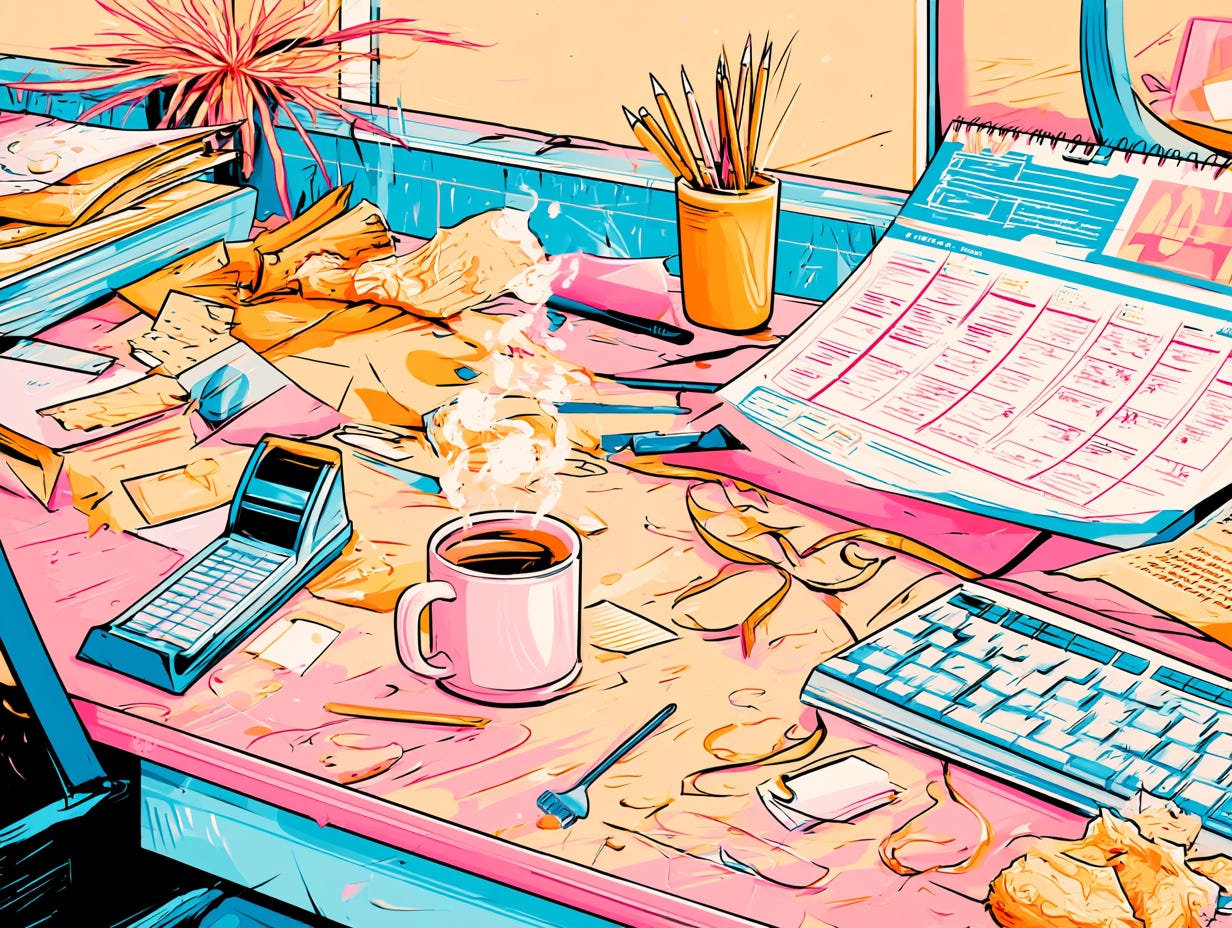
I have been thinking a lot about intelligence, which is a risky thing to do before coffee….
Okay, I’m back. Coffee crisis averted.
Now where were we? Oh yeah, intelligence. Specifically, I have been thinking about how often we confuse being well-spoken with being smart.
The title nods to David Sedaris’s “Me Talk Pretty One Day,” about trying to learn French in a classroom full of smart adults temporarily reduced to speaking like concussed toddlers. What I love about the essay is how cleanly it separates fluency from intelligence. The students are funny, observant, anxious, and trying very hard not to die of shame. They just cannot yet make the language behave. The mind is moving faster than the mouth. The sentence comes out mangled, but the person is not mangled. The intelligence is still there, waving helplessly from behind a pile of broken verbs.
We too often equate fluency with intelligence.
Someone has the “right” vocabulary, the “right” degree, the “right” accent, the “right” professional polish, and we assume they know what they are talking about. Someone else pauses, searches for words, speaks with an accent, lacks formal credentials, or otherwise communicates in a way that does not match our expectations. We silently downgrade their intelligence. We may even know better. Still, the bias is there.
Fluency gets treated as evidence.
This was already a problem before ChatGPT took the world by storm. AI just made it weirder.

Large language models are astonishingly fluent. That is part of what makes them useful. They can draft, summarize, translate, explain, rephrase, organize, brainstorm, and sound brilliant while doing it. Sometimes they come across more organized than my actual brain, which is both helpful and kind of embarrassing.
But fluency is not intelligence.
A model can produce beautiful language and still misunderstand the task. It can sound authoritative and still be wrong. It can summarize a situation without grasping the thing everyone in the room is afraid to say. It can generate a communication plan and miss the emotional weight of the message. It can analyze a transcript and miss the silence.
Don’t get me wrong. That does not make language models useless.
I use them constantly. I love them. I also want us to understand what kind of intelligence they represent and what kinds they do not.
Because public health cannot afford to mistake eloquence for understanding.
Years ago, I worked on a community-wide diabetes program.
We asked health care providers what they thought the problem was. Their answer was familiar: patients did not know how to manage their diabetes. They ate too much sugar. They did not check their blood sugar. They were not doing what they were supposed to do.
Then we talked to patients.
They told us something very different.
They could not get appointments at the clinic. The next available visit was often months away. But they had figured out that if they ate a ton of sweets and showed up as a walk-in, the triage nurse would check their blood sugar. Then they could get in to see the doctor that day.

Let’s think about that for a minute.
From one angle, the behavior looked like poor disease management. From another angle, it was a highly practical workaround in a system with too little capacity.
The patients understood their bodies. They understood the clinic. They understood the rules, written and unwritten. They understood how to get care from a system that was making care hard to access.
If we had relied only on what the providers told us, we would have misunderstood the problem.
The real intelligence came from putting the pieces together: language, behavior, incentives, power, access, trust, physiology, and the creativity people use to survive bad systems.
That is public health intelligence.
It is not simply what people say. It is what their choices reveal about the world they are navigating.
I have always been someone who notices the small things.
A held breath. A shift in posture. A passing expression. The way someone folds their arms or takes up space or tries very hard to take up less of it.
I do not always know I am noticing these things in the moment. Often, I just feel the room change.
This is not the kind of intelligence that shows up on an IQ test. It is certainly not the kind that shows up in a writing sample. It is not fluency. It is not vocabulary. It is not the ability to make a tidy argument in three bullet points.
Feeling is still a form of knowing.
Public health work depends on this kind of knowing more than we like to admit. So does leadership. So does care.
People do not always say what they mean. Sometimes they cannot. Sometimes they do not yet know what they mean. Sometimes they are protecting themselves. Sometimes they are talking to a person with power and giving the answer that feels safest.
If we focus only on words, we miss the breath before the answer.
We miss the glance across the room.
We miss the community leader who says, “That sounds fine,” in a tone that means absolutely not.
Language matters. Of course it does.
But language is just one channel. Human meaning moves through many channels.
I like to paint.
When I am painting, I make decisions constantly. Which color. Which brush. How much pressure. Which direction. Whether to leave a mark alone or keep working it until I ruin it, which I do with admirable consistency.
Most of those decisions do not arrive as sentences.
I am not standing there thinking, “Now I shall apply a moderate amount of blue with a medium brush at a forty-five-degree angle to express visual tension.”
Absolutely not. Nobody should have to paint next to that person.

The thought is more abstract than that. It lives in the hand, the eye, the body, the color, the motion, the feeling of too much or too little. I could narrate it afterward. I could try to explain it. You could set up a camera, record my brush strokes, analyze the chemical composition of the paint, measure the movement of my arm, and capture the sound of the room.
You would have data.
Would you have captured the process of creating a beautiful painting?
No way.
This is where AI conversations can get too narrow.
The version of AI most people have encountered is language-based. ChatGPT made AI feel like a conversation. For many people, AI now means a chatbot that answers questions in complete sentences.
That is understandable. ChatGPT was many people’s front door to AI.
It is also incomplete.
Some AI systems are built to work with numbers. Some work with images. Some work with sound, video, movement, signals, spatial patterns, biological data, weather data, satellite imagery, and combinations of all of the above.
In public health, that matters.
A model analyzing a large public health dataset is not doing the same thing as a chatbot drafting a grant proposal. An AI system looking for patterns in medical images is not doing the same thing as an LLM summarizing a report. A tool using weather patterns, satellite imagery, land use, or environmental signals to help predict dengue risk is working with a different kind of intelligence than a tool generating text.
Some problems need language.
Some need numbers.
Some need space.
Some need vision.
Some need time.
Some need a human being who understands why the official story and the real story are not the same story.

This is one reason I found Fei-Fei Li’s book, The Worlds I See, so useful. Her path into AI did not begin with chatbots. It began with vision: how humans and machines see, recognize, classify, and make meaning from images. Her work on ImageNet helped shape modern computer vision and deep learning.
That history is important right now because it reminds us that AI has never been only about language.
Li has also been arguing that one of AI’s next frontiers is spatial intelligence: the ability to understand, generate, reason about, and interact with the three-dimensional world. In her essay “From Words to Worlds,” she describes large language models as powerful, but also “wordsmiths in the dark; eloquent but inexperienced, knowledgeable but ungrounded.”
Eloquent but ungrounded.
Public health should pay attention to that distinction.
Our work is grounded work. It happens in homes, clinics, schools, mobile vans, shelters, food pantries, churches, community meetings, call centers, sidewalks, waiting rooms, and living rooms. It happens in histories, relationships, neighborhoods, weather, transportation routes, staffing shortages, grant cycles, distrust, grief, humor, workaround knowledge, and the three forms everyone forgot to translate.
A fluent answer may help.
It may also float several feet above the ground where the actual problem lives.
I know this seems counterintuitive, but even communication is not always best understood as a language task.
Yes, communication uses words. But public health communication is not simply the act of selecting accurate sentences.
Risk communication, health education, health awareness campaigns, advocacy, and community engagement carry emotional weight. They carry responsibility. They shape whether people feel respected, frightened, shamed, supported, manipulated, or seen.
Maya Angelou is often quoted as saying that people may forget what you said and what you did, but they will never forget how you made them feel.
Every public health professional charged with communicating with the public should have the quote tattooed on the inside of our eyelids.
An LLM can help draft a message. It can offer versions at different reading levels. It can translate jargon into plain language. It can summarize what people are saying online about a disease outbreak or identify patterns in how a community describes a health concern.
That is useful.
But the words are not the whole message.
The message also includes tone, timing, trust, messenger, history, fear, grief, power, and whether the person receiving it believes you understand anything about their life.
If we use LLMs to flatten public health communication into “the right words,” we will miss the point.
Worse, we may sound technically correct and emotionally vacant.
So where does this leave public health leaders?
I think it leaves us with a more interesting responsibility than “learn how to use ChatGPT.”
We need to understand what kind of intelligence a public health problem requires.
For large-scale numerical patterns, we may need statistical modeling, machine learning, or epidemiologic analysis.
Environmental risk may call for spatial data, satellite imagery, weather patterns, and models that can detect relationships across place and time.
Image-based problems may need computer vision.
Language tasks may be a good fit for LLM support.
Problems involving trust, grief, stigma, culture, fear, power, or meaning require extra caution before we decide the right tool is the one that writes the fastest paragraph.
Public health leaders do not need to become machine learning engineers.
Please, no.
But we do need enough AI fluency to stop treating all AI as one thing.

We need enough fluency to ask better questions:
What kind of intelligence does this task require?
What kind of AI is being proposed?
What does it measure?
What does it miss?
What human knowledge needs to stay in the room?
Who might sound less fluent and still understand the problem better than anyone else?
Where are we confusing a polished answer with a grounded one?
That last question may be the most important.
AI is moving quickly beyond language. It already sees, classifies, predicts, detects, translates, generates, simulates, and increasingly interacts with the world. Some of that will be extraordinarily useful for public health. I am excited about it.
I want public health people in those conversations early, often, and with confidence. But confidence should not mean being dazzled by fluency.
It should mean knowing that intelligence has many forms. It can sound polished, notice the room, see patterns in numbers, or read a landscape. It can live in a community’s memory of what happened the last time an institution promised help. It can know how to get a doctor’s appointment in a system that has made ordinary access nearly impossible. It can choose the right shade of blue without ever turning the choice into words.
Public health needs all of it.
The future of AI in public health will depend partly on better tools.
It will depend even more on leaders who know which forms of intelligence a tool can support, which ones it cannot, and which ones must never be pushed out of the room.
p.s. I just reached a major Substack milestone: 200 subscribers! Thank you for being part of this community. Please invite your friends and colleagues to subscribe and join us.
Share Transforming Together: Public Health in the AI Era
Disclosure: This article was a collaboration between me and Claude with me doing most of the heavy lifting. The images were generated by Midjourney with a style reference photo and the following prompts in the order they appear: 1990 office desk with steaming cup of coffee, rolodex, and large desk calendar; 1999 flip phone being pulled out of a man's back jeans pocket; brightly lit college library; messy artist’s desk (with a reference image of my own painting desk); paper road map open on a car dashboard; blackberry handheld phone; and 1995 home desktop computer.
No posts
Comments
Nothing yet. Say the first thing.
Sign in to join the conversation.