
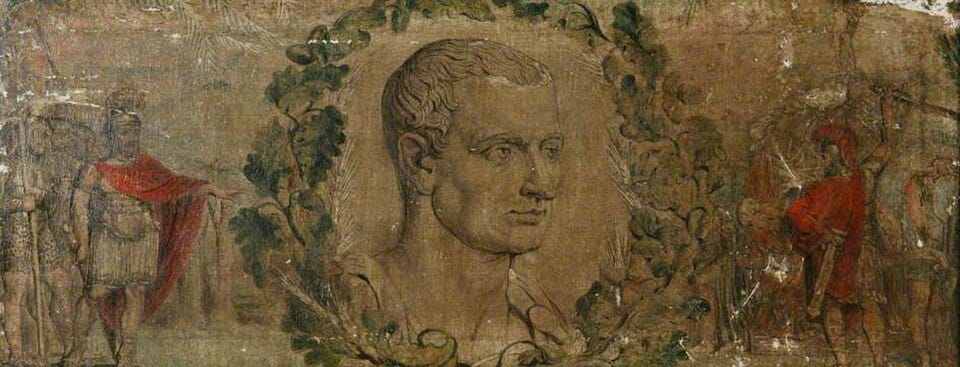
While natural law is commonly associated with the Catholic Church, as the name suggests, the knowledge of, discussion of, and history of the concept of natural law long predates the existence of the Catholic Church. In reality, many of the best pre-Christian pagan thinkers came to have some knowledge of the natural law and were able to develop concepts of it that were then expanded by Christians in later centuries. In this essay, we will focus on two such figures: Aristotle, the most famous of the Greek philosophers, and Cicero, perhaps the most famous classical Latin author. We will examine Aristotle’s brief references to natural law concepts in the Nicomachean Ethics and the Rhetoric and see how Aristotle grasped some basic truths of the natural law such as its universality. Then, we will examine Cicero’s more fully fledged theory of natural law, briefly compare the two, and show their consonance with the later natural law tradition as enunciated by Thomas Aquinas.
According to Thomas Aquinas, the natural law is man’s participation in God’s eternal law. He writes in the Summa theologiae that,
Now among all others, the rational creature is subject to Divine providence in the most excellent way, insofar as it partakes of a share of providence, by being provident both for itself and for others. Wherefore it has a share of the Eternal Reason, whereby it has a natural inclination to its proper act and end: and this participation of the eternal law in the rational creature is called the natural law.
The natural law is thus something which is defined with reference to God and to man’s reason. From this passage in Aquinas we can list several distinctive features of the natural law. First, it is universal both by being from God who is provident over all things and also since man’s reason is universal among mankind as that which specifies the nature of man. Natural law is something that men can come to know through their reason and so is at least in some capacity accessible to all.
Aquinas further notes that the natural law consists firstly in one universal precept and in a number of inclinations. Since the natural law has to do with human action and thus with the practical intellect, and since the practical intellect first apprehends good or being under the aspect of desirability, the first principle of the natural law is “good is to be done and pursued and evil is to be avoided.” Beyond this one principle, because men are living creatures, they will naturally perceive certain things such as self preservation as good. Aquinas lists self preservation, reproduction and education of offspring, knowing truth, and living in society as basic inclinations of the natural law.
Aquinas then relates the natural law to virtue and says that broadly speaking, all acts of virtue are prescribed by the natural law. The natural law, being universal and not specific, does not specify how to use modern medicine to eat healthily and so does not prescribe all virtuous action. Nevertheless, insofar as man’s nature inclines him to be virtuous, we can say the natural law prescribes virtue.
Lastly, Aquinas speaks to the universality and unchanging nature of the natural law by noting that in its common principles it is both unchanging and the same for all men. In particular cases, certain aspects of the natural law may not be known to all men, or may not apply to all men. Thus, in some respect the natural law is unchangeable and in another respect it is changeable. Having examined Aquinas’s presentation of the natural law we can now ask whether and to what degree such a concept was present in Aristotle and Cicero.
The passage in Aristotle’s corpus that relates most directly to the natural law is book 5 of the Nicomachean Ethics during a discussion of justice. In this passage, Aristotle distinguishes between natural and conventional justice. Aristotle says,
Of the just in the political sense, one part is natural, the other, conventional. The natural [part of political justice] is that which has the same capacity everywhere and is not dependent on being held to exist or not, whereas the conventional part is that which at the beginning makes no difference whether it is thus or otherwise, but once people have set it down, it does make a difference; for example, the sum of money to offer for ransom, or to sacrifice a goat rather than two sheep, or further, all that people legislate in each particular case–for example, to sacrifice to Brasidas, and specific decrees. In the opinion of some people, all [just things] are of this character, because what is by nature is unchangeable and has the same capacity everywhere, just as fire burns both here and in Persia, whereas they see the just things being changed. But this is not the way it is–or rather, it is this way in a sense while among the gods, at any rate, it is perhaps not all this way among us there is in fact something that is [just] by nature, though it is altogether changeable. Nevertheless, in one respect it is by nature, in another it is not by nature.
This passage has been difficult for commentators. As John Koritansky notes, “Probably no passage in all of Aristotle’s moral and political writing has tested the powers of interpretation among his commentators so much as his statement, in chapter 7 of Book V of the Nicomachean Ethics, that natural justice is changeable”Aristotle, it seems, believes that there is a kind of justice which is universal and not merely “conventional”, that is “by nature”, and is not dependent on whether people hold to its existence or not. However, this law is “altogether changeable”. Aristotle here seems to be affirming the existence of the natural law.
Some disagree with this interpretation however. Howard Tuttle for instance claims that Aristotle is actually a legal positivist and that this “changeable” natural law cannot “serve as a stable criterion by which the positive law could be either nullified or sanctified.” According to Tuttle, to interpret Aristotle as referring to what is commonly known as the natural law would make his political philosophy incoherent since many other passages in Aristotle suggest that law must be promulgated by humans for it to apply.
Koritansky lists three major schools of thought in the translation of this passage, the Thomistic, the Avveroistic, and the Straussian. Aquinas as we saw argues that the natural law changes not in its basic principles but can change due to very specific circumstances. For instance, while I might naturally owe back what I borrowed, if I borrowed a weapon from a friend whom I know will now use it to murder, I ought not give the weapon back. An Avveroistic reading according to Koritansky the natural law is ultimately conventional but some laws e.g. murder being prohibited are universal. Lastly, Leo Strauss argued that Aristotle was referring to extreme situations regarding the common good that would require as a matter of justice something that went beyond commutative or distributional justice. Koritansky for his part argues that the “changeability” of the natural law is due to the imperfection of human nature. While we cannot settle all of the interpretive disputes about this passage here, we can make a few remarks that affirm some unchangeability in the natural law contra Tuttle.
First, as Kortisansky is right to point out, Aristotle cannot be a mere conventionalist as Tuttle would have it since Aristotle clearly sees a unity in human nature and what the best form of living is. The Ethics clearly has a view to what is best for man since in book X Aristotle discusses contemplation as the way to achieve true happiness. This view of human nature directly informs his view of law since it is laws which are required to bring about a virtuous populace. Aristotle links law directly with human nature and human flourishing at the end of the Ethics and then takes up the rest of that discussion in the Politics. At various points Aristotle discusses the best types of regimes. For there to be a best or worst kind of regime implies some standard outside of human law by which one could judge the regime. From this it is clear that Tuttle’s positivistic reading of Aristotle is implausible. Second, we can take a look at two other passages in Aristotle that directly bear on the discussion of natural law and see further confirmation that Aristotle had something like natural law in mind even if he did not fully express the concept as later thinkers did.
Aristotle references “common law” in his Rhetoric at 1368b8 in a discussion of unjust action. While Aristotle does not use the term “natural law”, the koinos nomos here seems to be a very similar concept. Aristotle writes that law is either common or private. Common law is “the unwritten laws which appear to be universally recognized.” Here Aristotle gives another feature of the natural law, its universality among human recognition along with its being “unwritten”. Clearly this “law” is distinct from any written human law. The fact that Aristotle explicitly refers to “law” here reinforces the notion, contra Tuttle, that Aristotle was not a legal positivist.
Seagrave points to another passage in the Ethics that implies the natural law. Namely, in Aristotle’s discussion of unrestrained individuals in book 7. Here Aristotle is discussing the relation between knowledge and action and considers a case when a “universal opinion” which is present in men that “hinders” them from certain actions. For Aristotle, there are universal norms to which virtuous human acts are in line and against which are the actions of unrestrained men. While not explicitly called natural law, this concept is quite close to it, and as we will see, will be taken up in Cicero’s writings on the natural law.
The first clear references to natural law or a law of nature occur in the first century AD in Roman philosophical writing. Cicero is the most prominent such thinker to clearly mention natural law and does so in his work On Invention. Cicero writes,
We must consider the sources of law. The origin thereof appears to be in nature. Certain principles either obvious or obscure to us have by reason of advantage passed into custom; afterwards […] confirmed by statute. The law of nature is implanted in us not by opinion, but by a kind of innate force, including piety, kinship, gratitude, revenge, respect and truth.
Cicero expands on this concept of a law of nature in his works relating directly to law and government. There are a number of passages in Cicero’s works De Re Publica and De legibus that discuss the concept of natural law. By Cicero’s time, the concept had gone through a number of developments in the minds of Stoic, Epicurean, and other thinkers in Greek and Roman society. Cicero’s most famous passage in De Re Publica is from book III where the character Laelius states,
True law is right reason in agreement with nature; it is of universal application, unchanging and everlasting; it summons to duty by its commands, and averts from wrongdoing by its prohibitions. And it does not lay its commands or prohibitions upon good men in vain, though neither have any’effect on the wicked. It is a sin to try to alter this law, nor is it allowable to attempt to repeal any part of it, and it is impossible to abolish it entirely. We cannot be freed from its obligations by senate or people, and we need not look outside ourselves for an expounder or interpreter of it.
Here we can see that Cicero explicates more of the concept of law and its relation to nature than does Aristotle. Here true law is not just “universally recognized” but also explicitly “unchanging” and binding upon men. Not only is it impossible to escape this law but to try to do so would be sinful. It is also clearly identified with “right reason” and it has binding force on men through commands and prohibitions. It is impossible for this law to be destroyed which implies that in is in some way beyond man.
Cicero also explicitly connects the natural law with God. Laelius continues the above quotation with this,
And there will not be different laws at Rome and at Athens, or different laws now and in the future, but one eternal and unchangeable law will be valid for all nations and all times, and there will be one master and ruler, that is, God, over us all, for he is the author of this law, its promulgator, and its enforcing judge.
Here Cicero goes beyond Aristotle by directly referring to God in relation to the natural law. Indeed so strong is the language in this passage that Laelius seems to make the natural law merely the divine law with God as its “enforcing judge”. However, as Seagrave notes, the fact that we “need not look outside ourselves for an expounder or interpreter of it” still safeguards the concept as natural. In other passages, Cicero reaffirms the close connection between human reason and true law. “[T]he highest reason, implanted in Nature, which commands what ought to be done and forbids the opposite. This reason, when firmly fixed and fully developed in the human mind, is Law.” This universal law then is not some mere divine command, but “implanted in Nature” and is identified as “reason”.
Cicero also connects the natural law with virtue and builds upon Aristotle’s thought regarding human weakness. For Cicero, the natural law exists as both a rule of action in accord with human nature and by specific commands of reason that men have in specific circumstances. Cicero like Aristotle, recognized the possible disconnect between reason and man’s passions and he is able to derive from this account of human nature and the relationship of reason to actions an account of the natural law.
Cicero then affirms both the universality and the normative power of the natural law that were found in Aristotle. He goes beyond Aristotle by directly relating the natural law with God and by more clearly articulating the connection between law and right reason.
Since the era of modern philosophy, it has become fashionable to sharply divide Cicero and Aristotle and pit one against the other. However, a number of scholars have questioned this assessment and instead argued for greater continuity and development between Aristotle and Cicero. On the whole, Cicero certainly admired and took much from Aristotle’s philosophy. Walter Nicgorski notes that while Cicero does differ from Aristotle on a few points, “[T]he hesitancies of Aristotle must be ferreted out of a few places; the support of Aristotle and the Peripatetics for rhetoric and their contributions to the development of the art are frequently in evidence.”
When it comes to the issue of natural law in particular, Adam Seagrave has shown that Aristotle’s view of human nature and reason both feature prominently in Cicero’s account of human action and natural law. Aristotle’s account of nature, choice and virtue is mirrored by Cicero substantially. Seagrave summarizes the connection between them well,
Aristotle’s thought seems to approach a concept of natural law. Although Aristotle did not arrive at this concept himself, Cicero shows in his writings that the notion of law is indeed implicit in an Aristotelian account of human nature.9 ‘ In this way, then, Cicero lays the foundation for natural law theory on the soil of Aristotle’s nature.
Having looked at both ancient thinkers, it is now appropriate to see how their ideas relate to the natural law theory as it was put forth by Thomas Aquinas. We saw that in Aristotle, the unwritten common law was universal and perceived by all men. Moreover, there are certain universal norms which humans grasp that forbid certain actions. By right reason, men come to know these norms properly. While Aristotle does not explicitly mention “natural law”, the concept is there in seed form.
We also saw how Cicero, whose thought is largely consistent with Aristotle’s and informed by it, expanded this concept of law by explicitly affirming its binding power on all men, its unchangeable nature, and its relation to God. However, Cicero’s account of the natural law is not the final developed form of that concept. As Seagrave notes, “That which is present in Cicero’s derivation of the natural law in a relatively superficial and conjectural manner is thus present in a fundamental and certain manner for St. Thomas.”
Seagrave concludes,
If Cicero had not shown that an Aristotelian understanding of human nature was compatible with, or even implied, a theory of natural law, St. Thomas would likely have lacked the resources necessary to distinguish the natural law as a kind of law distinct from both the eternal and divine law. Thomistic natural law is, then, a developed statement of a “traditional” natural law theory which counts Cicero,and Aristotle through him, as its founding member.
Aquinas’s theory of natural law is more robust than either Cicero and Aristotle in part because Aquinas could integrate it into a larger system. Aquinas had a very robust view of God and numerous proofs of his existence from reason. While God features in both Aristotle and Cicero’s thought, he does so much more speculatively than in Aquinas where he is known both by faith but also by numerous demonstrations. It is therefore easy for Aquinas to link the natural law with God’s eternal law since God’s providence has already been established extensively in the Summa at that point.
The growth of the idea of natural law from Aristotle to Cicero to Aquinas is a good example of the development of doctrine. Over time, the notion of natural law, only implicit in Aristotle, was fleshed out in Cicero and then became highly developed in Thomas Aquinas’s thought.
In summary, we have looked at two of the most important classical philosophers and their views on the natural law. Aristotle had a real but undeveloped concept of natural law and, while not using that phrase clearly held that humans knew of a law that transcended human law and was universal though in some way “changeable.” Cicero developed his concept of natural law much further than Aristotle and explicitly used the phrase in his writings. Cicero directly identifies the natural law as something that is from God and states that human laws must conform to it. Between both thinkers, the broad foundation of the natural law that would be taken up by Catholic theologians such as Thomas Aquinas was laid. While neither Cicero nor Aristotle nor Aquinas’s views on the natural law are identical, they are in general agreement, each later thinker bringing more precision to the notion than his predecessors.
Aristotle. Nicomachean Ethics. Translated by Robert C. Bartlett and Susan D. Collins. Chicago: University of Chicago Press, 2011.
–––, Rhetoric. Translated by John Henry Freese. Cambridge, MA: Harvard University Press, 2020.
Aquinas, Thomas. Summa theologiae. Translated by Fathers of the English Dominican Province. New York: Benzinger, 1948.
Brouwer, René. “The Normativity of Law in Nature Revisited: Natural Law in Late Hellenistic Thought.” Ancient Philosophy Today 4 (December 2022): 91–110.
Cicero. De re publica; De legibus. Translated by Clinton Walker Keyes. Loeb Classical Library. Cambridge, MA: Harvard University Press, 1928.
Koritansky, John C. “Natural Justice and the Nature of Justice in Aristotle’s ‘Nicomachean Ethics.’” Interpretation: A Journal of Political Philosophy 44, no. 2 (2018): 233–56.
Nicgorski, Walter. “Cicero on Aristotle and Aristotelians.” Magyar Filozófiai Szemle 57, no. 4 (2013): 34–56.
Seagrave, S Adam. “Cicero, Aquinas, and Contemporary Issues in Natural Law Theory.” The Review of Metaphysics 62, no. 3 (247) (2009): 491–523.
Tuttle, Howard N. “The Problem of Natural Law in Aristotle.” Southwest Philosophical Studies 3 (April 1978): 75–78.
No posts
Comments
Nothing yet. Say the first thing.
Sign in to join the conversation.