

Fresh off a victory lap with his Groq bet, Chamath Palihapitiya recently characterized buying California municipal credit default swaps (CDS) as “the most asymmetric upside bet in the market now,” predicting that revelations of budget fraud will force borrowing costs higher and deliver “10-1000x returns with relative ease.”
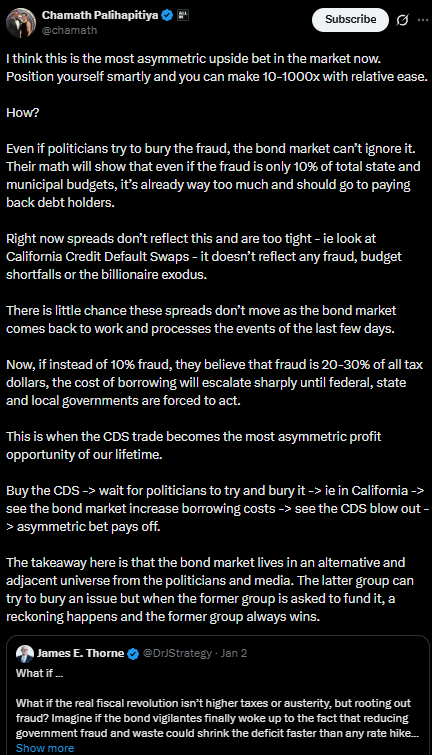
CDS are sexy instruments popularized by the Big Short, and the theoretical payouts are—on paper, anyway—eye watering. But does the California CDS thesis hold water?
In our opinion, no. While there is likely a great deal of fraud in the California budget, we think that Chamath overlooks key mechanics of CDS instruments. Chamath appears to be reacting to the recent Minnesota daycare fraud charges; he then reasons that California must be hiding proportionally larger budget fraud (reasonable), and concluded “this is bad, so CDS should widen.” While the intuition is understandable, that chain of reasoning in and of itself doesn’t translate into a defensible trade thesis for California CDS.
Even if California’s budget contains massive fraud, the direction of the trade depends entirely on what happens after the fraud is exposed. Novices might mistake the discovery of fraud in government books for an immediate credit negative trigger, but that may not necessarily be the case.
CDS do not inherently price morality or incompetence; they price changes in a borrower’s ability and willingness to service debt. CDS do not care about how money was spent, only whether future debt service is more or less likely to be paid, on time, in full. CDS spreads widen when credit quality deteriorates—such as when borrowers increase leverage or revenues fall. If fraud represents 20-30% of California’s budget—as Chamath suggests, and which would not entirely surprise us—then those fraudulent numbers are already baked into the state’s current spending and debt levels.
There are two types of income statement fraud: revenue fraud, and expense fraud. Revenue fraud is clearly credit negative. Expense fraud, on the other hand, is trickier. Unless those fraudulent expenses were directly driving revenue, eliminating them could be neutral—or possibly even positive—for bondholders. Imagine a company discovers that one of their employees has been funneling payments to a phantom vendor they control—once exposed, that pure waste can be eliminated without impacting actual operations, which improves the company’s ability to service its debt.
Exposing expense fraud, therefore, doesn’t inherently cause a deterioration in government credit quality. Rather, it reveals that the state has been operating with inflated budget expenses, which means they may now may have room to cut spending, reduce future borrowing, and—at least in theory—even improve their actual credit quality profile.
The first-order effect of exposing fraud in California is therefore potentially even slightly credit positive—it identifies waste that can be cut or possibly even clawed back.
For CDS spreads to really blow out as Chamath predicts, the discovery of fraud would need to reveal new liabilities we didn’t previously know about—not just explain the bloated inefficiency we can already see. The only genuinely CDS-relevant fraud revelation would be one that forces a restatement of liabilities or reveals legally binding obligations not previously priced. Alternatively, it would need to trigger catastrophic second-order effects such as tax revenues plummeting as people flee the state, fraud ballooning as honest citizens decide to join the grift, or the discovery of hidden off-balance sheet debt.
That’s certainly possible—and, to be clear, the state of California is a basket case—but that isn’t really the core of Chamath’s thesis. He’s betting that negative headlines about budget fraud, in and of themselves, will spook credit markets into repricing California’s creditworthiness. To move CDS, the discovery of fraud must change the forward distribution of outcomes, not reclassify past (and current) expenses. A CDS trader would likely look at the headlines and conclude that the news is neutral—or perhaps even that CDS spreads have room to modestly tighten, not widen—absent second-order effects.
The mistake in Chamath’s framing is jumping straight to the payoff convexity without mapping the event path—namely, timing of the catalysts, and the direction and rate of change of fundamentals such as tax revenues and expenses.

While Chamath bets on the chaotic unraveling of California state fraud, we can turn our attention to more reliably asymmetric CDS trades. These trades occur when you can foresee capital structure changes before credit markets price them in. Chamath’s trade offers higher absolute payoff asymmetry, but the asymmetry of expected value—accounting for likelihood—is far more important. He’s chasing lottery tickets while activist CDS trades are more like betting on dice loaded in your favor.
This type of trade played out repeatedly from 2006-2016, lay relatively dormant until recently, and is potentially staging a comeback—more on this soon. Activists paired equity positions with credit default swaps on the same underlying company, a position that profits when the activist’s own demands—for example, share buybacks funded with debt, leveraged dividends—increase the target company’s leverage.
When Elliott files a 13D disclosing a 5% stake (or leaks their playbook/intentions) in a struggling company, the disclosure moves the stock and dominates headlines, as we explored in our recent piece on 13F filings. The disclosed equity stake is analytically dissected from every angle while the more interesting trade happens in an instrument most observers never see: credit default swaps.
Elliott’s 13D filing might reveal a 5% equity position, but it might be paired with a hidden CDS position—not shown in the filing—sized for potential returns that dwarf those offered by the equity: the stock could grind up 20-30% over months as the activist campaign plays out, while CDS spreads could widen 200-300% in weeks as the company takes on debt to fund the stock buyback program the activist demanded.
In our piece on Oracle CDS, we explored how credit instruments serve as informational signals—protection bought early, when cheap, by actors who can’t afford to be surprised or who see risks others miss.
The activism CDS trade is the flip side of this. The activist creates its own self-fulfilling catalyst while observers watch the stock. The CDS position captures the catalyst in the instrument with maximum sensitivity to leverage changes. The shorts and hedges neutralize market risk.
When companies assent to activist demands for aggressive share buybacks or a leveraged dividend, the company’s debt-to-EBITDA ratio deteriorates. Credit spreads are more sensitive to changes in leverage ratios than are equity valuations. A company taking on $500 million in new debt to fund buybacks might see its stock rise 20% as the market applauds “shareholder friendly” capital allocation. That same action could push 5-year CDS spreads from 100bps to 300bps as credit markets reprice the deteriorating balance sheet. A sophisticated activist could profit from both legs of the trade.
There is timing asymmetry, too. Equity stories take time—activist files, board resists, proxy fight looms, settlements are negotiated, buybacks are announced, shares are repurchased over quarters. Credit markets begin repricing the moment the leverage increase becomes likely. By the time the equity has moved 20%, the CDS position has often captured most of its theoretical gain.
The sophisticated element of this trade has less to do with financial engineering and more to do with understanding how executives behave under pressure.
Once an activist does file a 13D (or leak their intentions), the clock starts ticking down until the proxy calendar. Management has limited time to settle before the fight goes public and proxy advisory firms weigh in. ISS and Glass Lewis have become increasingly sympathetic to activist proposals on basic governance and capital allocation questions. Directors who might otherwise resist activist approaches start contemplating their own reputational risk and conclude that capitulation beats public defeat.
Management has three ways to respond to activist pressure, but for a debt-based activist strategy all lead to increased firm leverage:
Quick settlement: Settlements occur more frequently than drawn-out battles. CDS spreads might widen 30-50bps rather than 200-300bps. Base hit instead of home run, but still profitable.
Preemptive capitulation: Sometimes boards anticipate the activists before the 13D is filed, and the company preemptively announces everything the activist would have demanded anyway—for example, see our recent piece on ZoomInfo.
The board forms a capital allocation committee. Buyback authorizations are announced to demonstrate shareholder focus. “We were already planning this capital return program.” The CDS trade still works because the leverage playbook gets executed regardless of who claims credit—activist or management.
Entrenchment: The home run scenario unfolds when management digs in. They either seek a white knight private equity bid—which incurs instant leverage and a blow out in CDS—or they try to outflank the activist by front-running the demands.
Sometimes, management teams panic and their response to activist pressure is even more extreme than what the activist requested. Nothing says “we’re serious capital allocators” quite like announcing a $1 billion buyback program funded with new debt. The activist gets what they wanted without a proxy fight, and the CDS position pays off asymmetrically because management overreacted to the threat.
This trade structure works best in exactly the companies where it superficially seems riskiest—struggling businesses with deteriorating fundamentals and lagging stock prices.
When a company’s stock has dropped 30-40% from its highs, management convinces themselves they’re being handed an opportunity. The stock is “cheap” at these levels—seemingly the perfect time to buy back shares and demonstrate intelligent capital allocation to skeptical shareholders. An activist demanding exactly what management already wanted to do anyway makes capitulating easier to justify.
The CDS trader sees this clearly. The stock fell for a reason: negative earnings revisions, eroding competitive position, accelerating customer churn. A lower stock price means nothing if the business is fundamentally broken. But executive compensation ties to EPS and stock price, so buybacks help the denominator even when they destroy long-term enterprise value. Management will take on debt to repurchase shares, framing value destruction as opportunistic capital allocation while engineering their way to compensation targets.
Debt-to-EBITDA climbs while EBITDA itself stagnates or declines. Credit quality deteriorates. The CDS position pays out precisely because management makes decisions that goose per-share metrics at the expense of actual credit quality.
This explains why certain companies become repeat activist targets. Management runs the leverage playbook, the activist exits, management reverts to old habits, the stock underperforms, and another activist runs the same trade. Private equity firms, too, run similar playbooks en masse.
Chamath looked at the fraud and assumed bad news = wider spreads. He fixated on payoff convexity—the 10-1000x upside if everything breaks his way and the market questions California’s solvency.
But asymmetry of payoff magnitude means little if the majority of likely outcomes aren’t favorable. More experienced CDS traders focus on probabilities, not just payouts—the full distribution of possibilities and their relative likelihood matters more than any given attractive scenario. They think through the timing, event path, and why spreads would widen.
The activism CDS trade works—and more importantly, rarely loses—because it has multiple event paths to profit and almost no path to loss. Actual losses for the activist on a trade setup like this are exceedingly rare. For losses to occur, management would need to tell the activist to pound sand, make zero concessions, implement zero leverage-increasing actions, and survive a proxy fight—all while ISS and Glass Lewis voting guidelines increasingly favor activist proposals on governance and capital allocation.
In contrast, Chamath’s thesis has few paths to profit, namely: the fraud revelation leads to increasing fraud at an accelerating rate; off-balance sheet debt is discovered; taxpayers accelerate flight due to fraud revelations. That’s a negative carry directional bet with uncertain timing and event path. He could very well be right about California’s fraud and long-term financial instability, but the path to truly asymmetric payout is narrow and negative carry erodes returns while waiting—death by a thousand basis points.
Real edge in credit markets—even for states like California—comes from understanding the relationships between governance, incentives, and capital structure. It comes from diligently reading bond covenants and mapping them to predictable catalysts. It comes from positioning before the leverage increase becomes obvious to everyone watching headlines. Only rarely—and after much experience—does edge come from reacting to headlines.
We’ll be writing more on governance, activism, dark arts trades, and investment process. We’ve also written about tokenization, Formula One, the NBA, and sometimes just tell a story worth remembering. Stay tuned.
No posts
Comments
Nothing yet. Say the first thing.
Sign in to join the conversation.