
Do you ever feel like an idiot when people start talking about AI agents, automations, MCPs, vibe coding, system architecture, super agents, and whatever new ai tool showed up on Tiktok or LinkedIn this morning?
Good.
Everyone does.
We’re in this strange moment where knowing slightly more about than the next person suddenly makes you look like an expert. That’s exciting… and it’s also dangerous.
I invest in this space directly, Lovable is in my portfolio, and I’m closing a position in Nectar AI right now. I’m not looking at this market from the outside. I fund the companies building the actual infrastructure. And even from inside it, finding people who can build — not just talk — is genuinely hard.
That’s not me admitting I’m behind. It’s the actual state of the market. Six months building a few no-code automations and you can call yourself an integrator. A couple of workflows in Zapier, Make, or n8n and suddenly you’re an “AI automation architect.” This isn’t new, either—When I was younger, companies paid hundreds of thousands of dollars to build websites that someone can now build alone in a weekend using a no-code platform. The price was not only about the complexity of the work. It was about the fact that almost nobody else knew how to do it.
We are in that moment again.
The language is new. The tools are changing every week. The gap between people who know nothing and people who know slightly more feels enormous. But everyone is still learning, and many of the people selling themselves as AI experts are only a few steps ahead. And most people hiring for it can’t yet tell the difference between someone who can actually build and someone who just learned the language, which means most people are hiring on vibes.
So how do you avoid hiring someone who knows how to talk about AI but cannot actually build anything useful?
Here is what I have learned.
It isn’t IQ. I’ve met plenty of very smart people who build things nobody can use. It’s IQ plus EQ. I would ask a very basic question: “What will this actually look like when it is working?”
Instead of a basic answer, I would hear about one platform connecting to another platform, which would then trigger an automation that would feed into an agent connected to some future dashboard.
Fine. But where do I go?
What do I see?
Does the answer appear in Slack? Is there a dashboard? Does it send me a report?
A person can know every technical step and still have no idea how to build something people will actually use.
If they can’t tell you what it looks like when it’s done — not the architecture, the actual experience, what changes on your screen Monday morning — they haven’t finished thinking it through. That’s not a knowledge gap. That’s an incomplete strategy dressed up as a finished one.
Not a deck. Not a diagram. Not a list of what they plan to build. Show me what you have already built. Walk me through it. Use it in front of me. Show me how it works in your own company, your own workflow, or even your own home.
If someone tells me they are amazing at building AI dashboards but cannot show me the dashboard they use themselves, I now have questions.
This technology is too accessible for everything to remain theoretical. You should be able to see the work. If you’re actually good at this, you’ve automated something in your own life. If you haven’t, you’re practicing on my time.
Everyone wants the exciting part. They want agents, automations, and intelligent dashboards.
Nobody wants to hear that their data is dirty.
Your CRM has duplicates. Your files are spread across three platforms. Half the team uses email, the other half uses Slack, and nobody agrees on where the latest version of anything lives.
Then you add AI and expect it to create order.
It will not.
AI cannot save a workflow that nobody follows. It cannot produce reliable answers from information that is incomplete, outdated, or sitting inside someone’s inbox. Before you automate the work, you need to understand the work.
The boring foundation still matters.
This is one of the biggest problems I keep seeing. There is usually one person on the team who is really into AI. They are building automations, trying new models, and sending everyone prompts.
Everyone else is still working exactly the same way they were two years ago. That is not AI adoption. That is one person with a very lonely hobby.
For AI to change how an organization operates, more people need to understand what is possible. They do not all need to become engineers, but they need a shared language, shared expectations, and enough knowledge to participate.
Everyone has to be on board with what success looks like. Otherwise, one person is building systems in a corner while everyone else quietly avoids using them.
AI projects always sound incredibly easy at the beginning.
“It is only three steps.” “I can have it done in two days.” “This should be simple.”
Then two days become two weeks. Two weeks become two months. Nothing works, but everyone is still explaining what they are about to build.
Of course, building involves iteration. Things break. Estimates change. That is normal.
But someone who understands the work should be able to show progress, explain what is blocked, and give you an honest sense of how long something will take.
If they repeatedly tell you something is easy and repeatedly fail to deliver it, either they cannot build it or they cannot properly scope it. Neither is a great outcome for you.
This is the part nobody wants to hear. You cannot fully outsource your understanding of AI. You can hire builders. You can work with integrators. You can bring in engineers and consultants who know far more than you do.
But you still need to know enough to ask good questions.
You need to understand what an agent is supposed to do. You need to know the difference between a useful workflow and a technically impressive demo. You need to recognize when someone is solving your actual problem and when they are distracting you with new vocabulary.
You do not need to become the best AI builder in the room.
You need to know enough to stop being impressed by someone simply because they know three tools you have not tried yet.
The strange thing about this moment is that it is incredibly difficult to find great no-code AI builders and automators. The genuinely good people are busy. Many do not want full-time jobs. Some have more clients than they can handle.
So, in a way, we all have to become versions of those people ourselves.
Not engineers. Not necessarily technical experts. But people who can build, evaluate, experiment, and understand how these systems fit into real work. Because everyone is talking about AI, but very few people are actually using it in a way that changes how they work. And you do not get good at this by sitting through another keynote, saving a TikTok for later, or collecting prompts.
You have to touch the ball. You have to try things, build badly, break something, fix it, and keep going.
That is a big part of why we created AI Maxxing.
Joan and I did not want to create another keynote-y program where you sit through six weeks of people talking at you about the future.
We wanted people with their hands on the keyboard, working through the same real problems we are all dealing with: building useful workflows, organizing information, understanding agents, choosing the right tools, getting teams on board, and figuring out what actually works.
Because none of us has this completely figured out.
That is the point.
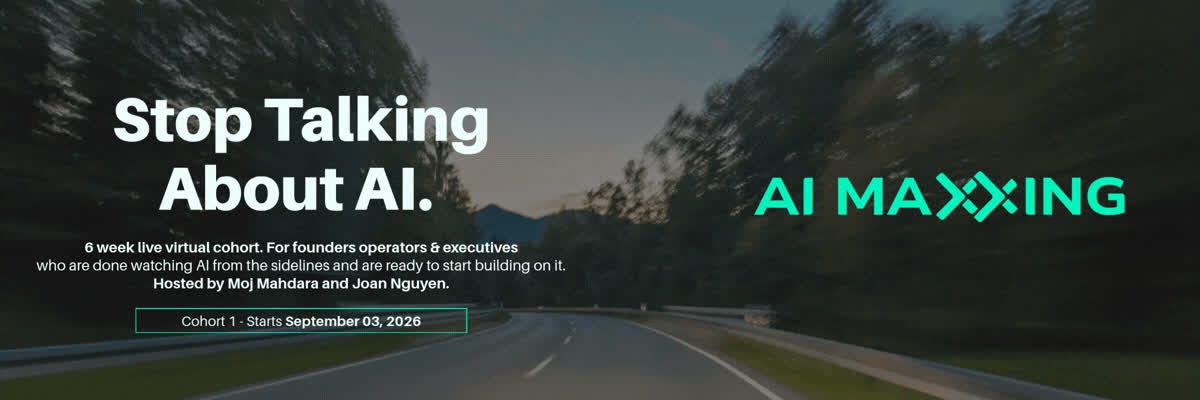
AI Maxxing is a six-week live mentorship for founders, operators, executives, consultants, and builders who want to stop watching this happen from the sidelines and start developing the judgment to build with it.
You will be in a community of people dealing with the same questions, testing solutions, making mistakes, building crap, improving it, and learning together.
AI Maxxing includes:
6 live sessions over 6 weeks
Real AI workflows and practical implementation
Weekly resources and prompts
A private community
The best way to learn AI is not to watch someone else do it. It is to get in there, start building, and bring the people around you with you.
You do not have to become an AI expert overnight.
But you do have to get in the game.
AI Maxxing starts September 3.
— Moj
📬 Share this with someone who’s ready to move differently.
💭 I’m curious: What’s the biggest challenge you’re facing with AI right now? Reply in the comments—I’d love to know what you’re building and where you’re getting stuck.
No posts
Comments
Nothing yet. Say the first thing.
Sign in to join the conversation.