
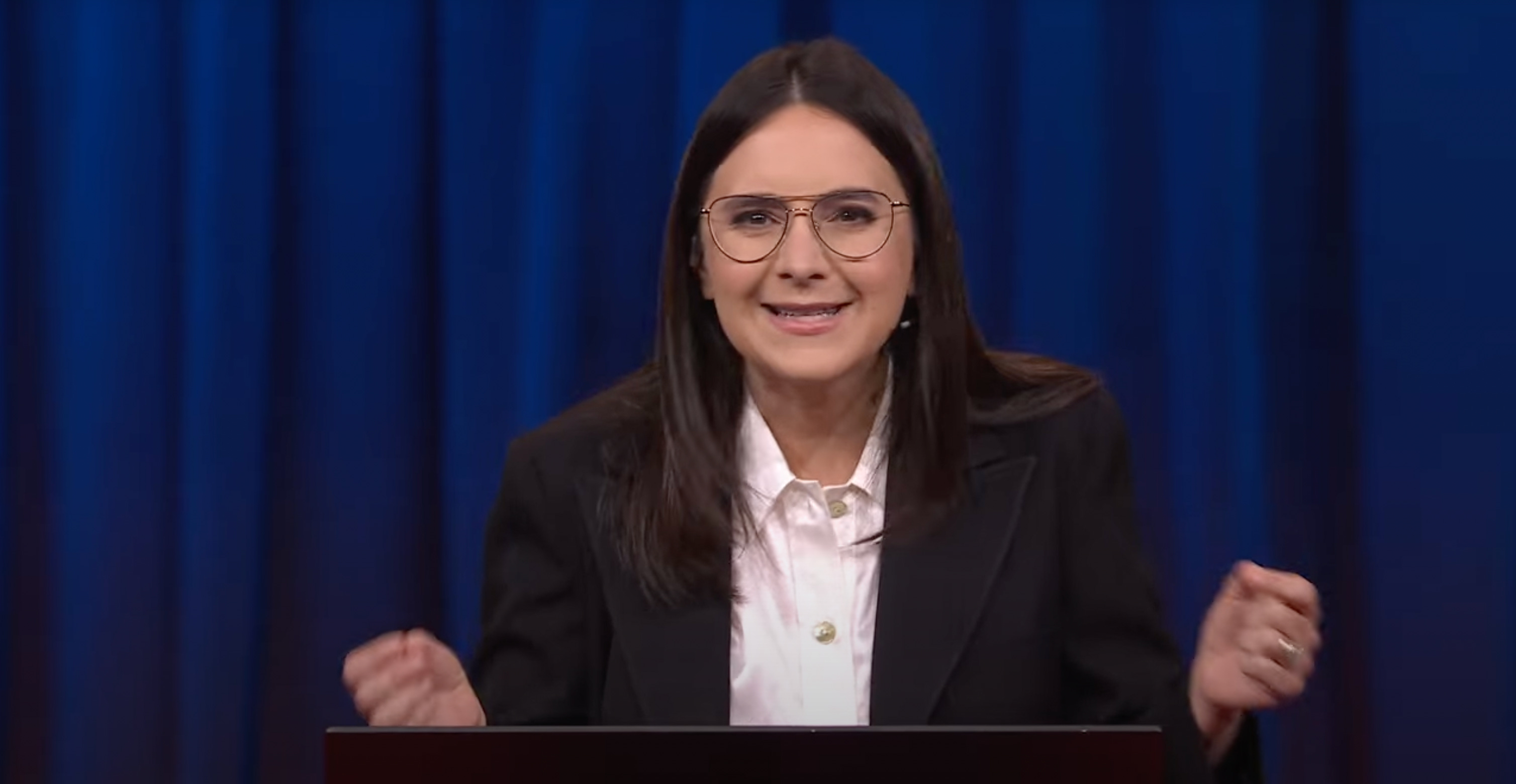
It’s been a heady ascent for Bari Weiss, the onetime New York Times opinion section anti-woke crusader, who was named the editor-in-chief of CBS News last Monday after her personal news startup, The Free Press, was purchased by Paramount-Skydance. The $150 million deal was brokered by David Ellison, son of Larry, the Trump-aligned billionaire owner of the media conglomerate.
Just a five years ago, in 2020, Weiss resigned from the New York Times, issuing a missive claiming to have been bullied by her supposedly more liberal colleagues, and went on to launch both her newsletter, a podcast called “Honestly,” and a college-level course program, the unaccredited University of Austin.
Both at the Times and in the years since, Weiss has fashioned herself a sort of provocateur of the middlebrow, rebranding reflexive conservative conventional wisdom as a kind of bold truthtelling. She has made a point of defending figures like the anti-trans children’s writer JK Rowling, and the millennial-twee comedian Aziz Ansari —who Weiss said was guilty only “of not being a mind reader” and had “no actual power” over a woman in her early twenties he allegedly pressured into sexual activity. At the Times, Weiss sought to elevate conservative podcasters like Joe Rogan and Eric Weinstein to the dubious status of “intellectuals”; she memorably featured glamor shots of the Christina Hoff Sommers, the author of several anti-feminist books, and the race science defender Sam Harris—who falsely suggested that there was a scientific consensus linking race and IQ in a podcast episode with Charles Murray called “Forbidden Knowledge”—as part of a piece in which she dubbed them “The Intellectual Dark Web.” Such figures now populate the pages of her own publication. Her longstanding aim has been to cast the defenders of traditional race and gender hierarchies as rebellious, inventive iconoclasts. She casts such figures as brave truth-tellers, honorable, above all, for their willingness to buck what she casts as an oppressive “woke” consensus.
But Weiss’ ideological project has sometimes come at the expense of a robust accounting of the facts. In its rush to condemn social justice claims as distortions of reality, The Free Press has sometimes allowed their own biases to get ahead of the truth. In 2023, the publication ran an incendiary essay alleging abuses and rushed treatment at a Missouri gender-affirming care clinic. The claims, from a lone source, incited political crackdowns against trans rights in Missouri, but were later debunked by the clinic’s patients and their parents. In 2024, they ran an article suggesting, speciously, that George Floyd died not because Eric Chauvin kneeled on his neck, but because of a drug overdose. And just this past August, they implied that the starvation deaths of children in Gaza were less morally egregious because the children, who were killed by an Israeli-imposed famine, were already sick to begin with. “The children in all of the images reviewed by The Free Press were either sick or facing death at the time their images circulated online,” the Free Press wrote of the dead children. “Their situations were dire. But in every instance, they were already facing grave situations because of their health, irrespective of any third-party action.” Such pieces have betrayed not only a shockingly cavalier approach to both personal freedom and human life; they have also often made arguments that are bizarrely immune to reality. None have been retracted.
For Weiss, it’s been a lucrative beat. She has long been a rich woman (she is married to Nellie Bowles, the heiress to a large California fortune); now, after the deal in which Paramount bought her company for about ten times its annual revenue, she is much richer. And yet many of her most prominent allies, since departing the Times, have been billionaires: the Trump allies David Sacks and Marc Andreessen are Free Press investors, as is the former Starbucks executive Howard Schults. The billionaire Peter Thiel, who once publicly opposed women’s right to vote, saying that “the extension of the franchise to women” has “rendered the notion of capitalist democracy an oxymoron,” appeared on her podcast.
But Weiss has claimed, forever, to be a victim: of liberal censoriousness, of closed left-wing minds, of a stifling culture of social-justice oriented ideological conformity; that the media had alienated what she called “ordinary Americans,” a group among which Weiss, a millionaire media mogul, presumably counts herself. She has plead, repeatedly, for sympathy—and for respect for her own professed status as a noble teller of unpopular truths—even as she collected handsome checks. And she has continued to cast herself as a bold contrarian, even as she has come to see her right-wing viewpoints acquire, in the Trump era, the force of official policy and law. No matter how often she wins, Weiss’ position seems to remain one of aggrieved woundedness, and her aspiration one of revenge.
She seems to have gotten it. Weiss, a career ideologue, will now helm what was until recently one of the most traditionally fact-forward and respected outlets in broadcast news.
CBS, however, has gone through a turbulent period since Paramount was acquired by the Ellison’s Skydance Media. CBS has had five presidents in the last five years; its ratings are dismal compared to its two main rivals, ABC and NBC. Editorial and strategic decisions that predate Weiss’ hiring have already eroded the credibility of the network: The Ellisons are perceived as partisans of Mr. Trump, and CBS has taken steps to make its editorial line to be more accommodating to Trump regime preferences, including by changing its rules for interviewing political figures and apppointing a conservative as ombudsman, a new position whose prerogative is widely seen to be to move the network’s editorial line to the right.They settled a lawsuit brought by Donald Trump over frivolous claims about an edited interview that the network aired with then-presidential candidate Kamala Harris—a lawsuit many thought that CBS could have won. They also abruptly cancelled the late night talk show of Stephen Colbert, whose jokes had displeased the president. Bill Owens, the executive producer of the network’s flagship news magazine show, “60 Minutes,” stepped down in April, saying that the network’s new corporate leadership’s priorities were incompatible with his own journalistic independence.Wendy McMahan, the president of the news division who had backed Owens, was forced out just weeks later. The network is set to lay off a full ten percent of its staff in the coming months.
The truth is that Ms. Weiss will inherit a diminished network. It is hard not to feel, surveying the wreckage that the Ellisons have already made of CBS, that she is being handed the keys to a very shiny but defective car—one whose engine is already breaking down.
Still, the move is a coup for Weiss, who has long aspired to remake the media in her own conservative image. And the right-wing transformation that is underway at CBS is mirrored across much of the rest of the mainstream press. The New York Times has come under criticism from left wing readers for its coverage of Israel’s genocide in Gaza, for its approach to stories about transgender rights, and for its sometimes excessively deferential coverage of the Trump administration. But an even more acute example can be found at The Washington Post, which has purged, through a series of high-profile firings, resignations, and buyouts, much of its news and opinion sections in an effort to reorient the paper toward a more right wing direction. The Los Angeles Times, too, last year saw its billionaire owner intervene to curtail the paper’s editorial independence when he prevented them from endorsing Kamala Harris for president. Disney, the parent company of ABC, also seems vulnerable to a right-wing turn: they suspended the comedian Jimmy Kimmel last month following threats from the Trump administration, only to abruptly un-suspend him after a consumer backlash.
In a threatening climate for journalists, many newsroom leaders seem to be assessing that the best way to please their owners—and to avoid the ire of the Trump administration—is to pivot rightward. These pivots often come at the expense of defending free speech, of doing a service to their audience, or of telling the truth. Whether there is a market for such a diminished and compromised editorial product —banalities, distortions, and propaganda arranged in something resembling the form of news—remains a different question.
Now, Weiss takes her place at the head of the Trump-backed transformation of national media; one that seems likely to narrow the range of viewpoints that are presentable in mainstream publications and broadcasters, to push stories in the name of right-wing cultural agendas, and to strive, always, to tell the powerful what they want to hear.
Every accusation Weiss
leveled at her perceived enemies is a confession of what she has enacted herself. She has fudged or misstated facts in the service of ideological conformity; she has claimed victimization from a position of power and reward; she has partaken of processes that seek to silence and stifle dissenting voices. She claimed, for years, to be the victim of a liberal media. Now, she is the face of a broad movement of media owners, government censorship, and private, targeted litigation that seeks to push liberal and left-wing voices out of the mainstream media altogether. A free press, one wonders, for whom?
No posts
Comments
Nothing yet. Say the first thing.
Sign in to join the conversation.