
In late February, laboratory staff at Cheyenne’s Board of Public Utilities found an unusual bacterium during routine wastewater sampling. The organism was later identified as Cupriavidus gilardii, a naturally occurring, metal-resistant bacterium rarely associated with human infection.
By then, it had established itself within the biological treatment processes at both of the city’s water reclamation facilities.
Cheyenne took its reuse system offline, drained and disinfected the distribution network and Prairie View Pond, and temporarily supplied affected irrigation systems with potable water. Reuse service resumed on June 29, after approximately two months of remediation and monitoring. The drinking-water system was unaffected.
The discharge was eventually traced to fill-and-flush work at Meta’s data-center campus under construction in Cheyenne. A contractor associated with the project, had discharged water used to clean and test the facility’s cooling piping. The utility classified the discharge as significant noncompliance, revoked the company’s discharge privileges and suspended acceptance of wastewater from data-center fill-and-flush and closed-loop system operations while it reconsidered its controls.
Meta said its general contractor stopped discharging as soon as it was notified, began hauling the wastewater off site and commissioned independent testing that found no trace of the bacterium. There is still some uncertainty about where and when the organism first entered the water. That uncertainty matters, but it should not obscure the broader engineering lesson.
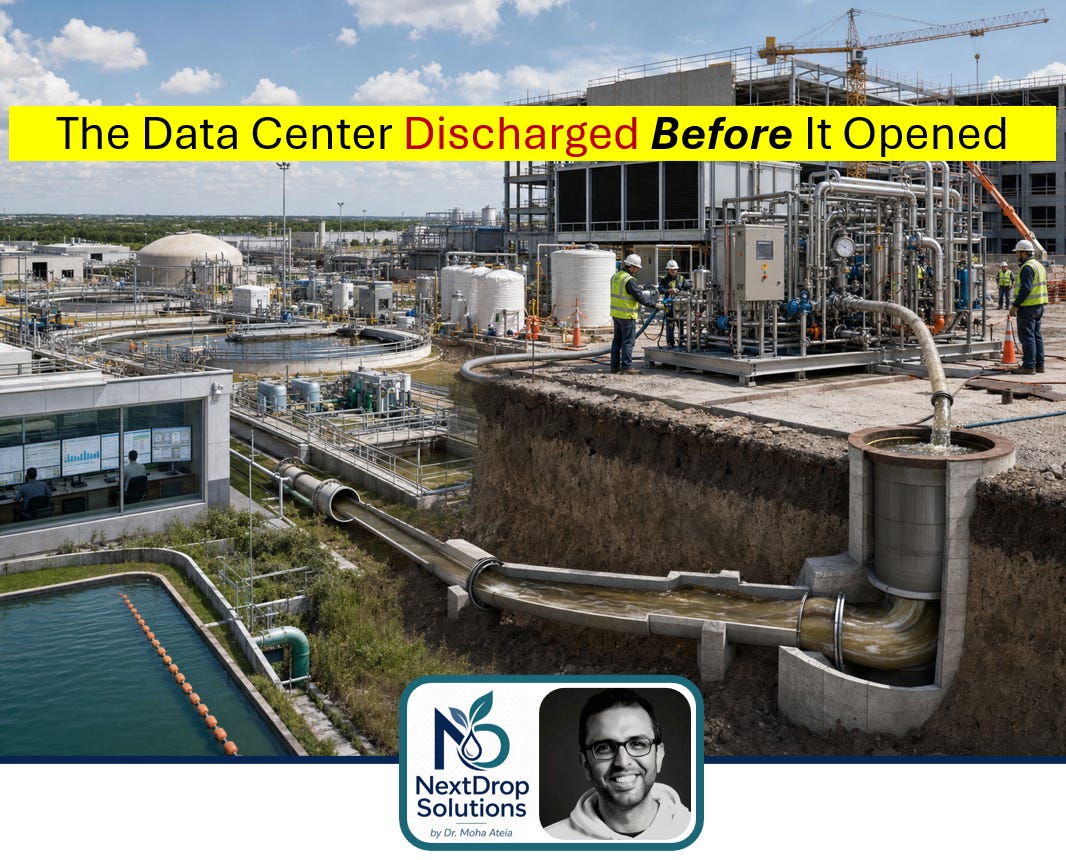
A closed loop must first be filled!
Closed-loop cooling is often discussed as a water-conservation feature. Once operating, the fluid circulates through a contained system rather than being continuously withdrawn and discharged.
Before that loop can operate, however, hundreds or thousands of metres of new piping must be cleaned, flushed, tested, sometimes disinfected, chemically treated and filled with its final working fluid.
Commissioning guidance for hydronic systems emphasizes rigorous cleaning, flushing and passivation. That process can remove construction debris, flux, pipe compounds, hydrocarbons, iron oxides and other materials left during fabrication and installation. ASHRAE’s recent data-center commissioning guidance warns that inadequate fluid cleanliness can foul cold plates and delay deployment of information-technology equipment.
All of that material has to leave through a pipe, a tank or a truck.
The wastewater may differ substantially from the facility’s eventual operating discharge. It can arrive as an intermittent batch with elevated solids, corrosion products, cleaning chemicals, treatment additives or microbial growth produced while water remained stagnant inside partially completed piping.
Average daily flow tells a utility little about such a release. A concentrated batch discharged over several hours can create a larger operational shock than a much greater volume released gradually over a month.
So, the permit boundary is organizational as well as physical.
The Cheyenne incident also exposes a difficult feature of large construction projects. The company that will eventually operate the facility may be several contractual layers removed from the subcontractor filling a cooling loop and opening the drain valve.
A municipal industrial pretreatment program may understand the future data center as its industrial customer. During construction, however, discharge decisions can sit with a general contractor, mechanical contractor, commissioning firm or temporary corporate entity.
That division of responsibility creates a practical gap. The operating facility may still be months from startup, yet its first industrial wastewater has already entered the sewer.
The federal pretreatment program gives utilities authority to control nondomestic discharges that may interfere with a publicly owned treatment works. It also allows a utility to designate an industrial user as significant when the discharge has reasonable potential to affect treatment operations, even when conventional flow thresholds are not met.
The regulatory tools therefore exist. The harder task is applying them early enough.
In other words, commissioning deserves its own discharge authorization.
A data-center wastewater plan should distinguish construction and commissioning from routine operation.
Before the first system fill, the utility should receive the expected water volume, water source, piping materials, cleaning and passivation chemicals, recirculation period and proposed disposal route. Responsibility should remain with a named industrial user that can control its contractors and pay for corrective action.
Batch water should be held before release. The appropriate analyses will vary by system, but may include pH, suspended solids, chemical oxygen demand, metals, glycols, biocides and microbiological indicators. Sampling should represent the water after circulation through the complete loop, rather than the clean water entering it.
A discharge decision can then be made from actual results. The options may include controlled sewer release, pretreatment, reuse elsewhere on site or off-site disposal. Storage and hauling capacity should be available before commissioning begins, rather than arranged after a sample fails.
Utilities also need to consider where their treated effluent goes. Cheyenne’s reclaimed water was used for irrigation, where spray creates a different exposure pathway than discharge to a river. The downstream reuse application therefore belongs in the industrial discharge review, even when the microorganism or chemical involved has no numerical pretreatment limit.
The response in this case here was costly and disruptive, but the utility laboratory detected the unusual organism, traced the discharge and prevented the reuse system from returning to service until the risk had been addressed. That is a functioning control system responding to an unfamiliar event.
The next improvement belongs upstream.
Data-center agreements increasingly address electricity, water supply, cooling technology and long-term sustainability commitments. They should also address the temporary wastewater generated before the servers are switched on. A closed loop may conserve water during operation. During commissioning, it remains connected to a much larger water system, and one open drain can move the consequences beyond the property line.
Comments
Nothing yet. Say the first thing.
Sign in to join the conversation.