
Welcome back to Money Games, my monthly take on sports, business, and all things leadership. Thanks for reading and subscribing, and please share with your friends and colleagues.
— Joe
The future will be tokenized
AI Bubble? Who cares!
The pitfalls of Spotify’s new management structure
It rained on the parade, but we had a great time anyway
I recently went on CNBC to talk crypto. The truth is, the people who grew up in the Web3 and DeFi world are still ahead of the game. Traditional finance hasn’t caught up yet. The next five years will be a wild ride.
It’s no secret that the U.S. stock market performance is being driven in large part right now by a handful of companies tied to the artificial intelligence (AI) boom. The promise of AI is that it will transform the way we do business and work and drive huge efficiency gains at companies, and that’s why there has been an unprecedented level of investment in it. In 2025 alone, venture capital firms poured an additional $192.7 billion into AI startups. As of August, big tech players had spent an additional $155 billion on AI—on everything from data centers and chips to water and power.
But there are concerns about circularity and a potential bubble. NVIDIA, for instance, is investing $100 billion into OpenAI—the most valuable tech startup ever—so that OpenAI can buy more NVIDIA chips. Google searches for the term “AI bubble” shot up in September. Research from MIT has found that 95% of companies have so far failed to make gains from AI.
So, on the one hand, AI is driving major stock market gains, investment keeps coming, and this technology promises to revolutionize entire industries. On the other, there are questions about how long that money can keep flowing without a return on investment and how strong the current crop of companies really are.
Journalist Andrew Ross Sorkin for his part has voiced concerns that we’re in a moment that increasingly resembles 1929, shortly before the stock market crash and the Great Depression. “I’m anxious that we are at prices that may not feel sustainable,” he told CBS. “And what I don’t know is we are either living through some kind of remarkable boom and part of that’s artificial intelligence and technology, and all of that, or everything’s overpriced.”
It all reminds me of the dot-com bubble, but maybe not in the way you’re expecting.
Let’s start by looking at the NVIDIA and OpenAI deal. NVIDIA CEO Jensen Huang and OpenAI CEO Sam Altman are both really brilliant guys, and they know what they’re doing. At the same time, the best deals are the ones that work for both parties. So, if I’m NVIDIA and going to invest in a company, I want to make sure it’s going to benefit us, and that I’m going to get something significant out of it, whether in the form of a return on investment or a strategic alliance. In this case, OpenAI is getting $100 billion that they need to keep growing, and NVIDIA is helping to guarantee demand while also potentially getting a slice of an incredibly valuable company.
So, when it comes to NVIDIA and OpenAI at least, I feel confident over the long-term. The circularity concerns don’t really concern me. But what about the possibility of a broader AI bubble?
AI is a technology that promises to change everything. The internet was the same during the 1990s and the dot-com bubble. Enormous amounts of money were invested during the dot-com boom, and guess what, the internet did change everything forever. It changed life as we know it. From social media to electronic trading to the way you’re reading this right now. None of it would have been possible without those investments in the 1990s.
From the time the internet really became alive in 1994 until March 2000, the stock market went bananas. When we look back at that time, there was such euphoria and there were definitely firms that were not ready to come to market that put “.com” at the end of their name and were able to go public and raise money when they weren’t making any money, and their balance sheets weren’t good. As time went on, things kept growing and growing for six years, until the bubble burst.
But the thing is, a lot of those companies shouldn’t have been in business to begin with, certainly not as publicly traded companies. Baseline, they had mediocre balance sheets and were banking on some kind of overnight growth that just wasn’t possible.
Turn to today. We’re still in the early stages with AI. We’re just in its infancy. So to me, this is like 1995 with the internet. On top of that, if we look at who the major players are in AI, the “Magnificent 7” stocks, they’re all major, major tech players. These aren’t tiny startups trying to sell investors a bill of goods. It’s Apple, Microsoft, Amazon, Alphabet, Meta, NVIDIA and Tesla. They have massive balance sheets, incredible profitability and growth, and incredible margins. They have lots of money to invest in AI. If it doesn’t work out, then that means they put a big number into something that doesn’t necessarily pay off for them. But they’re expecting it to pay off.
Let’s zoom out even further. The growth of AI is going to be exponential. It’s an incredible new technology and people are just beginning to figure out how to use it, even as it’s still being developed. Five years ago, AI lived in a lab. Now, it’s a tool that billions of people are using on a daily basis. Five years from now, so much of our world will be AI-driven.
Just consider what’s happening in finance: The entire financial world will be tokenized and driven by blockchain, and markets will go from being 9:30-4 to 24/7. Settlement will take mere seconds. That same kind of change is coming for every industry. In education, professors who used to be able to teach 10 or 20 students could be able to teach 50 because every student will have a 1-on-1 AI tutor. In medicine, AI will revolutionize how we diagnose and treat a myriad of diseases and improve the efficiency of so many diagnostics.
The list goes on and on, across every single industry. If you look at AI in that context, it’s still an incredible investment. Now, that doesn’t mean there won’t be volatility. There will be. There will be corrections. If you’re only interested in a six month horizon, then there are probably some storm clouds. But if you’re long on AI like I am, the forecast is great. Sure, some, AI startups are going to fail. Some experiments won’t work out. But the overall picture is one of titanic change and growth, and we’re still just at the very beginning. That means that the next Magnificent 7 is being born right now.
Spotify founder and CEO Daniel Ek announced recently that he’s moving into a new role—executive chairman—and elevating the company’s two co-presidents to co-CEOs. While we’ve seen a few examples of this structure recently, it’s never a guarantee that it will work. Sometimes, two are better than one. Other times, it leads to indecision or turf wars. I explored the whole dynamic over at Forbes.
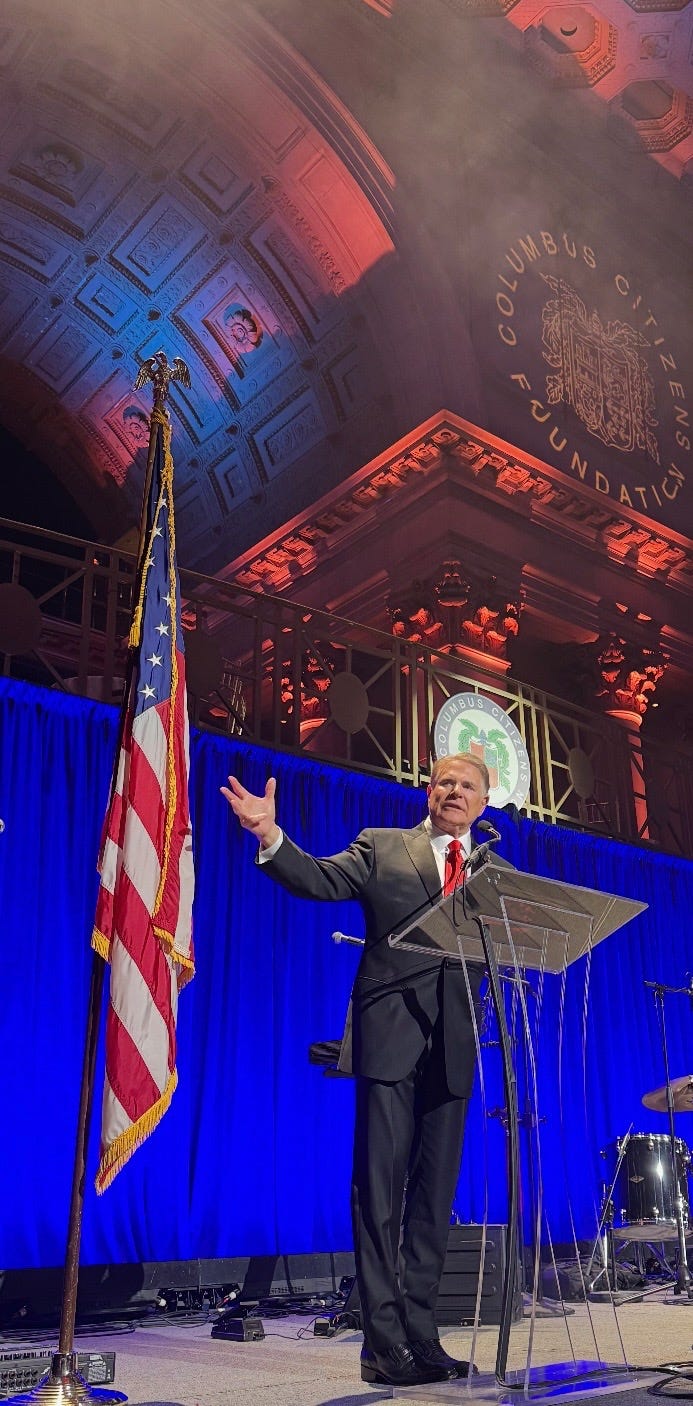
Although a classic New York nor’easter kept us indoors, it was still a great honor to be this year’s Columbus Day Parade Grand Marshal. My parents never would have been able to imagine it. The New York Post had all the details.
Investing means taking on some level of calculated risk. Good investors usually look past short-term ups and downs and act upon long-term convictions. In the words of Benjamin Franklin:
“There are no gains without pains.”

Comments
Nothing yet. Say the first thing.
Sign in to join the conversation.