
There’s a new word in the economic vocabulary this year: the mom-cession. Coined by Navy Federal Credit Union’s chief economist Heather Long, it describes something researchers have been tracking since December 2023 — labor force participation among college-educated mothers with young children has been falling, even while it holds steady or climbs for everyone else. Return-to-office mandates collided with a childcare system that never recovered from the pandemic, and mothers with the most credentials on paper are the ones losing ground in practice.
It’s a good word. It’s an honest word. And reading it, I couldn’t stop thinking about a recession that’s been running in plain sight for far longer, with no name at all.
Call it what you want. I call it the widow-cession.
It all started in the pandemic, 2020, we called it the she-cession — a term coined by C. Nicole Mason, then president of the Institute for Women's Policy Research.
True Advocacy Story: In 2021, MWC approached the Institute for Women's Policy Research and found their intake lumped divorced and widowed women into one category — "Divorced/Widowed" — making the data useless for our demographic. We asked for a meeting to request they be split, given how different those life stages are. No one could tell us who'd made the call to combine them in the first place. Widows weren't even their own category. We hope that's changed. This is widow advocacy.
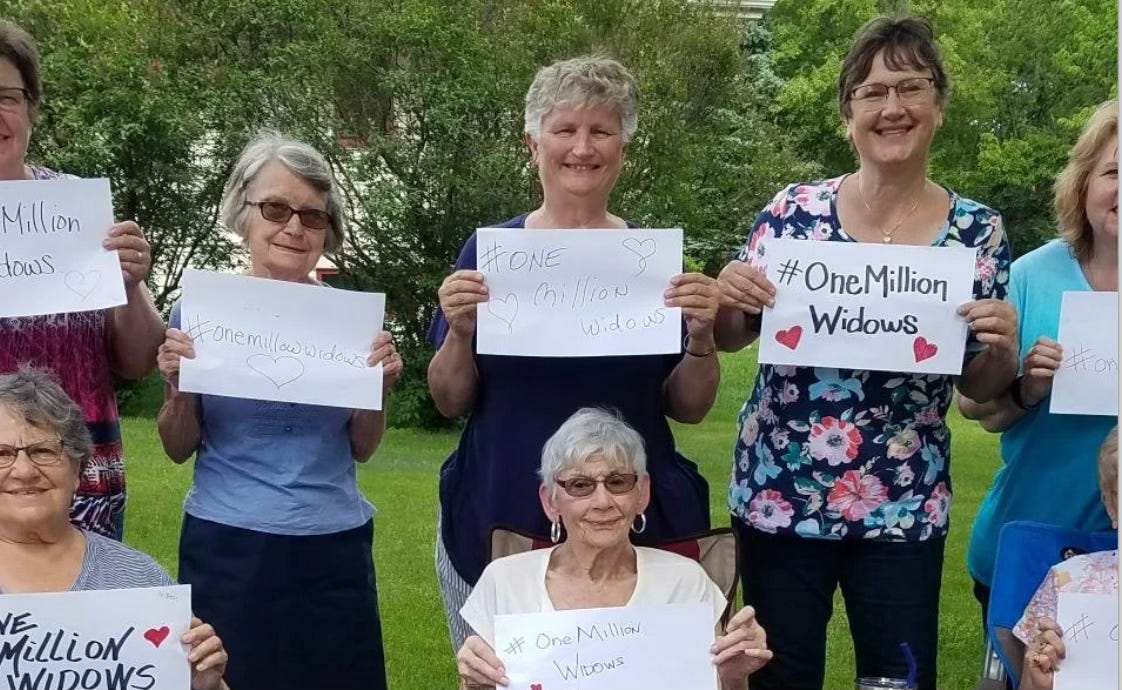
A mom-cession has a villain you can point to: an office mandate, a daycare waitlist, a policy that refuses to bend.
A widow-cession doesn’t announce itself with a memo. It shows up in a hospital hallway or a phone call in the middle of the night. Overnight, a household built on two incomes, two calendars, two sets of hands becomes one — and the workplace rarely notices, let alone adjusts.
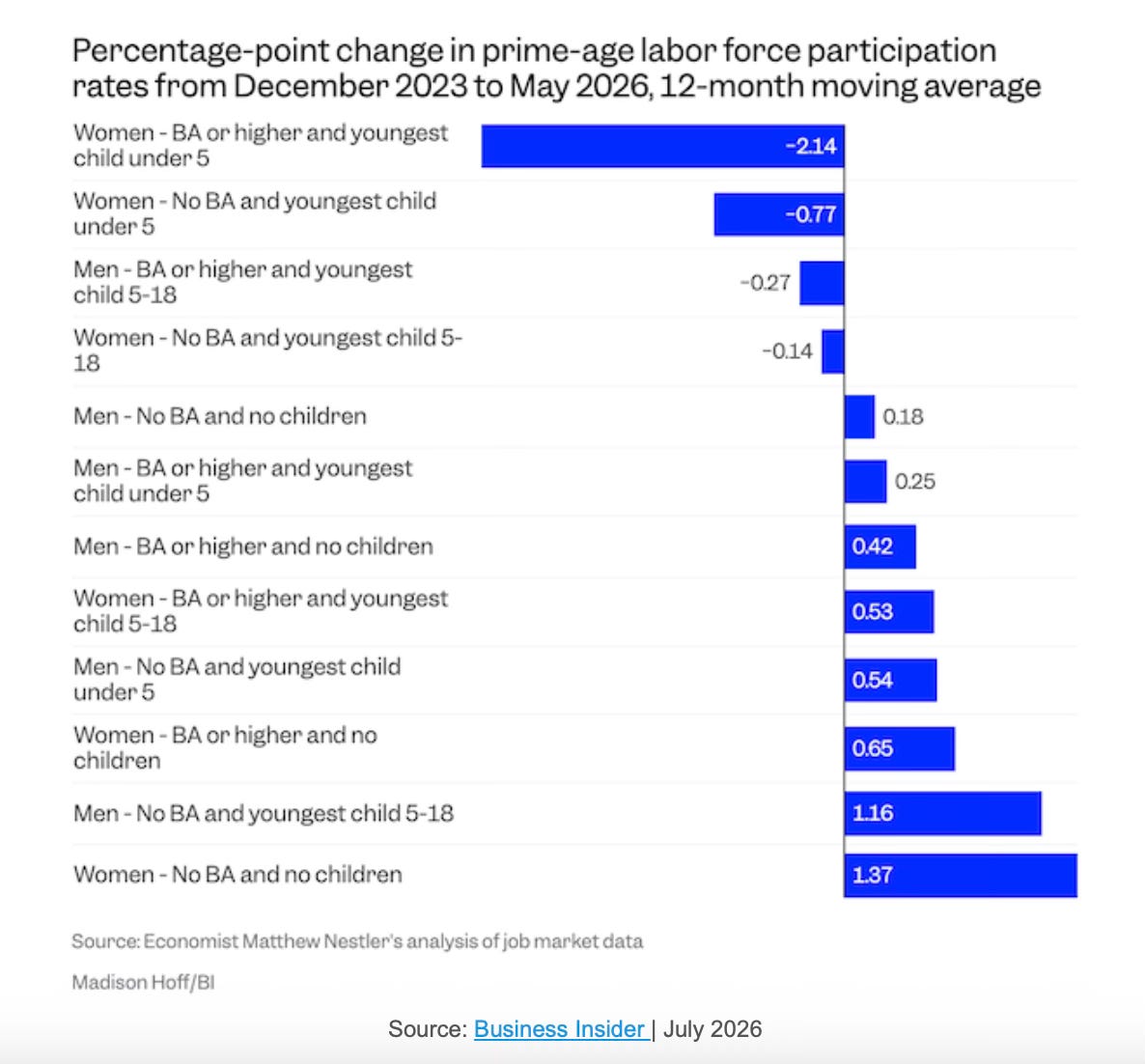
There’s no return-to-office battle for a widow, because most of us never got the option to work from home while we figured out how to function again. We were expected back at our desks or computers on someone else’s timeline (3 Days of U.S. Bereavement Leave), running the same math the mothers in a Business Insider piece describes — except our second earner isn’t stuck in traffic.
He or she is gone.
We don’t have to guess at this. MWC’s own research, drawn from nearly 8,000 widows, and the broader data in the UN’s Global Widows Report point to the same conclusion the mom-cession research does: the people carrying the heaviest invisible load are the ones the system was never built to hold or recognize.
The Holmes-Rahe Stress Scale ranks the death of a spouse as the single most stressful life event a person can experience — above divorce, above job loss, above illness. And yet there is no widow-cession headline, no chief economist tracking our labor force participation, no HR policy written with widowhood in mind.
Caregiving pressures top factor pushing women out of workforce. - Catalyst Research
Add to that the mechanics working against us quietly in the background: Social Security survivor benefit rules that force impossible choices about when and how to claim, estate tax and step-up-in-basis provisions few widows are told about until it’s too late to use them well, and a nonprofit landscape where, as our own two-year research report Left Behind found, only a sliver of U.S. nonprofits focus on widows at all — U.S. civilian widows least funded of anyone.
The mom-cession piece names something that I think is just as true for us: workplaces have spent years proving, in ways large and small, that grieving employees are a line item to be managed rather than people to be supported. Bereavement leave measured in days when healing is measured in years. No language in most HR handbooks for what a widow actually needs to come back functional, let alone whole.
Childcare now costs more than housing. - Fortune Magazine
And like the mothers in that graphic, widows are noticing.
We are not choosing to opt out. We are being shown, repeatedly, exactly how replaceable we are — right at the moment we’re discovering how irreplaceable we’ve become to the people still standing in our house and families.

Here is the line from that mom-cession piece I keep returning to: naming a crisis is not the same as fixing one.
That’s exactly the ground MWC has been standing on since 2011. We didn’t just want widowhood recognized as hard — we wanted it recognized as a women’s health issue, a human rights issue, and a policy failure for millions of women, because only good policy actually hands anyone their time, income, or footing back.
That’s the work behind the new SWIFT Act and the Widows’ Bill of Rights. Not another awareness campaign. Not another article that names the ache and stops there. The actual beginning of a fix — the one built by people who are living the math, not just studying it.
Until that full, comprehensive fix exists, it’s still the same 2 a.m. math for a widow that it is for a mother at 9 a.m. drop-off: figuring out, solo, how to hold a life the system never planned for.
We see you running it.
We’re building the thing that changes it. The Movement for Widow Care®.
— Carolyn Moor
If today’s issue hit close to home — if you’ve left the workforce, delayed going back, or you’re standing at that edge right now, wondering how you’re supposed to keep doing this alone — be heard.
We’re collecting these stories as part of a broader conversation, alongside the momentum Moms First is building with the American Motherhood Tour, because the data only tells half of it.
Your story is the other half. The mom-cession has a name now.
The widow-cession needs its stories of inclusion (your stories) told before it can have one too. Share Your Experience About Being a Mother and a Widow in the United States with Moms First and No Country for Mothers film campaign.
TELL THEM YOUR STORY BUTTON →
Comments
Nothing yet. Say the first thing.
Sign in to join the conversation.