
We’re one year on from the publication of Abundance, which named & packaged a decade’s worth of intellectual and organizing work on topics like housing production and state capacity.
The conceit of Abundance is that something has gone wrong in our public policy such that we’re living with artificial scarcity and a government that can’t deliver progress for its people.
The hope of Abundants is that a combination of thinking & doing can lead to better policy outcomes that will improve the lives of Americans.
How’s it all going?
Below are quick thoughts on five open questions our community is working through, based in part on a recent conversation Abundance co-authors Derek Thompson & Ezra Klein had with Why Nothing Works author Marc Dunkelman, and in part on our own unique vantage point as one of the core “doer” orgs in the movement.
Said differently, is Abundance a fundamentally transpartisan “common sense” framework, or does it contains a normative, ~ideological vision for the future?1
In the past we’ve argued Abundance is a methodology—or a “lens” or a “sense-making framework”—to the extent that the twin pillars of capture and capacity help us understand societal problems.
This notion of “methodology over ideology” is also one our colleague Giselle Hale frequently uses with 160+ local elected officials in 32 states who are part of our Abundance Electeds program. These electeds are get-shit-done leaders who want to move beyond abstract conversations to delivering concrete wins for their community.
What constitutes a win? At the local level, needs are roughly the same regardless of political party preference—reasonably-priced housing, good schools, safe streets, and functional public amenities.
At the national level there are broader clashes of values & preferences on everything from immigration levels to types of energy production to the depth and breadth of the social safety net.
Is Abundance just another word for State Capacity, which argues for a more empowered state but is neutral on what that state pursues?
Different folks involved in Abundance will have different answers to this question. Our take: Abundance is both a set of reasonably neutral tools AND a first expression of a nascent ideology that doesn’t yet have a name. Something like Abundance Liberalism.2
Assuming a left-of-center tenor to the normative vision of Abundance, combining pro-growth and pro-effective government tendencies in service of a more egalitarian society, the next question is whether we can actually build a political identity and political power around Abundance.
On this question there’s early progress but still a ton of work to do.
YIMBYism has built a real political identity and movement around the shared goal of increasing housing supply. There are YIMBY chapters all over the country, thousands of activists & advocates who consider themselves YIMBYs, and lots of YIMBY elected officials too.
Politicians are flirting with the language of Abundance, but in most cases are not yet hard-committed to the tradeoffs Abundance might entail them making within their own coalition. That’s in part because there is not yet sufficient outside organizing and power built up to back those politicians.
For our part, we have been organizing both electeds & citizens under the banner of Abundance via our membership programs. We’ve also organized under the political identity of Abundance for 3+ years in our flagship municipal chapter, Abundance San Francisco.
Interestingly, a couple of our newer Abundance Network-supported chapters, including For Seattle and Building Burlington’s Future, are not publicly branded “Abundance.” In Seattle in particular, part of the calculus of eschewing the Abundance brand was to avoid the intra-left conflict around Abundance vs. Left Progressives/Populists.
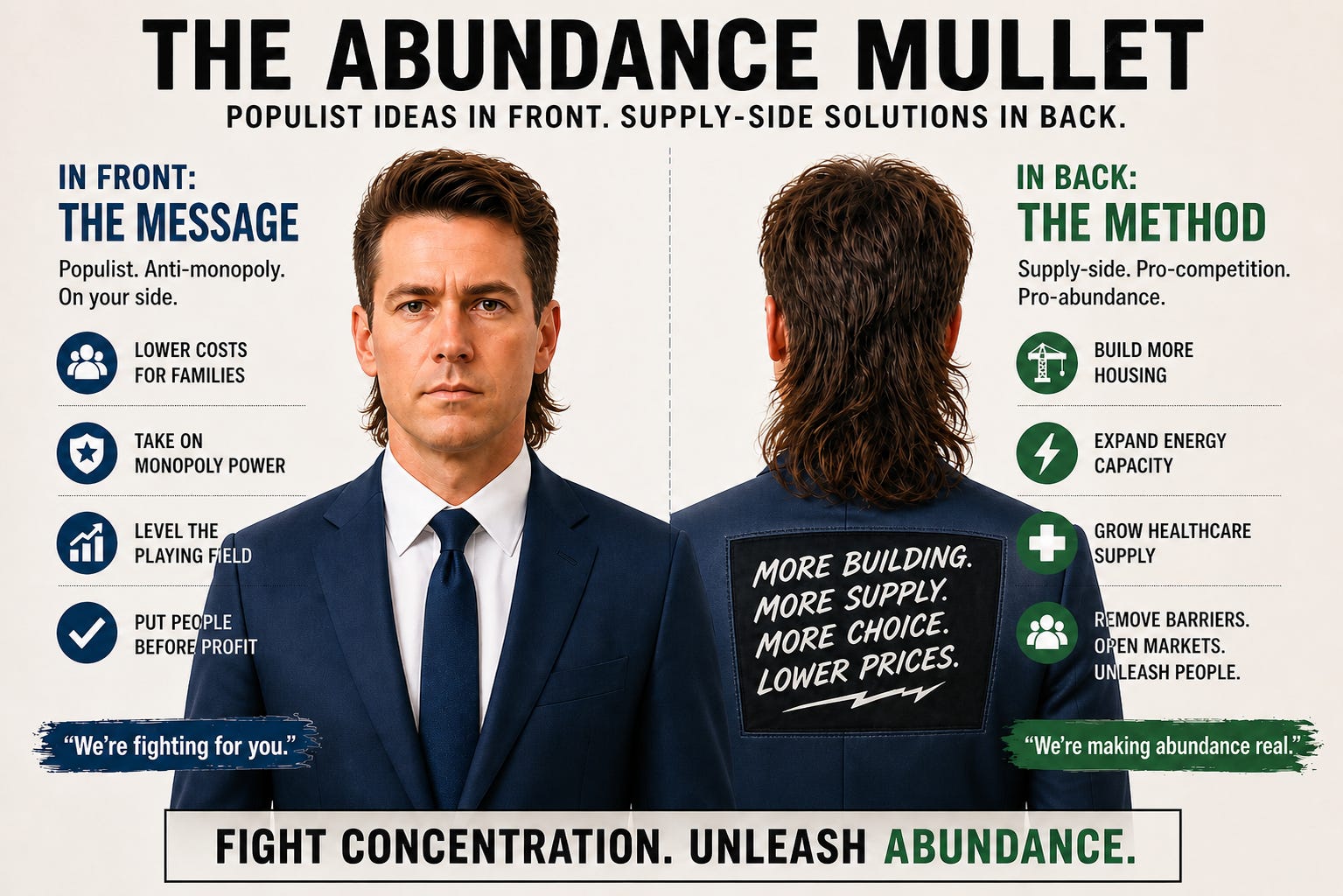
But this tension may be abating as we see the rise of what Derek Thompson calls the “Abundance mullet” a la Mamdani’s “Freeze the rent + expand supply” or Sherrill’s “Freeze utility prices + expand supply.”
One additional observation: because our work is focused on municipal chapters, and canonical Abundance issues like transmission siting and innovation policy happen at the state & federal level vs. the local level, we have naturally edged into less/non-traditional Abundance policy areas like vibrant public spaces, street safety, and public transit. In this way, we think an ~”urbanist” flavor of Abundance, building off of the YIMBY identity, is the most practical way to organize a set of real on-the-ground humans who show up and do the day-to-day work of politics and power-building.
While critics label Abundance as billionaire-backed, we and our peer org leaders know too well that there is a relative scarcity of money in the space today.
The two anchor funders to date are Arnold Ventures and Coefficient Giving, who are both funding at the level of tens of millions of dollars per year. While this sound like a large number, it nets out to a few hundred people per year working on these issues across local, state, and federal government.
Far bigger pots of money—on the order of hundreds of millions to billions of dollars per year—exist in political product categories like (i) fight climate change (ii) protect democracy (iii) Dems > Republicans.
Abundance liberalism touches on all of these topic areas, but hasn’t yet effectively tapped into those funding streams. There is much more work to do in the years ahead to mature a funder base to support the institutional reform work of Abundance.
This is doubly-true of our municipal focused work. In our experience both with chapters we are directly involved with, and those of allies (e.g. Abundance New York), raising sustainable local political dollars for local reform work is very challenging.
Abundance has done a good job of critiquing our current system, and has some material policy solutions to offer, but there are also a number of important open work streams.
One is how we de-judicialize our system such that the courts aren’t the final arbiter of so many important societal decisions. Nick Bagley, administrative law professor and author of the Abundance canon piece “The Procedure Fetish,” is finalizing a book on this topic to be published in December 2026, which will hopefully represent a major step forward on this question.
Another open question was well-framed up by Marc Dunkelman on the aforementioned Ezra podcast.
You’ve got a solar farm here and a city there, and between the two of them are a wealthy neighborhood, a pristine forest and a struggling, more marginalized neighborhood. The line has to go through one of those three places.
Abundance Democrats have not articulated the way that we’re going to come to that decision expeditiously. We have given in to our fantasy that if you just put these three groups, some of whom are going to be affected by this new transmission line, into a room and have them articulate their problems, we will magically come to some sort of consensus. But in most cases we don’t, and we often get tripped up by it.
This is the big challenge coming for abundance: We have to build a system that allows for us to make trade-offs. We need a system where everyone has a voice and no one has a veto, where we get to a decision expeditiously and it’s not subject to endless litigation.
Marc’s post-Why Nothing Works project is to come up with an answer to this conundrum.
A lot else has happened over the last year.
Gas prices have skyrocketed; we appear to be in a global energy crisis and a foreign war; the Inflation Reduction Act has been dismantled; ICE raids have torn communities apart, bringing a level of violence and militarization to US cities that we haven’t seen in decades; federal capacity has plummeted across multiple core agencies, including the NSF, NASA, NOAA, NIH, and USAID; the Voting Rights Act has been gutted; there’s been obscene personal corruption by Trump, senior Trump administration figures, and members of Congress; and AI seems poised to trigger a techno-economic paradigm shift—all while the employment market stalls and costs rise for ordinary Americans.
And so the final topic that’s swimming around, connected to the first issue of ideology, is whether Abundance as currently constituted is big enough to meet this moment in American society.
Whether Abundance is enlarged to make contact with these issues, or whether it’s drafted into a broader ideological tent, our distinct sense is that, in addition to the blocking and tackling on Questions 2-4, the next phase of Abundance will be an intellectual journey towards a bigger synthesis.
What’s a normative vision for a good life in a pluralist society, grounded in American principles, and how can Abundance play a role in enabling it?
Thanks to Aston Motes, Jen Pahlka, Jesse Wolfson, Matthew Meyers, and my colleagues at Abundance Network for contributing directly or indirectly to this post.
This also gets at the question of whether Abundance is a “movement.” To the extent Abundance puts methodology over ideology, Roosevelt Institute’s Ned Resnikoff is skeptical: “These factions are not just different wings of the same movement; they are pursuing entirely different and mutually exclusive objectives. It is not possible to build a coherent synthesis that accommodates both.”
No posts
Comments
Nothing yet. Say the first thing.
Sign in to join the conversation.