

For generations, many men were taught that being a good husband and father meant one thing above all else: to provide. Men were expected to work hard, earn steadily, sacrifice quietly, and demonstrate love primarily through financial stability. Fathers showed commitment by putting food on the table, not necessarily by packing lunches, scheduling dentist appointments, or managing the family calendar.
But fatherhood is changing, and the data now shows that this shift is real. New research from the American Institute for Boys and Men highlights a major trend that many couples are already experiencing in their own homes. After years of stalled progress, gender convergence inside the home has restarted, and fathers are helping drive the change. Men are spending more time caring for their children, taking on household responsibilities, and becoming more engaged in their children’s emotional lives.
That matters because modern marriages require a different model of partnership than the one many of us grew up observing. Today, most couples are dual-career couples. Women are earning more degrees, building ambitious careers, and contributing substantially to household income. Yet for years, many women continued carrying a disproportionate share of the invisible labor at home. They were not only working professionally but also serving as the default family manager, responsible for planning, organizing, anticipating, remembering, and coordinating nearly every aspect of family life.
Many husbands never intended for this imbalance to happen. In many cases, they simply inherited outdated assumptions about what it meant to contribute as a man. The encouraging news is that those assumptions are evolving. More fathers are recognizing that partnership at home is not secondary to providing financially. It is part of providing.
The traditional provider model developed during a time when many households operated very differently from the way they do today. Decades ago, it was common for one spouse, usually the husband, to specialize in paid work while the other specialized in domestic labor and caregiving. That arrangement shaped social expectations around gender, work, and family responsibilities for generations.
But modern life no longer fits neatly into that structure. Today, many families depend on two incomes simply to maintain financial stability. At the same time, many women want careers not just for financial reasons, but because work provides identity, purpose, growth, and fulfillment. Marriage has evolved from a relationship built primarily around survival and specialization into one centered more heavily on companionship, shared goals, and mutual support.
The problem is that household expectations did not evolve as quickly as workplace expectations. Women increased their participation in paid work dramatically over the past several decades, while men’s participation at home changed more gradually. As a result, many women found themselves carrying both professional responsibilities and the majority of household management responsibilities simultaneously. That imbalance has consequences.
When one partner becomes the default manager of the home, relationships often feel less like partnerships and more like unequal labor systems. Resentment builds. Exhaustion grows. Emotional connection weakens because one person feels perpetually responsible for keeping the family functioning.
The research showing that fathers are becoming more engaged at home is encouraging because it signals a movement toward a healthier model of partnership. More men are recognizing that their role inside the family extends beyond income generation. They are becoming active participants in caregiving, planning, emotional labor, and household ownership.
Importantly, this shift is not about fathers “helping” mothers. Helping implies that one person still carries ultimate responsibility while the other occasionally assists. Shared ownership is different. Shared ownership means both partners carry responsibility for making family life function well.
The pandemic changed many aspects of family life, but one of the biggest changes was visibility. Suddenly, millions of men were home during work hours in ways they had never been before. They witnessed the nonstop logistics involved in caregiving, household management, remote schooling, meal preparation, emotional regulation, and family coordination.
For many fathers, the invisible labor became visible for the first time. Before the pandemic, it was easier for some men to underestimate the amount of work happening behind the scenes because much of it occurred while they were physically absent from work. Once families were forced into the same physical space full-time, the complexity of running a household became impossible to ignore.
Research suggests this experience accelerated long-term changes already underway. Fathers increased their caregiving involvement during the pandemic, and while some patterns reverted afterward, many families did not fully return to old norms. In numerous households, dads maintained a higher level of involvement than they had prior to 2020.
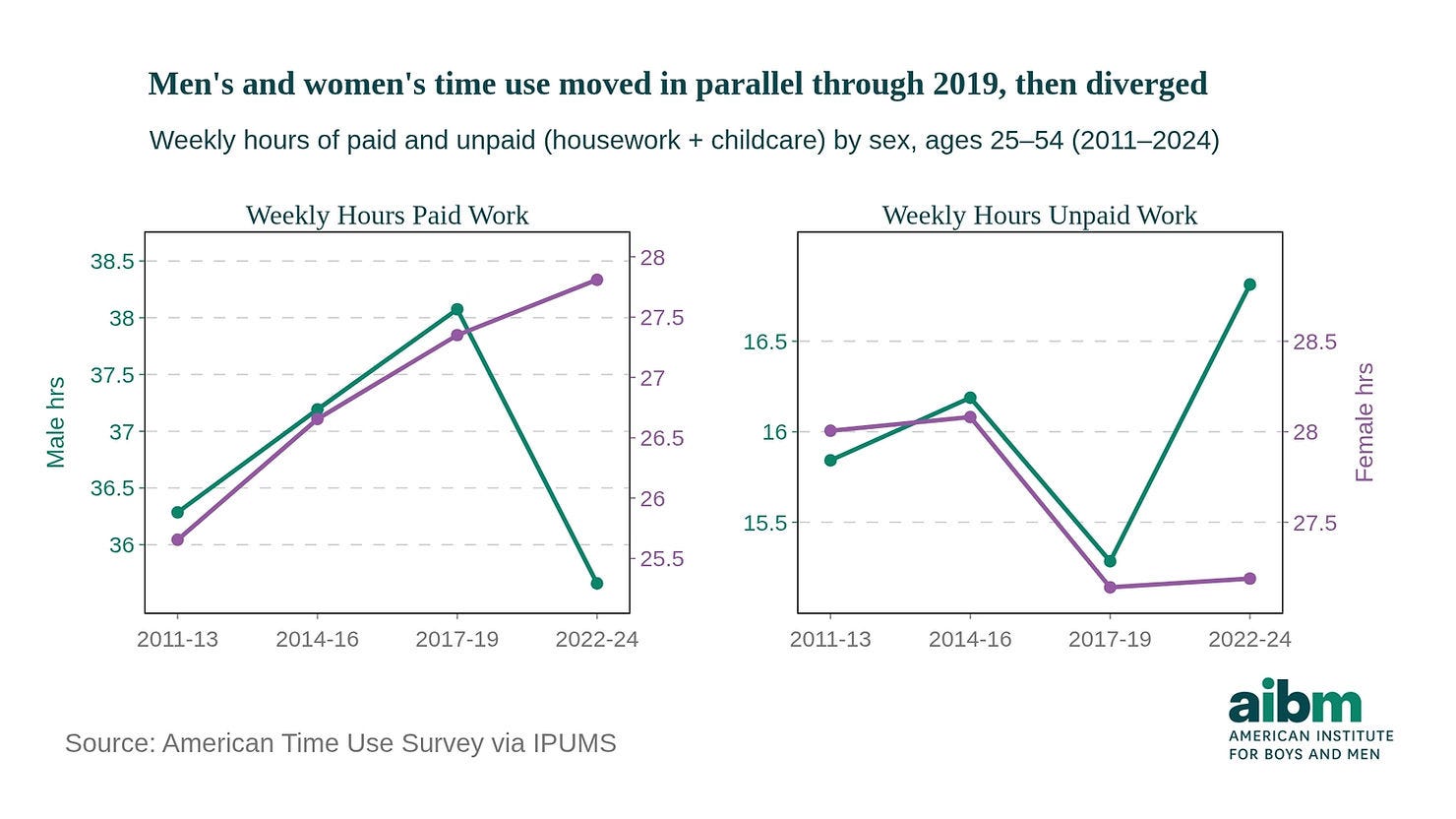
This matters because involvement changes perspective. When fathers actively participate in school logistics, doctor appointments, grocery planning, bedtime routines, and emotional caregiving, they begin to understand the full scope of family management. That understanding often leads to greater empathy, stronger partnership, and healthier communication between spouses.
Couples frequently argue less when both partners fully understand the demands each person is carrying. Visibility creates appreciation, and appreciation strengthens connection.
The evidence supporting engaged fatherhood is remarkably strong.
Click here to read the remainder of the article.
No posts
Comments
Nothing yet. Say the first thing.
Sign in to join the conversation.