
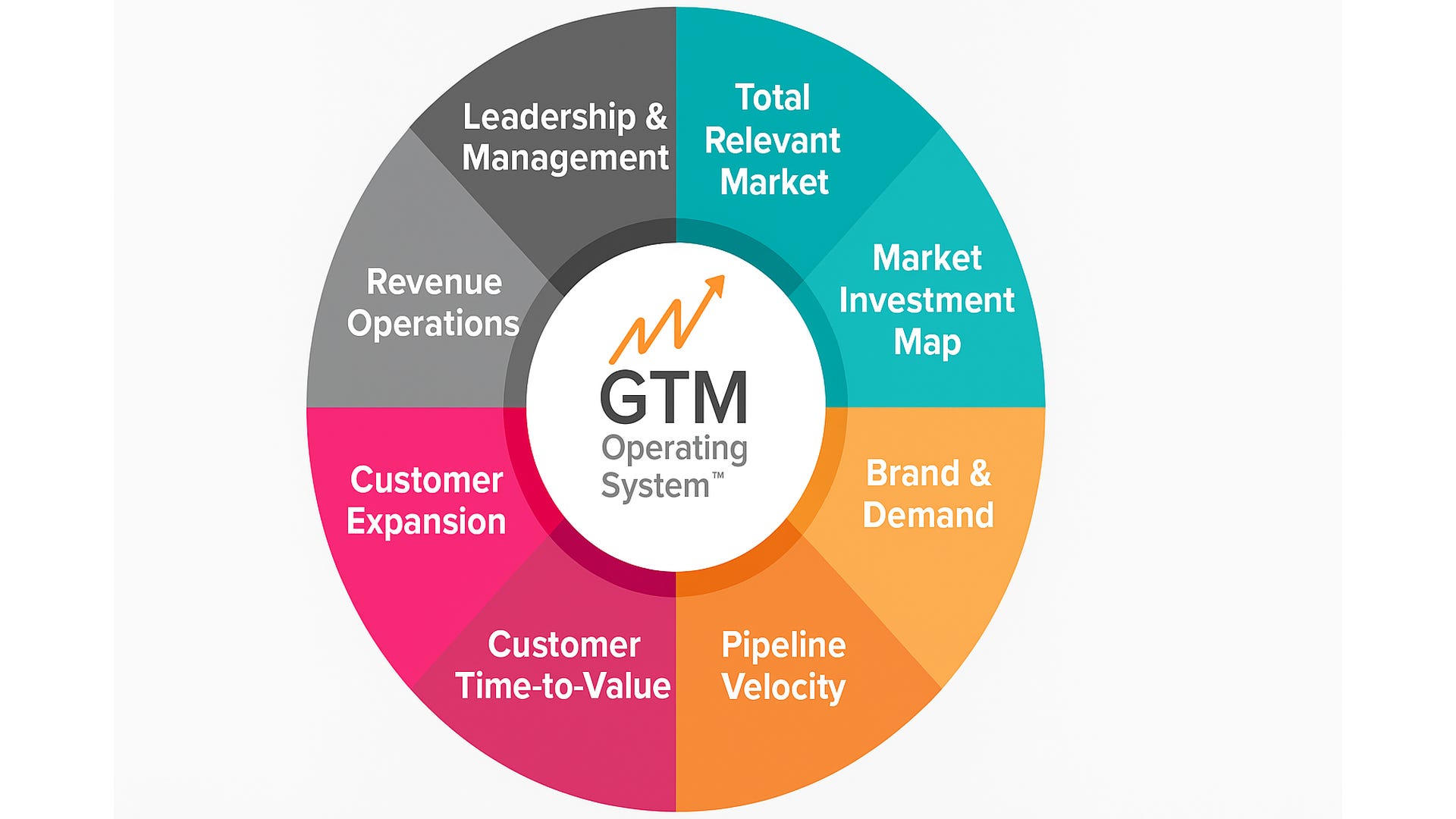
For four weeks, the audit has examined what the GTM system produces: the right market, the right demand, pipeline that converts at velocity, customers who reach value and expand. Each of those pillars is a function of the machine — a specific place where revenue is created or lost.
This week we audit something different. Not what the machine produces, but how it’s run. Pillars 7 and 8 — Revenue Operations and Leadership & Management — are the two pillars that don’t generate revenue directly. They govern everything that does. RevOps is the analytical backbone: the data, systems, and processes that let you see and steer the engine. Leadership & Management is the connective tissue: the clarity, alignment, and cadence that turn a strategy on paper into coordinated daily execution.
These are the pillars most founders under-audit, because their impact is indirect. A broken RevOps function doesn’t show up as a line item — it shows up as forecasts you can’t trust, meetings that argue over whose numbers are right, and decisions made on gut because the data is a swamp. A leadership gap doesn’t show up as a missed metric — it shows up as teams pulling in different directions, each optimizing for its own version of the plan.
GTM Partners’ research is blunt on this point: poor internal alignment is the number one reason companies fail to hit their targets. Not product. Not market. Alignment.
That single finding reframes the entire audit. For four weeks we’ve hunted for the broken pillar — the market misfit, the velocity leak, the expansion gap. But the most common root cause of GTM underperformance isn’t any single pillar. It’s the absence of the operational and leadership infrastructure that keeps all eight working together. This week’s audit is about that infrastructure.
There’s a reason these two pillars are the last ones most teams examine, and it’s the same reason they’re so often the actual problem: they’re invisible when they work and catastrophic when they don’t, but their failures always look like something else.
When RevOps is weak, the symptom presents as a sales problem, or a marketing problem, or a forecasting problem. The VP of Sales missed the number — but the real issue is that pipeline data was so unreliable that no one saw the miss coming. Marketing and sales are fighting about lead quality — but the real issue is that there’s no shared definition of a qualified lead and no single source of truth to resolve the dispute. The team is making decisions slowly and badly — but the real issue is that the data required to decide well is scattered across five systems that don’t talk to each other.
When leadership is weak, the symptom presents as an execution problem. The team isn’t hitting targets — but the real issue is that no one is entirely sure what the targets mean or how their work connects to them. Initiatives stall — but the real issue is that there’s no operating cadence to drive them forward and no accountability structure to surface when they’re off track. Good people underperform — but the real issue is that they were never given clarity about what winning looks like.
Because these failures always wear the costume of a different pillar, they get misdiagnosed constantly. A founder hires a new VP of Sales to fix a number that was actually a RevOps visibility problem. A team runs an offsite to boost morale when the real issue is a structural absence of clarity. The operations and leadership audit exists to strip away the costume and look at the infrastructure directly.
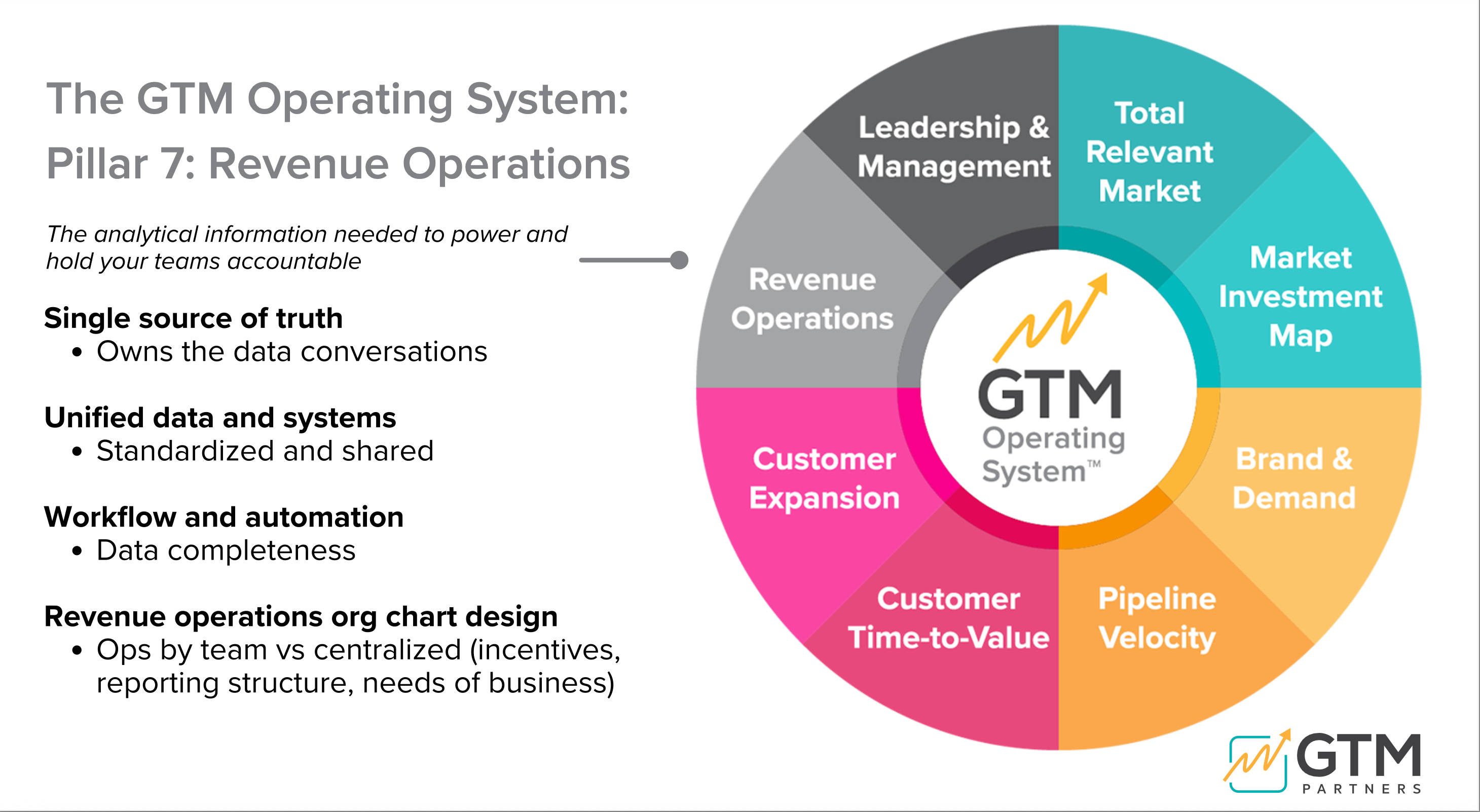
RevOps is the operating system underneath the operating system — the function that turns growth from a series of heroic efforts into a managed process. The GTM Partners framing is precise: RevOps sits above the revenue departments, not between them, architecting how leads flow, how opportunities convert, how customers hand off, and how every team shares data along the journey. It’s the single source of truth and the control center.
The audit of Pillar 7 covers three diagnostic zones: whether you have a single source of truth, whether your forecasting is a discipline or a guess, and whether your systems and processes actually connect.
Everything RevOps does depends on one foundation: clean, trusted, shared data. If marketing has its numbers, sales has its numbers, and customer success has its numbers, and none of them agree, you don’t have a revenue operation — you have three departments narrating three different versions of the same business.
The audit question is whether there’s a single system — almost always the CRM — that everyone agrees is the golden source, and whether the data in it is actually trustworthy. This isn’t glamorous work. It’s deduplication, required fields, consistent stage definitions, closed-lost reasons that actually get filled in. But it’s foundational, because every downstream analysis, forecast, and decision inherits the quality of this data. Garbage in, garbage out isn’t a cliché here — it’s the difference between steering with instruments and flying blind.
The deeper test is definitional. Does everyone agree on what a “qualified lead” is? What counts as an “active customer”? When a deal moves from one stage to the next, does every rep mean the same thing by it? Unified data definitions are what make the numbers comparable across functions — and their absence is why so many cross-functional meetings devolve into arguments about whose data is right instead of what to do about it.
Healthy signal: One system is the agreed source of truth. Data is clean, deduplicated, and governed by required fields. Everyone shares the same definitions for leads, stages, and customer states. When a number comes up in a meeting, no one disputes it — they discuss what it means.
Unhealthy signal: Each function maintains its own spreadsheet. Meetings start with arguments about whose numbers are correct. Deal stages mean different things to different reps. You can’t trust your own CRM without manual verification.
Missing your forecast is one of the fastest ways to lose credibility with your board. Yet for most early-stage companies, forecasting is closer to guesswork than science — the VP of Sales says you’ll hit the number, so you write it down and hope. When the quarter comes in light, everyone is surprised, and the surprise is the problem.
Mature RevOps turns forecasting into a repeatable discipline. There’s a consistent cadence and methodology — clear definitions of what counts as commit versus upside versus best case, and criteria a deal must meet before it’s forecasted at all. Rep optimism is pressure-tested against historical conversion rates and pipeline coverage. And increasingly, AI-driven models augment human judgment, catching patterns a rep’s happy ears might miss.
The audit question is whether your forecast is something leadership can actually trust, and whether it gives you enough warning to act. A good RevOps function doesn’t just predict the miss — it surfaces it early, when there’s still time to intervene. If you enter a quarter at 2x pipeline coverage when history says you need 3x, that’s a signal to intensify pipeline generation now, not a surprise to explain at the board meeting later.
Healthy signal: You have a defined forecasting methodology with clear categories and criteria. Forecasts are pressure-tested against historical data. Your forecast accuracy is known and improving. You catch likely misses early enough to course-correct.
Unhealthy signal: Forecasting is the VP of Sales’s gut feel. There’s no consistent methodology. Accuracy is poor or unmeasured. Misses arrive as end-of-quarter surprises, when it’s too late to do anything about them.
As a company scales, its tech stack grows — CRM, marketing automation, sales engagement, analytics, a customer success platform. The question isn’t how many tools you have. It’s whether they connect, and whether the processes running through them are designed or accidental.
When a lead fills out a form, does it automatically enter the CRM and alert the right rep — or does it sit in a queue someone checks manually? When a deal closes, does it trigger onboarding and update the revenue dashboards — or does someone have to remember to make it happen? These workflow connections are where RevOps either creates leverage or leaves it on the table. Every manual handoff is a place where things fall through, data degrades, and speed is lost.
Healthy signal: Your systems are integrated and data flows automatically between them. Key workflows — lead routing, deal-to-onboarding handoff, dashboard updates — are automated and reliable. RevOps manages these as designed processes, not ad hoc fixes.
Unhealthy signal: Your tools are islands. Data is re-entered manually between systems. Critical handoffs depend on someone remembering. Automation is minimal, and the process map exists only in people’s heads.
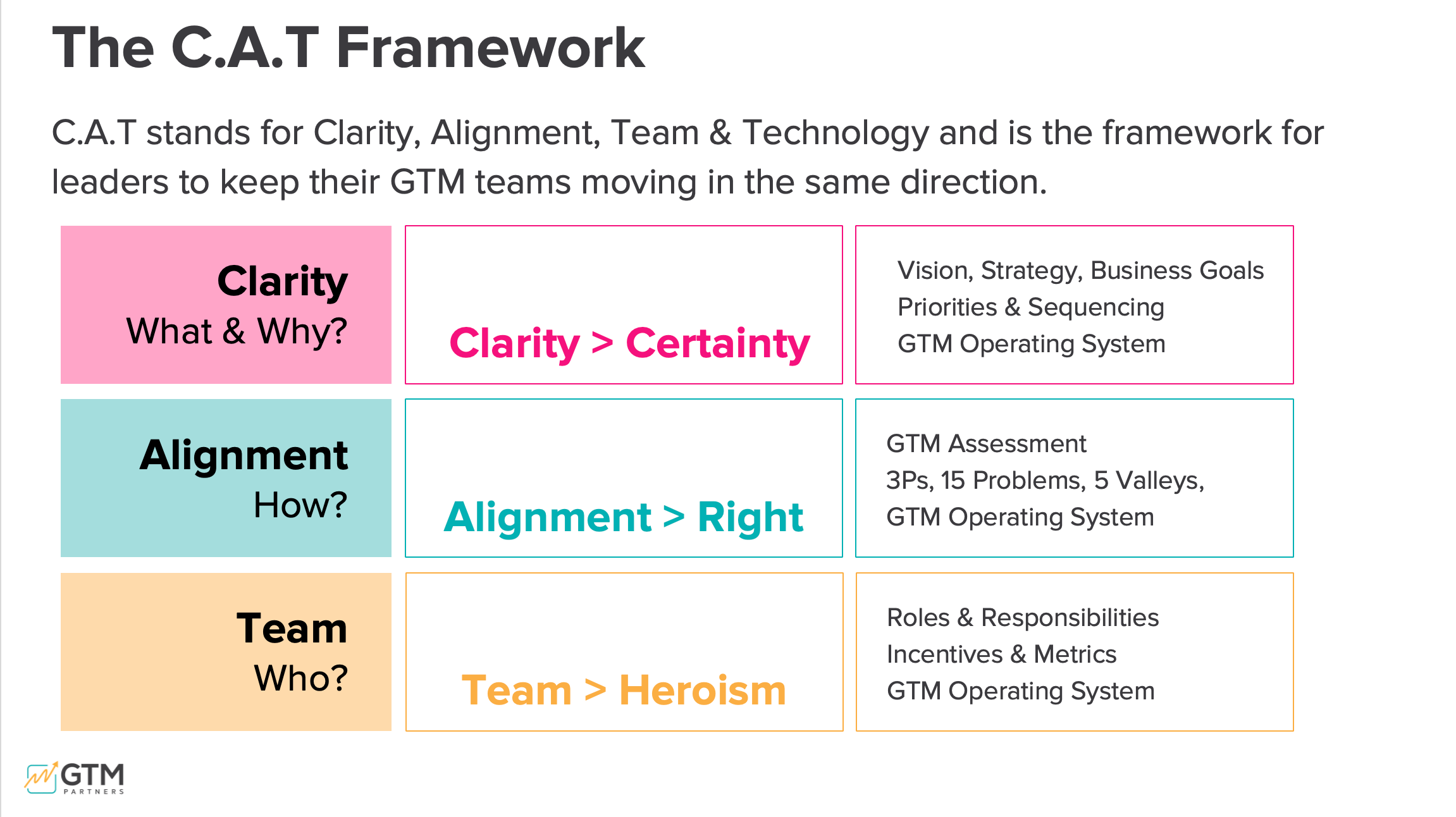
If RevOps is the nervous system of the GTM engine, Leadership & Management is the force multiplier across all of it. GTM Partners calls it the pillar that bridges the gap between strategy and execution — the glue holding the other seven pillars together. You can design a brilliant GTM strategy on paper, but it takes real leadership to translate that into coordinated daily action across marketing, sales, product, and customer success. Weak leadership leaves a void that fills with confusion, silos, and what the framework memorably calls “random acts of GTM.”
The audit of Pillar 8 uses the framework’s own CAT model — Clarity, Alignment, and Team — as its three diagnostic zones. Clarity is the What and Why. Alignment is the How. Team is the Who.
Clarity means everyone knows exactly what the plan is, what success looks like, and why it matters. It sounds obvious. It is almost never fully present. The statistic worth sitting with: 68% of GTM leaders say the biggest roadblock to reaching their goals is a lack of internal clarity. Not competition, not budget, not market conditions — clarity.
The framework’s principle here is that clarity beats certainty. It’s better to decide and give direction — even direction you may adapt later — than to suffer analysis paralysis while your team guesses at priorities. In practice, clarity often looks mundane: a plainly written one-page GTM plan that everyone can reference, defining the key objectives and the North Star metric. The mundanity is the point. Clarity isn’t a charisma problem; it’s a documentation-and-communication discipline that most teams simply never institutionalize.
The audit question is whether every person on your revenue team could independently state the current priorities, the definition of success this quarter, and why it matters — and whether their answers would match. When they don’t match, you’ve found a clarity gap that’s silently taxing every downstream pillar.
Healthy signal: There’s a written, shared plan defining objectives and the North Star metric. Every function can state the current priorities and why they matter, and their answers align. Leadership over-communicates direction rather than assuming it landed.
Unhealthy signal: Priorities live in leadership’s heads, not on paper. Ask five people what matters most this quarter and get five answers. Teams are busy but unsure whether they’re busy on the right things.
Clarity is knowing what to do. Alignment is knowing how to do it together. This is where each function’s roles and workflows either complement each other or collide. Alignment is marketing running campaigns that sales actually uses; it’s sales promising only what product has built; it’s every team operating on a shared cadence toward the same destination rather than each running its own play.
The mechanism of alignment is operating rhythm. A unified cadence — joint marketing-sales standups, a shared KPI dashboard reviewed together, deliberate cross-functional planning — is what keeps functions synchronized as they execute. Without it, even a team with perfect clarity drifts apart, because each function’s day-to-day pulls it toward its own local optimum. The framework is explicit that true alignment usually requires over-communication from leadership; it doesn’t happen once and hold. It has to be actively maintained through cadence.
This is also where Pillar 8 and Pillar 7 interlock. The shared dashboard that RevOps builds is the instrument alignment runs on. Leadership sets the cadence; RevOps provides the single source of truth that makes the cadence meaningful. Neither works well without the other — a leadership team with great rhythm but no trusted data is meeting to argue, and a great dashboard no one reviews together is instrumentation without alignment.
Healthy signal: There’s a defined operating cadence with cross-functional touchpoints. Teams review shared metrics together. Marketing, sales, and CS coordinate rather than collide. Handoffs are smooth because roles are clear and synchronized.
Unhealthy signal: Each function runs its own cadence and its own metrics. There’s no regular forum where the full revenue team looks at the same numbers. Misalignment shows up as campaigns sales ignores and promises product can’t keep.
The third zone is about people and incentives — the Who of execution. The framework’s principle here is “Team over Heroics.” A GTM system that depends on individual heroes — the one rep who carries the number, the one marketer who makes everything work — is fragile by design. Durable performance comes from a team where roles are clear, incentives drive the right behaviors, and success is repeatable rather than dependent on specific individuals.
This zone also covers employee success in the operational sense: ramp plans and enablement. When a new rep joins, is there a defined ramp — or do they sink or swim? When the team needs to execute a new motion, is there enablement to build the capability, or is it assumed? A leadership function that invests in ramp and enablement is building a system that scales. One that doesn’t is betting the company on the caliber of individuals it happens to hire, which is not a strategy.
The audit question is whether your results depend on heroes or on a system. If you removed your single best rep, your best marketer, your most capable CSM — would the engine still run? If the honest answer is no, you have a Team-pillar gap that no amount of talent can permanently paper over, because heroes leave, burn out, or simply can’t scale to match the company’s ambitions.
Healthy signal: Performance is broad-based, not hero-dependent. New hires have defined ramp plans. Incentives are structured to drive the right behaviors and reward team outcomes. Enablement builds capability systematically.
Unhealthy signal: A few heroes carry the results. Losing any one of them would be catastrophic. Ramp is sink-or-swim. Incentives reward individual heroics over team outcomes, or don’t reinforce the behaviors the strategy actually needs.
Consider a Series B company at $12M ARR that, on paper, has strong individual pillars. The market is well-defined. Demand is healthy. There are good reps and good customers. And yet leadership meetings are exhausting, the forecast is missed as often as it’s hit, and every quarter feels like a scramble that no one saw coming.
Run the operations and leadership audit, and the pattern emerges. On the RevOps side: there’s no single source of truth. Marketing reports pipeline from one system, sales forecasts from the CRM, and finance reconciles a third version in spreadsheets. Deal stages mean different things to different reps. Forecasting is the VP of Sales’s gut, pressure-tested by nothing. The result is that leadership spends the first twenty minutes of every meeting arguing about whose numbers are right before they can even discuss what to do.
On the leadership side: there’s no written plan. Each function has a sense of the priorities, but the senses don’t fully match — marketing is optimizing for one thing, sales for another, CS for a third. There’s no unified cadence; each team runs its own standup on its own metrics. And the results, such as they are, depend heavily on two star performers whose departure would take a third of the revenue with them.
The diagnosis is not that any single pillar is broken. It’s that the infrastructure connecting all of them is absent. This company doesn’t have a sales problem or a marketing problem — it has a Pillar 7 and Pillar 8 problem that manifests as chaos across every other pillar. The fix isn’t a new VP or a new campaign. It’s a single source of truth, a real forecasting discipline, a written plan, and an operating cadence. Unglamorous, foundational, and the highest-leverage work available to them.
This composite is worth holding next to the ones from earlier weeks. The Week 3 company had a velocity leak. The Week 4 company had an eroding customer base. This company has neither — its individual pillars are fine. What it lacks is the connective infrastructure, which is exactly why its problem was the hardest to see and the easiest to misattribute.
By Series B and C, investors scrutinize these two pillars directly, because they’re the clearest signal of whether a company is actually in control of its own growth. On RevOps, they’ll ask whether you have a handle on your key metrics, how you forecast and how accurate it’s been, whether your teams work off the same data, and what systems you’ve put in place to handle scale. A fumbling answer — “we still patch together spreadsheets” — makes them nervous that you can’t see your own business.
On leadership, the questions are subtler but just as consequential. Investors are assessing whether the team is aligned, whether execution is systematic or heroic, and whether the organization can scale beyond its founders. They’ve seen too many companies with great products and misaligned teams stall out, and they know — as the GTM Partners research confirms — that alignment failure is the most common reason targets get missed. A company that can demonstrate operational rigor and genuine alignment is demonstrating that its growth is repeatable, which is ultimately what they’re buying.
Work through these this week. These questions tend to be the most revealing of the entire series, because they surface the infrastructure gaps that have been quietly taxing every other pillar.
1. Is there a single system everyone agrees is the source of truth — and is the data in it actually clean and trusted?
2. Does everyone share the same definitions for a qualified lead, a deal stage, an active customer? Or do meetings start with arguments about whose numbers are right?
3. Do you have a defined forecasting methodology — or is your forecast someone’s gut feel?
4. How accurate has your forecast been, and do you catch likely misses early enough to act?
5. Are your systems integrated with automated workflows, or are they islands connected by manual re-entry and someone remembering?
6. Is there a written, shared plan? Could every function independently state this quarter’s priorities and why they matter — and would the answers match?
7. Is there a unified operating cadence where the full revenue team reviews the same metrics together?
8. Do marketing, sales, and CS coordinate — or collide? Where’s the misalignment showing up?
9. If you removed your single best performer, would the engine still run — or are your results hero-dependent?
10. Do new hires have a defined ramp, and do your incentives reward the behaviors your strategy actually needs?
The operations and leadership audit tends to be the one that reframes everything that came before it. Teams that have spent four weeks hunting for a broken pillar often discover here that their individual pillars are healthier than they thought — and that the real constraint was never a pillar at all, but the absence of the infrastructure that connects them. That’s not a disappointing finding. It’s a clarifying one, because operational and leadership infrastructure is among the most fixable things in a GTM system, and among the highest-leverage.
Next week, the series concludes. In the finale, we bring all eight pillars together — scoring your full audit, sequencing which fixes matter most, and building the 30/60/90 remediation plan that turns diagnosis into action.
Want to benchmark your operations and leadership findings against the full framework? The GTM Maturity Assessment scores you across all eight pillars and surfaces where your connective infrastructure is strongest and where it’s failing. I’ll share how to access it in this week’s companion posts. And if the audit reveals that alignment or operations is the real constraint, fractional GTM engagements are built precisely for this kind of infrastructure work.
No posts
Comments
Nothing yet. Say the first thing.
Sign in to join the conversation.