
This is the third piece in a six-part series on the 3Ps of GTM Maturity. Week 1 established the full framework and the diagnostic lens. Week 2 went deep on Problem-Market Fit — what it actually requires, and what premature departure costs. This week focuses on the transition between the first two stages: why it’s the most dangerous inflection point in early GTM, what makes it stall, and how to navigate it without disrupting the revenue your current system is still producing.
* * *
The growth deceleration usually starts quietly.
The company has been growing. Not cleanly — the deals have been uneven in size and source, the ICP has been loosely defined, the process has lived mostly in the founder’s head — but growing. Revenue is real. The board is encouraged. The narrative around the last financing was about scaling what’s working.
And then the new VP of Sales has been in role for ninety days, and the pipeline isn’t what anyone expected. The marketing function is up and running, generating leads, but the sales team isn’t converting them at the rate the model assumed. Deal cycles are longer than they were before. A couple of accounts the company expected to close have gone quiet. The founder, who used to close everything personally, is now trying to manage a team while also covering the deals that are genuinely at risk.
Nobody can quite name what changed. The product is the same. The market is the same. The team is, by most measures, more capable than it was six months ago.
What changed is the stage. The company has crossed an invisible line — or tried to — from Problem-Market Fit into Product-Market Fit. And the GTM system hasn’t crossed with it.
The transition from Problem-Market Fit to Product-Market Fit is not a milestone. It is a transformation. And most companies attempt it without a plan for what has to change.
This post is about that transformation: why it stalls even when the product is genuinely good, what misalignment looks like inside a leadership team navigating it, and how each of the critical GTM OS pillars has to evolve to support the stage you’re moving into rather than the stage you’re leaving.
* * *
Of the three transitions in the 3Ps framework — Problem to Product, Product to Platform, and the resets that occur with new motions — the Problem-to-Product transition is the one that destroys the most value in early-stage B2B SaaS. Not because it is the most complex transition, but because it is the most misread.
The Problem-to-Platform transition is hard, but companies that attempt it usually know they’re attempting something large. They’ve raised significant capital, they have a board pushing for it, and the scale of the change is visible to everyone involved.
The Problem-to-Product transition often doesn’t feel like a transformation at all. It feels like growth. Revenue is increasing. The team is expanding. There’s a VP of Sales now, a marketing function, maybe a CS hire. Everything looks like it’s working. The misread is that the company has already arrived at Product-Market Fit when it has actually just started the work of earning it.
The GTM Partners research on this is unambiguous. The $40M services business in the 3Ps certification is the reference case, but it describes a pattern that appears in company after company: growth that was 25% year-over-year decelerates to 10% not because anything broke, but because the company tried to run a Product-Market Fit motion — with Product-Market Fit headcount and Product-Market Fit investment levels — before the Problem-Market Fit foundation was solid enough to build on.
The cruelest version of this pattern is when the company has a genuinely good product. The product isn’t the problem. The product-market fit, in the narrow sense — the technical sense — exists. Customers who use the product correctly are getting value. But the GTM system hasn’t developed the infrastructure to find, qualify, close, and retain those customers at scale without heroic effort from individuals who won’t always be there.
That is not a product problem. It is a system problem. And it requires a system solution.
* * *
The GTM Partners M.O.V.E. framework gives us the most precise description of what changes between stages. Understanding what has to be true in each of the four dimensions at Product-Market Fit — compared to what was appropriate at Problem-Market Fit — is the clearest map of the transformation required.
At Problem-Market Fit, targeting was necessarily broad. You were learning which segment of the market had the sharpest pain and the clearest path to value. Minimal prioritization was appropriate because you didn’t yet have enough signal to prioritize against.
Product-Market Fit requires something fundamentally different: a defined set of relevant accounts, filtered against a specific ICP, scored against intent signals, and prioritized in a way that both sales and marketing are executing from. Not a list the founder built for a board deck. A living, operationalized TRM that the commercial team uses as its daily working reality.
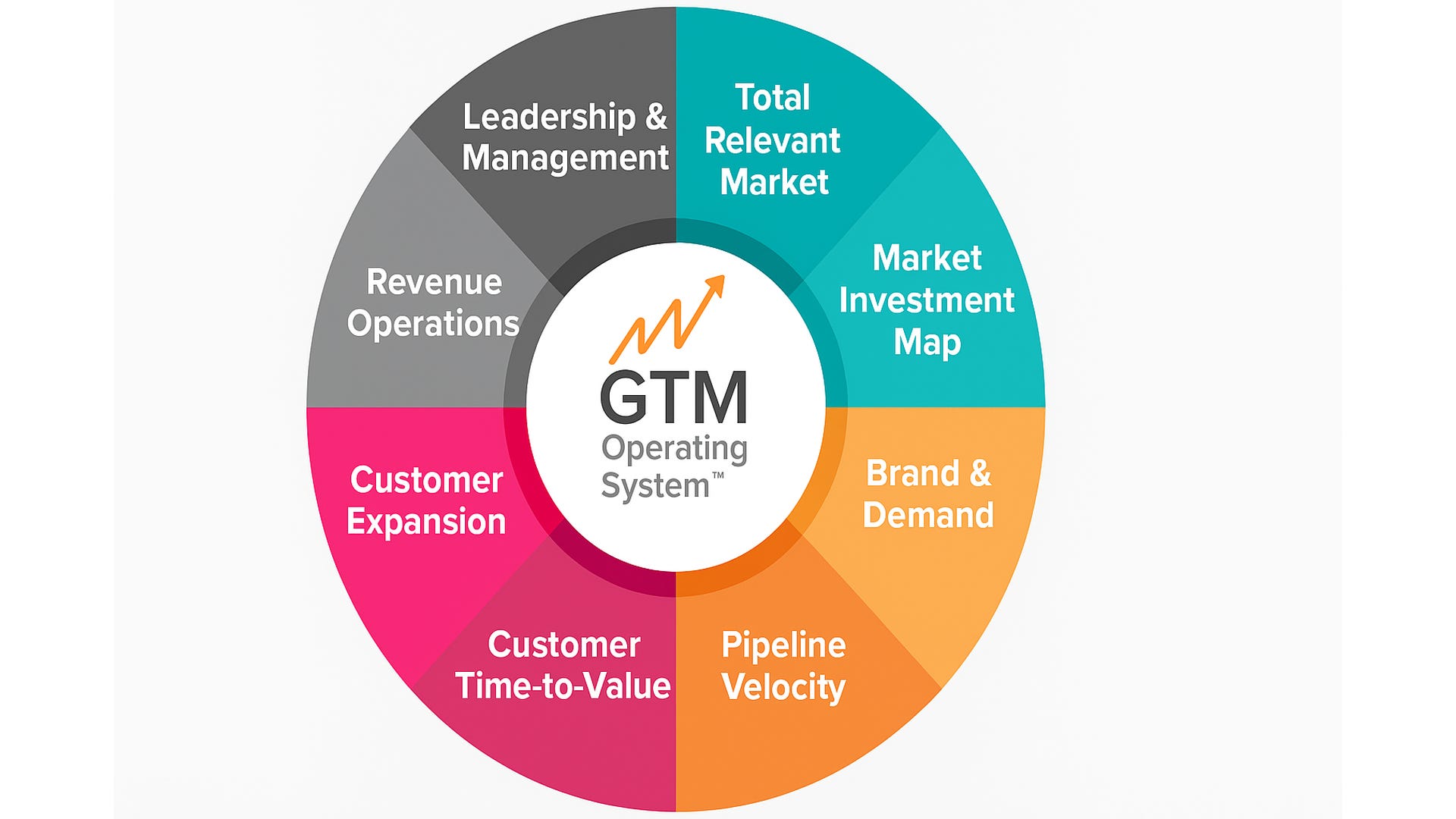
This is Pillar 1 work — Total Relevant Market — and it is the foundational prerequisite for everything else in the transition. If sales and marketing are not working from the same account universe, with the same ICP definition and the same prioritization logic, every downstream investment in demand generation, pipeline management, and sales process optimization is working against itself.
The transition fails here more often than anywhere else, and it fails quietly. It looks like a lead quality problem, or a sales and marketing alignment problem, or a conversion rate problem. Underneath almost all of those symptoms is a TRM definition that hasn’t been operationalized at the level Product-Market Fit requires.
At Problem-Market Fit, operations were department-level at best, founder-level in practice. Decisions were made based on what the founder knew. Data lived in disconnected systems. There was no shared definition of what a qualified opportunity looked like, because the founder knew one when they saw it and that was enough.
Product-Market Fit requires aligned operations: a shared understanding of the data across sales, marketing, and customer success, with aligned decision-making authority and dedicated ops functions for each department. This is the beginning of the RevOps investment — not the full centralized RevOps function that Platform-Market Fit requires, but the shared data infrastructure and common definitions that make cross-functional execution possible.
The practical implication: before you can build pipeline at scale, you need everyone working from the same definition of a lead, an MQL, an SQL, and a qualified opportunity. The gap between what marketing thinks is a qualified lead and what sales will work is one of the most expensive operational failures in early-stage GTM. It is almost always a symptom of operations that haven’t yet made the transition from ad hoc to aligned.
At Problem-Market Fit, investment was reactive. When something broke, you hired someone to fix it. When a new customer segment appeared, you chased it. When a deal required more support, the founder stepped in. This is the appropriate mode for a stage in which you are learning more than you are scaling.
Product-Market Fit requires proactive investment — building capacity ahead of need, not in response to it. This shows up most directly in sales capacity planning: how many reps do you need at the start of the next quarter to hit your bookings target, given your ramp assumptions and your expected pipeline coverage? The answer to that question requires a level of forecasting confidence that reactive investment never develops.
The Sales Velocity formula — Pipeline × Win Rate × Deal Size ÷ Sales Cycle Length — becomes a genuine management tool at this stage rather than a retrospective metric. The transition to proactive investment means understanding which lever to pull to increase velocity: more qualified pipeline, higher win rates through better targeting and enablement, larger deal sizes through packaging or segment focus, or shorter cycles through qualification discipline and friction removal.
Companies that remain reactive at this stage chronically underbuild capacity and then overcorrect with expensive, rushed hiring that adds cost without adding proportional revenue.
At Problem-Market Fit, you ran one motion. Direct founder-led sales, most likely, with whatever channels happened to produce deals. This was correct. You didn’t have enough proof of the motion to layer in additional complexity.
Product-Market Fit opens the door to partial expansion: adding a second distribution path alongside the proven primary motion, expanding geographic coverage, deepening vertical focus. But this expansion has to follow the proof — it cannot precede it. The mistake companies make at this stage is trying to run multiple motions simultaneously before any single motion has been proven to the level of repeatability that would justify the investment.
One of the most common and expensive versions of this mistake: launching an outbound motion before the inbound or direct motion is reliably producing qualified pipeline. Outbound requires a defined ICP, a clear message, and a sales team that can convert the meetings it produces. Without those prerequisites, outbound becomes an expensive activity metric that produces noise but not signal.
* * *
One of the most practically important — and least discussed — dynamics of the Problem-to-Product transition is what happens when the executive team isn’t operating from a shared understanding of which stage the company is in.
The GTM Partners $40M services business case illustrates this with unusual clarity. In that company, the executive team was surveyed about where they believed the company sat on the maturity curve. The results showed three distinct clusters: some executives believed the company was still in Problem-Market Fit and were advocating for investment decisions appropriate to that stage. Others believed they were approaching Platform-Market Fit and were pushing for expansion investments that the system wasn’t ready to support. Nobody was executing Product-Market Fit correctly — because there was no shared agreement that Product-Market Fit was the stage the company was actually trying to achieve.
The result was exactly what you’d expect: misaligned investment, competing priorities, and a team that couldn’t execute against a coherent strategy because they didn’t share one. Revenue growth decelerated from 25% to 10% year-over-year. The product was fine. The people were capable. The system was incoherent.
Executive misalignment on GTM stage is not a strategy problem. It is a shared framework problem. And it doesn’t resolve itself through better communication — it resolves through agreement on which stage you’re in and what that stage requires.
In the Seed-to-Series B companies I work with, this misalignment shows up in more subtle forms than the $40M case. It looks like:
A founder who is still operating in Problem-Market Fit mode — chasing every deal personally, adjusting the pitch for every prospect, making product commitments to accelerate closes — while simultaneously asking a VP of Sales to build a repeatable process. These two things cannot coexist. The founder’s involvement in every deal signals to the team that the process isn’t trusted, and undermines the very repeatability the company is trying to build.
A VP of Sales who has been hired from a Product-Market Fit or Platform-Market Fit environment and is trying to install the processes and infrastructure appropriate to those stages before the foundational elements are in place. Sales methodology training before the ICP is defined. Salesforce customization before there’s a process worth capturing. Compensation plan redesign before the motion is repeatable enough to measure accurately.
A marketing leader who is generating demand into a segment that hasn’t been validated as the primary ICP, because the ICP definition they were given at hire was too broad to execute against and they’ve been targeting based on their own judgment ever since.
Each of these is a version of stage misalignment. And the resolution in every case is the same: get the leadership team aligned on which stage the company is actually in, what that stage requires, and what the specific work is that has to be done before the next stage can be earned.
* * *
The transition from Problem-Market Fit to Product-Market Fit isn’t a single event. It’s a series of parallel evolutions across the GTM OS — some of which can happen simultaneously, and some of which have to happen in sequence because earlier pillars are prerequisites for later ones.
The ICP hypothesis that was tested during Problem-Market Fit needs to become an operationalized, scored account list that the entire commercial team works from. This means defining the ICP with firmographic, technographic, and behavioral specificity; mapping it against a realistic universe of accounts; scoring and tiering those accounts; and loading the result into the CRM as the team’s primary working reality.
This is not a one-time exercise. The TRM needs to be validated against the customer base — your best customers should score highly, and accounts that look like your worst customers should score poorly. If that validation doesn’t hold, the ICP definition needs refinement before it’s used as the basis for pipeline investment.
At Problem-Market Fit, the Market Investment Map was simple: fund the one motion that showed the most promise. At Product-Market Fit, it becomes a more structured question: which GTM motions are you running, what evidence do you have for each, and what does the revenue model look like for each motion at the scale you’re trying to reach?
This is where companies that have been running multiple motions informally — some inbound, some founder-led outbound, some channel — need to make deliberate choices about which motions to invest in scaling and which to deprioritize until the primary motion is fully proven. Trying to scale three partially-proven motions simultaneously is not a strategy. It is a resource diffusion problem.
This is one of the most psychologically difficult evolutions of the transition, because it requires the founder to step back from a role they’ve been performing successfully. The founder’s personal credibility, domain expertise, and network have been the primary demand engine. That isn’t wrong — it’s exactly what Problem-Market Fit requires. But it doesn’t scale.
The Brand and Demand evolution at this stage has two components. The first is transferring the core POV — the compelling argument for why the problem the company solves matters, and why this company’s approach is the right one — into assets and programs that can generate demand without the founder in the room. This means documented positioning, a defined messaging architecture, and demand generation programs that produce qualified pipeline from the defined TRM.
The second component is the shift from activity metrics to pipeline metrics. At Problem-Market Fit, marketing was measured on outputs: leads generated, content produced, events attended. At Product-Market Fit, marketing needs to be measured on pipeline contribution and pipeline quality. The transition to shared accountability between marketing and sales for revenue outcomes is one of the defining characteristics of a company that has made this shift.
The sales process that lived in the founder’s head needs to become a documented, teachable, measurable system. This doesn’t mean a rigid playbook that constrains every rep interaction. It means a clear definition of what each stage of the process requires, what constitutes a qualified opportunity at each stage, and what moves a deal forward.
The Sales Velocity formula becomes a management discipline at this stage. Tracking pipeline volume, win rate, average deal size, and sales cycle length — by segment, by rep, by source — gives you the diagnostic visibility to know which lever to pull when velocity is below where it needs to be. Without this visibility, every shortfall becomes a crisis rather than a signal.
The qualification discipline required at Product-Market Fit also becomes explicit here. At Problem-Market Fit, you often couldn’t afford to be selective — you needed every deal you could get to build the pattern recognition that informed the ICP. At Product-Market Fit, poor qualification is one of the primary destroyers of Sales Velocity: it inflates pipeline volume while deflating win rate and elongating cycle length. The discipline of getting out of bad deals early is worth more, in velocity terms, than most demand generation investments.
The RevOps evolution at this stage is about establishing the shared data infrastructure and common definitions that make cross-functional alignment possible. A single source of truth in the CRM. Consistent stage definitions that sales, marketing, and leadership all use. Forecasting capability that gives the business reasonable confidence about what the next quarter looks like.
This doesn’t require a dedicated RevOps leader at most companies at this stage — though for companies above $5M–$8M ARR with a commercial team of ten or more, the investment often pays for itself quickly. What it requires is someone owning the data infrastructure question explicitly: cleaning up the CRM, establishing stage definitions, building the reporting that lets leadership make decisions from shared facts rather than competing interpretations of disconnected dashboards.
* * *
One of the legitimate fears that founders and GTM leaders have about the Problem-to-Product transition is that the changes required will disrupt the revenue the current system is still producing. It’s a reasonable concern. The founder-led motion is still closing deals. The informal process is still generating pipeline. Formalizing everything risks making the system more rigid without making it more effective.
The way to manage this risk is sequencing — being deliberate about which elements of the transformation to prioritize first, and which to layer in after the foundational elements are stable.
The right sequence, in most cases, is:
First: ICP and TRM. Everything else in the transition depends on knowing precisely who you’re targeting. Get this right before scaling any motion. A well-defined, operationalized TRM is the prerequisite for almost everything else — demand generation programs, sales capacity planning, qualification frameworks, pipeline metrics. Build this first.
Second: Sales process documentation. Before adding headcount to the sales team, document the process that’s currently producing results. Not perfectly — but well enough that a new hire could follow it. This is the minimum viable playbook: stage definitions, qualification criteria, common objections and responses, the close path. This work also forces the founder to articulate what they actually know about why deals close, which is valuable beyond its operational utility.
Third: Shared operations and data. Once the ICP is defined and the process is documented, establish the shared data infrastructure that makes cross-functional execution possible. CRM hygiene, stage definitions, the reporting that gives leadership a shared view of pipeline health. This is where RevOps investment — even at a light level — begins to pay dividends.
Fourth: Brand and demand. With a defined TRM and a documented process, the demand generation investment becomes much more efficient. Marketing now knows who to target and what the sales team needs from a qualified lead. The investment in brand programs, content, and outbound activation can be sized and measured against pipeline contribution rather than activity outputs.
The companies that navigate this transition most successfully are the ones that resist the pressure to do everything simultaneously. The board wants to see a full GTM buildout. The investors want to see marketing spend. The VP of Sales wants to hire reps. All of these are reasonable things to want. But doing all of them before the foundational sequencing is right is what produces the twelve-to-eighteen month setbacks that look, from the outside, like GTM failure.
They’re not GTM failure. They’re GTM sequencing failure. The difference matters because the fix is different.
* * *
The most useful output of this post is a way to assess where your company currently sits in the Problem-to-Product transition — not as a pass/fail grade, but as a map of which work is done, which is in progress, and which hasn’t started yet.
Does your sales team have an operationalized account list they are actually working from — not a conceptual ICP description, but a scored, tiered set of target accounts loaded into the CRM? If not, this is the first work to do.
Do your sales and marketing leaders give the same answer when asked who you’re targeting and why? If the answers diverge by more than nuance, the TRM work isn’t done.
Is marketing measured on pipeline contribution or on activity outputs? If the answer is activity outputs — leads, MQLs, events — the shift to shared revenue accountability hasn’t happened yet.
Can the core POV be articulated by someone other than the founder in a way that resonates with the defined ICP? If the answer is no, the brand equity is still personal rather than institutional.
Do you have consistent, reliable data on win rate, average deal size, and average sales cycle length — by segment, by source, by rep? If not, you cannot manage velocity. You can only observe it after the fact.
Is qualification discipline enforced — meaning deals that don’t meet ICP criteria are actively removed from the pipeline rather than left to age? If pipeline is full of low-quality opportunities, the velocity math is being distorted in ways that make planning unreliable.
Do sales and marketing share a definition of a qualified opportunity, and is that definition enforced in the CRM? If there are ongoing arguments about lead quality or handoff criteria, the operations alignment hasn’t happened.
Can leadership produce a forecast with reasonable confidence from shared data? If the forecast lives in a founder’s head or in a spreadsheet that nobody else trusts, the foundational RevOps work is still ahead of you.
Does the executive team share a common understanding of which stage the company is in and what that stage requires? If you can’t answer this with confidence, doing the diagnostic explicitly — using the 3Ps framework as the shared lens — is worth the time before making the next round of investment decisions.
* * *
Next week’s post examines Product-Market Fit as an operating state — not a milestone to reach, but a stage to run well. The common failure mode at Product-Market Fit isn’t that companies can’t achieve it. It’s that they treat it as a destination rather than an operating discipline, and either underinvest in sustaining it or try to skip past it to Platform-Market Fit before the engine is truly reliable.
The two failure modes at Product-Market Fit — underbuilding and overreaching — look different from the outside but share the same root cause: treating the stage as something to get through rather than something to build on.
If the dynamics described in this post feel like a live issue in your company — the sales team isn’t converting the way the model assumed, marketing and sales are misaligned on what a good lead looks like, or the leadership team has different assumptions about what stage you’re in — the most productive next step is a structured diagnostic rather than more investment in the current motion. StageWise GTM runs exactly that kind of diagnostic, grounded in the GTM Partners framework. Reach out if you want to talk through where your system is and what the sequencing should be.
Scott Travis is the Founder & CEO of StageWise GTM and a GTM O.S. Certified Partner. He serves as a Fractional CRO and GTM Systems Advisor to Seed-to-Series B B2B SaaS, AI, and MSP companies.
No posts
Comments
Nothing yet. Say the first thing.
Sign in to join the conversation.