
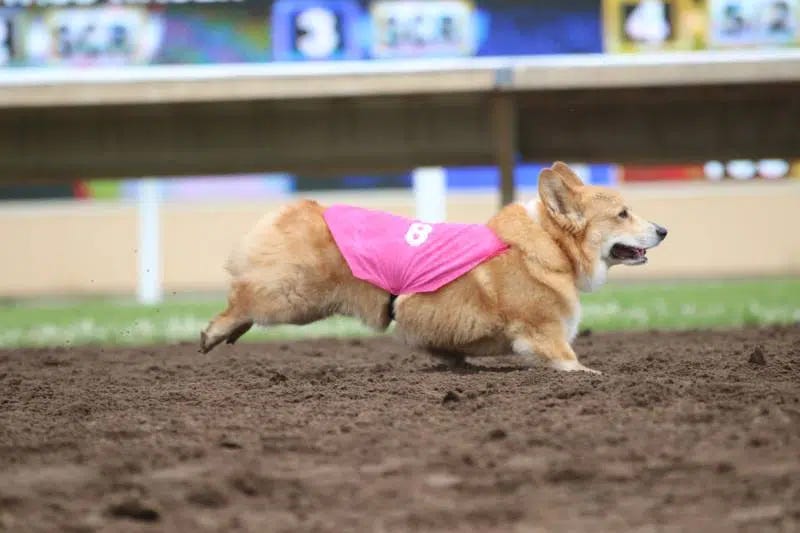
Image Credit: Maren Dale, Shutterstock
hobble (verb)
To move along unsteadily or with difficulty, especially because of injury.
To hamper the movement or progress of someone or something.
(transitive) To cause to limp or restrict the ability to walk normally—often by tying together the legs.
The first dog I ever acquired, as an adult, was a Basset Hound. My husband and I lived in a rented condo at the time. There was a large common lawn in the center of the complex, and people allowed their dogs to play off leash, so we got to meet all the neighbors’ dogs. I remember my impressions from that time (my thinking has evolved since then). There was a Chow (scary), a Golden Retriever (boring and unoriginal), a mixy mix brown thing (nice but also boring), a little white fluffy poodle (cute, but too barky), and a Basset Hound (now we’re talking!).
He was sweet and docile and I adored his sad droopy eyes, long velvety ears, and waddling gait. As soon as I could talk my husband into it, I searched for and found a Basset puppy and brought him home. We named him Dudley (of course we did). He was treated like a prince and helped my husband put off letting me have a real baby for almost two more years.
You might predict, if you read a lot of functional breeding content, that I’m about to start telling you how unhealthy he was. How he had chronic pain, back problems, bad knees.
No, he seemed fine. He was sweet and we loved him. I never got to see how he fared as he aged because we ended up rehoming him with a retired couple after our son was born. He couldn’t cope with my attention not being entirely centered on him. So, maybe he did have back issues as he got older. I’ll never know.
The last photo update we got from his new owners was him wearing a sailor outfit, including a hat, riding in their boat on a sunny day. No need to compete for attention. Good boy Dudley. I am tearing up thinking of it, almost 30 years later. I will have to write a post sometime about rehoming dogs, in all its heartbreaking practicality. Not today.
The reason that dogs like Bassets have short legs is entirely because they have been selectively bred by humans to have short legs. And the mutated genes that give them short legs also predispose them to chronic pain from disc degeneration, herniated discs, and paralysis. I didn’t know that in my 20s. I had the very common, very vague idea that “breeds” were spontaneous occurrences. Bassets had short legs because, well, that’s just how they are. I never thought about it much.
But this essay isn’t about chondrodystrophy and its related health problems.
It’s about Corgi races.
I had never heard of these until last week. A reel popped up on my feed of a Corgi race at a “Celtic Festival” in my state. (not sure what that is either, but I bet there are funnel cakes and craft sales). I googled Corgi race and found several examples, including at an NFL halftime show last year. Apparently this is a thing.
People bring their pet Corgis to a field, they line up, and then the owners attempt to get them to run in a straight line across the field to another handler calling them and enticing them with treats, etc. It’s chaotic, as you would expect, given the dogs have not apparently been trained much to do this, and that’s the fun part. The chaos. The dogs running this way and that, going the wrong direction, etc. I do love a naughty dog. Cute idea.
I found an article exploring the ethics of Corgi races. Except it turned out to be a comparison between Corgi racing and greyhound or horse racing and listed the main ethical concerns: whether the dogs might get overheated or get into fights. The conclusion:
“Corgi races are an adorable and humorous event for recreational or fund-raising purposes since everyone loves to watch these short legged pups fail to follow the rules. Unlike other animal races, these races are entirely ethical and safe for your dogs.”
Dogster article
So, what’s the problem? Isn’t this harmless?
Except, why Corgis? Why not just any dog? Why not “dog races”? I can assure you most, if not all, pet dogs would perform similarly funny antics in that setting.
Because it wouldn’t be as funny to see fast athletic dogs do this. It’s funny to watch a dog with tiny legs try to run fast.
And this is what I can’t unsee. After 30 years of owning dogs, and six years of immersing myself in the ethics of breeding them, what has changed in me more than anything is my respect for dogs. I’ve had to negotiate my relationship with several dogs now and I’ve watched them mate, whelp, and tend their puppies. Dogs have lives that go beyond us. They are unique individual animals with whole inner worlds we can access if we watch and listen closely. That’s not anthropomorphizing, it’s humility. Dogs are here to teach us things if we are listening.
Dogs love to run. It’s an awe-inspiring thing to watch a fit, sturdy dog race across a field in chase, or leap into the water on a hot day and swim across a pond. It’s a lesson in the joy of embodiment to be with a healthy animal in its prime, enjoying its own movement and being connected to the earth.
So maybe: let’s not take away their legs in order to be entertained by their disability.
The idea of breeding healthy, functional companion dogs in an ethical, science-based way is still in its infancy. We haven’t clearly defined how to do it or what “functional” pet dog temperament really is. Is it functional for a pet dog to be a little needy? A little... slow? Is that part of their job?
We know we want to breed for things like resilience, sociability, biddability. But where do we find the perfect sweet spot between wild dogs and hobbled captives?
Our tendency as humans, so far, has been to gravitate toward dysfunctional body types in pet dogs. The traditional companion breeds are mostly either miniaturized versions of their ancestors, or have disabilities written into their breed standard, sometimes both. The flat faces and round eyes of the brachycephalic dogs trigger our oxytocin response. The waddling gait of the chondrodystrophic breeds makes us chuckle.
Whether it’s a rescue, a broken dog, or a baby puppy, people are often drawn to dogs who need them. This isn’t necessarily wrong or bad. It may be a critical part of the canine-human bond, but we need to develop some self-awareness about it.
If we are going to change things and center welfare in breeding pet dogs, we need to recognize this history and come face to face with what it means about us—and how we really feel about dogs.
Are we breeding dogs to love us—or breeding dogs who can’t live without us? Is that the same thing? We haven’t adequately distinguished between true behavioral stability and the kinds of stillness, sweetness, and compliance that emerge from constraint—whether physical, metabolic, or emotional.
I had a dog once who could catch birds right out of the air. She was a huntress. She liked us humans well enough, but she’d much rather have spent her days roaming the woods and fields than conform to the plan we had for her, which was to stay inside a fence. She was a disappointment as a breeding prospect, since prey drive is not something we want in “ideal” pet dogs.
After she died, I realized I hadn’t appreciated her enough. I had spent too much time wishing she was different than she was. I didn’t allow myself to wonder enough at her hunting prowess; at her soft, gentle, independent nature. I failed to really notice what a gift it was to share a home with a creature so wild and so tame all in one body. I failed to be grateful enough that she chose to spend her life with us, when she must have known that she was quite capable of fending for herself.
She taught me things about dogs, and about myself. Maybe those lessons were something I needed more than a compliant low drive pet. I’m not sure.
We could give Corgis their legs back in a couple generations of careful outcrossing. But then what would they be? Would they catch birds right out of the air? Would they run right off that silly race field and into the woods to hunt? Maybe. I don’t know.
But I know this—true love is given freely and involves mutual respect. We can’t know what dogs are giving us freely, when they are hobbled.
No posts
Comments
Nothing yet. Say the first thing.
Sign in to join the conversation.