
0:00
-21:09
Good day my good friend.
As I mentioned last week, on Monday I will be presenting at Active County Cambridgeshire, and next Wednesday and Thursday I will be at the Transport Practitioners Meeting. If any of you are at either of these it will be great to see you there. Come and say hi - I don’t bite!
This year, Mobility Camp is coming to Sheffield on 30th September, and it promises to be another amazing day of discussion, debate, and taking action. Anyone with an interest in transport should be there, and so should you. You can get tickets here.
I have got a confession to make. I don’t like hot weather. I don’t do well in hot weather at all. The minute the mercury passes 26C I start to feel it. The lethargy, the discomfort, and the feeling that every ounce of energy is being drained from me by either the sun or the humidity. Or in the case of a recent heatwave, both.
I grew up in Devon, an area of the UK where the air temperature was heavily modulated by the Atlantic Ocean. In the 1990s in Devon, 25C was a hot day. 30C was insufferable. One day it went north of that, and if I have not headed to Saunton Sands to spend the day swimming in the waves, I might not have made it.
Where I live now in Bedfordshire is one of the hottest parts of the country. As I write this, we are in the middle of our third heatwave of the summer. We are sat under our second hot weather warning of the summer, and we are thankful that it is only an amber warning and not a red warning like two weeks ago. It now regularly exceeds 30C for at least two weeks every summer. And the frightening thing is that compared to what is coming, this might actually be a cool summer.
The Met Office offers a completely free service that is amazing and nobody knows about called the Local Authority Climate Service. What it does is provide data at a local authority level as to what the impacts of a warming climate are likely to be. For my local authority - Central Bedfordshire - the data is showing likely increases in temperature between 1C and 4C. This is the future world we must adapt to.

In this context, many discussions have turned to something surprisingly controversial - air conditioning. In my mind, far too many people see it as a threat to the climate (as it increases electricity use substantially, which can burn fossil fuels), or a matter of social justice (namely that the poorest are less likely to own air conditioning, which is reasonable). As you know, I like to try and look at things differently, and what I have discovered is that far from being something that is for the comfort of the rich, air conditioning actually saves lives on our transport network right now. So maybe it does not deserve a reputation of being a rich persons technology that we should turn our noses up at.
We need to start with understanding quite what heat does to us. When the air around us climbs above the narrow band our physiology prefers, thermoregulation stops being a background process and becomes an active demand. Blood is redirected towards the skin to shed heat, the heart works harder, fluid is lost through sweat, and the brain finds itself competing for resources it would otherwise spend on the task in front of it. The result is not simply discomfort. It is a measurable tax on cognition and mood.
If you have ever felt that your normal work on a hot day is much harder, that is because it is. In normal conditions, your background brain capacity regulates your temperature. But when it becomes hot, the brain needs more capacity to dedicate to stopping you from overheating, and it takes it from your conscious mind. You literally have less capacity to think, because your brain is trying to keep you cool.
The most authoritative synthesis of this is a meta-analysis by Hancock, Ross and Szalma, published in Human Factors in 2007. Pooling 528 effect sizes across 49 studies, they confirmed a substantial and consistent negative effect of thermal stress on human performance. They found that abstract cognitive tasks were the least affected of the categories they examined, while psychomotor and perceptual tasks degraded more severely.
Put this in a driving situation. You are driving a car, and the air conditioning doesn’t work. Its hot and you are sweating from the heat. Your driving suffers hugely in this situation. The hand-eye co-ordination, hazard detection, vigilance and rapid response are psychomotor and perceptual actions. The capacity for which your brain raids first to keep you cool.
A later systematic review and meta-analysis by Taylor and colleagues in Building and Environment in 2018 put numbers on the shape of the decline. Relative to a comfortable baseline, performance falls away as temperature rises, with the sharpest losses on the most attention-demanding tasks and a bell-shaped curve centred on thermal comfort. We do not lose a little of everything evenly. We lose most of the very faculties a driver leans on hardest.
A key term here is relative to a comfortable baseline, as the baseline air temperature varies by region. For instance, in the UK, the south is generally warmer than Northern England and Scotland, and so the baseline for what constitutes hot in places like Glasgow and Newcastle might be a slightly warm day in Milton Keynes.
There is now neurophysiological texture to this too. A controlled cabin study using electroencephalography, published in Sustainability in 2023, exposed drivers to cabin air at 20C, 23C, 26C and 30C and found that cognitive ability declined as the temperature rose, with subjective ratings of thermal discomfort and self-reported mental load climbing in step. The subjective and the objective moved together, which is important. People know they are struggling, and their brain activity confirms it.
The psychological pathway runs alongside the physical one, and it is at least as consequential for safety. Heat does not only slow us down. It makes us angrier. The foundational work here is Craig Anderson’s long programme on the heat hypothesis, summarised in his review chapter on temperature and aggression, which draws together field, laboratory and archival evidence that uncomfortable heat raises aggressive motivation and, given the right provocation, aggressive behaviour. The mechanism most relevant to transport is irritability. When we are hot we perceive minor provocations as larger ones, and our threshold for an aggressive response drops. Or, in more simple terms, we get angry much more easily in hot weather.
If heat degrades the faculties that keep us safe and raises the emotions that endanger us, we would expect to see it in the crash record. We do.
The cleanest demonstration comes from Barcelona. Basagaña and colleagues, writing in Environmental Health Perspectives in 2015, analysed more than 118,000 motor vehicle crashes in Catalonia across a decade and found that crash risk rose by around 7.7 per cent on heatwave days compared with otherwise similar warm days. Note that this is isolating the effects of extreme heat, rather than the effects of a warm summer day which may result in more driving. The extreme heat itself is correlated with more collisions.
The pattern replicates across very different settings. A study of the continental United States published in Accident Analysis and Prevention found road fatalities rising on heatwave days relative to non-heatwave days, and reviewed the mechanisms behind it, from drivers becoming drowsy and irritable to missed signals and larger, later steering corrections. Work in New York City has identified a temperature threshold of around 26C above which each additional degree lifts crash counts by roughly one and a half per cent. European analyses in France and the Netherlands have found that a single degree of warming raises motor vehicle injuries by one to two per cent. The effect sizes differ with climate and method, as we should expect, but the direction of travel is strikingly consistent.
The burden is not shared evenly. A time-stratified case-crossover study of Jinan in Frontiers in Public Health in 2024 found that pedestrians, cyclists and motorcyclists faced greater injury risk than occupants of enclosed vehicles under both hot and cold extremes. More recent work in California shows extreme heat disproportionately increasing high-severity crashes, particularly at intersections and among vulnerable road users. The people with the least protection from the heat carry the most risk from it.
What we mentioned about the link between heat and aggression also shows up. The classic study is Kenrick and MacFarlane’s field experiment on horn honking, in which a participant deliberately stalled at a green light and the researchers measured how drivers responded. As the Association for Psychological Science summarises, honking rose directly with temperature, and the effect was concentrated among drivers whose windows were down - which is to say drivers without air conditioning.
Most of these are observational studies, and several of their authors are careful to say they establish association rather than proof of causation. But the convergence of laboratory studies, field experiment and epidemiological association across continents is about as strong as this kind of question allows, and the mechanism is not mysterious. After all, we all get angry when we are hot.
The road is only half the story. Public transport concentrates people in metal boxes that heat readily and cool slowly, and the consequences fall on both passengers and staff.
The passenger side is oddly under-studied given how visible it is, and the reason is instructive. When Greenham and colleagues examined the relationship between heat and delays on the London Underground in Meteorological Applications in 2020, they deliberately stripped passenger illness, staff illness and personal injury out of their dataset in order to isolate infrastructure causes. That methodological choice tells us two things. Passenger illness is logged as a distinct and recognised category of delay, and it has been left largely unquantified in the academic literature. We know it holds trains and closes platforms. We have not properly measured it.
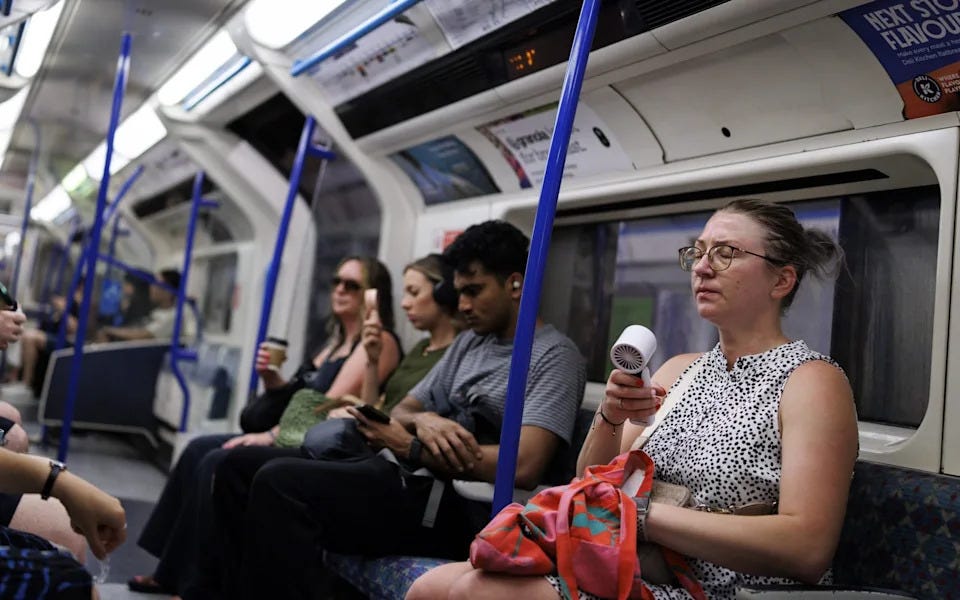
What we can measure is the discomfort that precedes the collapse. A study in Nature Cities in 2026 analysed more than 85,000 crowdsourced commuter posts across Boston, London and New York and mapped widespread thermal discomfort in underground systems, with recurrent peaks by hour, by day of the week and by season. A packed, poorly ventilated carriage in a heatwave is a place where a vulnerable passenger faints, with inevitable consequences.
Bus drivers, train drivers and control room operators are doing exactly the sustained, vigilance-heavy, psychomotor work that the thermal stress literature identifies as most vulnerable to heat. A driver in a hot cab is subject to the same degradation of reaction time and judgement documented before, except that this driver is responsible for dozens or hundreds of lives rather than one.
Active travellers sit outside the cooled cabin entirely, and their relationship with heat is more complicated than the simple assumption that good weather means more walking and cycling.
The relationship is not linear, it is bell-shaped. Böcker and Thorsson, writing in Weather, Climate, and Society in 2014, drew on panel travel-diary data and found that warmth encourages cycling only up to a point, after which higher temperatures suppress it, with the turning point sitting lower than most people assume, often in the mid to high twenties Celsius. Above that threshold the discretionary and less confident cyclists are the first to disappear. Warmth is the friend of active travel and heat is its enemy, and the two are separated by only a few degrees.
The heat that remains for those who still ride carries a health cost. Research on the heat health risk of cycling, published in Applied Geography in 2025, uses satellite land surface temperature data and shared-bike trajectories to map the exposure cyclists accumulate on hot commutes, and identifies where that exposure concentrates. Walking is affected too, in ways we can measure at the level of gait. A study in Scientific Reports found that walking cadence correlates inversely with maximum temperature, and suggested that the mechanism regulating our pace begins to fail when the heat becomes excessive.
Here I have to be honest about the limits of my own argument. Air conditioning does nothing for the cyclist at the traffic light or the pedestrian on the pavement. For them the interventions are different: shade, street trees, water, cooler surfaces. A piece arguing that AC saves lives has to concede that it saves the lives of people inside vehicles and carriages, and that the exposed majority need a separate and arguably more urgent set of protections. The active travel evidence belongs here not because AC helps these users, but because it completes the picture of who heat endangers, and reminds us that the enclosed cabin is a privilege the road does not extend to everyone.
So we arrive at air conditioning itself. The claim is not that cooling is pleasant, which is obvious, but that it reverses the specific physiological and psychological damage the earlier sections described, and that this reversal has a safety value we can trace.
Take the physical pathway first. A controlled experiment on driver thermal comfort published in Applied Sciences in 2021 measured drivers using electroencephalography, photoplethysmography and skin temperature while cabin conditions were moved from uncomfortable heat towards comfort. Cooling a 35C cabin measurably lowered the surface temperature of the forehead, hands and abdomen, and, crucially, the study tracked a stress index derived from heart rate variability that fell as the cabin approached a comfortable range. In plain terms, cooling the cabin calmed the driver’s autonomic nervous system. The body stopped fighting the environment and returned to a state in which it could attend to the road.
The cognitive pathway follows the same logic in reverse. If rising cabin temperature degrades cognition, then restoring a comfortable temperature restores the cognitive headroom that driving demands. Air conditioning is the mechanism that holds the cabin inside the narrow band where the performance curve is at its peak, rather than out on the degraded tail.
Then there is the psychological pathway, and here the evidence is almost poetic in its directness. Recall Kenrick and MacFarlane’s finding that the drivers who honked most in the heat were the ones without air conditioning. The corollary is that the drivers who kept their cool literally, kept their cool figuratively. A cooled cabin does not merely make an aggressive driver slightly less aggressive. It removes one of the triggers that manufactures aggression in the first place. Given how much of road danger is behavioural rather than mechanical, an intervention that lowers the baseline level of irritability across every occupied vehicle on a hot day is acting as a safety valve that no other single measure can match.
The strongest evidence that cooling saves lives comes not from transport at all, but from public health, and it is worth borrowing because it establishes the principle at scale. Barreca and colleagues, in a landmark paper in the Journal of Political Economy in 2016, tracked the United States across the twentieth century and found that the mortality impact of extremely hot days fell by around three quarters, with almost the entire decline occurring after 1960. Their central conclusion is stark. The diffusion of residential air conditioning explains essentially the whole of that decline. A supporting analysis of 105 US cities in Environmental Health Perspectives documented the same broad flattening of the heat mortality relationship over time.
Barreca studied homes, not vehicles or carriages, and their finding is about residential cooling and all-cause heat mortality rather than transport collisions specifically. But the underlying physiology is identical. If cooling the home removed most of the death from hot days across a continent, it is not a leap to expect that cooling the cab, the carriage and the car addresses the transport-specific expressions of the very same stress.
None of this lets air conditioning off the hook for its costs. Cooling demands energy, and in a still largely fossil-fuelled system that energy carries emissions. The refrigerants themselves are a problem, since many are potent greenhouse gases when they leak, which they do across the life of a unit.
In electric vehicles the cost is visible in range, with cabin cooling and battery thermal management drawing on the pack, a loss quantified by testing from bodies such as AAA. At the systemic scale the waste heat that air conditioning rejects into the street contributes, perversely, to the very urban heat island that makes more cooling necessary, a feedback loop we should take seriously. And there is a sharp equity dimension. Cooling protects those who can afford it and those whose transport happens to be well specified, while leaving the exposed majority, the pedestrians and cyclists and the passengers on older un-refurbished stock, to bear the heat unaided.
These are reasons to deploy cooling thoughtfully. They are not reasons to treat it as an indulgence. This is a trade-off to be managed rather than a choice to be refused: cleaner refrigerants, cooling powered by decarbonised electricity, efficient thermal design that reduces the load before we meet it, and a deliberate prioritisation of the modes and users where the safety return is highest.
Moderate warmth carries a number of genuine benefits for transport. Extreme heat carries almost none. It degrades the driver, inflames the passenger, increases the number of crashes and amount of illness in ways we can measure across continents and decades.
We have spent decades treating air conditioning as a comfort feature, a line item to be value-engineered out of a bus specification or tolerated as an indulgence on a train. The evidence asks us to reclassify it. In the cab of a vehicle it protects the reaction time and the temper of the person we have entrusted with other lives. In a carriage it is the difference between a bearable journey and a medical incident that stops a line. At the scale of a whole society, the public health record suggests that cooling removes some of the death that hot days used to bring.
It does its work invisibly, which is exactly why it goes unthanked. That invisibility is the mark of good safety engineering, not the absence of it. Air conditioning is a silent saviour on our transport network, and for all its real environmental costs, it deserves to be named as one. The evidence has been sitting quietly in the corner for years, keeping us safe while we looked the other way. It is time we returned the favour and paid it some attention.
While I love writing this, and my writing will always remain free to view, if you are able to donate whatever little you can to help out it is much appreciated. I do have bills to pay after all! You can do that right here.
The clever clogs at our universities, government departments, and other clever people have published the following excellent research. Where you are unable to access the research, email the author – they may give you a copy of the research paper for free.
Increased Risk of Work Safety Accidents During Extremely High Temperatures
TL:DR - Using an environmental epidemiology approach across Chinese cities, researchers found that exposure to extreme heat was associated with an 18.7 per cent increase in work safety accidents, with road transport and vehicle accidents among the categories most susceptible.
TL:DR - An analysis of police reported crash data from 177 Californian cities and found that extreme heat raises the risk of fatal and severe crashes in particular, concentrated at intersections and among people walking and cycling.
Impact and control of conditioned air supply modes in automobiles on drivers’ thermal comfort
TL:DR - The authors test how different air distribution strategies affect driver thermal comfort under summer conditions, and find that directing airflow onto the hottest body areas stabilises comfort fastest while trimming energy use.
Measuring transit riders’ heat exposure and mitigation during the 2021 Vancouver heatwave
TL:DR - This study quantifies how much extreme heat public transport passengers actually accumulate across a whole journey, including the walk and the wait, and reveals stark socio-spatial inequalities in who gets thermal reprieve and who does not.
Climate and Crash: Unveiling the Environmental Impact on Road Trauma, a Systematic Review
The researchers pull together the evidence on how weather, including heatwaves and extreme temperatures, shapes road trauma, and confirm that heat affects driver behaviour and vehicle performance alongside the more familiar effects of snow and rain.
Heat haters rejoice, for there is plenty of good news on the AC front.
London launches Heat Ready London, its first ever city heat plan
The Mayor’s first citywide heat plan confirms that more than 190 Tube trains, around 40 per cent of the Underground, are now air conditioned, alongside all London Overground and Elizabeth line trains, with air conditioned Piccadilly line and DLR trains to follow and every new double decker fitted with air cooling.
Athens Metro secures €149.5m to fit air conditioning to Lines 2 and 3
Greece has approved a major EU co-funded programme to modernise twelve older trains on two of the capital’s busiest lines and equip them with new air conditioning, with officials explicitly linking passenger comfort to encouraging a shift away from private cars.
Metro de Madrid invests €3.5m to reinforce air conditioning on 93 trains.
The regional government awarded a four year contract to maintain and optimise 744 air conditioning units on Lines 1 and 5, which together carry almost 197 million passengers a year.
Mumbai adds 26 new air conditioned suburban trains
From late January, Mumbai’s Central and Western Railway lines began running 26 additional air conditioned local services, targeted at the busiest corridors and peak hours where overcrowding on non air conditioned stock is worst.
Delhi rolls out 300 new air conditioned electric buses,
Delhi’s latest batch of 300 air conditioned electric buses continues a staged expansion that has taken the city fleet past 6,000 vehicles, pairing zero tailpipe emissions with cabin cooling.
I’ve run out of time to write this section, believe it or not. So next week, perhaps.
This is a fantastic cover of a classic song by Type O Negative. Its about finding comfort in domestic bliss, with a very strong summer theme to it.
This section is intended to notify you of important things that may or may not annoy you, depending on your view of the world. But these are things I feel it is worthwhile pointing out.
Regarding Artificial Intelligence. For my newsletter, I use AI like a research assistant. I get the AI (in my case Claude Opus 4.8) to find for me well-cited and evidenced research in the subject matter, focussed on academic journals with a high impact factor. I follow this up with my own research, and I check each source myself. Where I have the time to, I contact domain experts or seek out their published works to validate the findings. The words written here are my own, spelling mistakes and all.
Regarding my expertise. I am a transport planner, so my realm is public policy, how people and things move, and their impacts. While I research everything in a manner I consider robust, there may be some instances where my lack of domain expertise fails me. That’s on me, but that’s all part of learning. I always encourage any reader to do their own research on the subject matter.
If you have been sent this newsletter, please consider signing up. Its free to do so, and I don’t spam your inbox with random rubbish - just my own words.
Comments
Nothing yet. Say the first thing.
Sign in to join the conversation.