
Author Joachim Joesten, while criticizing New York Governor Thomas Dewey for allegedly meddling in the content of The Luciano Story (cowritten by Sid Feder and Joesten for David McKay Company in 1954), put together a fairly elaborate conspiracy theory related to Dewey’s 1946 liberation of imprisoned Mafia boss Salvatore “Charlie Luciano” Lucania. A major character in the Joesten tale, told through the pages of his self-published book, Dewey, Luciano, and I, was a career criminal named Joseph Victor Bendix.
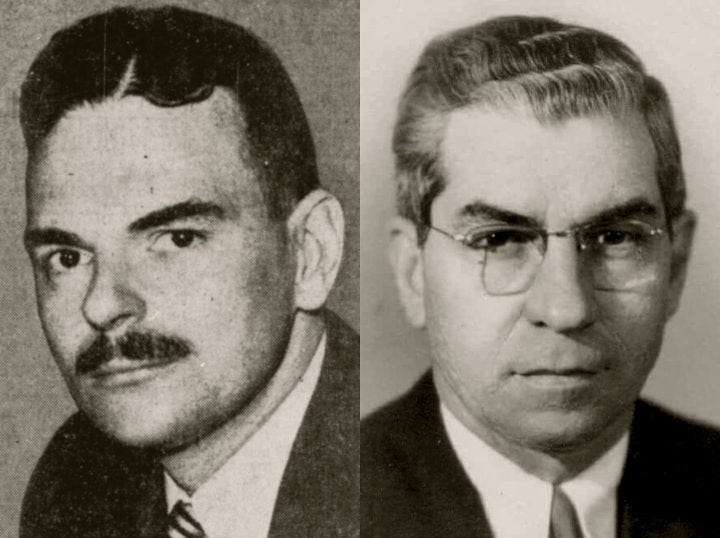
You likely recall that Dewey served as the “special prosecutor” when Lucania and eight codefendants were convicted on June 7, 1936, of organizing prostitution in New York City. Lucania, portrayed in court as the powerful leader of the vice syndicate, as well as a lifelong outlaw, was sentenced June 18 to a hefty prison term of thirty to fifty years. Early in January 1946 (less than ten years into that lengthy incarceration), then-Governor Thomas Dewey commuted the remainder of Lucania’s sentence. Citing, with a degree of skepticism, reports that the imprisoned Lucania had rendered assistance to the U.S. military during World War II, Dewey released Lucania on the condition that he be deported to his native Italy.
Many seemed to accept the idea that Lucania had provided some sort of valuable wartime help to the U.S. while inside prison and, so, deserved special consideration for that aid. But others felt that Dewey’s apparent about-face on the public danger posed by Lucania was evidence of corruption. Hadn’t Dewey previously sought to have Lucania put safely away for the longest possible time? Some claimed Dewey’s reversal was the result of a payoff. Some suggested it was brought about because Dewey was being blackmailed for his own personal indiscretions.
(Quotes attributed to Lucania at different times seemed to support both of those allegations. This can be interpreted as evidence supporting the payoff or blackmail theories or as evidence that the creation of Lucania quotes was a popular hobby.)
In the years that followed his deportation, law enforcement agencies on both sides of the Atlantic branded Lucania a kingpin in narcotics trafficking from the Mediterranean into the U.S. For some, this made America’s growing drug problem the direct result of Dewey’s alleged corruption.
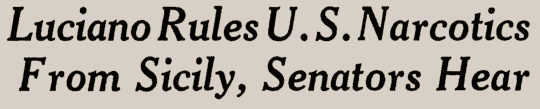
Joesten basically accepted this argument (which seems incredibly naïve today): Dewey had brought about postwar narcotics trafficking from Europe into the U.S. by freeing Lucania. But the author, who later made a career of conspiracy theories related to the Kennedy Assassination, felt Dewey’s corruption was less blatant than bribery or personal blackmail. Joesten built his corruption case upon the (somewhat shaky) foundation of Joseph Victor Bendix.
It is extremely likely that Bendix would have been thoroughly forgotten by history (Do you recall who the guy was?) if not for his involvement in the 1936 trial that sent Lucania to prison. Though Joesten made much of the Bendix role as a state witness in the trial, it seems Bendix was not really a major factor in the trial outcome.
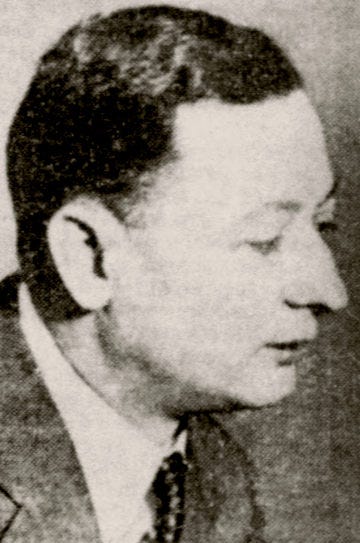
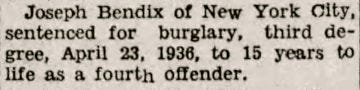
Joseph Victor Bendix was born in Pittsburgh. For public records, he consistently stated a birth date of May 13. He had trouble settling on a birth year, however. In different records, he indicated he was born in 1894, 1897 and 1898. The most likely year of his birth looks to be none of those. Census records from 1905 and 1910 suggest that he was born about 1892-1893. Bendix reportedly was a toddler when his father died. He and his mother Jennie Bruch Bendix relocated to New York City. Jennie was married there to Max Goldstein, salesman for a moulding company, in 1904. Bendix left school as a young teenager. By early 1915, Bendix had begun his career as a criminal. He was sentenced to four and a half years in prison on March 1, following a conviction for second degree larceny. He was still incarcerated when he registered for the World War I draft. His prison experience did not alter his behavior, as evidenced by a 1924 sentence for attempted grand larceny. Somewhere along the way, Bendix acquired some training as an artist and found work as a cartoonist and illustrator. He married on December 27, 1929, and, according to a story related by writer Hickman Powell, was sent on a magazine assignment to Cleveland soon after that. While in Cleveland, Powell reported, Bendix was caught stealing from a room at the Statler Hotel and earned himself a prison stay. In May 1936, when Dewey launched his case against the Lucania-supervised vice ring, Bendix was just starting another prison term. This one was to be fifteen years to life. He had confessed to stealing $550 worth of jewelry. That marked his fourth such offense, and New York’s “Baumes Law” called for an extreme penalty for four-time felons. He was initially arrested at the time of the January burglary and was held in city jail through his trial. He was sentenced on April 23 and entered Sing Sing Prison four days later. As he returned to the prison, he was asked what caused his (by then chronic) criminal activity. He answered, “Needed money.” Bendix gave his testimony in the vice ring case a month later. After the successful prosecution, Bendix was sent back to Sing Sing, along with several other convicted-felon witnesses who had testified for the state. To shield them from possible underworld vengeance, Warden Lewis E. Lawes set them up in an isolated section of the facility. Though the Baumes Law prevented the State Parole Board from acting on his behalf, the governor was still free to do so. Bendix’s fifteen-years-to-life sentence was later cut to about seven years, when, in August of 1943, Governor Dewey commuted the remainder of his term. But the commutation left Bendix on parole – one serious complaint away from a return to prison – for the rest of his life. By 1950, Bendix, wife Joan and a daughter were residents of Brooklyn. He and Joan made their living running an “antique supply” business. It appears that Bendix later moved to Paterson, New Jersey, and that city was his last known address at the time of his October 1974 death.

While awaiting his own trial on the jewelry theft charge, Bendix reportedly came to the attention of Dewey’s staff because he boasted to fellow prisoners held at the Tombs in Manhattan that he knew Lucania. Word got out to the special prosecutor’s office. The Dewey team was then working frantically to assemble a convincing compulsory prostitution case against the Mafia boss and received the news of a potential witness with enthusiasm.
When Bendix was put on the witness stand in the Lucania trial on May 21, 1936, he stated that he had known Lucania since about 1928. He testified that in 1935 he requested and was granted by Lucania a job as a collector for the vice operation. He would visit brothels and gather the regular payments of operations protected by the ring. He said Lucania cautioned him that the job didn’t pay much, but Bendix said he felt it was “better than going back to stealing,” especially with a Baumes Law life sentence hanging over his head. Bendix recalled that Lucania decided, “If you are willing to work for $40 a week, it is O.K. with me.”
“If you are willing to work for $40 a week, it is O.K. with me.”
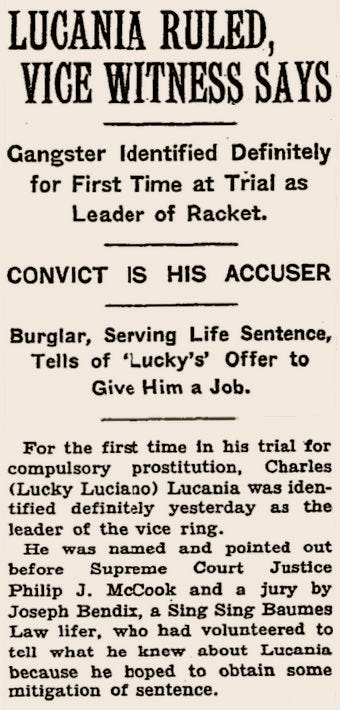
The author said that Bendix delivered that testimony as the result of an arrangement with Dewey. Dewey promised, Joesten stated, that Bendix would not suffer a Baumes Law sentence, but, “allowing maybe for a few weeks or months of face-saving detention, he would again be a free man.” According to Joesten, Bendix met his obligations under the deal and Dewey conveniently forgot his own.
Joesten acknowledged that concerns about Bendix’s truthfulness quickly surfaced at the trial.
A pretrial letter Bendix intended to send to his wife was somehow misaddressed to Assistant District Attorney Morris H. Panger in the Manhattan District Attorney’s Office. That letter seemed to suggest that Bendix was cooking up a story that would win him some helpful government support. In it he asked his wife to visit with a lawyer on Special Prosecutor Dewey’s staff: “Try to think up some real clever story which would prove interesting to Mr. Ariola...”
Panger, himself, appeared as a witness in the Lucania trial on June 2. The assistant district attorney described the letter he received from Bendix and stated that Dewey had been made aware of its existence as well as its significance – Bendix clearly was seeking to ingratiate himself to prosecutors in order to avoid spending the rest of his life in prison – before the vice case had even started.
Despite the erosion of Bendix’s credibility, Joesten argued that Dewey’s successful prosecution of Lucania was the result of Bendix’s testimony more than any other factor:
“He [Bendix] was the first and the most important witness produced by Dewey to connect Luciano directly with the vice syndicate he was accused of operating.”
Special Prosecutor Thomas Dewey won the conviction, Joesten stated, “on the strength of deliberately concocted, perjured testimony.”
From then on, Joesten wrote, Dewey lived in fear that the public would discover his use of fraudulent evidence in his most famous case. Dewey’s later political career – as a repeat Presidential candidate and as governor of New York – was built upon the reputation the case earned him as a virtuous crime fighter, Joesten argued.
Dewey’s 1943 commutation of Bendix’s sentence was a belated payment for perjury, according to Joesten. But Bendix was angry that he had been made to wait so long, the author said, and he began gathering information for an autobiography that would expose Dewey’s tactics. After some time, Bendix took the additional step, according to Joesten, of reaching out to Lucania attorney Moses Polakoff. Word then got to Dewey.
Joesten said that, in 1946, Governor Dewey arranged for the release and deportation of the still-powerful and dangerous Lucania simply because he feared that Lucania attorney Polakoff was preparing to expose Dewey’s deliberate use of Bendix’s false testimony. The release of Lucania satisfied the crime boss and his attorney and allowed Dewey to continue to cover up his earlier prosecutorial misconduct.
When the release of Lucania quickly became a political liability for Dewey, because of the widespread reports that Lucania was at the helm of international narcotics trafficking, the governor devised an acceptable rationale for his action, Joesten charged.
Read and interact with MobHistory’s short-form content in Substack Notes
The author claimed that Dewey latched firmly onto Lucania’s rumored contribution to the U.S. war effort and installed his pal William B. Herlands as New York Commissioner of Investigation in order to provide supportive documentation for the tale. Dewey diminished his own action in the Lucania matter, suggesting he merely agreed to the recommendation of a state pardon board, which had been convinced of Lucania’s remarkably selfless patriotism by U.S. military officials.
Having washed his hands of the Lucania release to the greatest degree plausible, Dewey then seized an opportunity to publicize the new cover story. Becoming aware of Joesten’s work on a Lucania biography, The Luciano Story, the governor used his influence to delay publisher David McKay Co.’s planned release and have the tale inserted into it. It was an extraordinary abuse of his public position, according to Joesten:
State governors do not, as a rule, double in brass as editors or literary critics. If Dewey didn’t like what was going to be published in THE LUCIANO STORY, he had a perfect right to speak out against it, to set the record straight, or to sue the authors and the publisher for libel. But the actual course he followed in bringing his influence to bear upon the publisher; putting one of his top aides to work – at state expense! – on “research” intended for the book; and finally filtering it into the work behind the back of the original author... cries out to high heaven that Bendix’ accusation is true!
Joesten said he became fully aware of Dewey’s maneuvering only after The Luciano Story was released and after Joesten communicated his displeasure with the revised work to the press. That’s about when Joseph Bendix got in touch with him.
Author Joachim Joesten had been greatly disturbed by Governor Dewey’s apparent input into the book project before that time. When he accepted the contract to pen Lucania’s life story in December 1952, Joesten was fairly new to the subject of organized crime, having previously written about politics and international affairs. He seems to have accepted in stride a summer 1953 request by McKay’s president, Kenneth Rawson, to punch up his early draft of The Luciano Story. And he agreed when Rawson suggested in the fall that writer Sid Feder (who recently worked with former Brooklyn prosecutor Burton Turkus on the popular book, Murder, Inc.) be brought into the project as a coauthor. Joesten reportedly had no significant problem with Feder’s initial rewrite of the manuscript. Inexplicable publication delays began to bother the author, however. In spring 1954, he learned that Rawson had shown a copy of The Luciano Story’s manuscript to Governor Dewey, and Dewey asked for a delay in its release, promising to provide important new information for the book and pledging that he would help to promote the work. It should be no secret that Joesten was not fond of Governor Dewey. (We can probably safely assume that Dewey disliked Joesten.) The two men occupied near-opposite positions on the political spectrum. Dewey was a leading Republican anti-communist, and Joesten was pro-Democrat and anti-fascist. It was entirely natural for Joesten to resent any level of Dewey involvement in his book project and to suspect Dewey’s motives. Just as it was entirely natural for Dewey to try to protect himself from political damage on the sensitive Lucania issue. In fall, Joesten learned that Dewey provided Sid Feder with some access to the findings in William Herlands’ report on the Lucania sentence commutation, which had been completed in September 1954. Feder went back to work on the The Luciano Story and turned the new information into an entire chapter devoted to Lucania’s alleged wartime cooperation with the military. Joesten received a copy of the new version of the book only on the eve of its scheduled mid-November press run. He objected to the new chapter and the political cover it provided for Dewey’s questionable action in freeing Lucania, and he promised that he would make his opposition to the work known at an appropriate time. Early in January 1955, The Luciano Story was released. Dewey had left the governor’s office by then, replaced by Democrat William Averell Harriman, but he was still widely expected to remain a political power in the U.S. Almost immediately, Joesten sent out a press release repudiating the book. (See: “Author Joachim Joesten criticized his own 1955 Lucania bio.”)
Joesten received numerous letters and telephone calls following his press release. One of the callers was Joseph Bendix. Another was George Hunter White, agent with the Federal Bureau of Narcotics, who had already criticized the book and its authors before learning of Joesten’s position. Both of those men wanted to get together with Joesten for discussions. Joesten, apparently a fan of the Bureau of Narcotics, met first with White, and they immediately hit it off. The author was more hesitant to meet with Bendix. He knew little about the man, and what he knew wasn’t good.
After delaying for a while, Joesten arranged with his new friend George White to meet with Bendix at a Midtown Manhattan apartment that White had secretly equipped with microphones and recording equipment. The meeting occurred on January 21, 1955, and, according to Joesten, the entire conversation was recorded.
Bendix described the process of becoming a witness for Dewey. He said he was initially approached by a fellow prisoner, Daniel Caputo, who had turned state’s evidence and was working with Dewey. Bendix, desperate for help in avoiding a lifetime in prison, agreed to consider becoming a state witness. Representatives of the special prosecutor met with Bendix “to brief him on the advantages he might gain if he could ‘remember’ that he knew Lucky quite well...” When Bendix committed to assisting the vice case prosecution, he was “thoroughly coached by Dewey’s staff” about his testimony. He was well rehearsed by the time of his court appearance. And Bendix told Joesten that he delivered testimony that was entirely fraudulent.
“[Bendix] told me so flatly,” recalled Joesten. “He had never come face to face with Lucky before they met in the courtroom.”
Bendix reportedly asserted that he was on the verge of being freed from prison on appeal, when Dewey commuted his sentence and he was released on parole. That left the career criminal at Dewey’s mercy, virtually guaranteeing that Bendix would not publicly discuss his troubling history with Dewey. Bendix summed up his position for Joesten: “I am trying to say that Mr. Dewey knew I had lied on the stand.”
“I am trying to say that Mr. Dewey knew I had lied on the stand.”
Of course, anyone with any serious interest in the subject knew that Bendix had lied on the stand. And knew that Dewey knew that Bendix had lied on the stand. That much was established just days after his testimony, when Panger brought out that Bendix effectively had been auditioning for a role in the Dewey courtroom production. (Other defense witnesses also punched holes in the Bendix testimony and proved him unreliable, while additional prosecution witnesses provided damaging testimony against Lucania that took the place of Bendix’s discarded story.) It was in the newspapers. Lucania’s defense attorney focused on it in his case summation. It was a cause of embarrassment for Dewey and the office of the special prosecutor, and it threatened more than aided Dewey’s case against Lucania.
Dewey did not win Lucania’s conviction because of Bendix’s testimony; he won it despite Bendix’s testimony. (Other witnesses defined Lucania’s connection with the vice ring. And, due to Dewey’s questionable tactics, those witnesses appear to have been under enormous pressure to testify for the state. But Joesten neglected their stories.)
When Lucania attorney George Morton Levy delivered his summation, he spoke at length about Bendix’s obvious “cock and bull story” and about Dewey’s quick abandonment of his own false witness. Levy said he was sure that Dewey did not suborn perjury. Dewey didn’t need to instruct witnesses to lie, the defense attorney said, as Dewey “was dealing with a class of people only anxious to find out what lie they could tell.”
But the key aspect of the Bendix story, as presented by Joesten, was the assertion that Dewey knew that Bendix was going to lie on the stand before he did so. While there was some suggestion during the trial that Dewey had been in a position to have foreknowledge of the false testimony (from the strongly suggestive letter provided by the D.A.’s office, for example), and while Joesten accused that at least some members of Dewey’s staff had foreknowledge of the false testimony, evidence is lacking that Dewey intentionally put Bendix on the stand to have him lie about Lucania.
Joesten’s idea of the corrupt bargain between Dewey and Bendix remains a problem. Dewey was not then in a position to arrange for Bendix to go free for any reason. The Manhattan District Attorney’s Office had jurisdiction over the burglary charge against Bendix. And that matter had already been decided before the Lucania trial began. It is doubtful that Bendix’s May 1936 witness-stand performance, credible or not, could have affected it. Judge Charles Cooper Nott, Jr., had sentenced Bendix on April 23, 1936, to fifteen years to life in prison. Bendix was received at Sing Sing Prison to begin that sentence on April 27.
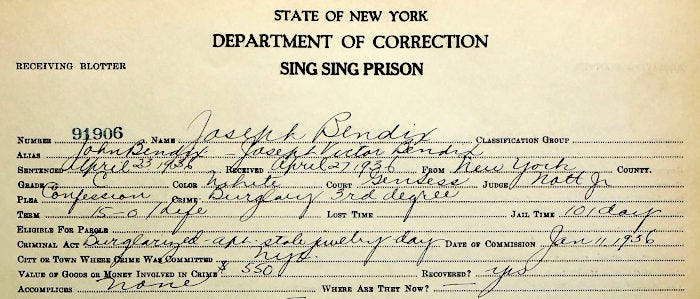
(The Bendix guilty plea to a fourth felony burglary charge may be seen as evidence that he believed he had some kind of deal in place. Such a plea legally required the stiffest prison sentence. Why would Bendix, who clearly wished to avoid prison, trigger such a result with a guilty plea. It generally made little sense for any Baumes Law defendant to plead guilty – no benefit was legally available for confession and no greater jeopardy was faced by contesting the charge. But odd things did occur in those situations. Recall the February 1929 case of Joseph Valachi’s brother, Anthony “Frank Rocco” Valachi. Anthony was caught taking what turned out to be virtually worthless items from a store and was charged for the fourth time with burglary. Rather than accept a plea deal on a lesser charge that would have earned him a few years in prison, he demanded an immediate hearing on the burglary charge. He was convicted and sentenced to life in prison.)
So, it is not clear what reward Bendix expected from Dewey in exchange for invented testimony or what promises might have been made by the prosecutor or his staff members. Dewey could have recommended executive clemency, though the weight of such a request by an ambitious Republican prosecutor on popular Democratic Governor Herbert H. Lehman is uncertain. (Did Bendix somehow foresee Dewey’s 1942 election as governor?) Dewey surely had little to no influence over Manhattan District Attorney William Copeland Dodge. The mere fact of Dewey’s existence was objectionable to that office. It had been suspicion directed against Dodge’s office that triggered Dewey’s appointment as special prosecutor in the first place.
(It is interesting that, in March 1942 – about six years after he was sentenced – Bendix attempted to change his plea in the burglary case to “not guilty.” The prisoner claimed that he had only pleaded guilty because he had been promised executive clemency, though the story was vague on the source of that promise. At that moment, the New York County District Attorney’s Office actually supported Bendix’s attempt to undo what he had done in 1936. Note: No such support had been evident while Thomas Dewey held the D.A. office between the start of 1938 and the end of 1941. Bendix’s legal counsel found a sympathetic judge in Jonah J. Goldstein of the General Sessions Court. However, State Commissioner of Correction John A. Lyons opposed the change of plea – probably because allowing incarcerated confessed criminals to decide that they were no longer guilty could create havoc in the penal system. Supreme Court Justice Ferdinand Pecora sided with Lyons, ruling that a defendant cannot change a plea after beginning to serve a sentence received on that plea. Justice Pecora prohibited Judge Goldstein from taking any role in the matter. Dewey was inaugurated as New York governor less than a year later. And he granted clemency to Bendix the following August.)
Finally, it seems we have little more than Joesten’s word in support of the Bendix story. It appears that Bendix allowed the matter to drop after he vented at Joesten. As is so often the case with alleged recordings of supposedly earthshaking statements, the Joesten tapes of Bendix’s statement vanished. Well…, Joesten reported that the recordings mostly vanished... for a while, at least. After the meeting with Bendix, Joesten obtained two reels of audiotape from George White. These reportedly contained his interview with Bendix. But, when Joesten later had an opportunity to listen to the reels, he found that one contained “only a small and relatively unimportant portion of my talk with Bendix” and the other contained jazz music.
Joesten claimed that George White deliberately retained the bulk of Bendix’s taped statement for his own use. The author said that both reels of tape eventually found their way, through White, to Senator Estes Kefauver. It is uncertain if the senator – a political adversary of Dewey – ever made use of the material. Joesten seemed satisfied: “...Senator Kefauver is just the right man to have all the elements of this fantastic story in his possession.”
Like much of Joesten’s later work, the Dewey conspiracy theory was a fantastic story. And like that other work, it probably also was strongly influenced by Joesten’s politics.
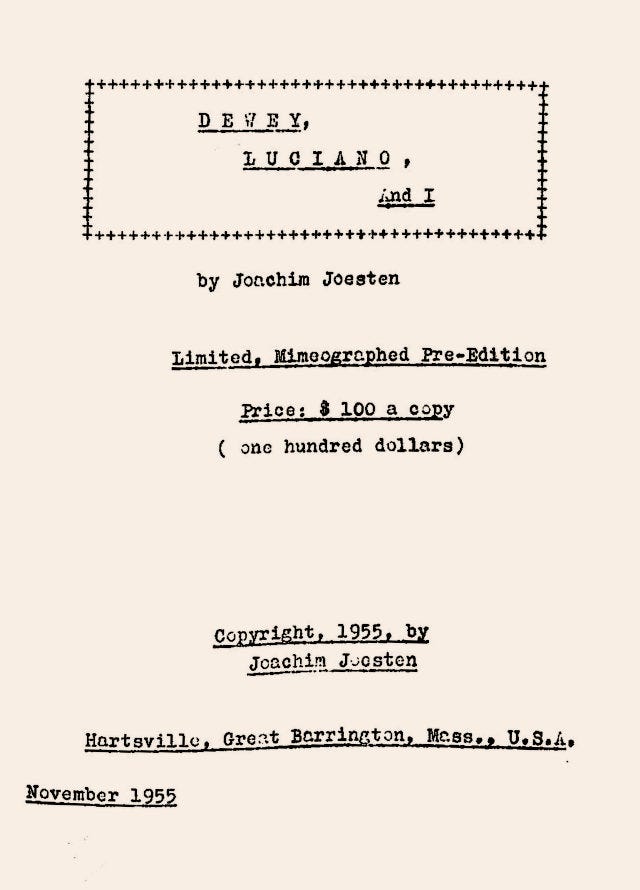
→ It has been many years since I first became aware of Joachim Joesten’s book, Dewey, Luciano, and I. I remember that I received an email from a website visitor, who had heard the book existed but knew nothing more about it. Some searching of archives produced an April 25, 1957, letter from Joachim Joesten to the editor of the Berkshire Eagle newspaper in Pittsfield, Massachusetts. The letter mentioned The Luciano Story, then a couple of years old, and it went on to discuss Dewey, Luciano, And I:
…if you want to dig a little deeper into one of the most intriguing and best-guarded secrets of New York politics, take an even better look at my mimeographed 102-pp, exposé, “Dewey, Luciano and I” (Great Barrington, Mass., 1955). There, you will find the whole, unvarnished story of how Thomas E. Dewey first framed Lucky Luciano, and then was blackmailed into releasing him, which is, in a nutshell, all of the “mystery” New York State has been investigating for years.
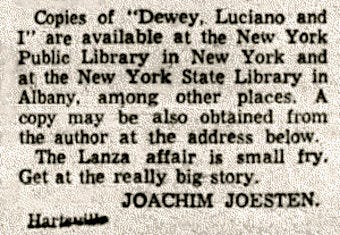
Joesten indicated that mimeographed copies of the book were available through the New York Public Library in Manhattan and the New York State Library in Albany. “A copy may be also obtained from the author at the address below,” he added. (The address was simply “Hartsville,” referring to a village just outside Great Barrington, Massachusetts.)
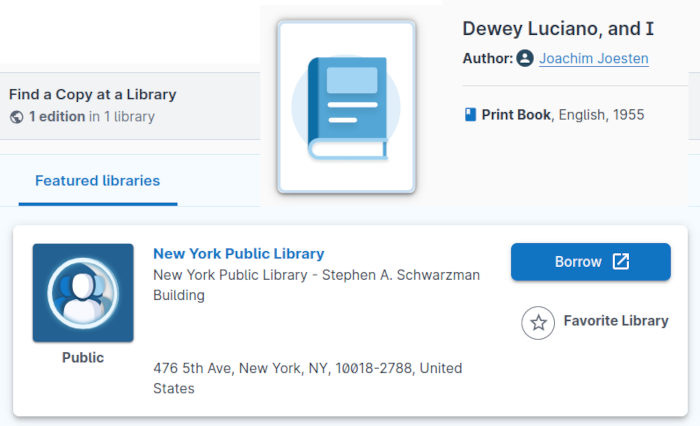
There was no mention of how many copies had been produced. When I sought to take a look at the book, I contacted the New York Public Library, the New York State Archives and the Great Barrington, Massachusetts, Libraries. One copy turned up in the NYPL main branch on Manhattan’s Fifth Avenue. (The WorldCat library catalog reports no other copies known.)
The title page of the work specifies that it is a “limited, mimeographed pre-edition.” And it carries a pricing notice: “Price: $100 a copy (one hundred dollars).” (Seems a little steep for a hundred-page booklet.) ←
Much of the material in this article was drawn from Joesten, Joachim, Dewey, Luciano, and I, Great Barrington MA: 1955. Thank you to Talia Nudell, librarian, General Research Division, New York Public Library; Janice Carapellucci, Feet on the Ground New York City Genealogy Research; and Donna Brown, assistant director of operations, Great Barrington MA Libraries, for assistance in acquiring a copy of this work.
“4th offender gets life stealing empty boxes,” New York Herald Tribune, April 20, 1929, p. 2
“5 sentences commuted,” Rochester NY Times-Union, Aug. 17, 1943, p. 3.
“Bargain wages blamed for vice,” Buffalo Evening News, May 22, 1936, p. 15.
Chas. Luciano, Sing Sing Prison Receiving Blotter, inmate no. 92168, received June 18, 1936.
Conboy, Martin, Brief on Behalf of Defendant-Appellant, Charles Luciano, The People of the State of New York against Charles Luciano, et al., Record on Appeal, Volume III, Supreme Court of the State of New York, Appellate Division - First Department, 1937.
“Court forbids judge to hear plea change,” New York Times, March 4, 1942.
Dewey, Thomas E., Twenty Against the Underworld, Garden City, NY: Doubleday & Company, 1974.
“Dewey commutes Luciano sentence,” New York Times, Jan. 4, 1946, p. 25.
“Dewey paroles Luciano for deporting to Italy,” New York Daily News, Jan. 4, 1946.
“Gets life after $1 theft,” New York Times, April 20, 1929, p. 25.
“Guard Luciano ‘squealers’ in reprisal fear,” New York Daily News, Aug. 19, 1936, Bklyn. Sec. p. 2.
Herlands, William B., Report of Investigation, State of New York Office of Investigation, Sept. 17, 1954, Thomas E. Dewey Papers, University of Rochester.
Joseph Bendix, 121-20-6909, Social Security Death Index, death Oct. 1974.
Joseph Bendix, inmate no. 65699, Sing Sing Prison Receiving Blotter, received March 1, 1915.
Joseph Bendix, inmate no. 75999, Sing Sing Prison Receiving Blotter, received June 2, 1924.
Joseph Bendix, inmate no. 91906, Sing Sing Prison Receiving Blotter, received April 27, 1936.
Joseph V. Bendix and Adele Dragiles Certificate and Record of Marriage, Kings County, certificate no. 69, Dec. 27, 1929.
Joseph V. Bendix, New York City Extracted Marriage Index, certificate no. 67, Kings County, Dec. 27, 1928.
Joseph Victor Bendix, World War I Draft Registration Card, Sept. 12, 1918.
“Lucania sentenced to 30 to 50 years; court warns ring,” New York Times, June 19, 1936, p. 1.
“’Lucky’ Luciano to be paroled and deported,” Brooklyn Daily Eagle, Jan. 3, 1946, p. 1.
Max Goldstein and Jennie Bendix Certificate of Marriage, Borough of Manhattan, certificate no. 23656, Nov. 24, 1904.
Names of Convicts Discharged from Auburn Prison during the Month of March 1917.
New York State Census of 1905, New York County, Assembly District 21, Election District 12.
Poulsen, Ellen, The Case Against Lucky Luciano: New York’s Most Sensational Vice Trial, Little Neck, NY: Clinton Cook Publishing, 2007.
Powell, Hickman, Ninety Times Guilty, New York: Harcourt, Brace and Company, 1939.
“Sing Sing isolates Lucania squealers,” Brooklyn Times Union, Aug. 18, 1936, p. 20.
“Six in state prisons released under parole,” Binghamton NY Press, Aug. 17, 1943, p. 11.
“State cop on stand for Lucky,” New York Daily News, June 3, 1936, p. 6.
Symontowne, Russ, “Assistant D.A. helps Luciano fight vice rap,” New York Daily News, June 3, 1936, p. 3.
Symontowne, Russ, “Vice defense paints Dewey as ‘glorifier,’” New York Daily News, June 6, 1936, p. 3.
Transcript, The People of the State of New York against Charles Luciano, et al., Record on Appeal, Volume III, Supreme Court of the State of New York, Appellate Division - First Department, 1937.
United States Census of 1910, New York State, Kings County, Ward 30, Enumeration District 1412.
United States Census of 1940, New York State, Westchester County, Ossining, Sing Sing Prison, Enumeration District 60-256.
United States Census of 1950, New York State, Kings County, Enumeration District 24-1257.
Valachi, Joseph, The Real Thing: Second Government - The Expose and Inside Doings of Cosa Nostra, unpublished manuscript, John F. Kennedy Presidential Library and Museum, 1964, p. 171-172.
No posts
Comments
Nothing yet. Say the first thing.
Sign in to join the conversation.