
Part V
Click here to return to Part IV.
The former followers of Joseph Noe reportedly worked closely with Dutch Schultz for a time. Eventually, they pulled away from Schultz. Following a surprising reconciliation with Noe’s suspected killer, Jack “Legs” Diamond, the group – led by brothers Peter and Vincent Coll and by Edward “Fats McCarthy” Popke – became violent enemies of the Dutch Schultz-Ciro Terranova combination, causing havoc in the rackets and spilling blood on the streets during the Bronx Beer War.
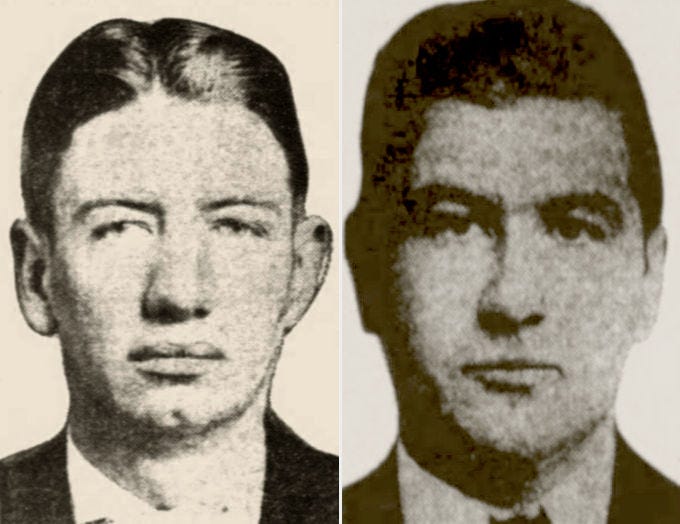
The precise moments that these shifts occurred remain uncertain. They can be broadly bracketed in time. They surely occurred no earlier than the close of 1928 and no later than the first months of 1931. Valachi suggested that spring of 1931, on the later side of that bracketed period, was the point of no return for the Coll-Schultz relationship. However, looking back from the moment of Vincent Coll’s 1932 murder, the New York Times placed the final Coll-Schultz breakup much earlier, in January of 1930. A period of tension may have preceded that.1
The Times did not offer a detailed defense of its selection. But it chose a very interesting moment:
Just one month before that time, in December 1929, a testimonial dinner for City Magistrate Albert H. Vitale at the Roman Gardens restaurant in the Bronx was brazenly held up by seven gunmen. The incident exposed connections between the Tammany Hall Democratic machine and the Schultz-Terranova partnership. Some leading underworld figures of East Harlem and the Bronx attended the event. New York Mafia leaders appeared to be involved in having much of the loot quickly returned to the dinner guests.2
Just one month after the moment specified by the Times, in February 1930, Bronx-based Mafia boss Gaetano Reina, whose organization had been an annoyance to the Schultz-Terranova organization, was shot to death. The killing was one of the triggers for the Mafia’s 1930-31 Castellammarese War. Some attributed the killing of Reina to “a cut-rate war among wholesale ice dealers.” In that scenario, Reina’s ice racket rival is generally thought to be Mafia boss of bosses Giuseppe “Joe the Boss” Masseria. While ice racket friction may have been a factor, as boss of bosses – the supreme arbiter of Mafia territorial disputes – Masseria was in position to resolve such a matter in his own favor. So, it seems the killing was caused by some more weighty issue. If Reina’s crime family had been found to be in any way supportive of the Coll group’s efforts against Schultz-Terranova, a profitable wing of Masseria’s organization, Reina could have been sentenced by Joe the Boss to an underworld death penalty. (I have always found it interesting that Reina was murdered during a visit to his mistress at the same Bronx apartment complex where Dutch Schultz’s close aide Abraham “Bo” Weinberg lived.)3
Also in February, a gangster named Carmine Borrelli (sometimes written “Borelli” or “Barelli”) and his girlfriend were murdered by four gunmen at 170th Street and Inwood Avenue in the Mount Eden neighborhood of the West Bronx. Once friendly with Vincent Coll, Borrelli reportedly remained loyal to Schultz after Coll went his own way. Coll was charged with the double-murder in March 1930, but there was no evidence to convict him. Some theorize that Coll believed Borrelli was providing information to the other side about Coll gang movements.4
It is often said that the Coll group had been an integral component of the Schultz organization until a split that was based on different opinions about whether Coll deserved a pay raise. But there may have been a different sort of paid relationship. Coll gangsters may have viewed Schultz as a paying client for their security and enforcement services. Such a relationship would have been more like a protection racket – such as that practiced by the old 19th Century “Frog Hollow Gang” of the Bronx – than an underling-boss relationship. If the Coll group considered itself a band of independent contractors (or underworld mercenaries or something along those lines) it is easier to accept that a financial disagreement caused the post-breakup hostilities and allowed the gang to come quickly under the influence of Schultz-enemy Diamond. Coauthors Delap and Gold came close to this same conclusion when they reasoned that Vincent Coll had considered himself the “natural successor” of the murdered Joseph Noe. Coll possibly never considered himself any sort of underling to Schultz.5
On June 29, 1929, John Jacapraro married Rose Parlapiano in a ceremony at Our Lady of Pity Church, 276 East 151st Street near Morris Avenue in the Bronx. Rose, daughter of Nicholas and Mary D’Uva Parlapiano, was twenty-two and a resident of 307 East 154th Street (a short walk from the church) as she became a bride. Jacapraro was twenty-one and claimed to work as a clerk. He gave his home address as 1646 Williamsbridge Road. That address was just south of Van Nest Avenue in the East Bronx.6
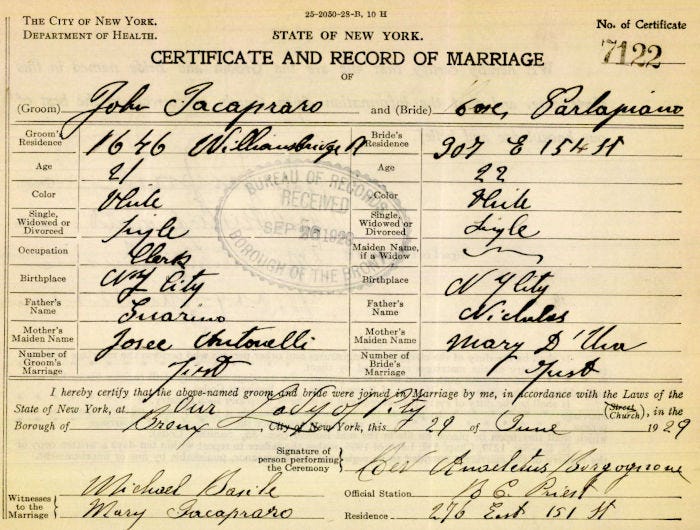
Jacapraro’s selection of best man may be a strong indicator of his personal loyalties. Michael Basile, who had been arrested with Jacapraro, Coll and others at the Bronx speakeasy in December 1928 and was suspected of involvement in the Yonkers bank truck robbery, stood beside Jacapraro at the ceremony.7
John and Rose Jacapraro moved into an apartment at 1056 Sherman Avenue in the West Bronx. The address was a few blocks east of the Grand Concourse and about a half mile northeast of the old Yankee Stadium. For the 1930 U.S. Census, John Jacapraro reported working not as a clerk but as a private chauffeur.8
At roughly the same time, Jacapraro’s parents and siblings moved. Apartment renters since father Guerino Jacapraro first arrived in the U.S. in 1893, the Jacapraros suddenly became homeowners near the end of the 1920s, moving into 1646 Williamsbridge Road in the Bronx. (That family home was used as John Jacapraro’s home address in his 1929 marriage document and in reports of his 1931 murder.) For the 1930 Census, Guerino, then sixty-one, continued to report that he worked as a piano maker.9
The census valued their new home at $15,000 – in the same ballpark as the per-man average of $13,062 stolen by the Yonkers bank truck robbers. But the family’s financial turnaround may have been due in large part to the fact that several of the Jacapraro children in the household had reached working age. One was a telephone operator, another was a laborer in construction, and a third was a dressmaker. The census also shows that half of the home was rented out to another family, earning the Jacapraros $85 a month.10
John and Rose Jacapraro may have hoped for a long and happy life together. Gangland conflict prevented that. Soon after their marriage, people connected to the regional underworld began turning up dead.
Just after midnight, Wednesday, August 28, 1929, a patrol officer found a murdered man behind the wheel of a still-running car at 107th Street and First Avenue in East Harlem. The victim had been struck twice in the head by gunshots apparently fired through the vehicle’s rear window. Police identified the victim as Fiore Chicone, known by the alias of “Joseph Furey” (and known to Joseph Valachi as “Joe Fiore”). The press reported that Chicone had once been a private detective and then launched a new business as a protection racketeer, contracting with Little Italy merchants who paid him weekly fees. Police theorized that Chicone had entered into a dangerous competition with an area gang involved in the same line of work.11
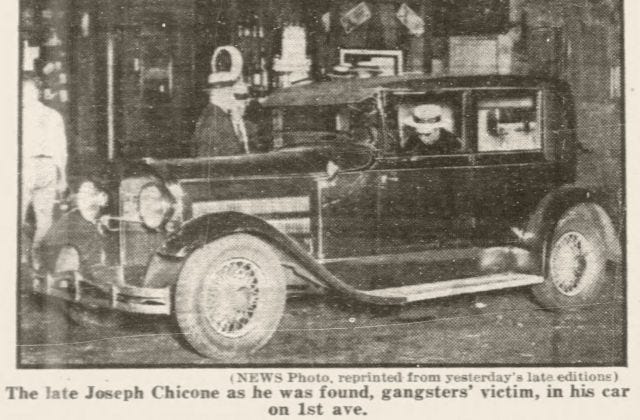
The Chicone killing seemed unrelated to the Bronx Beer War, but there may have been a link. Police strongly suspected that the responsible party was Dominick “the Gap” Petrelli, a member of the Reina Mafia organization and a friend of what Valachi called the “Irish Mob” in the East Harlem area. Petrelli was arrested (Valachi recalled a severe police beating he and Petrelli received at that time) and charged with the murder in September, but he was soon released for lack of evidence.12
The Bronx peanut merchant known both as Thomas Russo and as James Batto was found murdered in an abandoned automobile left in front of 2 East 107th Street near Fifth Avenue in East Harlem. He had been one of the gang arrested at the Bronx speakeasy and suspected in the Yonkers robbery in December 1928. His body, doubled up on the floor of the green sedan, was first noticed by a group of boys playing ball on the street on Wednesday, September 11, 1929.
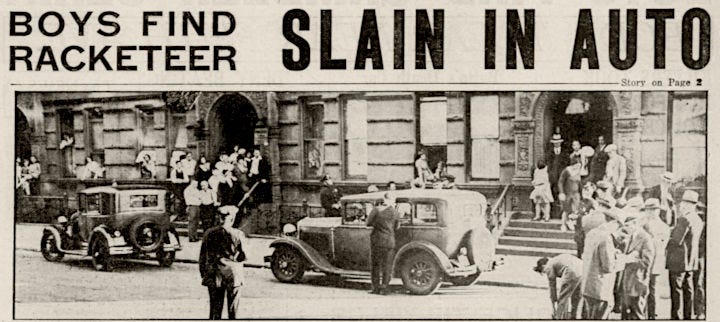
Russo/Batto had been fatally shot in the body, head and neck. Police concluded that he was killed somewhere else and then driven to the site where he was found. The newspapers noted that his peanut vending business had been a cover for his involvement in slot machines in New York and New Jersey. Fingerprints revealed that he had an arrest record dating back to 1904, when he was placed in the Catholic Protectory – a combination orphanage and reformatory – for a year and a half. His record since 1910, showed he had been arrested seven times and discharged each time.13
Read and interact with MobHistory’s short-form content in Substack Notes.
The Bronx Beer War appeared to heat up as the Mafia concluded its Castellammarese War in spring 1931. “Joe the Boss” Masseria was assassinated on April 15, 1931, and was replaced as crime family leader by Salvatore “Charlie Luciano” Lucania. With the support of many underworld factions, including the former Reina organization, Salvatore Maranzano became the new Mafia boss of bosses. This must have been an encouraging development for anti-Schultz-Terranova forces in the Bronx and East Harlem.
There appeared to be a rapid exchange of murders between the Schultz and Coll sides at the end of May and the start of June in 1931:
Coll gangsters attempting to kill Terranova lieutenant Joey Rao on Thursday, May 28, fatally shot Frank “Big Dick” Amato of East Harlem and Dominick “Louis Slats” Bologna of the Bronx. Rao got away. Joseph Valachi recalled that this double-homicide occurred shortly after a Coll gangster tried to enlist his support in the war against Schultz-Terranova.14
Early Saturday morning, May 30, Peter Coll was shot in the back while driving on Harlem’s St. Nicholas Avenue near 111th Street. Peter died a short time later at Flower Fifth Avenue Hospital. Press reports noted that Coll had been an associate of Dutch Schultz. (Combining that with the earlier attack against Terranova men, city authorities insisted that the Bronx Beer War was between Schultz and Terranova.)15
Genaro Ataroli (the surname was also spelled “Iadaroli,” “Iadarola” and “Atarali”), known around the Bronx as “Chin,” was put on the spot on Sunday, May 31. He stopped in at the Hub Bowling Alley, in the basement of 354 East 149th Street, expecting to receive a telephone call there. Several strangers entered the place and, when they identified Ataroli, they opened fire. Ataroli died of hemorrhage from a gunshot wound to the pelvis. Several other men in the alley were wounded. Ataroli, said to be a small-time gambler and protection racketeer, is generally linked to the Coll organization.16
A Bronx watchman found Louis DeRosa (or “DeRose”) dead on the sidewalk in front of 211 Rider Avenue near 138th Street in the Bronx on Wednesday morning, June 3. DeRosa, described by police and press as a Schultz henchman, had been shot repeatedly in the head and body – all shots entering from the back. The “savagery” of the killing caused historian Patrick Downey to wonder “if Coll and his cohorts didn’t hold a special grudge against DeRosa.”17
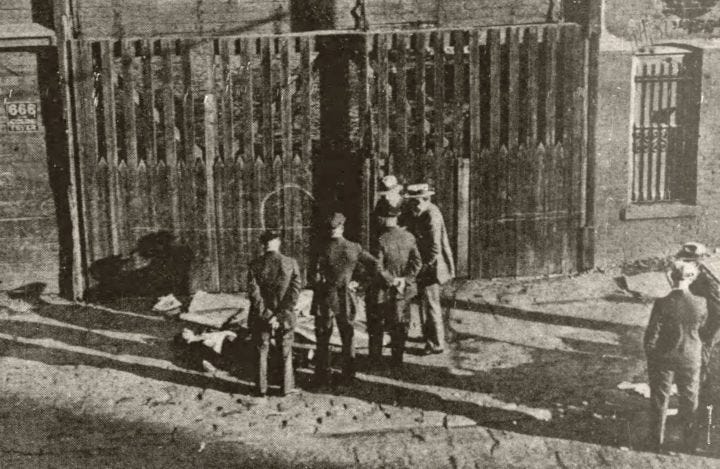
John Jacapraro was found murdered in an automobile left on Stratford Avenue in the Bronx just five days later, June 8, 1931. As noted in Part I of this series, Jacapraro was identified as a member of the Schultz organization. The basis for that identification remains uncertain.
Jacapraro’s arrest history (the speakeasy raid and the Yonkers robbery investigation) and his personal history (his selection of close Coll ally Michael Basile as his best man) suggests that he may have been much closer to the Coll side in the Bronx Beer War.
Delap and Gold found additional reason to believe that Jacapraro was part of the Coll gang. The coauthors of the Mad Dog Coll biography (Amazon affiliate link) summarized a portion of an article written by Edward J. Doherty of the Daily Mirror newspaper. It said that, following the death of John Jacapraro, Vincent Coll visited Jacapraro’s wife, gave her money to pay her debts and had her taken up to Acra, New York, to live in a house near the home of Jack “Legs” Diamond.18
To date, I have been unable to confirm the content or even the existence of this Daily Mirror article. (If anyone has located it, I would appreciate a copy.) For some reason, Delap and Gold did not provide a citation for it in the “select bibliography” of their book. The omission was glaring, as this was one source that starkly disagreed with the conventional telling. Note: Some of the Daily Mirror story details do not fit with documented details.

Very close to the time that her husband was murdered and then laid to rest in St. Raymond’s Cemetery, Rose Jacapraro learned that she was expecting. With the Parlapiano and Jacapraro families living close by in the Bronx, it seems unlikely that she would have chosen that moment to move to Acra. Joan Marie “Jackie” Jacapraro was born to Rose in New York City on January 17, 1932.
Given Joan’s birth date of January 17, 1932, Rose Jacapraro probably would not have had much reason to suspect she was pregnant until the middle to end of May. By early June, the moment of her husband’s murder, the symptoms of pregnancy should have been evident.
Allow me to suggest a somewhat romantic – and completely fabricated – storyline fitted to the documented details (screenplay possibility?): Young John Jacapraro becomes aware of the impending addition to his family and, determined to provide for his wife and child, immediately seeks steadier work than he could ever obtain as a follower of underworld renegade Vincent Coll. He abandons his close friends in the Coll gang for dangerous employment as a beer truck driver with the Schultz mob. Faced with Jacapraro’s undeniable but certainly justifiable betrayal, Vincent Coll reluctantly becomes the killer of his old pal Jacapraro. Then, proving himself not quite a complete sociopath, Coll scrapes together money for the widow and her expected child. (With that out of the way, there’s a bit more about the real-world tragedy of Jacapraro, below.)
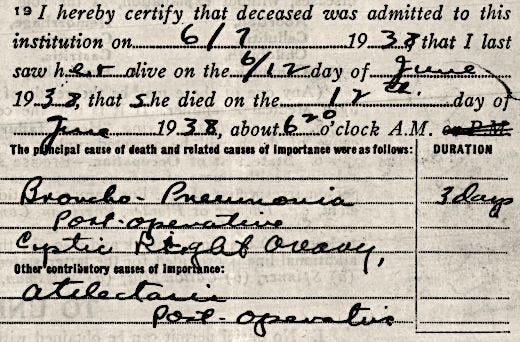
The child, who never knew her father, also lost her mother when she was just six years old. Rose Jacapraro went into New York Post-Graduate Hospital in Manhattan in June 1938 for surgery. Following the procedure, she suffered a collapsed lung (possibly due to general anesthesia) and developed pneumonia. Within a few days, on June 12, she died. Rose Parlapiano Jacapraro was buried at St. Raymond’s Cemetery on June 15.19
At the time of her death, she was said to be a resident of 963 Sherman Avenue in the Bronx. That was one block south of the apartment she and her husband were known to have occupied in 1930.20
Guerino Jacapraro succumbed to prostate cancer on September 18, 1939. Retired for several years by then, he was still a resident of the house at 1646 Williamsbridge Road. The U.S. Census of 1940 found his widow Josephine as owner of that home. Living with her were daughters Mary and Helen.21
The same 1940 census showed their Parlapiano in-laws residing at 967 Sherman Avenue, an apartment building that adjoined the building at Rose’s last address. Their household included Nicola Parlapiano, widowed mother of the late Rose Parlapiano Jacapraro, along with married daughter Florence and her husband, unmarried daughter Angelina and eight-year-old “Joan Jackaparo,” who had completed first grade.22
John Jacapraro’s best man, Michael Basile continued to be a determined Schultz opponent and Coll partner. He remained so even after the Coll gang lost its important patrons, with the assassinations of Mafia boss of bosses Salvatore Maranzano in September 1931 and Jack “Legs” Diamond three months later.
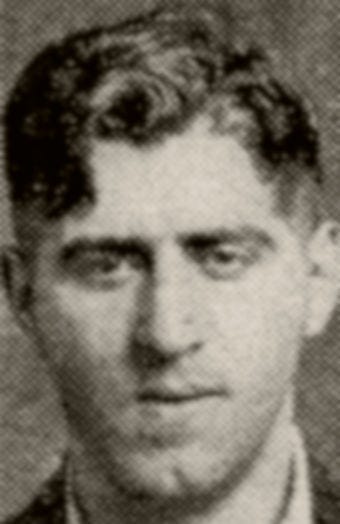
It possibly was the new, united stand of the post-Maranzano Mafia against the independent-minded Coll that made his war against Schultz unsustainable. Valachi noted that Mafia boss Salvatore “Charlie Luciano” Lucania had no patience for Coll’s mischief. Even while Maranzano was still alive, Lucania threatened to have all Irish mobsters eliminated in order to deprive the Coll war machine of its backing. (See: “Did ‘Charlie Lucky’ threaten ‘Owney’?”)
By the start of 1932, it seemed Coll and his followers had nowhere left to hide.
In January of 1932, Basile and Vincent Coll were arrested together, along with Patsy Del Greco and Lottie Kreisberger, and questioned by police. The arrest reportedly came about after police intercepted a Coll message from a public telephone to the home of Coll underling Frank D’Onofrio at 1218 Commonwealth Avenue in the Bronx. The four were soon released.23
That incident should have warned Coll that his activities and locations were being closely monitored. But he seemed not to address the problem.
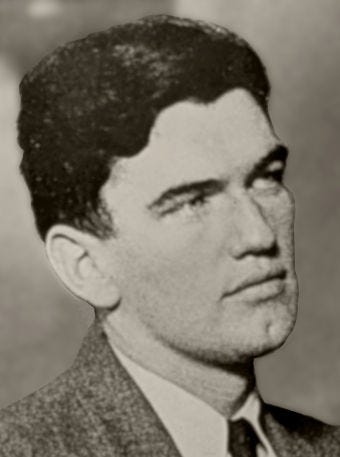
Early the next month, four gunmen stormed into an apartment at 1216 Commonwealth, next door to the D’Onofrio home. They found Coll gang members inside and somewhat indiscriminately opened fire. Coll adherents Patsy Del Greco and Fiorio Basile (brother of Michael) were killed. Also killed was Emily Tarreizello, whose connection with the gang was uncertain. Louis Basile (another Basile brother) was critically wounded. Joseph Parrone and Lena Vinciguerra were less seriously wounded.24
Coll reportedly had been in that apartment a day earlier and was fortunate not to have been present when the gunmen arrived. His luck ran out a week later, when he was shot to death while making another call from a pay telephone.25
With Coll gone and his gang decimated, Michael Basile and Edward “Fats McCarthy” Popke relocated upstate to the Albany area. On July 11, 1932, New York State Police and detectives from New York City swarmed an apartment at the Albany suburb of Colonie. Popke emerged from the apartment and fired on the officers. He was felled by a gunshot to the head. Another gangster, George Kelly, was wounded when he tried to escape from the building. Michael Basile and Popke’s wife exchanged fired with the police for a time and then surrendered.26
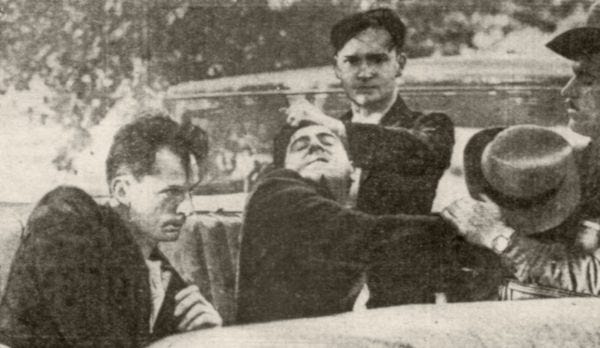
In January of 1933, Michael Basile was convicted in Albany County Court of attempted murder. He was sentenced to a minimum prison term of seventeen and a half years and a maximum of thirty-five years. (George Kelly, also convicted, received the same sentence.) He entered Clinton State Prison on January 4 and was soon referred to by the press as “the last living member of the Vincent (Mad Dog) Coll gang.” (Two other Coll gunmen, Dominic Odierno and Frank Giordano, had been convicted of the Beer War murder of Joseph Mullins. They were executed in the electric chair early in July, 1932.) Basile registered for the World War II draft while an inmate at Clinton. He seems to have served only the minimum sentence.27
He appears to have been back in the Bronx in time for the United States Census of 1950, which found him living with his Ziccardi in-laws on Gleason Avenue and working as a laborer in building construction. By then, Dutch Schultz was long gone, having been murdered by his former underworld allies in October of 1935, and the Bronx Beer War and its young victims were virtually forgotten. Basile died in the Bronx on February 2, 1965.28
Part I. Casualty of ‘Bronx beer war’ is hardly remembered today
Part V. Jacapraro is slain as ‘Bronx beer war’ escalates (now open).
Valachi, Joseph, The Real Thing: Second Government - The Expose and Inside Doings of Cosa Nostra, unpublished manuscript, John F. Kennedy Presidential Library and Museum, 1964, p. 351; “Coll is shot dead in a phone booth by rival gunmen,” New York Times, Feb. 8, 1932, p. 1.
“Seven bandits hold up 50 at dinner to Vitale; escape with thousands of dollars’ loot,” New York Times, Dec. 8, 1929, p. 1; “Vitale guests ex-convicts, is Whalen claim,” Brooklyn Daily Eagle, Dec. 12, 1929, p. 1; “7 of Vitale guests had police records, Whalen declares,” New York Times, Dec. 13, 1929, p. 1.
Gaetano Reena Certificate of Death, Borough of Bronx, registered no. 1800, Department of Health of the City of New York Bureau of Records, Feb. 26, 1930, filed Feb. 27, 1930; “Third man slain in ice rate war,” Asbury Park NJ Evening Press, Feb. 27, 1930, p. 4; “Wealthy ice dealer slain in doorway,” New York Times, Feb. 27, 1930, p. 3; “Two Schultz aides freed from jail,” New York Times, July 27, 1935, p. 28.
Carmine Borrelli Certificate of Death, Bronx, registered no. 1351, Department of Health of the City of New York Bureau of Records, Feb. 13, 1930; Delap, Breandan, and Rich Gold, Mad Dog Coll: An Irish Gangster, Las Vegas: Huntington Press, 2016, p. 45; “Suspect in crime here again held,” Yonkers Statesman, March 5, 1930, p. 1; “Coll is freed in N.Y. slaying,” Yonkers Statesman, March 18, 1930, p. 8; “Freed in murder, jailed for 2 guns,” New York Daily News, March 19, 1930, p. 27. [Amazon affiliate link]
Delap and Gold, Mad Dog Coll, p. 43.
Built in 1929, the church was deconsecrated in 2017, and it was demolished in 2020.
John Jacapraro and Rose Parlapiano Certificate and Record of Marriage, Borough of Bronx, certificate no. 7122, City of New York Department of Health, June 29, 1929.
United States Census of 1930, New York State, Bronx County, Enumeration District 3-150.
United States Census of 1930, New York State, Bronx County, Enumeration District 3-848.
Zillow.com and Realtor.com report that the two-story brick home currently found at 1646 Williamsbridge Road was built in 1930. Either that timing is a little off, or the lots have been renumbered. United States Census of 1930, New York State, Bronx County, Enumeration District 3-848.
Fiore Chicone Certificate of Death, Borough of Manhattan, Registered no. 21480, Department of Health of the City of New York Bureau of Records, Aug. 28, 1929; “Finds man shot dead in auto; police blame ‘protection’ racketeers,” Brooklyn Daily Eagle, Aug. 28, 1929, p. 20; “Two gang slayings baffle police,” New York Daily News, Aug. 29, 1929, p. 8.
Valachi, The Real Thing, p. 191-198; Davidson, Louis, “Boys find gambler slain,” New York Daily News, Sept. 12, 1929, p. 2.
James Batto Certificate of Death, Manhattan Borough, registered no. 22422, Department of Health of the City of New York Bureau of Records, Sept. 11, 1929; “Murder victim had long record,” Brooklyn Daily Eagle, Sept. 12, 1929, p. 11; Davidson, “Boys find gambler slain”; “Car parked hours, slain man inside,” Asbury Park NJ Press, Sept. 12, 1929, p. 1; “One of suspects in First National Bank car holdup is slain by ‘racketeers,’” Yonkers NY Herald, Sept. 13, 1929, p. 1.
“2 slain in Harlem in beer price war,” New York Times, May 29, 1931, p. 2; Frank Amato Certificate of Death, Borough of Manhattan, registered no. 14650, Department of Health of the City of New York Bureau of Records, May 28, 1931; Dominick Bologna Certificate of Death, Borough of Manhattan, registered no. 14649, Department of Health of the City of New York Bureau of Records, May 28, 1931; Valachi, The Real Thing, p. 348-351.
“Trio in car riddle brother of man slain by gunmen,” Brooklyn Daily Eagle, May 30, 1931, p. 7; Peter Coll Certificate of Death, Borough of Manhattan, registered no. 14761, Department of Health of the City of New York Bureau of Records, May 30, 1931; “Dutch brews Harlem beer war reprisal,” New York Daily News, May 30, 1931, p. 4.
“One slain, 4 shot by hired gunmen,” New York Times, June 1, 1931, p. 6; “2 slain, 8 hurt in weekend’s crime outburst,” Brooklyn Daily Eagle, June 1, 1931, p. 4; Genero Ataroli Certificate of Death, Borough of Bronx, registered no. 5097, Department of Health of the City of New York Bureau of Records, May 31, 1931; Downey, Patrick, On the Spot: Gangland Murders in Prohibition New York City, 1930-1933, 2017; “Dicer killed, 4 shot up in tenpin alley,” New York Daily News, June 1, 1931, p. 13; “2 dead, 7 shot in gun battles,” Brooklyn Daily Times, June 1, 1931, p. 2. [Amazon affiliate link]
Louis De Rosa Certificate of Death, Borough of Bronx, registered no. 5187, Department of Health of the City of New York Bureau of Records, June 3, 1931; “Schultz aide put on spot in Bronx Beer War,” Brooklyn Daily Eagle, June 3, 1931, p. 1; “Schultz aid corpse no. 5 in beer war,” New York Daily News, June 4, 1931, p. 13; Downey, Patrick, Legs Diamond: Gangster, Createspace, 2011, p. 162. [Amazon affiliate link]
Delap and Gold, Mad Dog Coll, p. 60-61.
New York City Birth Index, Bronx County, January 17, 1932; Rose Jacapraro Certificate of Death, Borough of Manhattan, certificate no. 12802, Bureau of Records Department of Health, June 12, 1938; Falteisek, Chris, “Rose Parlapiano Jacapraro,” memorial ID 185613456, Find A Grave, findagrave.com, Dec. 1, 2017.
Rose Jacapraro Certificate of Death.
Guerino Jacapraro Certificate of Death, Bronx Borough, certificate no. 8693, New York City Bureau of Records Department of Health, Sept. 18, 1939; United States Census of 1940, New York State, Bronx County, Enumeration District 3-858.
United States Census of 1940, New York State, Bronx County, Enumeration District 3-291.
“Schultz mob kills 2 men and woman in Coll fort,” New York Daily News, Feb. 2, 1932, p. 2; Delap and Gold, Mad Dog Coll, p. 203.
“Schultz mob kills 2 men and woman in Coll fort”; Davis, J. Richard (Dixie), “Things I couldn’t tell till now,” Article II, Colliers, July 29, 1939, p. 40.
Vincent Coll Certificate of Death, Borough of Manhattan, registered no. 3110, Department of Health of the City of New York Bureau of Records, Feb. 8, 1932; “Coll is shot dead in a phone booth by rival gunmen,” New York Times, Feb. 8, 1932, p. 1; Davis, “Things I couldn’t tell till now,” Article II, p. 40.
“Kill ‘Fats’ M’Carthy at Albany hideout,” New York Times, July 12, 1932, p. 1; “Fats M’Carthy aids face police charge,” New York Daily News, July 13, 1932, p. 14; Downey, Patrick, Gangster City: The History of the New York Underworld 1900-1935, Fort Lee NJ: Barricade Books, 2004, p. 221-222; Downey, On the Spot. [Amazon affiliate link]
Michael Basile, number 22976, Clinton Prison Receiving Blotter, received Jan. 4, 1933; “Coll gangster and pal given 17 to 35 years,” New York Daily News, Jan. 5, 1933, p. 6; “2 gangsters die for beer murder,” Brooklyn Times Union, July 2, 1932, p. 3; Michael John Basile World War II Draft Registration, serial no. 3781, Clinton Prison, May 4, 1943; “Police to guard Basile from foes at mother’s rites,” New York Daily News, Feb. 24, 1933, p. 42.
United States Census of 1950, New York State, Bronx County, Enumeration District 301531; New York City Death Index, 1965.
No posts
Comments
Nothing yet. Say the first thing.
Sign in to join the conversation.