
The Haultain Brief is a weekly compilation of the news that matters for Alberta and Western Canada. Each Wednesday, we cover the prior week’s political, economic, energy, legal, and institutional developments, organized by theme and linked to primary sources. The editorial perspective will be familiar to Haultain Research readers: evidence-driven, skeptical of fashionable orthodoxies, unapologetically Western Canadian. The Brief complements rather than replaces the longer analytical essays published here. If you find it useful, consider subscribing to support the work.
Prime Minister Mark Carney suspended negotiations with Washington on 21 August and recalled Canada’s negotiators. The United States then imposed 50 per cent tariffs on roughly US$20 billion of Canadian goods, and Ottawa will match them from 8 September.
Why it matters: We read the split among premiers as the more durable fact. Every other first minister, including Saskatchewan’s Scott Moe and British Columbia’s David Eby, endorsed matching tariffs. Premier Danielle Smith alone questioned them, warning on her radio program that “I know emotionally it feels good to retaliate. I get that, but let’s remember what happens when we retaliate.” She is right that counter-tariffs tax Canadian buyers, and right that Alberta’s exposure is not the same as Ontario’s. She is also isolated at the moment Ottawa is trying to use Western energy, 60 per cent of American crude imports, as the country’s leverage.
Sources: Prime Minister of Canada, 21 August 2026; Prime Minister of Canada, 22 August 2026; 620 CKRM, 22 August 2026; CP24, 22 August 2026.
Order in Council 302/2026 issued the writ on 17 August for Calgary-Shaw, vacant since former Environment Minister Rebecca Schulz resigned her seat in May. Voting is 14 September, nominations close 27 August, and four candidates have declared.
Why it matters: At Haultain Research, we take by-elections seriously as evidence and lightly as prophecy. Calgary-Shaw is a suburban seat the United Conservatives have held comfortably, and it is the only ballot Albertans will cast before the referendum on 19 October. What makes it worth watching is not the winner but the composition of the vote. A four-way field that includes a Progressive Tory candidate contesting the same ground as the governing party may show whether the centre-right coalition Premier Smith assembled is holding or fragmenting under the strain of the independence question. Turnout in a September by-election is normally poor. If it is not poor, that is itself the finding.
Sources: Government of Alberta, 17 August 2026; Elections Alberta, 17 August 2026.
Elections Alberta is recruiting tens of thousands of officers for the 19 October referendum, which carries ten questions and will be hand-counted. Premier Smith told a closed party town hall a binding independence vote would follow in spring 2027.
Why it matters: At Haultain Research, we think the administrative design deserves more scrutiny than it has drawn. Ten questions on one ballot, hand-counted, with unofficial results promised within 48 hours, is a heavy load for an agency that has had to ask counterparts in other provinces for help filling senior specialist roles. A former chief electoral officer estimated in June that it will cost about $130 million, roughly three and a half times the $37 million spent running the 2023 general election. That is a defensible price for a genuine constitutional consultation and an indefensible one for a poll that binds nobody. Whether it is depends entirely on what the government intends to do with the answer, and voters are entitled to know before they mark the ballot, not after.
Sources: Elections Alberta, accessed 23 August 2026; CP24, 19 August 2026; Alberta Politics, 20 August 2026.
The Alberta Utilities Commission, the province’s independent energy regulator, refused Synapse Real Estate Corporation’s bid on 17 August for 1.4 gigawatts of gas-fired generation beside Olds, finding the site “simply not suitable.”
Why it matters: We regard this as a regulator doing precisely the job it exists to do, and we will say so as readily as we criticize. The Commission did not rule on data centres, which it does not regulate, or on Alberta’s appetite for artificial intelligence investment. It ruled on siting: 1.4 gigawatts of gas generation plus 1.8 gigawatts of backup diesel, proposed across the road from homes, shops and hotels in a town of about ten thousand, with no compelling justification offered for that location. Roughly 1,500 parties sought standing and more than 900 received it. A process that lets affected landowners be heard and then produces a reasoned refusal is not an obstacle to investment. It is what makes the next approval credible.
Sources: Red Deer Advocate, 17 August 2026; Global News, 17 August 2026; Lethbridge Herald, 21 August 2026.
Kendall Dilling, president of the Oil Sands Alliance, the five-producer group formerly called Pathways Alliance, said a final investment decision on the Pathways carbon capture project will come in “late 2027 into early 2028.” Fiscal terms are targeted for mid-November.
Why it matters: The project’s first phase has already shrunk from 22 million tonnes a year by 2030, as proposed in 2021, to roughly 6 million tonnes by the mid-2030s, with a further 10 million by 2045. Cenovus chief executive Jon McKenzie put the cost at up to $30 billion in June. A decision in 2028 puts construction and any emissions benefit well beyond the life of the current federal and provincial mandates. Governments that have promised each other performance should be candid that neither can now deliver inside the deal they signed.
Sources: Reuters, via WHBL, 18 August 2026; Government of Canada, 13 July 2026.
A Reuters analysis published 18 August found proposed projects would lift Canadian export capacity by 45 per cent, some 2.25 million barrels a day by 2035, while Suncor and Canadian Natural declined to accelerate expansion and Enbridge shelved a Mainline phase.
Why it matters: We think this is the most useful corrective published all week. Alberta’s political argument treats export capacity as the binding constraint, and for a decade it genuinely was. The industry’s own capital behaviour now says otherwise. Oil sands investment fell from $35 billion at its 2014 peak to $14.2 billion in 2024, the last major new project started up in 2018, and shippers would not sign for Enbridge’s expansion. Wood Mackenzie analyst Mark Oberstoetter observes that the growth-at-all-means mantra at some producers “seems quite different today.” Pipelines built ahead of supply are stranded assets that somebody pays for. Before Ottawa or Edmonton underwrites new capacity, both should state publicly which barrels they expect will fill it.
Source: Reuters, via WTVB, 18 August 2026.
Keep the Brief coming
The Haultain Brief is compiled by Haultain Research staff and is a reader-supported publication. To receive new posts and support our work, consider becoming a free or paid subscriber. You may also support us by sharing our work with like-minded friends and family, or making a modest donation at www.haultain.org
Canada Mortgage and Housing Corporation, the federal housing agency, reported on 18 August that Alberta housing starts are down 19 per cent so far this year, with Calgary off 23 per cent, even as crude trades near US$87.
Why it matters: At Haultain Research, we note that Alberta has spent three years telling the country it is the place Canadians can still afford to live. That claim rests on supply, and supply is contracting: 12,855 Calgary starts through July, down from 16,601 a year earlier. Statistics Canada separately recorded Alberta as posting the largest retail sales decline of any province in June, down 1.3 per cent. High crude prices aren't translating into houses. Part of this is interest costs and construction wages, which no province controls. Part of it is municipal levies, approval timelines and skilled labour supply, which provincial policy does control. The province should say which of the three it believes is binding because those answers point to very different remedies.
Sources: Canada Mortgage and Housing Corporation, 18 August 2026; Statistics Canada, 21 August 2026.
Manitoba, Ottawa and the Indigenous-owned Arctic Gateway Group released three studies on 21 August concluding that existing ice-class vessels could keep the Hudson Bay port open all year, against a current shipping window of about four months.
Why it matters: At Haultain Research, we think Prairie producers should read this closely, especially as American tariffs went to 50 percent. Churchill is the only saltwater port the Prairies effectively own; it is majority Indigenous-owned, and it already moves grain, potash and zinc. But it should not be the only one. Extending a four-month window toward twelve would change the arithmetic for Saskatchewan potash and Alberta grain now routed south or through congested West Coast corridors. A plan exists to open a corridor to Nelson.
Sources: Government of Manitoba, 21 August 2026; Global News, 21 August 2026.
Alberta’s harvest stood at one per cent complete and Saskatchewan’s at four per cent, both well behind average, though Alberta crops are rated in unusually good condition. Canada’s retaliatory tariff list, effective 8 September, includes agricultural equipment.
Why it matters: At Haultain Research, we would flag the timing rather than the tonnage. Alberta’s crop is in genuinely good shape, rated 59 per cent good to excellent with yields estimated a fifth above the five-year average, a welcome reversal after the drought years. The difficulty is the calendar. Combines are barely moving, and Ottawa’s counter-tariffs on agricultural equipment take effect on 8 September, in the middle of harvest and the autumn machinery cycle. A tariff on farm equipment is a tax on Prairie producers, not on American manufacturers, and it falls on the sector least able to pass costs forward to a buyer. If Ottawa wants Western support for retaliation, exempting the machinery farmers must buy this month would be a cheap and obvious place to begin.
Sources: Alberta Agriculture and Irrigation crop report, via Big West Country, 17 August 2026; Government of Saskatchewan, 20 August 2026; Al Jazeera, 22 August 2026.
Provisions of Alberta’s Bill 11 allowing physicians to work in both the public system and a privately paid one take effect on 1 September. The federal health ministry said on 18 August it is “listening” to Albertans’ concerns.
Why it matters: At Haultain Research, we would separate the legal question from the political one. The Canada Health Act lets Ottawa withhold transfer cash, about $7 billion for Alberta in 2026-27, where extra-billing or user charges are found. Whether dual practice, physicians working in both systems, amounts to extra-billing has never been squarely tested, and a departmental spokesperson saying officials are listening is not a finding. Alberta is entitled to test the boundary of a federal spending condition; Ottawa is entitled to enforce the statute. Neither should do this through press releases while patients guess what they will be charged. The province has still not published what a privately paid consultation costs or how public wait times will be measured against it. It should, before 1 September.
Sources: CUPE Alberta, 18 August 2026; Sylvan Lake News, 18 August 2026; Legislative Assembly of Alberta, Bill 11, 23 October 2025.
Municipal Affairs Minister Dan Williams and Energy and Minerals Minister Brian Jean accepted in principle the Property Tax Accountability Strategy working group’s recommendations on unpaid oil and gas municipal taxes. No dollar figures, timelines or enforcement details accompanied the announcement.
Why it matters: We would call this the oldest unpaid bill in rural Alberta. The Rural Municipalities of Alberta, the association representing the province’s counties and municipal districts, surveyed its members and found at least $253.9 million in municipal taxes unpaid by oil and gas companies as of the end of 2024. A county cannot withhold the roads and emergency services those well sites consume, so the shortfall is made up through the residential and farm mill rate. Accepting recommendations in principle costs a government nothing. What would make this real is a figure, a date, and a stated consequence for companies that do not pay. Until those three appear, the counties carry it.
Sources: Rural Municipalities of Alberta, 21 August 2026; Rural Municipalities of Alberta, unpaid oil and gas taxes survey, March 2025.
On 23 August 1876, at Fort Carlton on the North Saskatchewan River, Crown commissioners and Cree, Assiniboine and Saulteaux leaders signed Treaty No. 6, with further signings there on 28 August and at Fort Pitt on 9 September. The treaty covers roughly 121,000 square miles across what is now central Alberta and central Saskatchewan, running west to the Athabasca River and the Rocky Mountains, and including the ground Edmonton stands on. Treaty 6 is distinctive among the numbered treaties for two clauses: a promise that a medicine chest would be kept at each Indian agent’s house, and an undertaking of relief in the event of famine or pestilence. Those two sentences have been at the centre of litigation and negotiation over treaty health rights ever since.
The 150th anniversary fell this past Sunday. Governor General Louise Arbour marked it at Fort Carlton Provincial Historic Park alongside Premier Scott Moe and Assembly of First Nations National Chief Cindy Woodhouse Nepinak. Alberta’s Indigenous Relations Minister Rajan Sawhney issued a written statement; the province had been absent from an Edmonton commemoration six days earlier, and Grand Chief Joey Pete of the Confederacy of Treaty Six First Nations said so publicly. Whatever one makes of that, the anniversary is a useful reminder that Alberta’s constitutional position rests on two sets of instruments rather than one. The 1930 Natural Resources Transfer Agreement gave the province the minerals that fund it, and that agreement itself carried forward obligations to the treaty nations whose signatures came fifty-four years earlier.
Sources: Crown-Indigenous Relations and Northern Affairs Canada, Treaty Texts No. 6; Government of Alberta, 23 August 2026; Calgary Journal, 18 August 2026.
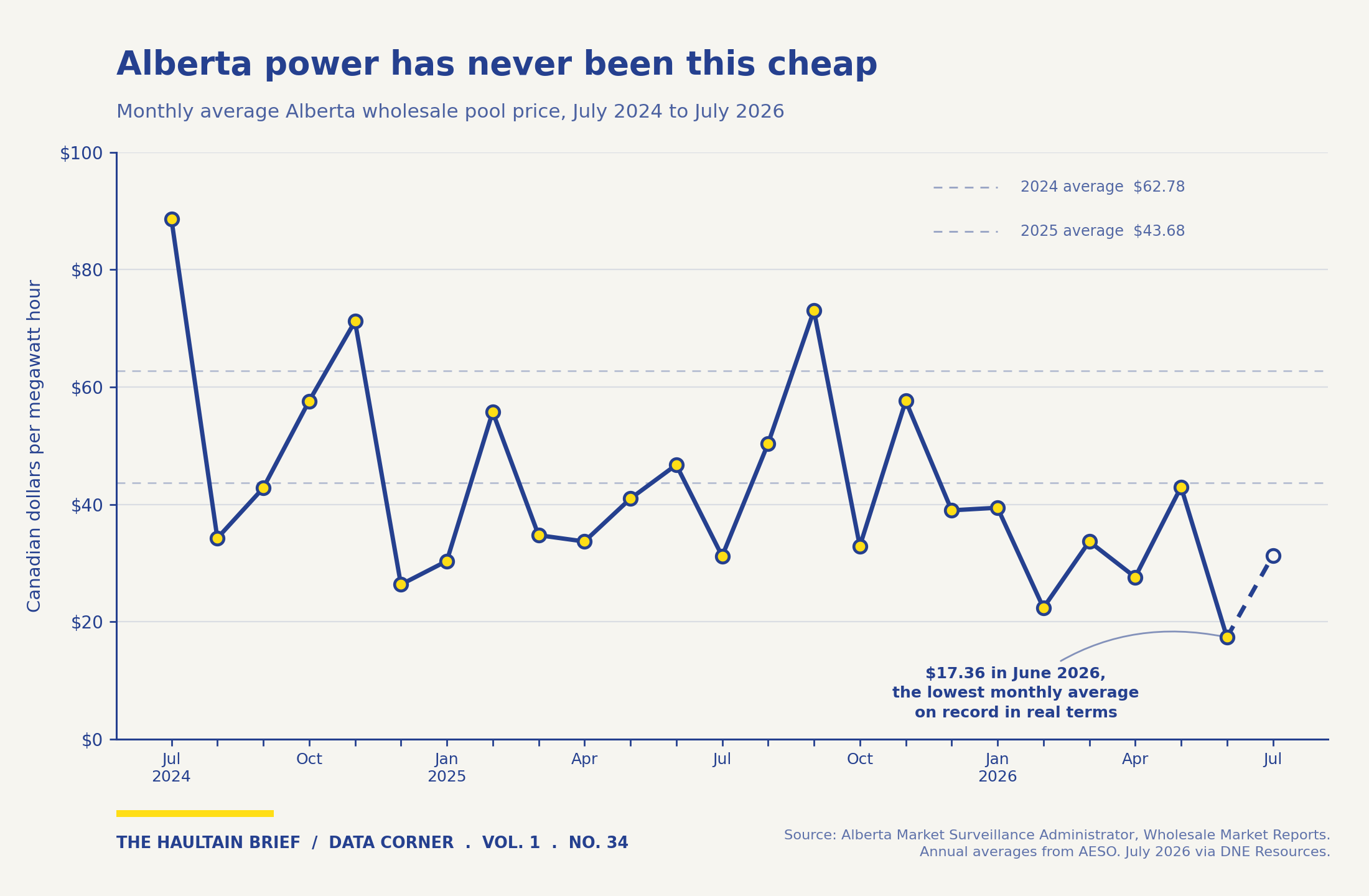
Alberta’s wholesale power price averaged $17.36 per megawatt hour in June, which the Market Surveillance Administrator, the province’s independent market monitor, describes as the lowest monthly average on record once adjusted for inflation. July recovered to roughly $31.30. The direction of travel is the story. The pool price averaged $43.68 across 2025 and $62.78 in 2024, against $162.46 in 2022. Three years ago Alberta had the most expensive electricity in the country and a political emergency to match. It now has some of the cheapest, and a quite different problem.
Inexpensive power is precisely what is drawing artificial intelligence data centres to Alberta, and it is also what makes new generation hard to finance. The Alberta Electric System Operator reported in June 2025 that 29 proposed projects representing more than 16 gigawatts of demand were seeking connection, against an interim limit of 1,200 megawatts to 2028. A market clearing at $17 sends no signal to build the supply those loads would need, which is why so many proponents arrive with their own generation attached, and why the binding constraint has turned out to be siting, as at Olds, rather than price. Two cautions on the chart: June and July are shoulder-season months and soft even by that standard, and the July point is a trade estimate rather than a published MSA average, marked hollow.
Sources: Alberta Market Surveillance Administrator, Wholesale Market Report Q2 2026, August 2026, and the Q3 2025, Q4 2025 and Q1 2026 reports in the same series; Alberta Electric System Operator, 2025 Annual Market Statistics, March 2026; AESO interim approach to large load connections, June 2025; July 2026 average via DNE Resources, 12 August 2026.
1. Alberta’s job numbers are real. The way the government is presenting them is not.
Jobs, Economy, Trade and Immigration Minister Joseph Schow’s team put out the claim that Alberta accounted for 81.2 per cent of all new jobs created in Canada in the first seven months of 2026. The arithmetic holds, and that is the problem. National employment grew by only about 71,000 over those seven months, so Alberta’s share of a very small number is indeed very large. A share of a near-zero denominator measures how weak the rest of the country was, not how strong Alberta is. In July itself Alberta shed 7,300 jobs while Ontario added 52,000, and Alberta’s unemployment rate of 7.0 per cent remains well above the national 6.4 per cent. The underlying record is good enough without the framing: Alberta added 91,000 jobs year over year, the largest proportional gain of any province. Governments that dress up decent numbers invite the suspicion that the numbers are not decent.
Teachers’ association warns members over a public reporting website. The Alberta Teachers’ Association told members that a third party is building a site inviting the public to identify and comment on individual teachers’ conduct, said it is working with legal counsel, and directed those targeted to its member support line. The organizer told a Western outlet the project is about accountability. Alberta Teachers’ Association, 20 August 2026.
Springbank reservoir diverts the Elbow for the first time. The province reported that the Springbank Off-stream Reservoir, built after a decade of litigation and land disputes, was used for the first time to divert high Elbow River flows upstream of Calgary, part of a $125-million flood and drought program. Government of Alberta, 21 August 2026.
A day with no wildfires in Alberta’s forest protection area, the first in August in about 40 years, with 177.2 square kilometres burned this season against 6,705 a year ago. British Columbia, meanwhile, extended its provincial state of emergency to 29 August. CP24, 18 August 2026.
Federal release, then an Edmonton stabbing. A 27-year-old man released from federal custody on 20 August, who failed to report to his assigned Edmonton halfway house, was arrested after two worshippers aged 75 and 51 were stabbed at a northeast Edmonton gurdwara the following morning. Global News, 21 August 2026.
Express Entry tilts further toward French. The 19 August draw issued 5,000 invitations restricted to French-language candidates at a score of 382, the year’s lowest cutoff in that category, continuing a selection pattern that historically directs newcomers away from the West. Immigration, Refugees and Citizenship Canada, 19 August 2026.

Published Wednesdays. Follow the links above to primary sources. A Haultain Research publication: www.haultain.org
Comments
Nothing yet. Say the first thing.
Sign in to join the conversation.