
THE HAULTAIN BRIEF
Vol. 1, No. 33 | Wednesday, August 19, 2026
A Haultain Research publication
The Haultain Brief is a weekly compilation of the news that matters for Alberta and Western Canada. Each Wednesday, we cover the prior week’s political, economic, energy, legal, and institutional developments, organized by theme, with links to primary sources. The editorial perspective will be familiar to Haultain Research readers: evidence-driven, skeptical of fashionable orthodoxies, unapologetically Western Canadian. The Brief complements rather than replaces the longer analytical essays published here. If you find it useful, consider subscribing to support the work.
Dominic LeBlanc, Ottawa’s lead minister on Canada United States trade, met trade representative Jamieson Greer on Sunday, three days before Washington’s threatened 50 per cent tariff on roughly $28 billion in Canadian exports. Sources said both sides remained far apart.
Why it matters: At Haultain Research we read the published priority lists rather than the press conferences, and they say something uncomfortable. Ottawa’s stated order of business is relief on steel, aluminum, autos and then lumber, which places British Columbia’s forest sector last behind three Central Canadian and Quebec industries. The concessions on offer run the same way: dairy quota access, the return of American alcohol to provincial shelves, and an end to counter-tariffs on non-compliant vehicles. Western Canada supplies almost none of what Ottawa proposes to trade away, yet carries plenty of the exposure. Alberta alone produced over 34.2 million pounds of honey last year, more than any province, into a market where the United States takes 52.9 per cent of Canadian honey export value by dollar.
Sources: CP24, 16 August 2026; Global Affairs Canada, 14 August 2026; Manitoba Co-operator, 13 August 2026.
Energy Minister Brian Jean publicized a letter from the Explorers and Producers Association of Canada, whose members produce more than 40 per cent of the country’s oil, backing a pipeline from Bruderheim, Alberta to a deepwater port near Delta, British Columbia.
Why it matters: At Haultain Research, we treat shipper commitment as the only real test of a pipeline proposal, because political enthusiasm costs nothing and volume commitments cost a great deal. The federal notice opening the listing of the West Coast Oil Pipeline as a project of national interest sets a comment deadline of 18 September, which is now the operative date on the file. Two cautions are worth stating plainly. The Assembly of First Nations has told Parliament that the fixed statutory timelines underpinning the approvals regime are coercive, and that objection goes to the mechanism rather than the route. A duty owed to identified rights holders is real, bounded and dischargeable, and discharging it properly is what makes a project survive judicial review.
Sources: Government of Alberta, 14 August 2026; Canada Gazette, Part I, Supplement, 1 August 2026; Blacklock’s Reporter, 12 August 2026.
Environment and Climate Change Canada published draft regulations repealing the zero emission vehicle sales requirements introduced in 2023, which mandated 20 per cent of model year 2026 light duty sales rising to 100 per cent by 2035.
Why it matters: At Haultain Research, we note first what the government’s own arithmetic concedes. The regulatory impact statement books $57.6 billion in avoided vehicle and charger costs against $53.8 billion in forgone energy savings and 326 megatonnes of forgone emissions reductions valued at $94.2 billion, for a net societal cost of $90.3 billion to 2050. That is Ottawa publishing a negative cost benefit result for its own proposal and proceeding anyway, which tells you the decision was made on trade grounds after Washington rescinded its vehicle standards. The mandate deserved to go, but a government that can produce a $90.3 billion figure and not address it is not governing by evidence either.
Source: Canada Gazette, Part I, Vol. 160, No. 33, 15 August 2026.
Trans Mountain has asked the Canada Energy Regulator to lift the share of its 890,000 barrel a day system reserved for long term contract shippers from 80 to 90 per cent. Uncommitted spot capacity would roughly halve, to about 89,000 barrels.
Why it matters: At Haultain Research, we care about who gets access, not only about how much pipe exists. Only investment-grade producers can sign the long-term contracts this change rewards; smaller Alberta operators would be pushed toward third-party marketers or back to Edmonton and Hardisty pricing, forgoing the overseas premium. Sixty four per cent of the 528 tankers loaded since the expansion opened in May 2024 have gone to Asia, and the Business Council of Alberta puts the improved market access at roughly $5 billion in additional provincial revenue this year. The regulator must decide by 1 October for a January 2027 start. This is a genuine efficiency case against a genuine access case, and the small producer side deserves an actual hearing rather than a filing deadline.
Source: EnergyNow, carrying the Edmonton Journal, 14 August 2026.
Court of King’s Bench Justice P.K. Johal dismissed O’Leary Digital Limited’s bid to quash Sturgeon Lake Cree Nation’s judicial review of a Water Act licence, and refused the company standing. The licence allows diversion of six million cubic metres from the Smoky River.
Why it matters: At Haultain Research, we distinguish between process that has an endpoint and processes that do not, and this is the first kind. The licence went to the Municipal District of Greenview, not to the developer, and Johal held the company’s connection to it “both contingent and speculative.” The Nation’s claim that Alberta failed to consult at all now goes to a full hearing in December. Alberta has attached its $70 billion Wonder Valley proposal to a water allocation whose consultation record has never been tested, which is a self-inflicted risk. A court insisting that the province meet a duty it already owes is the rule of law working, and the province is better off finding out now than in 2029.
Source: APTN News, 14 August 2026.
Requests to connect data centres to Alberta’s grid total about 19,565 megawatts, more than the province’s highest recorded hourly demand. The Alberta Electric System Operator capped its first allocation round at 1,200 megawatts, awarding 970 to Meta and 230 to Keephills.
Why it matters: At Haultain Research, we take the Premier at her word and then check it. Danielle Smith says these are “100 per cent private projects. No subsidies, no grants, no discounted power, no taxpayer backstop,” and if that holds it is the right posture: let capital build its own generation and pay its own transmission. The numbers behind the claim are narrower than the billing. The roughly $200 million a year in transmission fees is attributed to Meta specifically, and the projected saving is up to six per cent of the transmission portion of a household bill, not six per cent of the bill. Ontario has just moved the other way, charging large facilities above standard industrial rates, which hands Alberta a real competitive advantage worth defending honestly.
Sources: EnergyNow, carrying the Financial Post, 14 August 2026; Global News, 11 August 2026; Alberta Counsel, 13 August 2026.
The Haultain Brief is compiled by Haultain Research staff and is a reader-supported publication. To receive new posts and support our work, consider becoming a free or paid subscriber. You may also support us by sharing our work with like-minded friends and family, or making a modest donation at www.haultain.org
Statistics Canada put Alberta manufacturing sales up 21.0 per cent in the second quarter, the strongest provincial gain in the country, driven primarily by petroleum and coal products. Housing starts over the first half fell to 22,077 units from 27,902.
Why it matters: At Haultain Research, we separate price effects from volume effects, because governments rarely do it for you. Alberta’s manufacturing surge is a global diesel squeeze showing up in refinery margins, not new plants or new shifts. The domestic economy underneath is telling a different story: housing starts down about 21 per cent, unemployment at 7.0 per cent against 6.4 per cent nationally, and population growth that has fallen from roughly 205,000 in the four quarters to October 2024 to about 47,000 in the four quarters to April 2026. June building permits of $1.8 billion, up 19.6 per cent, are the one genuinely encouraging number. A budget built on the manufacturing headline would be built on the oil price.
Sources: Statistics Canada, Monthly Survey of Manufacturing, 14 August 2026; Statistics Canada, Building permits, 12 August 2026.
Three measures in Bill 25, the spring statute amending the Education Act, will not take effect on 1 September as planned: restricting school flags to the Canadian and Alberta flags, a weekly national anthem requirement, and the minister’s power to approve school names.
Why it matters: At Haultain Research, we count a government’s retreats as part of its record, and this is a retreat from the most symbolic provisions of its own statute, three months after Royal Assent and two weeks before classes begin. The measures that survive are the substantive ones: the requirement that teachers present curriculum neutrally, the bar on school boards issuing political or social statements, and the mandatory board level code of conduct addressing bullying. Those are defensible on accountability grounds. Flags and anthems were never going to improve a single reading score, and legislating them created an implementation problem the department could not answer when asked which flags would be permitted. Governing by symbol has an administrative cost like anything else.
Sources: Global News, 14 August 2026; Legislative Assembly of Alberta, Bill 25.
Albertans moved on 1 July from AISH, the long-standing disability benefit, to the new Alberta Disability Assistance Program and have kept reporting missing and short deposits into August. Roughly 46,000 of about 80,000 recipients transferred, on the figures reported.
Why it matters: At Haultain Research, we ask three questions of any new provincial body or program: what does it replace, who answers for it, and how would anyone know if it failed. On the third question this one answers itself, because the people it failed are the ones least able to absorb a missed rent payment. Opposition critic Marie Renaud reports constituents “shorted $400, some people only got $400,” and others still on AISH receiving nothing. The ministry gave three different correction deadlines. Alberta’s own program page publishes no caseload figure at all, which means the only numbers in public circulation come from a newspaper. A government that reorganizes a benefit for 80,000 people owes the public a monthly count of who has been paid.
Source: Medicine Hat News, 14 August 2026.
Grifols, which collects plasma from paid donors in Canada under an exclusive agreement with Canadian Blood Services, paused collection at all its Canadian centres on Friday. Two people died after donating at its Winnipeg site; the Calgary site was found non-compliant.
Why it matters: At Haultain Research, we support private provision of services the state need not deliver itself, and precisely because we do, we insist that private providers meet the standard. Alberta banned payment for plasma in 2017 and the current government repealed that ban in 2020, on the reasonable argument that Canada imports most of its plasma products and domestic collection is thin. That argument has not been refuted by these events, but it has acquired a condition. The regulator found a problem and the company stopped, which is the system working rather than failing. What is missing is the public record: neither Health Canada nor the province has published the inspection finding, and Albertans are learning the details from an advocacy group’s statement.
Sources: Medicine Hat News, 15 August 2026; Friends of Medicare, 14 August 2026.
Tyson Foods will close plants at Joslin, Illinois and Eagle Mountain, Utah and sell its Pasco, Washington facility. The company cited a 75-year trough in American cattle supply and forecast an adjusted operating loss of up to $650 million in beef this year.
Why it matters: At Haultain Research, we watch American packing capacity because Alberta feeders live on it. The United States is the major destination for Canadian beef cattle, and every plant that closes narrows the bid on fed and feeder animals moving south, widening basis at exactly the moment tight supply should be rewarding Alberta producers. The January closure at Lexington, Nebraska alone took roughly 5,000 head a day out of the system. This strengthens the commercial case for domestic processing capacity in Alberta, and the case should be made on those terms. A shortage of American packing capacity is a market signal to private investors; it is not by itself a reason for a provincial cheque.
Source: Manitoba Co-operator, carrying Reuters, 14 August 2026.
Calgary, Rocky View County and the Canada Infrastructure Bank, the federal project financing agency, signed a memorandum advancing the Prairie Economic Gateway, a 1,300 acre rail served industrial district on the CPKC mainline east of Calgary. The first phase is targeted for 2031.
Why it matters: At Haultain Research we prefer trade infrastructure to trade rhetoric, and this is the former. The projection is more than $7 billion in economic activity over ten to twelve years and more than 30,000 regional jobs, on land that already sits on a Class I railway. Two things are worth watching. The Canada Infrastructure Bank has a mixed record and its involvement should be measured by private dollars actually committed rather than by the size of the announcement.
Sources: City of Calgary, 11 August 2026; Global News, 11 August 2026.
Alberta announced this week that its hundred-year water review will not reopen the province’s allocation priority system. That system is 132 years old, and it was not made in Alberta.
In July 1894 Parliament passed the North-West Irrigation Act (S.C. 1894, c. 30), drafted by William Pearce, then superintendent of mines in the federal Department of the Interior. The Act transferred ownership of water throughout the North-West Territories to the federal Crown, in terms strengthened by amendment the following year, and swept away the common law doctrine of riparian rights that tied water use to land abutting a stream. In its place came a licensing system borrowed from the American doctrine of prior appropriation: where a river could not satisfy every licensee, water was distributed by licence seniority, and the most junior holder was cut off first.
That is first in time, first in right, and it is still the backbone of Alberta’s Water Act. Note who owned the water in 1894. Alberta did not acquire its lands, minerals and water until the Natural Resources Transfer Agreement of 1930, twenty five years after it became a province. Frederick Haultain, who had sat in the Territorial assembly since 1887 and became the Territories’ first premier after 1897, spent much of his public life arguing that the West should own what lay upon and beneath its own ground. On water, the rule he inherited from Ottawa is the rule Alberta chose to keep.
Sources: David R. Percy, “Seventy-Five Years of Alberta Water Law,” Alberta Law Review 35:1 (1996); Dictionary of Canadian Biography, “Pearce, William”; Encyclopedia of Saskatchewan, University of Regina.
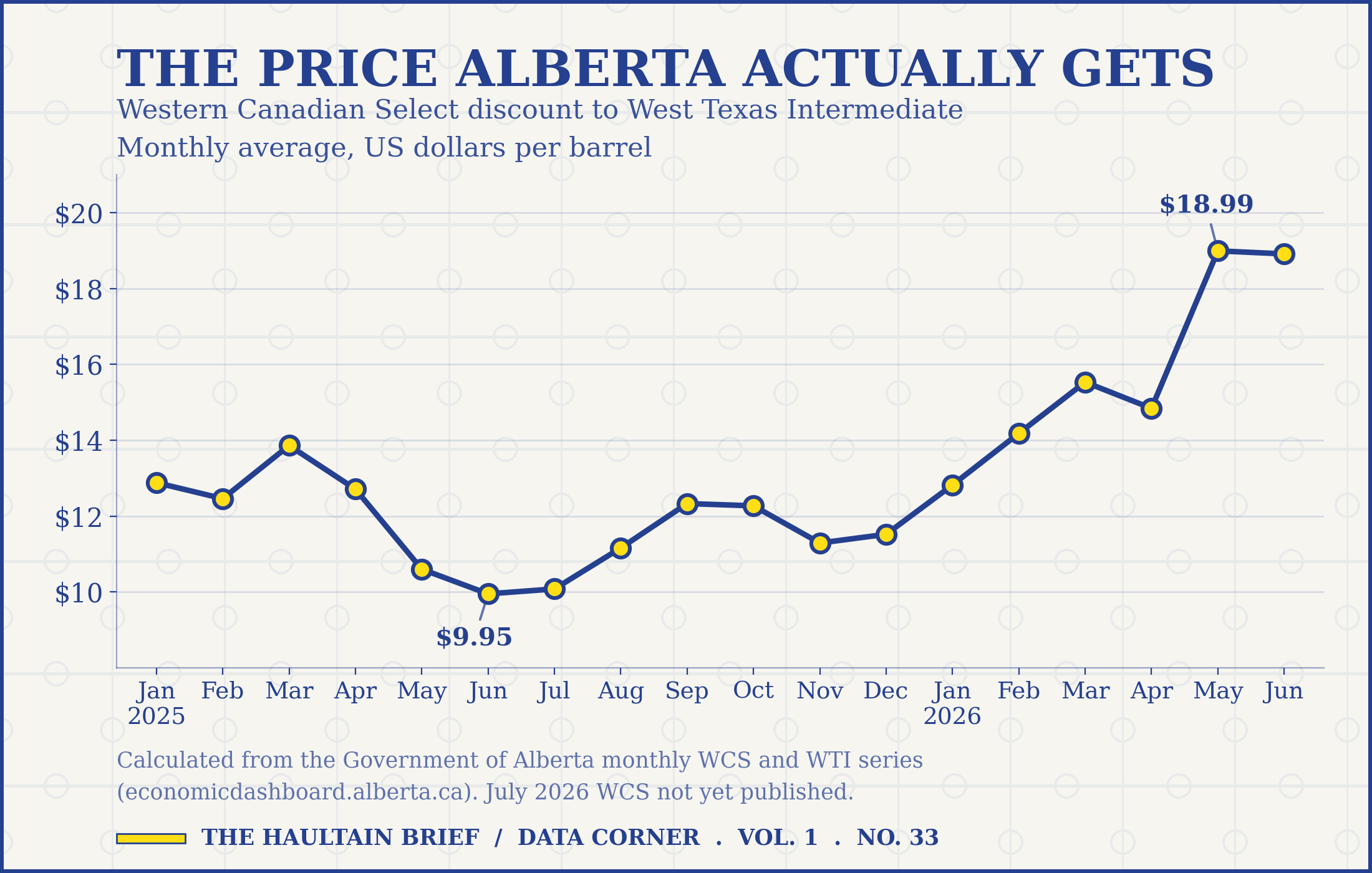
The read: The headline oil price is not the price Alberta gets, and the gap has been widening through the very rally that was supposed to help. Western Canadian Select traded at an average discount of $9.95 a barrel to West Texas Intermediate in June 2025, the tightest month in this series. By May 2026 the discount had reached $18.99, and June 2026 was barely narrower at $18.91. Over the same stretch West Texas Intermediate ran from $68.17 to $84.81, peaking above $102 in May. Alberta captured less of that move than the headline suggests, and the differential is what the province is really selling into when it books royalty revenue. It is also the clearest single argument for the market access files above: a discount that widens when prices rise is a capacity problem, not a quality problem. Figures are calculated from the Government of Alberta’s published monthly WCS and WTI series; July 2026 WCS is not yet published.
Source: Government of Alberta economic dashboard; July 2026 WTI confirmed against the US Energy Information Administration.
1. The story almost nobody covered: Ottawa spent the week quietly raising the cost of Western drilling and Western housebuilding.
While the country watched the tariff deadline, two trade notices went the other way. The Canada Border Services Agency determined on 4 August that oil and gas well casing from Austria had been dumped, sending the question of injury to the Canadian International Trade Tribunal for a decision by 1 September (Canada Gazette, Part I, 15 August 2026). Well casing is an input in every drilling program in Alberta, Saskatchewan and northeast British Columbia, and duties would raise costs across the basin to protect a small number of domestic mills. Published the same fortnight: a 25 per cent provisional safeguard surtax on imported wood cabinets and vanities, in force from registration on 31 July for up to 200 days, after imports rose 25 per cent in value between 2023 and 2025 to $340 million in 2025 (Canada Gazette, Part II, 12 August 2026). That is a direct addition to the cost of finishing a house, in a housing affordability crisis, applied by the same government asking Washington to drop its tariffs.
2. The best policy idea in the file came from a city, and it is the cheapest housing money Alberta has spent.
Calgary’s secondary suite registry has gone from 431 units in 2015 to 13,000 in 2024 to 26,000 today, with roughly half of the recent additions coming through an incentive of up to $10,000 per qualified homeowner. Chief Housing Officer Reid Hendry: “At less than $10,000 per door, this program has been the most efficient and cost-effective way to create thousands of new homes across Calgary” (City of Calgary, 13 August 2026). Compare that to the per-unit cost of almost any purpose-built affordable housing program in the country. The intervention is small, temporary, local, and it pays private owners to add supply inside existing infrastructure rather than paying an agency to build it. We should say so as readily as we say the opposite when it is true.
Elections Alberta pushes back on voter registration rumours. Chief Electoral Officer Gordon McClure states that no registrations have been removed without consent and that the Voterlink tool cannot delete anything, nine weeks before the 19 October referendum. Elections Alberta, 14 August 2026
Alberta’s hundred-year water white paper. $400,000 from the TIER water availability budget, due spring 2027, with basin models from Kerr Wood Leidal and Aquanty due in March. The review explicitly excludes first in time first in right, licence transferability and inter-basin transfers. Government of Alberta, 13 August 2026
The Berland sub-regional plan opens for comment. A draft land use plan covering 19,529 square kilometres southeast of Grande Prairie, governing forestry, grazing, energy, recreation and caribou habitat. Consultation closes 12 November. Government of Alberta, 14 August 2026
The federal fuel excise holiday expires 7 September. Ottawa has not said whether it will extend the suspension, worth 10 cents a litre on gasoline and four on diesel. Reinstatement lands on Prairie trucking and grain hauling at the front end of harvest. EnergyNow, 15 August 2026
Alberta’s immigration allocation rises by 200 against a queue of nearly 37,000. The provincial nominee allocation went to 6,603 for 2026, with 4,184 issued as of 12 August and roughly 36,948 worker expressions of interest waiting, 62.4 per cent of them in a single stream. CIC News, 15 August 2026
Published Wednesdays. Follow the links above to primary sources. A Haultain Research publication: www.haultain.org
Comments
Nothing yet. Say the first thing.
Sign in to join the conversation.