

The Haultain Brief is a weekly compilation of the news that matters for Alberta and Western Canada. Each Wednesday, we cover the prior week’s political, economic, energy, legal, and institutional developments, organized by theme, with links to primary sources. The editorial perspective will be familiar to Haultain Research readers: evidence-driven, skeptical of fashionable orthodoxies, unapologetically Western Canadian. The Brief complements rather than replaces the longer analytical essays published here. If you find it useful, consider a paid subscription to support the work.
Prime Minister Mark Carney and Premier Danielle Smith signed in Red Deer: $510 million federal over eight years, with Alberta funding at least a third of eligible costs, up to $428 million, for the water and sewer lines new subdivisions need. One Airdrie pipeline reportedly enables 45,000 homes.
Why it matters: Servicing capacity is a genuine constraint on Alberta homebuilding, and the money will build real infrastructure. But this is conditional cost-shared funding that obliges the province to cover at least a third of eligible costs, which means Alberta’s own capital plan now bends toward the projects Ottawa has agreed to co-sign. At Haultain Research we would ask two questions before calling this a win: whether Albertans have simply bought back their own tax dollars on someone else’s terms, and whether the binding constraint on new housing was ever money rather than the municipal permitting and servicing queues that no federal cheque can shorten.
Sources: Prime Minister’s Office and Government of Alberta, July 29, 2026; reporting by The Canadian Press.
Organizers of the anti-coal petition fronted by country musician Corb Lund filed for judicial review after Elections Alberta verified 172,088 of 207,435 signatures against a threshold of 177,732, leaving the petition 5,644 short. They argue the standard applied exceeds what the law requires.
Why it matters: The Citizen Initiative Act was sold as a way for Albertans to put questions to their own government without waiting for a party to adopt them. That promise is worth only as much as the verification process behind it, and two separate campaigns from opposite ends of the political spectrum are now both alleging the process is stricter than the statute. At Haultain Research we take no position on coal leases or on any petition’s subject matter, and we think that is precisely the point: the rules for counting a signature should be the same regardless of what the signature is for, published in advance, and applied identically. This is now a matter for the Court of King’s Bench, which is the right forum, but the legislature should not need a judge to tell it whether its own Act is being read correctly.
Sources: Elections Alberta verification result, July 3, 2026; judicial review filing reported by Calgary Journal, July 31, 2026; independence petition figures from Elections Alberta, July 24, 2026.
Real GDP rose 0.3 per cent in May, a second consecutive monthly increase. Mining, quarrying and oil and gas extraction was the strongest sector at 1.0 per cent, and support activities for the industry jumped 7.3 per cent.
Why it matters: That 7.3 per cent in support activities is the number worth keeping. It covers drilling, servicing and rigging, which is to say the work that happens before production shows up in anyone’s statistics, and it was the largest monthly gain in that category since March 2024. It is a leading indicator, and right now it points up. The wider picture is an asymmetry that Alberta should state plainly rather than resentfully. The sector that three provinces would like to see placed on the tariff bargaining table is the one currently holding up the national average, while the manufacturing that the tariffs actually target is not. At Haultain Research we would add the necessary caution: monthly GDP is volatile, one month is not a trend, and Statistics Canada’s June advance estimate of 0.2 per cent suggests the pace is already easing.
Source: Statistics Canada, July 31, 2026.
Pembina Pipeline, the Calgary energy infrastructure company, approved the 932 megawatt Greenlight Electricity Centre, a gas-fired plant dedicated to the data centre Meta is building in Alberta, plus a $570 million processing plant in the Industrial Heartland northeast of Edmonton.
Why it matters: Alberta’s artificial intelligence build-out is being financed by companies constructing their own on-call generation rather than trusting the public grid to supply it, which is about as clear a market verdict as one could ask for on what actually powers a data centre. Three Alberta power companies pointed at the same demand in second quarter results: Capital Power has 250 megawatts under contract to Meta, ATCO is building the $2.9 billion Yellowhead gas pipeline and cites a projected $100 billion of Alberta data centre investment by 2030, and TransAlta mothballed a coal-converted unit at Sheerness while reporting weaker earnings. At Haultain Research we would watch one file above all others: whether Alberta’s electricity market redesign lets this scale on private capital, or whether it ends in negotiated subsidies and transmission costs spread onto ordinary ratepayers.
Source: Pembina Pipeline Corporation, July 30, 2026.
Cenovus posted its best ever quarter at $5.0 billion in cash from operations. Imperial Oil’s profit more than doubled to $2.2 billion while it cut refinery guidance. ARC Resources’ $22 billion sale to Shell closes this quarter.
Why it matters: Two quarters of strong prices have produced debt repayment, share buybacks and raised guidance rather than new megaprojects. The telling detail sits in Athabasca Oil’s results: its Corner Phase 1 project, which would be the first brand new oil sands mine-equivalent sanctioned in the McMurray formation since 2013, is explicitly waiting on Alberta’s new oil sands royalty framework before proceeding. At Haultain Research we read that as the signal worth keeping. At US$80 oil the binding constraint on Alberta investment is no longer the commodity price or the cost of capital. It is confidence that the rules governing a thirty year asset will still be the rules in five years.
Sources: Cenovus Energy, July 29, 2026; Imperial Oil, July 31, 2026; Whitecap Resources, July 29, 2026.
From July 31, adults may pay out of pocket for MRI, CT, ultrasound and X-ray scans at participating private clinics without a doctor’s referral. Patients later diagnosed with cancer can claim the cost back at public rates within a year.
Why it matters: This is a real market experiment inside a system that has only one buyer, and it deserves to be judged on measured results rather than on the phrase “two-tier.” The province projects privately paid testing rising from about half a per cent of all scans to roughly two per cent. If it works, public queues shorten because paying patients leave them. If it does not, scarce radiologists and technologists shift to the private side and public waits lengthen. Both are plausible, and only data settles it. At Haultain Research we would hold the government to a simple discipline: publish public diagnostic wait times every month, by health zone and by scan type, and let the numbers make the argument.
Sources: Red Deer Advocate, July 27, 2026; Government of Alberta, July 27, 2026.
Keep the Brief coming
The Haultain Brief is compiled by Haultain Research staff and is a reader-supported publication. To receive new posts and support our work, consider becoming a free or paid subscriber.
You may also support us by sharing our work with like-minded friends and family, or making a modest donation at www.haultain.org
The chief operating officer maximum pay band rose 29 per cent for 2026, and every director level role was consolidated into a single maximum of $290,700, under the city’s first new job evaluation system in more than twenty years.
Why it matters: Compensation is the largest single line in almost every municipal budget, and it is set with less public scrutiny than any comparable sum. Calgary employs 16,846 people across more than 2,000 positions, and some individual bands moved sharply: Preventative Maintenance Leads went from a maximum of $128,548 to $189,822. At Haultain Research we would be fair about two things before drawing conclusions. Bands are ceilings rather than salaries, so a band increase is not by itself a payroll increase, and consolidating dozens of accumulated classifications into a coherent structure is sound administration rather than largesse. What ratepayers are entitled to is the number that follows: the actual paid distribution against the new bands. Bill 28 will require individual disclosure above $130,000 from 2027, which will settle the argument. The reason to raise it now is that it lands in the same season as a council decision to plan its next four year budget around higher property tax revenue, and those two facts belong side by side.
Sources: City of Calgary 2026 Compensation Disclosure List, effective April 30, 2026; band-by-band figures obtained from the City by LiveWire Calgary, July 27, 2026.
Statistics Canada puts Alberta’s 2025 Crime Severity Index at 90.6, down 6.6 per cent. The Alberta RCMP separately reports a 10.4 per cent decline across the 149 jurisdictions it polices, its lowest since 2014, with break-ins down 19 per cent.
Why it matters: The two numbers are worth separating, because almost everyone quotes the second one as though it were the first. The provincial figure covers every police service in Alberta including the cities. The 10.4 per cent figure covers only the jurisdictions the RCMP polices, which is most of rural Alberta and most of its small towns. That the rural decline is steeper than the provincial average is the reverse of the assumption underpinning a decade of rural crime politics. At Haultain Research we do not read this as evidence that policing is solved. We read it as evidence that a $2 million policing decision in a small town, or a request for 660 new officers in Calgary, should begin with the measured trend rather than the public mood, and that anyone citing the 10.4 per cent should say which Alberta they are describing.
Sources: Statistics Canada, Police-reported crime statistics, 2025, July 22, 2026; Alberta RCMP figures reported by rdnewsnow, July 28, 2026.
Rocky View County, the rural municipality wrapping Calgary’s north and east, voted 5 to 2 in late July for a moratorium on new data centre proposals. Days later dozens protested Meta’s $13 billion Sturgeon County project over water and grid strain.
Why it matters: Alberta’s largest inbound investment wave has found its real constraint, and it is not electricity. It is municipal land use. Residents raising water allocation, road wear and property values are asking legitimate questions about their own property, and they are entitled to a hearing. A blanket moratorium, however, substitutes uncertainty for rules, and uncertainty is the one thing a fifteen year capital commitment cannot price. At Haultain Research we would far rather see clear published standards a developer can read, cost, and either meet or walk away from, than a pause that quietly hands the decision to whoever lobbies hardest while it lasts.
Sources: Medicine Hat News, August 1, 2026; Global News, August 2, 2026.
Alberta Agriculture rated crops 85 per cent good to excellent in the South and 81 in the Central region, against 54 in the Peace, 48 in the North East and just 31 in the sodden North West.
Why it matters: The provincial average of 63 per cent conceals two entirely different harvests. Edmonton has just recorded its wettest summer on record, 580 millimetres between June 1 and July 28, against a full season June to August record of 417 millimetres set in 1953. Aggregate statistics are precisely how regional distress gets overlooked in Edmonton and Ottawa alike. At Haultain Research we would ask whether crop insurance and AgriStability, the federal and provincial farm income support program, are calibrated to regional conditions or to a provincial mean that describes almost no actual farm, and whether a producer in the Peace can get help this year without waiting for a province-wide number to deteriorate first.
Source: Government of Alberta crop report for conditions as of July 21, 2026, published through Alberta crop reports; regional figures as reported by Alberta Seed Guide, July 27, 2026.
Two new conservation dogs join the veteran Hilo on Alberta’s invasive mussel programme, which is running a record twelve inspection stations this year. Six fouled watercraft have been intercepted in 2026, against thirteen in 2025 from 21,995 boats inspected.
Why it matters: At Haultain Research we spend most of our time asking whether a government programme justifies its cost, so it is worth saying clearly when one does. Zebra and quagga mussels foul irrigation headworks, hydro intakes and municipal water systems, and once established they are effectively permanent. The Alberta irrigation network alone represents billions of dollars of infrastructure serving the province’s most productive farmland. Against that, a dozen seasonal inspection stations, a handful of dogs and penalties of $4,200 for failing to stop are close to trivial. This is what a defensible intervention looks like: narrow, cheap, aimed at a specific and irreversible harm, and measurable. The programme’s problem is that its success is invisible, and invisible success is what gets cut first when a budget tightens. Alberta has kept mussels out while neighbouring jurisdictions have not. That record is worth protecting.
Source: Government of Alberta, July 29, 2026.
More than $107 million in scholarships, awards and bursaries for 2026-27 opened for application on August 4, with the New Beginnings Bursary expanding from 1,000 to 2,400 recipients on a $7 million funding increase.
Why it matters: Alberta now moves more than $1 billion a year in total student aid to roughly 50,400 students, which makes this one of the larger transfer programmes the province runs and one of the least examined. Two questions deserve asking, and neither is hostile to the programme. The first is whether broadly available aid raises attainment or is quietly captured by institutions in higher tuition, which is a well-documented pattern in the American literature and an open question here. The second is the mix. The Rutherford Scholarship, which is merit based, paid nearly $50 million to more than 24,000 students last year, while need based bursaries remain a much smaller share. At Haultain Research we would want the province to publish completion and labour market outcomes by award type before expanding any of them further. A cheque that goes to a student who would have enrolled anyway is a transfer, not an investment, and the two should not be reported as the same thing.
Source: Government of Alberta, July 29, 2026.
Seven OPEC+ producers agreed a 188,000 barrel a day increase for September, finishing the unwinding of the 1.65 million barrels a day of voluntary cuts agreed in 2023. Reuters reports a pause in further increases through the fourth quarter.
Why it matters: This is the machinery by which Alberta’s windfall unwinds, and it turns in Vienna rather than in Edmonton. Roughly 2 million barrels a day of the 2022 cuts remain in place through the end of 2026, which is the only reason the rollback has not already pushed prices down harder; the analysts Reuters quotes are now discussing how to manage a surplus rather than a shortage. Alberta’s budget assumed US$60.50 oil, the first four months of the fiscal year have averaged closer to US$92, and the difference is a windfall the province did nothing to earn and cannot control. At Haultain Research we draw the obvious conclusion. Revenue set by a cartel’s quota meetings is not a basis for permanent spending commitments, and a government that treats it as one will be cutting in eighteen months. That is precisely the argument Peter Lougheed made in 1976, and it is below in this issue.
Sources: OPEC Secretariat statement, August 2, 2026; Reuters, August 2, 2026.
The Alberta Heritage Savings Trust Fund Act received Royal Assent on May 19, 1976. Thirty per cent of the province’s non-renewable resource revenue was directed into the Fund, some $620 million in the first year, alongside a special transfer of $1.5 billion in cash and financial assets. The contribution rate was cut to 15 per cent in 1983, and in 1987 transfers of resource royalties into the Fund stopped altogether. They were never systematically restored.
Peter Lougheed’s premise was simple and correct. A one-time inheritance converted into current consumption is not income; it is liquidation. Norway began saving its own oil revenue in 1990, fourteen years after Alberta did, and its fund is now larger by more than an order of magnitude. On the Heritage Day weekend just past, with oil averaging roughly US$92 through the first four months of this fiscal year against a budget assumption of US$60.50, Alberta faces the same question Lougheed asked in 1976. The province answered it wrongly in 1987, and every Albertan born since has paid for the answer.
Source: Government of Alberta, Heritage Fund historical timeline.
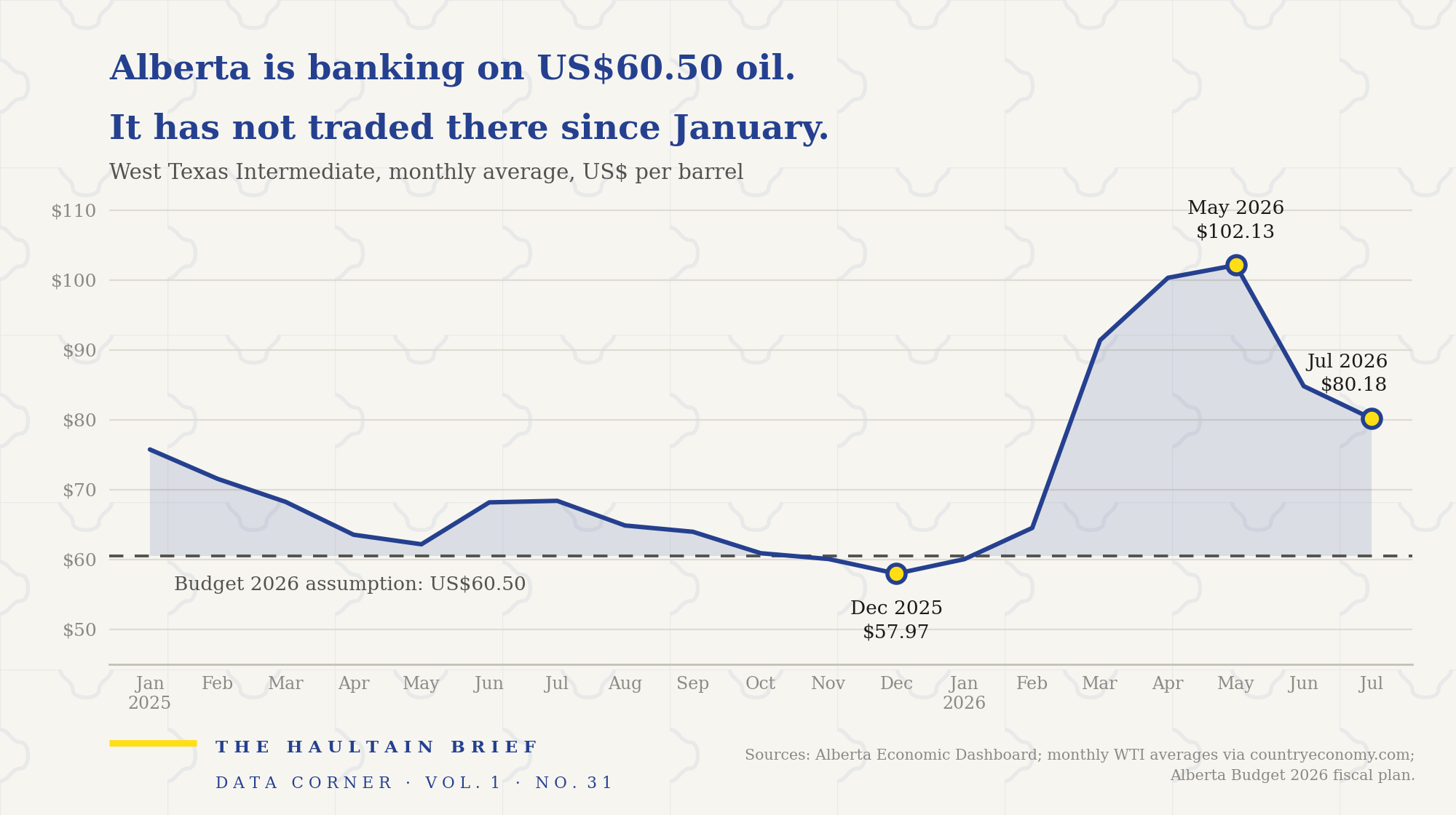
West Texas Intermediate, the North American benchmark crude against which Alberta’s royalty revenue is forecast, averaged US$102.13 in May 2026 and US$80.18 in July. Budget 2026 assumed US$60.50, and on that assumption the province projected a $9.4 billion deficit, $74.6 billion in revenue and bitumen royalties falling to $9.7 billion.
Through the first four months of the fiscal year, the benchmark has averaged roughly US$92, some $31 above assumption. Alberta’s first quarter fiscal update, due at the end of August, will therefore report a very large positive variance that has nothing whatever to do with anything the government did. The interesting question is not the size of the number. It is where the number goes.
Sources: Alberta Economic Dashboard; monthly WTI averages via countryeconomy.com; RBC Economics on Alberta Budget 2026.
1. The biggest political development of the week was administrative, not electoral.
An application for judicial review landed in the Court of King’s Bench over Elections Alberta’s rejection of roughly 35,000 signatures on the anti-coal petition, on grounds the organizers say are stricter than the Citizen Initiative Act requires. A second, entirely unrelated campaign lost some 64,000 signatures to the same verification method. Nothing binds those two groups together except the rulebook, and both now distrust it. When the referee’s discretion is the only thing the contestants agree to complain about, the referee’s rules are the story. The legislature wrote this Act four years ago and can clarify it in an afternoon. It should not need a court to do that work.
2. The biggest economic signal is that Alberta’s marginal energy buyer is now a data centre.
Pembina Pipeline committed $4.6 billion to dedicated gas generation for Meta. Capital Power has 250 megawatts under contract to the same customer. ATCO is building a $2.9 billion gas pipeline and citing $100 billion of projected Alberta data centre investment by 2030. TransAlta, in the same week, mothballed a Sheerness unit and reported weaker earnings on a soft Alberta power market. Read together, those results describe a wholesale power market that is oversupplied at the margin while private generation built behind the customer’s fence is booming. That is capital routing around a market structure it does not trust. If Alberta wants this investment without subsidy, the province’s electricity market redesign is now the most important file in Edmonton, and it is receiving almost no coverage.
3. The story the media largely missed was good news, which is very likely why they missed it.
Alberta’s Crime Severity Index fell 6.6 per cent in 2025, and across RCMP-policed Alberta it fell 10.4 per cent to its lowest level in eleven years, with break-ins down 19 per cent. It received a wire brief. The same week produced extensive coverage of policing structure, bail and municipal police budgets, nearly all of it conducted on the premise that things are getting worse. Evidence that cuts against the prevailing narrative is not less newsworthy for being inconvenient. It is more.
Macdonald-Laurier Institute, published in The Hub, July 30, 2026
Tombe, an economist at the University of Calgary, makes the unfashionable free trade case that Canada should not retaliate. He grounds it in Adam Smith’s test, that retaliation is justified only when there is a real prospect it procures the repeal of the other side’s duties, and argues that condition is plainly not met here. The empirical core is his own analysis of roughly 51,000 tariff lines, which finds Canadian goods face rates broadly comparable to those other countries face. Canada is not being singled out, which undercuts the grievance driving the retaliation politics. He estimates provincial exposure once the 50 per cent tariffs take effect on August 19, with Quebec worst hit at roughly 13 per cent, and notes that about three quarters of Canadians initially backed counter-tariffs. His prescription is entirely domestic: credential recognition, internal competition reform, infrastructure, tax reform and the end of supply management.
Why we are recommending it: It is the rare piece that tells its own audience its instincts are wrong and then does the arithmetic rather than asserting it. For Western readers it also reframes the tariff fight as an argument about barriers Canadians impose on themselves, which is the agenda Alberta has been pushing for a decade. The strongest objection is one Tombe underweights: retaliation may carry bargaining or deterrent value that his framework prices at zero, and Ottawa’s 2018 steel counter-tariffs are the usual case for the other side. Read it anyway. It is the week’s most rigorous argument on the file.
Source: Macdonald-Laurier Institute, July 30, 2026.
Carney ruled out using Canadian oil as leverage in the trade war, standing beside Smith in Red Deer: “Being a reliable supplier is important. People trust us.” Ontario, Quebec and New Brunswick want energy on the bargaining table. Energy is currently carved out of the 50 per cent tariffs due August 19. (Reuters, David Ljunggren, July 29; also CP24)
TD Economics put the proposed West Coast pipeline at roughly half the economic benefit governments advertise, 0.3 per cent of national GDP and 2 per cent of Alberta’s against official figures of 0.6 and 3.5. The line would be built and operated by a federally owned corporation, so taxpayers carry the risk. (TD Economics; The Canadian Press)
A technical failure sent wrong or missing August payments to about two per cent of disability recipients as 50,000 AISH clients moved to the new provincial disability programme, which pays roughly $200 a month less. The province says it was corrected by July 29. Tens of thousands of files remain to be moved. (Red Deer Advocate)
WestJet’s 4,400 flight attendants struck on August 2, grounding the Calgary based airline at the peak of summer travel over unpaid ground work, since pay begins only once the aircraft is airborne. Watch whether Ottawa refers it to the Canada Industrial Relations Board rather than letting the parties settle. (Global News)
The Alberta Energy Regulator permitted the Vista coal mine expansion near Hinton without a public hearing, covering 630 hectares, a twelve year extension of the mine’s life and up to 5.4 million cubic metres of annual water diversion in the Athabasca headwaters, over formal objections. The water licensing and process questions here will outlast the coal debate. (Alberta Energy Regulator decisions register, decision dated July 20, 2026)
Calgary council voted 8 to 7 to build its next four year budget around higher property tax revenue, against a stated $49 billion decade-long infrastructure need and a police request for 660 officers. Deliberations begin in November, alongside the new compensation structure above. (Global News)
Alberta’s first quarter fiscal update lands at the end of August, and on current prices it should show a dramatic improvement on the budgeted $9.4 billion deficit. Watch whether the windfall goes to debt, to the Heritage Fund, or quietly into base spending.

Published Wednesdays. Follow the links above to primary sources. A Haultain Research publication: www.haultain.org
Comments
Nothing yet. Say the first thing.
Sign in to join the conversation.