
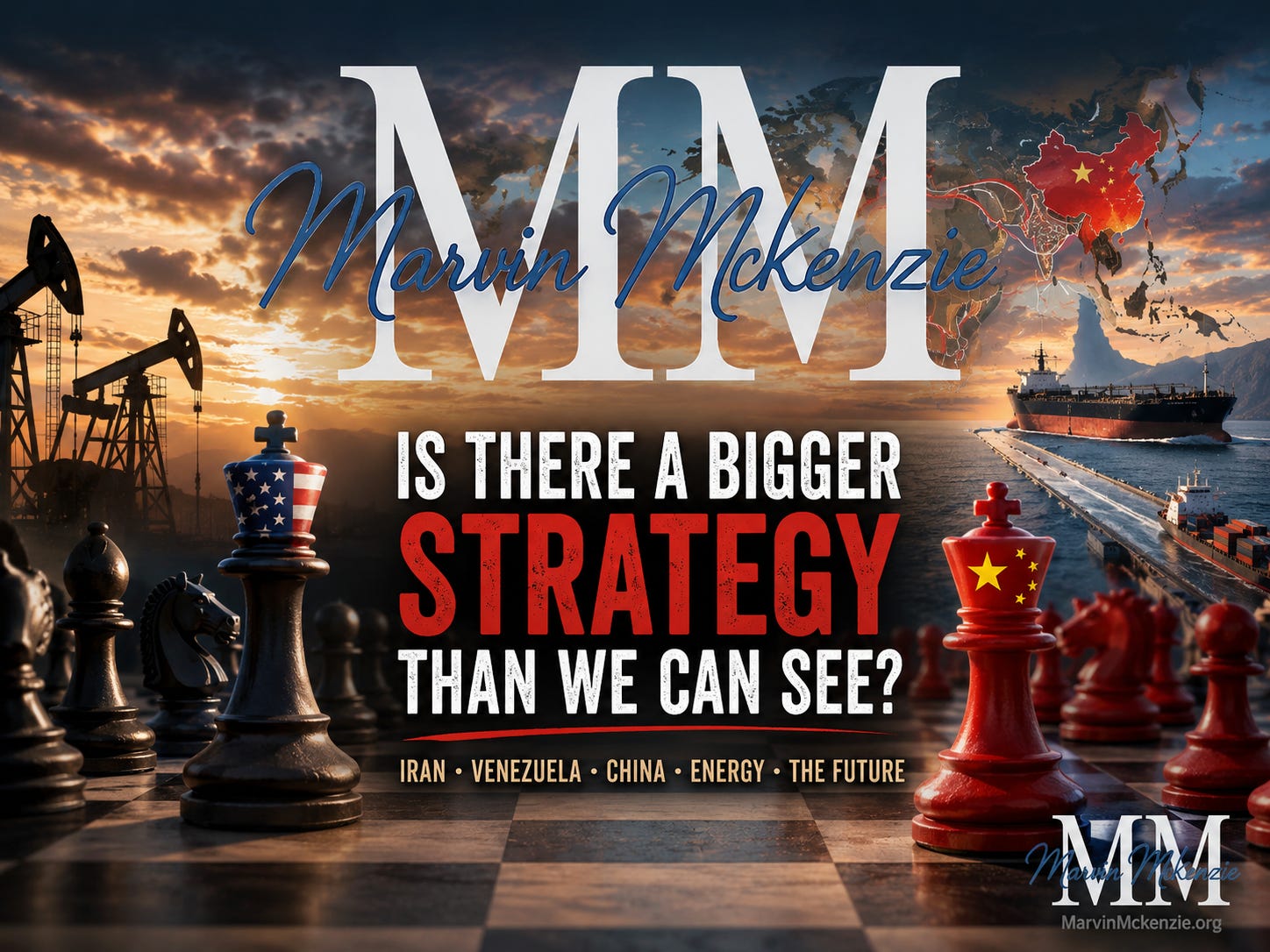
For months, critics have asked why President Donald Trump has not gone further in dealing with Iran. Others wonder why America has not taken stronger action to guarantee unrestricted shipping through the Strait of Hormuz. Still others are frustrated whenever gasoline prices rise a few cents.
Those are understandable questions.
But perhaps they are not the most important questions.
A growing number of political commentators have suggested that the real contest is not between the United States and Iran at all. Rather, they argue that Iran is only one piece of a much larger chessboard, and that the true opponent is Communist China.
Glenn Beck has been one of the strongest advocates of this view. Victor Davis Hanson has observed similar geopolitical patterns. Gordon Chang has repeatedly pointed to China’s dependence upon nations such as Iran and Venezuela. While these men differ in their conclusions, they all point in the same general direction: the struggle is larger than most people realize.
Is that actually President Trump’s strategy?
The honest answer is that we do not know.
Neither the President nor his administration has publicly confirmed such a plan. That means anyone claiming certainty has gone farther than the available evidence permits.
Yet the theory deserves thoughtful consideration.
China imports enormous amounts of oil to fuel its economy. Much of that energy comes from nations that have often found themselves at odds with the United States. Iran has become an important supplier. Venezuela has likewise developed increasingly close ties with Beijing over the years.
Suppose the United States could gradually reduce China’s access to those energy supplies.
Suppose America could strengthen its own energy position while weakening China’s.
Suppose those actions caused temporary discomfort at home but produced long-term strategic advantages.
Would that be worth it?
Many Americans instinctively answer every economic question by asking, “Will gasoline be cheaper next week?”
That is understandable. Families feel the pressure every time they fill their vehicles.
But history teaches that great nations sometimes endure short-term sacrifices to secure long-term victories.
The generation that fought World War II accepted rationing, shortages, and extraordinary sacrifice because they understood something larger was at stake.
The Cold War required decades of patience before the Soviet Union finally collapsed.
Sometimes the greatest victories cannot be measured by next month’s prices.
As Christians, we should especially understand this principle.
The Bible repeatedly shows God accomplishing His greatest works through processes that appeared confusing in the moment.
Joseph spent years in slavery and prison before anyone understood God’s purpose.
David spent years fleeing Saul before becoming king.
Esther entered the palace without realizing she had come “for such a time as this.”
Even the disciples struggled to understand why Jesus repeatedly refused opportunities to establish an earthly kingdom immediately.
God was working on a timetable they could not yet see.
Perhaps that biblical principle should also shape the way we think about current events.
No, I am not suggesting that every political leader has a brilliant hidden plan.
Neither am I suggesting that every conspiracy theory deserves our attention.
Quite the opposite.
Christians should reject sensationalism.
But Christians should also reject the arrogance that assumes everything important is visible on the evening news.
Military strategy has always depended upon secrecy.
Business negotiations require confidentiality.
Diplomacy often succeeds because certain conversations remain private until agreements are completed.
Why should we expect national security to operate differently?
The Bible even recognizes this reality.
Proverbs 25:2 says,
“It is the glory of God to conceal a thing: but the honour of kings is to search out a matter.”
Notice that Scripture does not condemn every hidden matter.
Sometimes concealment serves a righteous purpose.
Sometimes revealing every detail too soon would guarantee failure.
Could that be true today?
Perhaps.
Perhaps not.
The wise Christian leaves room for both possibilities.
There is another lesson here that may be even more important.
Our confidence should never rest upon any president.
Whether President Trump succeeds or fails, whether this theory proves correct or incorrect, whether gasoline rises or falls, our trust remains fixed upon the Lord.
Political leaders make plans.
God directs history.
Proverbs 21:1 reminds us,
“The king’s heart is in the hand of the LORD, as the rivers of water: he turneth it whithersoever he will.”
That verse ought to calm every believer.
God is not reacting to world events.
He is ruling over them.
As Baptists, we have always believed that Scripture—not cable news, social media, or political pundits—is our final authority.
Therefore, let us think carefully.
Let us distinguish between facts and theories.
Let us avoid speaking with certainty where certainty does not exist.
At the same time, let us remember that history often reveals purposes long after the events themselves have passed.
The disciples understood the cross only after the resurrection.
Joseph’s brothers understood Egypt only after the famine.
Perhaps years from now we will better understand the decisions being made in our own generation.
Until then, Christians should pray for those in authority, seek wisdom rather than speculation, and remember that the greatest strategy unfolding in the world today is not ultimately America’s.
It is God’s.
And unlike every earthly plan, His cannot fail.
No posts
Comments
Nothing yet. Say the first thing.
Sign in to join the conversation.