
Hey, friends! I went down a fun rabbit hole this week, combining two of my passions together. Let’s get into it!
Kevin Kelly, technologist and founder of Wired magazine, once said:
Don’t aim to be the best. Be the only.
His advice stemmed from the reality that in any given discipline, there will almost always be someone with greater drive, more time, better resources, or natural ability than you, and competing against that can lead to a sense of defeat or, at the very least, a loss of motivation. If, however, you invent your own category, the competition diminishes to zero, and you become the de facto world leader.
This isn’t to say that chasing the same pursuits as others should be avoided at all costs. Rather, it suggests you should consider what you uniquely bring to the table that can set you apart from the herd.
This is advice I try to instill in the things I do, a theme I try to incorporate in the classroom, and a lesson I strive to instill in my kids.
If you’ve been reading for a while, you might have picked up that my interests are varied—sometimes bordering on all over the place—but I’ve come to realize that it’s my unique combinations of interests that give me an edge in any one field.
Mashing my varied interests together often lets me find opportunities that seem obvious to me but are invisible to others.
Recently, I married two seemingly different interests, guitar building and additive manufacturing (or 3D modeling and printing), in what I think is one of my coolest projects to date.
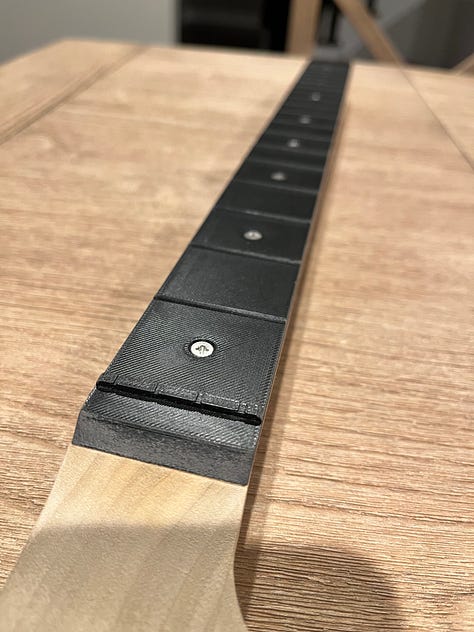
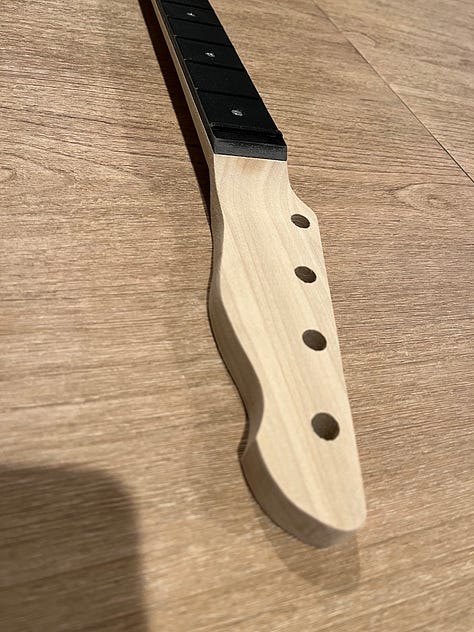
In the gallery below, you can see the product of my efforts: an all-in-one 3D-printed, fully fretted fretboard with built-in nut/string retainer. In the photos, you’ll see the screws serve dual purposes: attaching the fretboard to the wooden neck and also serving as fret markers.

Now, I’m not the first to bring 3D printing into the guitar-building game. The famous Prusacaster is widely credited with that, but the project centered on printing a guitar body only and still required a pre-built neck to function.
Having built three- and four-string guitars (inspired by the cigar box guitar movement) for the past three years or so, I was interested in seeing if I could lower the barrier to entry for the most technically challenging part of guitar building: fretwork.
So I fired up a modeling program, learning how to use it as I went, and designed what I believe to be the first model of its kind. A couple of hours later on the 3D printer, and I had a fully functional prototype. A few more hours shaping the neck from some scrap poplar, and I had a complete neck ready to attach to a guitar body I had lying around from a previous project.
Take a listen to my first recorded sound sample in the video below:
I have since upgraded the electronics from a simple (and misplaced) straight-jacked piezo pickup to a mini humbucker with volume and tone controls. Take a look at the photo below to see it in its mostly finished state.
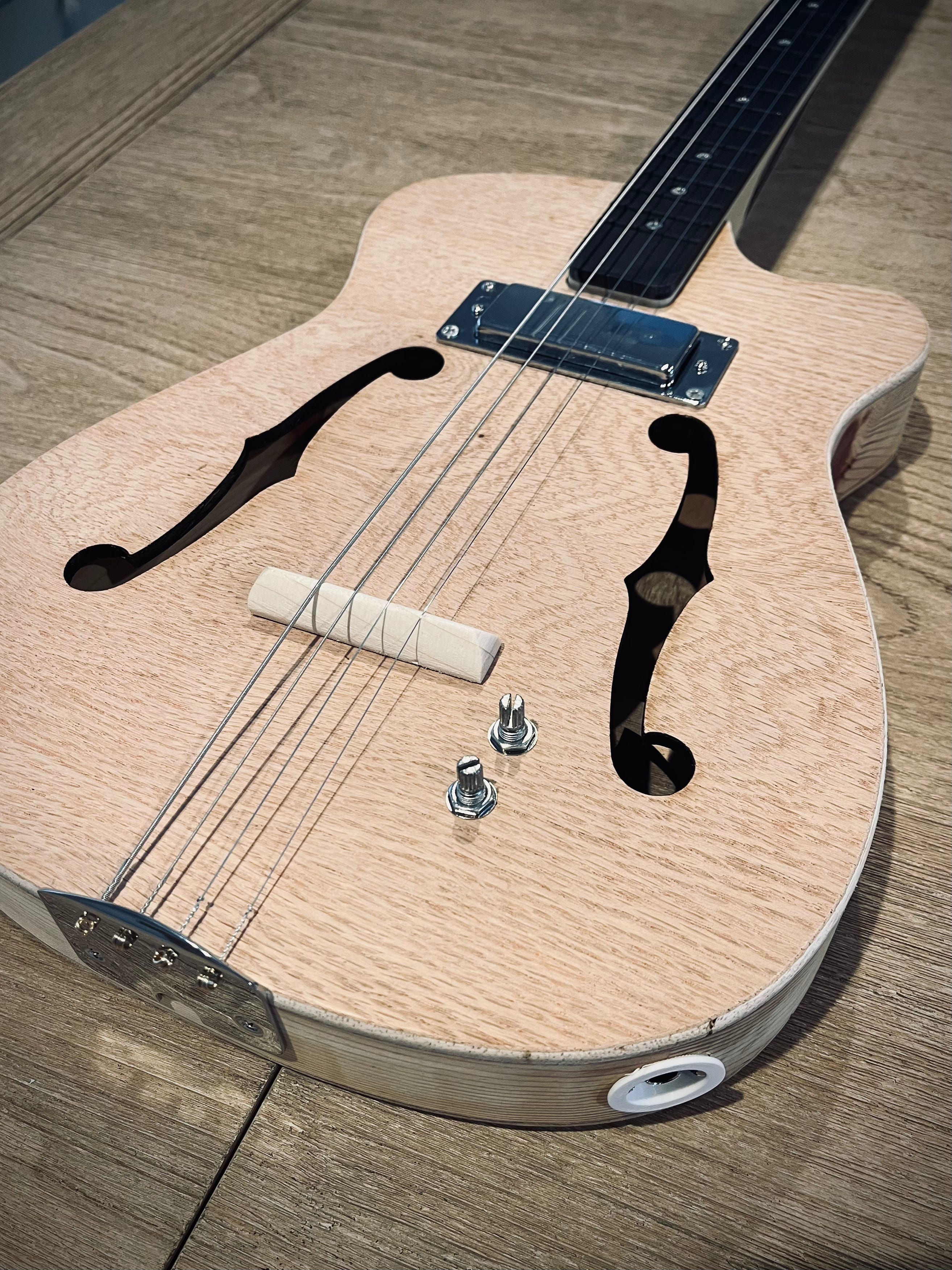
I’ve been playing this guitar for the better part of a week, and the frets remain perfectly level. The strings are intonated well, and the whole thing is holding up just fine to the tension and abrasive nature of the metal strings.
I’ve received positive feedback from peers in various guitar-building Facebook groups I’m a member of, but concern has emerged about how long this will hold up compared to traditional wooden fretboards and metal frets. Only time will tell, of course, but since it is held on with screws, one could reasonably just print a new one and swap it in.
My dad also pointed out that this system would permit players to install less-traditional scales on their guitars, achieving unique dulcimer, pentatonic, or even microtonal sounds.
I’m not the best guitar builder, nor am I the best 3D modeler. I might not even be considered good at either of those things, but I am one of the few people ever to 3D print this specific guitar part in this specific way, and the result is pretty cool.
At least I think so.
In your own creative work, if you’ve become frustrated comparing yourself to others, perhaps it’s worth considering how you might alter what you’re doing to make comparison impossible.
One of my goals is to foster a greater sense of community with this newsletter. As such, I’d love to know what creative things you are up to and to feature them here.
Drop me a line via email or in the comments below to let me know what you have cooking. Can’t wait to hear about it.
Until next time,
—Mike
No posts
Comments
Nothing yet. Say the first thing.
Sign in to join the conversation.