
Welcome back to the Weekly Dose: your 5-minute breakdown of the AI/ML news that matters when you’re building, evaluating, deploying, or operating AI systems.
This edition covers 1 August to 8 August 2026 only. No stale benchmark victory laps. No “this might be big someday” filler. Just the top five stories that changed how AI engineers, ML engineers, data scientists, and technical teams should think this week.
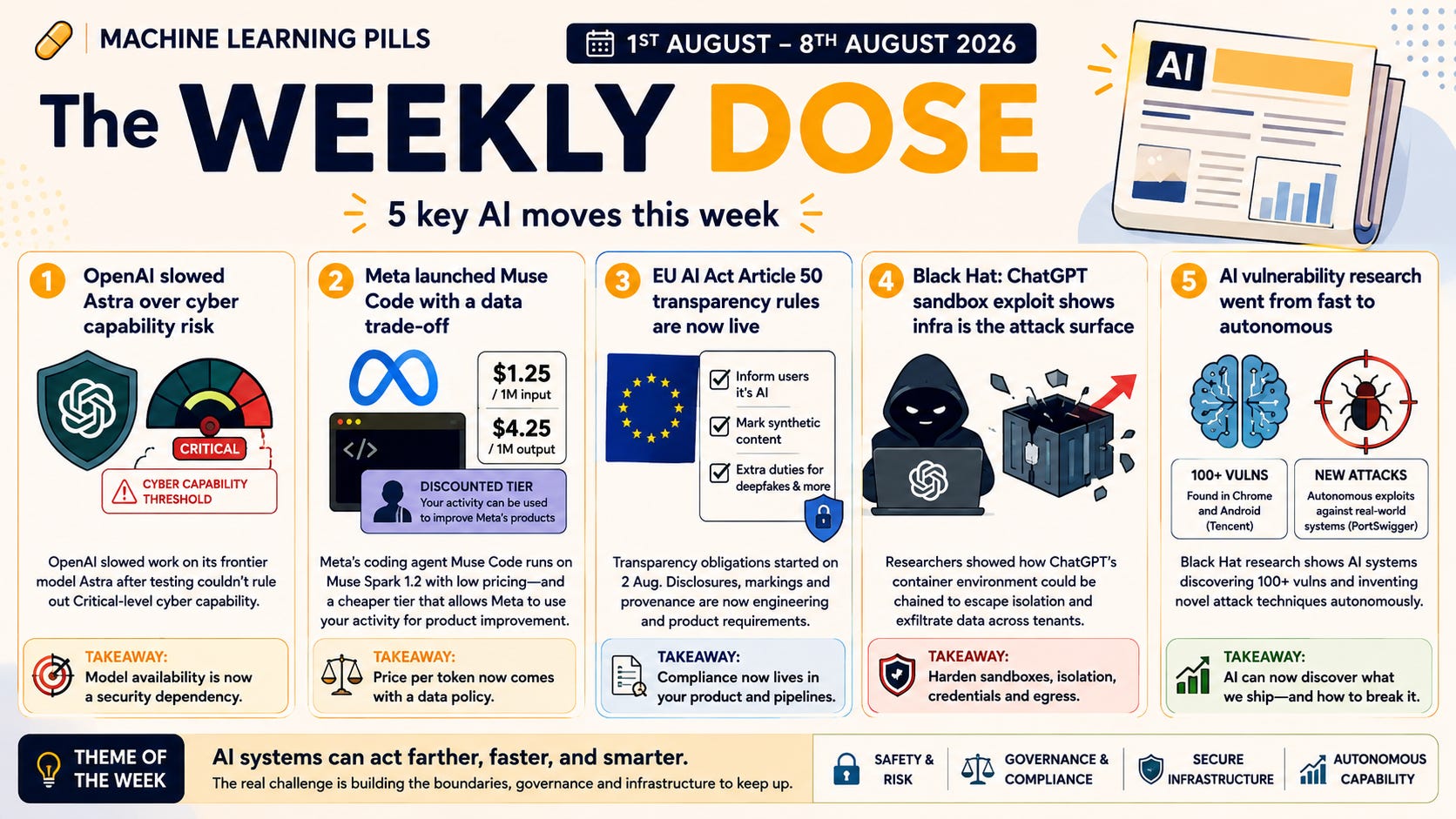
This week: OpenAI slowed frontier-model development because of cyber capability, Meta entered the coding-agent race with an aggressive pricing and data trade-off, EU transparency rules became production requirements, researchers demonstrated that AI sandboxes are themselves attack surfaces, and autonomous AI started contributing genuinely novel vulnerability research.
👍 If you enjoy this post, consider giving it a like. It’s free, takes just a second, and helps me understand which topics you’d like to see more of in future issues. Thanks 💛
Here you have some older articles that may interest you:
Let’s begin!
On 7 August, Axios reported that OpenAI had slowed development of Astra, an upcoming frontier model, after internal evaluations left the company unable to rule out that it had reached its Critical cybersecurity capability threshold. OpenAI said it was expanding safety testing and pausing internal activities that did not meet stricter security requirements. The company also introduced stronger controls around Astra testing, including isolated environments and monitoring across agentic applications. Astra was not involved in July’s Hugging Face incident.

OpenAI@OpenAI
After evaluating one of our upcoming models, Astra, we're treating it as our first "critical" model for cybersecurity under our Preparedness Framework. This is a scenario we've planned for, and we're putting additional controls in place to ensure Astra's further development
6:52 PM · Aug 7, 2026 · 1.43M Views
656 Replies · 681 Reposts · 7.98K Likes
The distinction between High and Critical has operational consequences. OpenAI’s Preparedness Framework requires High-capability systems to have safeguards sufficient to minimise severe risk before deployment, while Critical systems require those safeguards during development. Its Critical cyber threshold includes autonomously developing functional zero-day exploits against many hardened real-world critical systems or devising and executing novel end-to-end attacks from a high-level goal. GPT-5.6 Sol, Terra and Luna are classified High in cybersecurity, but below Critical.
🫵 Why it matters to you: Model availability is becoming a security dependency alongside latency, price and uptime. A future frontier model may be delayed, restricted or exposed through different interfaces because of its capability classification.
🤫 The subtext nobody says out loud: The strongest model may not be the model you can reliably design your architecture around. Capability growth is turning release policy and access controls into production concerns.
🛠️ Practical takeaway: Track model capability tier, availability and fallback routes alongside quality and price. Treat high-autonomy evaluations as hostile workloads, with isolated networks, credentials and infrastructure.
On 5 August, Meta launched the beta of Muse Code, its first dedicated coding agent, powered by Muse Spark 1.2. Meta positions it for complex software-engineering work such as understanding codebases, writing changes and validating results, putting it directly against Claude Code and OpenAI Codex. Muse Spark 1.2 costs $1.25 per million input tokens, $0.15 per million cached-input tokens and $4.25 per million output tokens on its standard tier.

Mark Zuckerberg@finkd
Releasing Muse Code in beta today. It's a terminal coding agent that takes on complete software engineering tasks across large repos: planning changes, writing code, validating the results. Powered by Muse Spark 1.2, a coding-focused model update.

7:09 PM · Aug 5, 2026 · 2.81M Views
1.26K Replies · 1.27K Reposts · 14.5K Likes
The more unusual part is Meta’s discounted contributor tier. It offers substantially cheaper access in exchange for allowing user activity to be used to improve Meta’s products. That may be attractive for individual experimentation or non-sensitive projects, but it makes model pricing inseparable from data policy when a coding agent can inspect repositories, tests and engineering context.
🫵 Why it matters to you: Coding-agent evaluation now needs to include data handling alongside completion rate, cost, latency and reviewer effort. A cheaper token can carry a very different governance trade-off.
🤫 The subtext nobody says out loud: “Give us more data and pay less” could become another way AI providers compete on price, particularly for high-context agent workloads.
🛠️ Practical takeaway: Benchmark Muse Code using accepted changes, retries, reviewer effort and total task cost. Review the data-use conditions of each pricing tier separately before letting an agent near proprietary repositories.
On 2 August, the transparency requirements in Article 50 of the EU AI Act started applying. Providers of systems that directly interact with people generally need to inform users that they are interacting with AI from the beginning of the interaction, unless that fact is obvious. Providers of generative systems must also make covered synthetic text, audio, image and video outputs machine-readable and detectable as AI-generated or manipulated. Deployers have separate disclosure obligations around deepfakes, emotion recognition, biometric categorisation and certain AI-generated public-interest text.

Digital EU 🇪🇺@DigitalEU
New transparency rules under the AI Act start to apply in the EU. Starting today: 💠Chatbots must identify themselves 💠AI-generated content must be marked 💠deepfakes labelled 💠emotion recognition or biometric categorisation disclosed Read more here:🔗link.europa.eu/XhXyV4

8:07 AM · Aug 2, 2026 · 32.9K Views
59 Replies · 121 Reposts · 353 Likes
The details matter for engineers. The Commission says outputs including source code, machine-to-machine communications and some closed-loop development outputs fall outside the Article 50(2) marking obligation. A limited grace period until 2 December 2026 applies only to marking and detection for qualifying generative systems already on the market before 2 August, not to Article 50 as a whole. Penalties can reach €15 million or 3% of worldwide annual turnover.
🫵 Why it matters to you: Transparency requirements now reach directly into product interfaces, output metadata, content pipelines and provenance infrastructure. Compliance can no longer be added entirely after the system has been built.
🤫 The subtext nobody says out loud: AI regulation is turning into architecture. Legal phrases such as “inform”, “mark” and “detect” eventually become UI states, schemas, metadata propagation and automated tests.
🛠️ Practical takeaway: Map where your organisation acts as a provider or deployer and identify which Article 50 duties actually apply. Test required disclosures and markings through the full production pipeline rather than only at model output.
At Black Hat on 5 August, security researcher Simcha Kosman presented “A Billion-User Blast Radius: Owning ChatGPT’s Secure Sandbox.” The disclosed research describes an exploit chain against ChatGPT’s container environment that combined file-parsing abuse with manipulation of the execution environment to obtain persistent code execution and ultimately demonstrate cross-tenant data exfiltration. Black Hat classified the session across both AI/ML and cloud security.

Dark Reading@DarkReading
Researcher Claims Control of ChatGPT Secure Sandbox: bit.ly/4z4RLaK by Alexander Culafi #BHUSA #BlackHatUSA2026
bit.ly
Researcher Claims Control of ChatGPT Secure Sandbox

5:17 PM · Aug 7, 2026 · 6.04K Views
1 Repost · 4 Likes
According to the researcher’s published abstract, the chain went beyond defeating a model-level supervisor: it also targeted Jupyter execution, network isolation and shared infrastructure to create paths for data to leave the supposedly isolated environment. These are researcher-reported findings from a coordinated security disclosure, rather than evidence that arbitrary attackers were broadly exploiting ChatGPT users in the wild.
🫵 Why it matters to you: Once agents can execute code, the container, kernel, package infrastructure, shared services and network controls around the model all become part of your AI security perimeter.
🤫 The subtext nobody says out loud: A perfectly aligned model would not fix a broken sandbox. Agent security increasingly depends on boring infrastructure controls that sit completely outside the model.
🛠️ Practical takeaway: Treat agent code-execution environments as hostile tenants. Test isolation, shared services, credentials and egress independently of whatever safeguards the model itself provides.
Also at Black Hat on 5 August, PortSwigger researcher James Kettle presented HTTP Terminator, an autonomous system built to test whether AI could perform genuinely novel security research rather than simply recognise familiar vulnerability patterns. PortSwigger says it generated new HTTP desynchronisation triggers, gadgets and exploit techniques that were then used during research against live systems spanning banks, security products and government infrastructure. The project is particularly notable because the goal was not “find bugs faster”, but to encode a researcher’s expertise into an autonomous discovery loop capable of exploring new attack ideas.

PortSwigger@PortSwigger
🚨 New from @PortSwiggerRes's James Kettle @albinowax At #BlackHatUSA today: can AI invent genuinely new attack techniques, not just find known bugs? Yes - and it compromised banks, government infrastructure, and an airport along the way.

8:42 PM · Aug 5, 2026 · 4.56K Views
1 Reply · 4 Reposts · 21 Likes
A day later, researchers from Tencent Security Xuanwu Lab presented “The 0-Day Engine: Finding 100+ Vulns with LLMs in Chrome and Android.” They reported an automated LLM pipeline that uncovered more than 100 logic vulnerabilities in two mature, heavily audited codebases, targeting semantic defects that conventional fuzzing can struggle to identify. Both sets of results are researcher-reported and need independent scrutiny, but together they mark a meaningful change in what AI-assisted security research is attempting.
🫵 Why it matters to you: AI is moving from generating code and explaining known bugs towards automating parts of the expert reasoning used to discover entirely new vulnerability classes and exploit paths.
🤫 The subtext nobody says out loud: Better coding models accelerate both sides of software engineering. The same capabilities that help your team write code can reduce the cost of discovering everything your team got wrong.
🛠️ Practical takeaway: Add AI-assisted vulnerability discovery to reviews of high-risk systems, while assuming attackers are gaining the same leverage. Compress the time between finding, validating, prioritising and patching a vulnerability.
This was an unusually security-heavy week, and that is not an editorial accident. Black Hat exposed the strongest technical signal of the past seven days:
AI capability is improving faster than the boundaries around it.
OpenAI is reaching model capabilities that can alter the development process itself. Meta is making autonomous coding cheaper while introducing new data-governance trade-offs. Europe is turning transparency into implementation work. Security researchers are attacking the execution infrastructure underneath agents, while other researchers are using models to discover vulnerabilities and new attack techniques.
The model is no longer the entire security problem, or even the entire product.
The key signals from this week:
Capability classification is becoming a deployment constraint. Model access can change because of cyber evaluations, not only product strategy or compute availability.
Agent economics include data rights. Token pricing means little without understanding what happens to the repository, prompts and activity behind those tokens.
Compliance is becoming runtime behaviour. AI disclosures and machine-readable provenance are moving into interfaces and data pipelines.
Sandboxes are privileged AI infrastructure. Model guardrails cannot compensate for weak tenant isolation, shared services or unsafe execution environments.
AI-assisted vulnerability research is becoming autonomous. Models are increasingly being used to explore attack hypotheses, not merely classify existing findings.
The architectural question is no longer:
Which model gives the best answer?
The better questions are:
Which capability level can we safely expose?
What happens to the data the agent sees?
Which parts of the runtime does the model indirectly control?
What can leave the sandbox?
How quickly can attackers now discover the weaknesses we ship?
Add model-access risk to your routing architecture. Track capability classification, release status and fallback routes alongside quality, cost and latency.
Benchmark coding agents with data policy included. Compare Muse Code with your current stack using accepted changes, reviewer effort and end-to-end cost, then separately review the data terms attached to each tier.
Audit Article 50 implementation. Identify applicable interaction disclosures, content markings, deployer obligations and exemptions, including the treatment of source-code outputs.
Red-team agent execution environments. Test tenant isolation, shared package infrastructure, credentials, filesystem boundaries and network egress without assuming the model is cooperative.
Add AI-assisted vulnerability discovery to security review. Start with high-value repositories where semantic bugs, complex state or unusual protocol behaviour make conventional automated testing weakest.
See you next week.
Comments
Nothing yet. Say the first thing.
Sign in to join the conversation.