
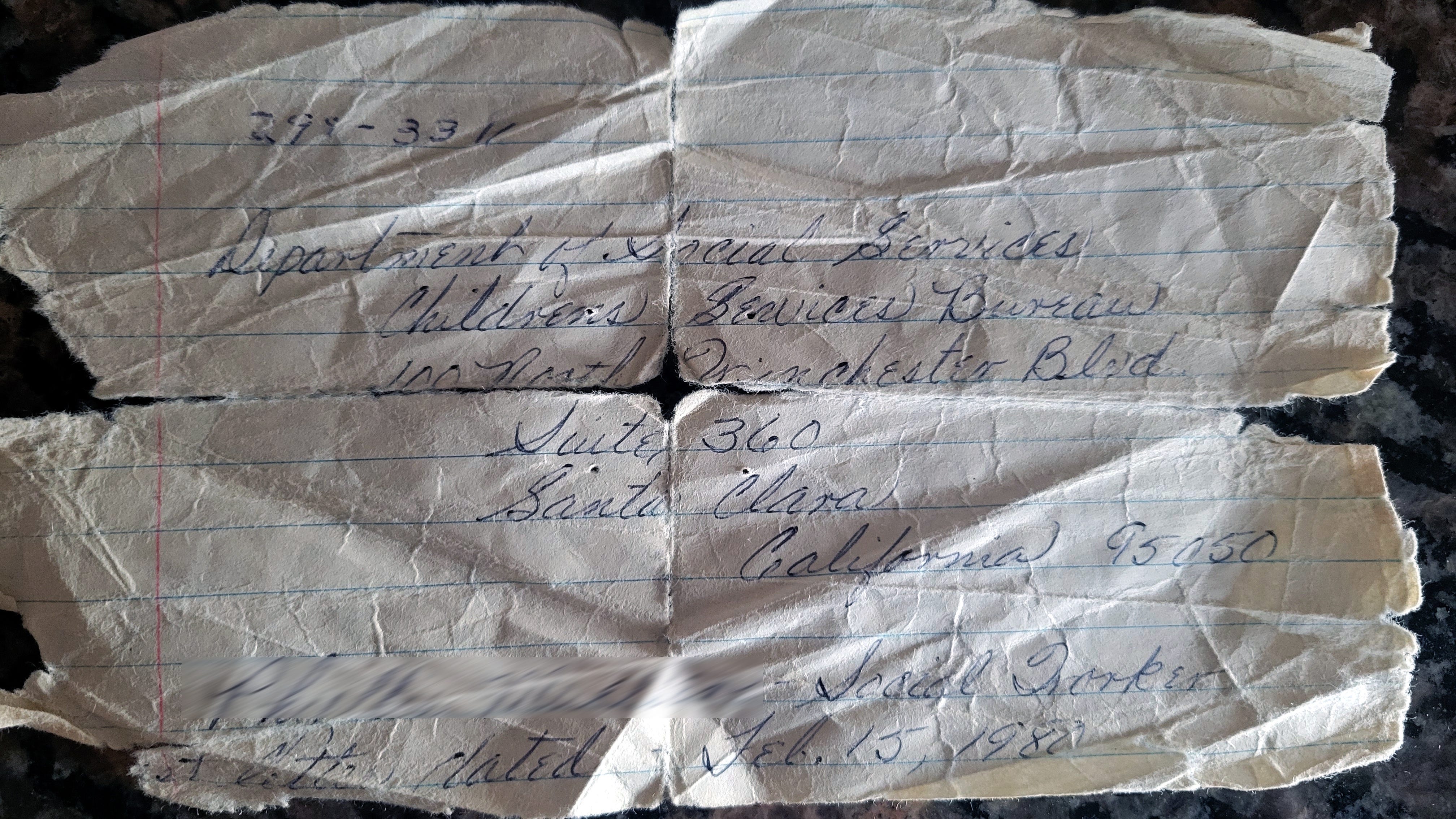
I’ve kept an old piece of paper in the zipped compartment of my wallet for years. The lined paper—creased, and tearing at its folds—holds an important piece of my family history.
I found the note as an adult after my grandmother died, tucked into a folder in her house, buried among bills and old letters. On one side are the words:
“Department of Social Services
Children’s Services Bureau
100 North Winchester Blvd
Suite 360
Santa Clara, California 95050.”
At the bottom is social worker’s name, and on the back, a single word: “Benjamin.”
When I was seven, my younger brother and I rode with our grandfather to the state mental institution. The enormous brick building looked like a castle—taller and wider than anything I had ever seen. “We’re here to visit your mother.” My grandfather turned his head to Chris and me in the back seat. “Hold hands and be quiet.”
Inside, pajama-clad people shuffled through the halls with empty faces. Trying to be brave, I gripped Chris’ hand as strangers passed, some yelling and crying, others talking to themselves. We rode an elevator and walked down a long hallway. Despite our small feet, our shoes echoed with each step we took on the marble floors. We stopped at a room, and Grandpa urged us inward as the nurse pulled back a curtain.
There she was in pretty blue pajamas, sitting on a rocking chair in front of the window with sunlight circling her head. Our Mom. An angel.
“Mama!” Chris released my hand and ran into her arms. She scooped him onto one knee.
I hesitated until she reached out for me. “Come here, Shell. I’ve missed you, sweetheart.” She lifted me onto her other knee and I exhaled, happy in her arms again. Her long hair tickled my cheek as I laid my head against her chest, and my hand landed on a surprise roundness of her belly.
“Did you eat too much, Mama?” Chris asked, poking her large belly.
“No, sweetheart,” she whispered. “You’re going to have a little brother.”
My mom gave birth to my second brother after leaving the mental institution but never went home with Benjamin, the name she’d given him at birth. Her mental illness robbed her of much—memories, relationships, stability—but nothing haunted her like the loss of her third child.
When she was healthy, she rarely spoke of him. As an adult, I asked her about him—hoping to learn more—but regretted it when her eyes dropped and shoulders stiffened. “It’s in the past, Michele. Let it go.”
But in the bi-polar manic spirals that eventually returned, she’d cry out for him in the early morning hours when she should have been sleeping. She’d scribble his name on notepads and photos before tearing them apart and tossing them on the floor.
When I found the note that held a few precious details about his existence, I made a promise to myself that I would find Benjamin. For her. For us.
It was the only clue I had, so I kept it with me. Over the years, between raising my own children, working and navigating my own cycles of life, I searched. I called social services and adoption agencies, but I kept hitting dead ends. I browsed early online adoption message boards with disappointment. Months would go by, sometimes years, and I’d get the urgency to try again only to fail.
Then, over-the-counter DNA testing emerged, and with it, new possibilities. I’d gotten mine tested and registered with Ancestry®, but had no matches that would indicate a sibling. My young adult daughter, on a whim, got hers done with 23andMe®. She called me one day with positive results. “Mom, 23andMe® shows someone that might be my uncle or cousin. Do you know him?”
It was Benjamin. I finally found Mom’s baby.
It should have felt like a win—finding this long-lost brother and taken son—and mostly it did. I needed to tell my mom, sure it would help to heal some cracks in her heart.
I visualized the call to her, “Mom. Guess what!” With my heart racing, I’d be unable to suppress the smile on my face.
“Hi, Shell.” Her warm voice always fills my heart with love.
“I found him, Mom. I found Benjamin!”
“Oh, Michele.” Her voice would crack—she’d be breathless and speechless. And happy.
But Benjamin never got to meet her. My brother would never look his mama in the eye, and she’d never know he was okay. She was only fifty-nine when years of smoking and advanced cardio-pulmonary disease took her life—a decade before I found her lost baby.
I’ve learned his story, and shared ours. I love being able to give him details about her. I’ve sent him a photo album of decades of memories that show her brilliant smile, large soul-filled eyes, and a laugh that could fill a room with joy. No matter the trauma she’d endured, or the years of cycling in and out of psychiatric hospitals, she remains the kindest person I’ve ever known.
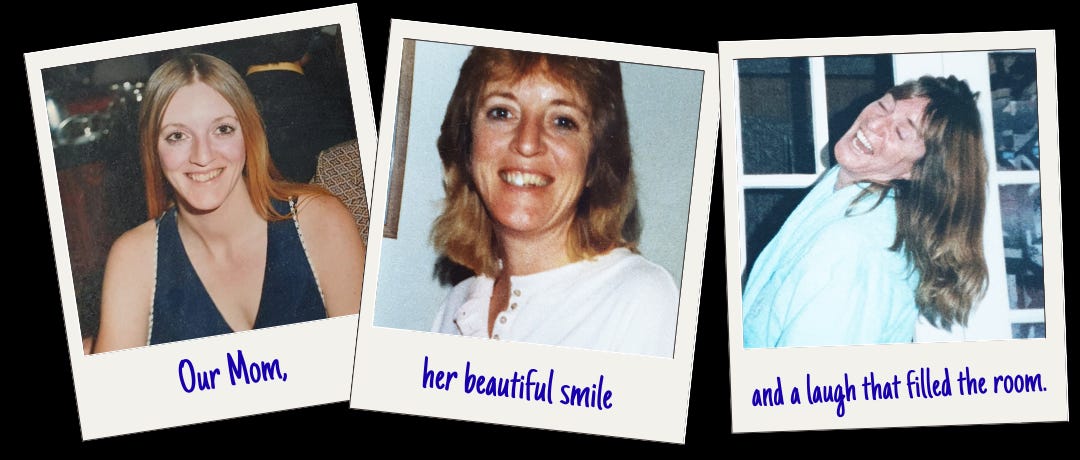
I’ve got hours and decades of VHS tapes I want to review and digitize so I can share more of her with him. He has never heard her voice outside of the womb. Can you imagine what a gift it would be to provide even a mere ten-second clip of her amazing laughter?
I still carry the note. Creased and faded, it’s tucked away in my wallet even though my searching for him is over. I can’t let it go. It’s an important reminder of the love I’ve lost—and the love I’ve found.
Do my words resonate with you? Talk to me. When we share our stories—honestly and without fear—we strip shame of its power. We start to feel less alone. Our truths, even the messy ones, create connection. They remind us we’re human, and that we belong. Right now, more than ever, we need that. We need each other. So if something in you stirs, don’t stay silent. Let’s remind each other we’re not alone.
Comments
Nothing yet. Say the first thing.
Sign in to join the conversation.