
HOT TAKE
Most agent-built internal tools should be disposable by default.
Maintain or Regenerate?
LAST WEEK’S TAKE
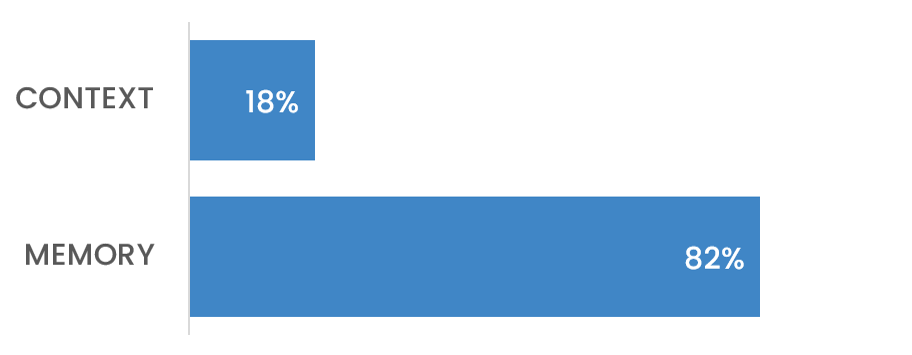
We’ll remember not to ask twice when it’s this clear you’re choosing memory over long context for agents.
HIDDEN GEMS
Persistent Memory for Coding Agents
Local memory for AI coding agents, with MCP, REST, hooks, search, and project context that can persist across sessions and tools.
Codebase Graph Memory for Agents
Persistent codebase knowledge graphs, served through MCP, give coding agents structural search across functions, classes, call chains, routes, and cross-service links without repeated file-by-file exploration.
Distributed AI Inference Deployment Guide
Six traffic-shape blueprints pair vLLM and llm-d topologies with TTFT/TPOT diagnostics, mapping how teams can move from single-instance serving to distributed inference.
1,000-Token Agent Inference Engine
Running Kimi K2.7 Code at model-native precision on a single 8×B200 node, Lithos reports inference above 1,000 tokens per second for faster coding-agent workflows.
Agentic AI Momentum Report
The open-source agent stack is attracting contributors and adoption quickly, but popularity does not show whether a project is secure, responsive, or structurally resilient. AAIF’s new Momentum Report compares 116 projects across five layers using adoption, development health, maintainer activity, vulnerabilities, governance, and contributor concentration.
Frameworks and infrastructure lead adoption with 1.5 million GitHub stars and 226,000 forks. Agent applications tell a different story: they attract the most active contributors and resolve issues in roughly two weeks, with pull requests merged in about two days.
Security presents a less encouraging picture. Unpatched CVEs across the projects rose 2.6x between December 2025 and June 2026, reaching around 9,200. Framework and infrastructure projects account for nearly half of them.
The governance data also separates formal processes from genuine contributor diversity. Some projects meet OpenSSF governance checks but remain controlled by one organization, while others have broader participation but weaker documentation.
Read the report and compare individual projects.
JOB OF THE WEEK
Member of Technical Staff - Platform // Runlayer // Hybrid NYC / Remote (US Timezones)
Runlayer is hiring a platform engineer to build the systems behind enterprise MCP, agent, and workflow deployments. The role covers scalable platform architecture, integrations, data transformation, customer requirements, and rapid feature iteration in production AI environments.
Responsibilities:
Architect scalable systems for customer MCP, agent, and workflow deployments.
Build APIs, integrations, and data transformation workflows for enterprise systems.
Translate customer requirements into platform features and technical delivery plans.
Prototype, validate, and ship features based on real usage feedback.
Requirements:
7+ years building and operating production software systems.
Experience designing APIs, databases, integrations, and enterprise platform services.
Background working with AI/ML systems or related infrastructure.
Strong communication across engineering, product, and customer-facing technical teams.
MLOPS COMMUNITY
Models can now run 80 to 100 tool-call loops, while one compact tool can expose a huge capability surface without flooding the context window.
RL has improved how agents chain actions, navigate environments, and use minimal tool interfaces.
Small MCP surfaces can generate code, query large hubs, and return results without replaying everything through the model.
MCP apps can place rich results directly in the UI, reducing token waste.
The design question is shifting from tool count to how efficiently each tool expands what an agent can do.
An MCP server can take seven lines of Python, but each exposed tool consumes context and creates another surface to secure.
MCP does not make an API intelligent. It gives an LLM a structured way to select and call functions.
Strong designs expose a small set of common actions, with clear annotations, validation, authorization, and limits on costly requests.
The practical lesson is to treat MCP as a controlled interface for model-driven API use, not a layer of magic.
A Flask container can become an expensive bottleneck once inference traffic rises and latency starts to matter. This guide compares four production serving options.
TensorFlow Serving and TorchServe suit teams committed to one framework.
BentoML favors Python flexibility, broader compatibility, and simpler implementation.
Triton offers stronger GPU utilization and optimization, with considerably more operational complexity.
The right choice depends on whether your priority is development speed, framework support, or squeezing more predictions from each machine.
IN-PERSON EVENTS
Munich - July 23
San Francisco, Voice Agents Forum - September 16
VIRTUAL EVENTS
Coding Agents Lunch & Learn Session - July 17
A Discussion on Loop Engineering - July 21
MEME OF THE WEEK

ML CONFESSIONS
We were testing a voice agent for booking appointments, and it kept interrupting people before they’d finished giving their ZIP code. I adjusted the endpointing settings until it stopped happening and the test calls looked much better.
A few weeks later, support started getting complaints that the agent was taking ages to respond. Someone on the team said, “It’s going full mute for five seconds after every sentence.” It turned out I’d mostly tested it myself, and I speak quickly with short pauses. The new setting worked fine for me, but for anyone who paused naturally between parts of an answer, the agent sat there waiting to see if they’d carry on.
We went through recordings and tuned it against a much wider mix of speakers.
Share your confession here.
No posts
Comments
Nothing yet. Say the first thing.
Sign in to join the conversation.