
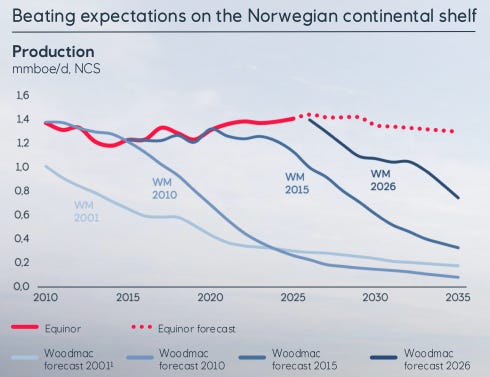
My guest on this week’s episode of Cleaning Up was Anders Opedal, CEO of Norwegian Oil and Gas giant Equinor. It’s a great episode, not just because any conversation with the CEO of one of the world’s leading energy companies is always fascinating, but also also because of the relevance to the discussion currently raging in the UK - about whether or not to open the North Sea to new oil and gas exploration and drilling.
Before we start, for disclosure, between 2019 and 2023 I was a member of Equinor’s Global Advisory Board, advising on their very substantial push into clean energy.
Also relevant: regular readers will be familiar with my Pragmatic Climate Reset, which holds that the world will make rapid, profound and affordable progress on decarbonization by focusing on immediate gains and accepting that a fossil fuels will provide a diminishing proportion of our energy as backup for many more decades.
Finally, before you think the whole episode is just a love letter to the oil and gas industry, please note that I start my conversation with Anders by pointing out the heat wave during which we recorded was caused by his products, and I finish by giving giving him a hard time about the industry’s attempts to “stop the clock” on methane regulations.
For those who have not been paying attention to the UK North Sea Soap Opera (and I can’t blame you), the Conservative government in power until 2024 maintained the “cakeist” approach to oil and gas extraction put in place by Boris Johnson when he was Prime Minister: enthusiastic support for climate action, alongside enthusiastic support for drilling - though by the end of Rishi Sunak’s time in office drilling was taking centre stage and climate was undergoing a “reset”.
With Keir Starmer’s Labour landslide in 2024, the new government promised to stop drilling in the North Sea - and under Energy Secretary Ed Miliband it has stuck to that pledge despite its becoming increasingly unpopular. Reform, the nativist party leading the polls, immediately made it a flagship policy to repeal the 2008 Climate Change Act and remove all restrictions on fossil fuel extraction; the Conservative Party, abandoning the bipartisan consensus on climate in place since the days of David Cameron, has followed.
Now, rumours abound that the incoming administration under Andy Burnham is about to scrap the ban on new exploration and drilling. The reality is probably much murkier. While Burnham has said he “has something of an open mind” on the issue, and Labour’s deputy leader has said there will be a change of emphasis, claims of a radical re-opening of the North Sea can so far all be traced back to various industry spinners and activist pearl-clutchers.
The discussion boils down to four key questions:
How much oil and gas can be extracted?
How would increased output affect energy prices and resilience?
Would increasing North Sea output have any impact on the climate?
How much tax would it generate?
Let’s take each of these in turn.
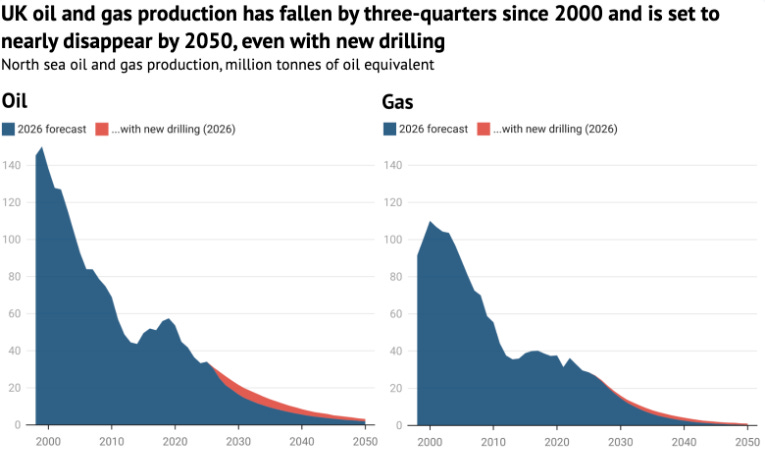
The simple to how much oil and gas can be extracted is YMMV. According to the UK’s North Sea Transition Authority, the decline is dramatic and inevitable even if new licenses are issued, as summarised in a recent piece by Carbon Brief:
The oil and gas industry’ however, begs to differ (as discussed in a superb segment by Cleaning Up alumnus Ed Conway recently on Sky News).
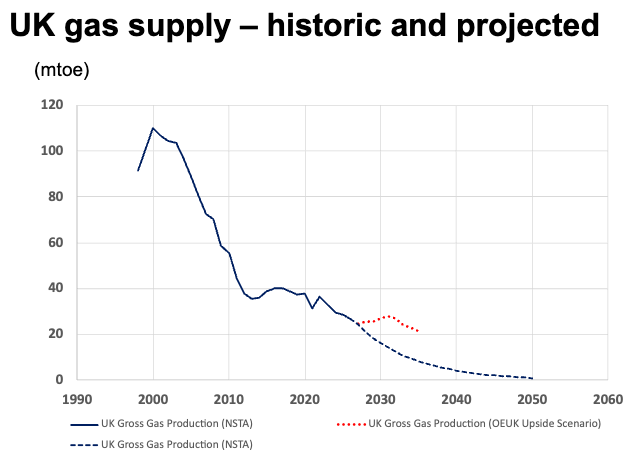
What is so interesting about the Wood Mackenzie data highlighted in the Equinor Capital Markets Day presentation is that it would rather suggest that the industry is right - it could maintain output at a much higher level were it allowed to do so, a point echoed vigorously by Offshore Energies UK:
The quick answer on prices is no, increasing UK gas production from the North Sea will do almost nothing to push down gas prices in the UK (oil even less so).
The UK is deeply integrated into the European gas market, so pushing down prices in the UK requires pushing them down across Europe. Even if we did not have multiple pipelines to continental Europe, our links to Norway act as a highly efficient price transmission mechanism across the continent.
The difference between the forecasts by industry and the North Sea Transition Authority amounts to only 10 mtoe per annum by 2035. Annual gas demand across EU and non-EU Europe is around 50 times that. Any claim that extracting a bit more gas from the declining resource that is the UK continental shelf will meaningfully push down UK gas prices is not serious.
While I’m at it, let me say that the idea fracking in the UK can meaningfully push down UK gas prices is equally unserious. The best estimate of how much fracked gas could be produced in the UK is another 10 mtoe per year over 30 years - again too little to change prices in any meaningful way.
When it comes to resilience, the argument in favour of increased domestic production is a little stronger. With more supply delivered by pipeline, more of it would be under long-term contract and hence insulated from price spikes in global LNG markets. In the case of an international crisis so extreme that delivery contracts are being breached (think vaccine nationalism during Covid), there is always the option for the government to requisition and manage domestic gas supplies. There is no scenario where the UK can insulate itself entirely from global markets.
The short answer is that opening up the North Sea for oil and gas drilling would probably reduce emissions, not increase them, in the short to medium term.
The UK imports just under half of its gas today, a number that is set to increase to 80% by 2035 according to the North Sea Transition Authority, but which Offshore Energies UK believes can be reduced to 40%.
Offshore Energies UK is also at pains to point out that “liquefied natural gas imported from countries such as the United States and Qatar generates four times the carbon emissions of UK-produced North Sea gas”
This is, of course, entirely misleading, as it ignores the embodied CO2 released when the gas is burned. It gives the impression that importing US gas is 3x worse than using UK North Sea gas, when the reality is that it is only 14% worse:
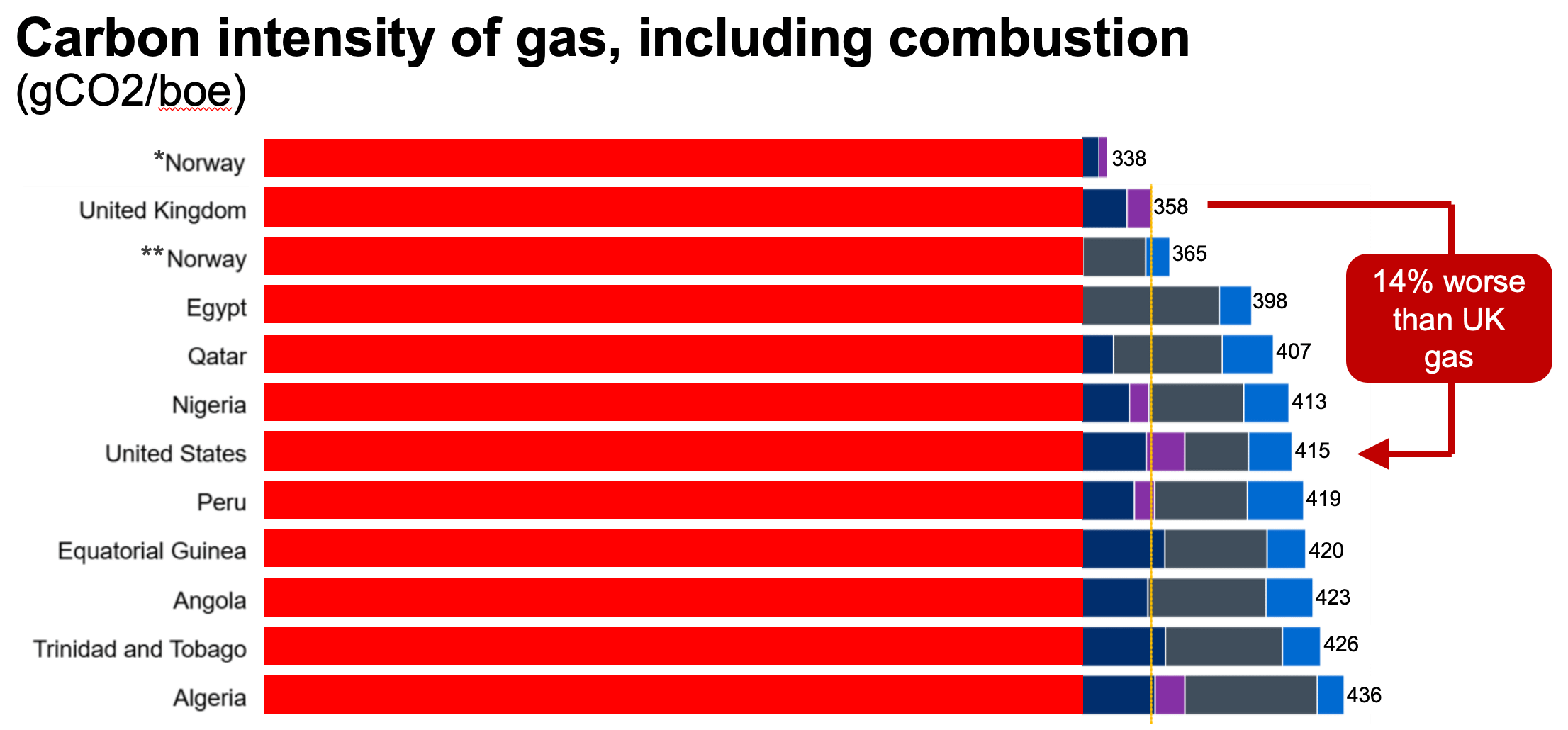
Using gas from our own continental shelf would be up to 18% lower emissions (in the case of Algeria) than importing it - a reduction, for sure, but not by a factor of three for US LNG and up to four from other sources.
Opponents of drilling in the North Sea point to the signal sent to other nations if the UK opens up the North Sea to drilling. It’s a valid argument: the UK has been one of the most steadfast climate leaders internationally, and has walked the walk, reducing emissions very substantially even on an import-adjusted basis.
The idea that the UK does not need to act on climate change because it is responsible for less than 1% of total global emissions has always been absurd. By that logic no country can solve climate change by itself, so none should do nothing. Or, to use an analogy, Australia contributed less than 1% of Allied troops in WW2. Should it have sat out the fight against Nazi Germany? We are enormously grateful that it didn’t.
The question that opponents of drilling have to anwer is why they think unilateral initiatives by the UK translate into global action. If they claim that local action is needed to reduces climate risk, it is incumbent on them to demonstrate that others will follow. Otherwise they are proposing that the UK public takes the pain, but with no clear pathway to reduced risk.
This is where things get really interesting.
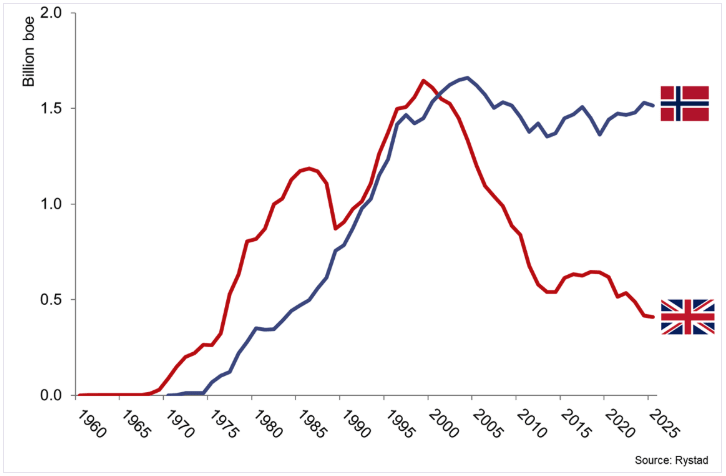
The UK has only had one period in the last 25 years in which oil and gas output did not decline, between around 2015 and 2021. In 2015 the Conservatives won a surprise election victory that allowed them to ditch their previous coalition partner, the Liberal Democrats, and govern alone. They slashed taxes on the oil and gas sector, and output stabilised.
Here’s the kicker, though: it turns out when you slash taxes you get little or no tax receipts. Who would have thought?
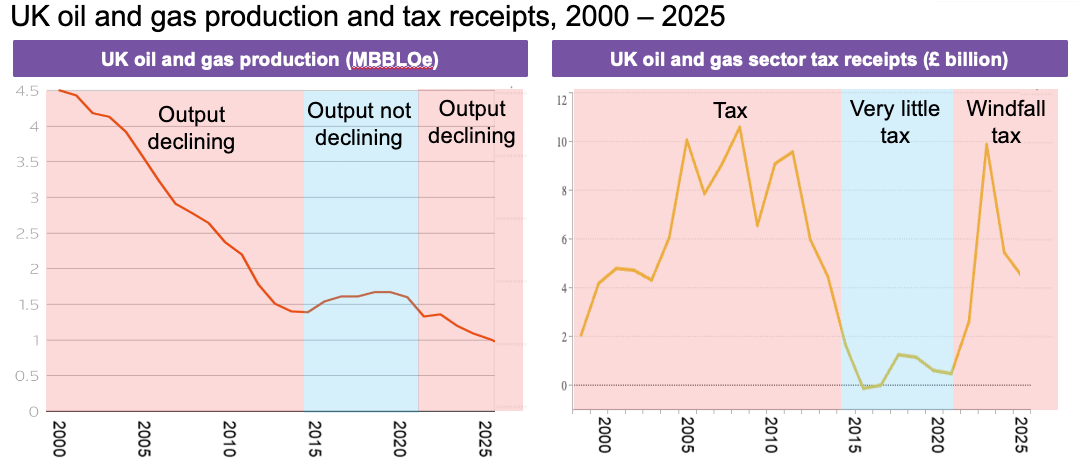
What happened next, though, was that Russia invaded Ukraine, oil and gas prices soared and the government imposed a windfall tax. No oil and gas production, no windfall tax - so maybe one should average the tax take over the entire last decade. In that case you get to about £2.5 billion per year of tax receipts.
Before the 2024 election, Conservative Energy Secretary Claire Coutinho said on BBC Breakfast that opening up the North Sea would deliver £50 billion of additional tax revenue over five years that could be spent on “public services, welfare and support for people when they are struggling” as well as used to fund a “transition into different forms of energy, for example things like offshore wind and solar energy.” In her defence, she did say this sum would be from “a thriving oil and gas sector and all the supply chain underneath it”, not just oil and gas itself - nevertheless, £10 billion per year seems farfetched.
More recently she has talked about “£25 billion in tax over the next ten years if you use the North Sea”. That’s a more plausible £2.5 billion per year - but more modest too: enough to cover less than 0.2% of annual UK government expenditure.
So the benefits of opening up the UK North Sea seem very modest. But hold your horses: Norway imposes a tax rate of 78% on Equinor’s profits from the Norwegian Continental Shelf; it also owns 67% of the company and so receives 67% of its dividends. And the country is expecting to receive a whopping $78 billion (£59 billion) this year from its oil and gas sector, in the form of tax and dividends.
In our conversation, I asked Anders how on earth Equinor can keep investing in the Norwegian continental shelf despite a 78% effective tax rate. This is what he said:
“What’s important for us is the predictability. Yes it’s 78% tax in Norway, but it’s been predictable for decades.
“I normally say it takes one election cycle for us to do the preparation for a project. When you then start to execute, take the final investment decision, it’s another four or five years, another election cycle. And then you need to make your money in three to five election cycles.
“And if policies and taxes and framework conditions change during that period, your investment decision basis is no longer true. So what do you do next time you’re looking for investment?”
I also asked Anders if Norway’s experience could be translated to the UK.
“So you asked, can this also happen in the UK? Definitely yes.
It’s the same geology. It’s the same big discoveries. It’s the same kind of potential around the existing fields. So we think it’s up to the UK government at the time to say if you want to explore it or not.”
“Definitely in Norway, this has been the very, very decisive politics and long term politics for decades with quite a lot of bipartisan agreement to do so. Stable frame condition, stable tax conditions, constantly giving out new acreage and that we are investing the same amount every year.
“We create this kind of explore, drill, develop, take Final Investment Decision, on these new projects constantly. That is what’s kept the production up.”
So there you have it: it’s not the tax rate that drives investment, its the consistency across multiple election cycles.
The UK has, of course, utterly failed in providing such consistency. Taxes on oil and gas have oscillated between tax breaks and windfall taxes for decades. We have utterly failed to provided the long-term certainty that has been key to the success story of Norwegian gas. Even worse, our polarised political and media ecosystem has turned the North Sea into one of the biggest wedge issues of our time between political parties.
Why is that? By far the biggest beneficiary of Equinor’s success has been and remains the Norwegian people. In the UK, by contrast, the largest beneficiaries have been the shareholders of Shell, BP and other international oil and gas companies, including a lot of UK pensioners but also a lot of global investors.
Or maybe it’s just our political system. In the time that I’ve been an energy analyst, we’ve had 16 energy ministers, of which seven studied Politics, Philosophy and/or Economics; four studied literature, classics and history; and two were lawyers.
In any case, perhaps the lesson is that if you treat energy like politics, don’t be surprised if it becomes a political football*.
* Did you see what I did there? I managed to get football into a piece about Norway. Revenge for “Maggie Thatcher, your boys took a hell of a beating”.
Comments
Nothing yet. Say the first thing.
Sign in to join the conversation.