
Jensen Huang says NVIDIA’s engineers would rather build AI agents than write Python. Welcome to the future of work, where everyone becomes a manager and most of your employees technically do not exist.
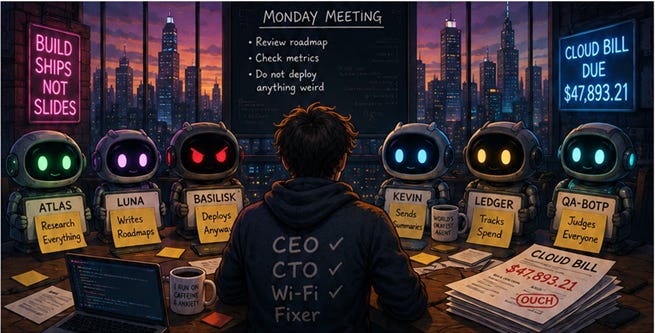
Your 2030 startup stand-up: one human manager, six digital workers and a bill with board-level ambitions.
YOUR 2030 MONDAY-MORNING MEETING IS ABOUT TO BEGIN.
• You, the founder, CEO and only person who knows the Wi-Fi password
• One human software engineer
• Six AI agents with unnecessarily dramatic names
• A cloud-computing invoice large enough to demand board representation
Agent Atlas has already researched your competitors.
Agent Luna has written three versions of the product roadmap.
Agent Basilisk has deployed something to production without permission.
Agent Kevin has produced no useful work but has sent everyone a detailed summary of his useful work.
The future is here. It needs supervision.
🔍 Are AI agents the future for Startups?
📼 Weekly Videos
🚗 July Events
🚀 AI Bits for Techies
🔮 Behind the Buzz
🦘 Memes of the Week
Written by: Jun Kai Chang (Luc), Julia Ponder, Saumya Jain (Sam), Yinghan Ma, Dr Sam Donegan, Dr Anurag Ganugapati
We’re building something we believe has the potential to change how leadership is measured.
Genesis is a leadership decision intelligence platform powered by human-led AI, designed to help leaders understand the gap between who they intend to be and who they become under pressure. Rather than another personality test or leadership programme, Genesis provides a new way to reflect, learn and make better decisions.
To celebrate the launch of our Minimum Viable Product, we’re hosting two exclusive showcase events in Melbourne during July and August. Whether you’re curious about the technology, interested in leadership innovation, or want to meet the team behind Genesis, we’d love to have you there.
Register your interest and reserve your place today.
MVP Showcase Family & Friends - https://events.humanitix.com/genesis-family-friends
MVP Showcase: Investors - https://events.humanitix.com/genesis-mvp-showcase-angel-investors
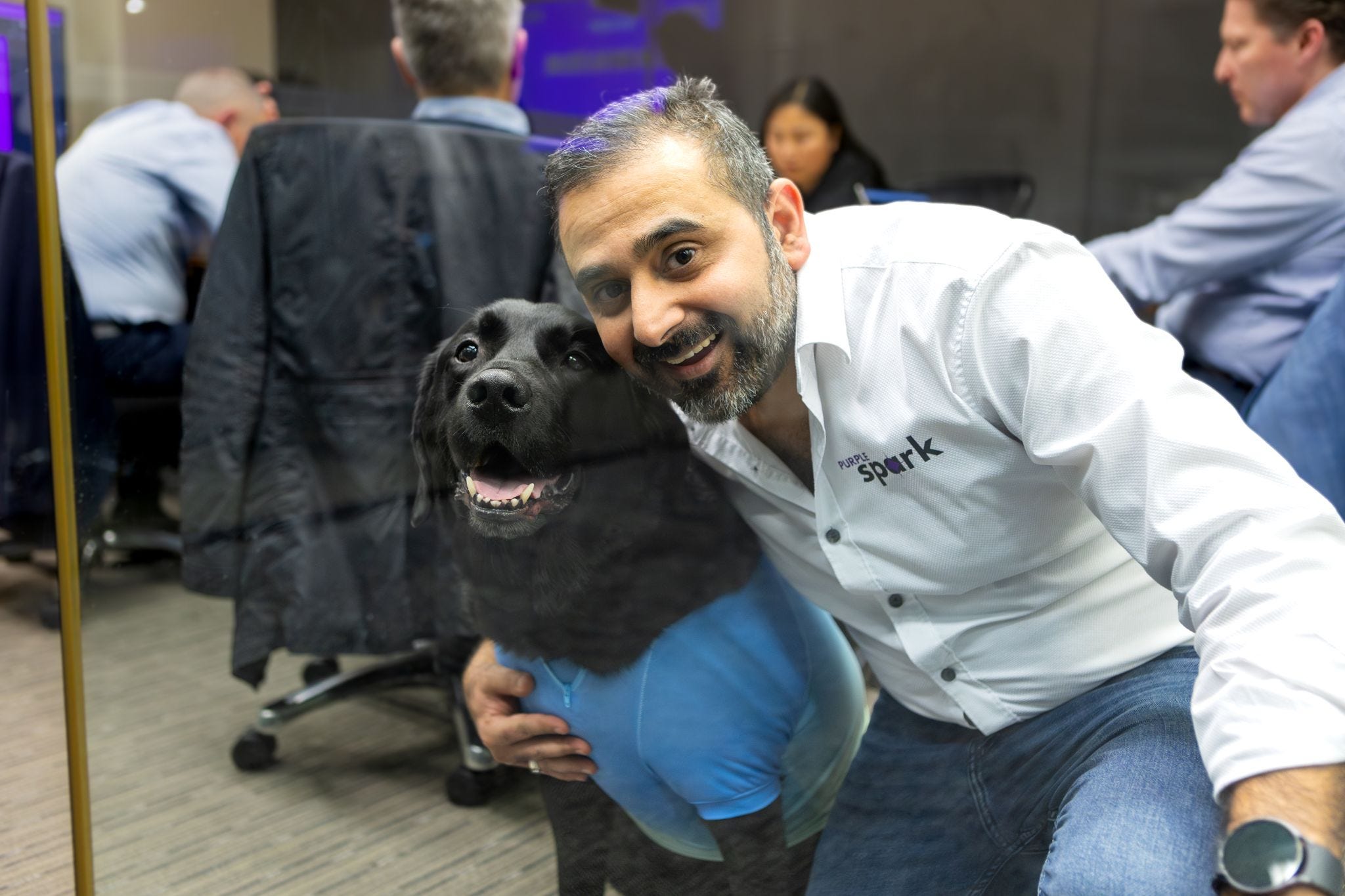
In the photo: Our Founder & CEO Dave and our Chief Vibes Officer Seve

In a recent interview, NVIDIA CEO Jensen Huang said the company’s software engineers increasingly prefer building AI agents to manually writing Python code. the company’s software engineers increasingly prefer building AI agents to manually writing Python code.
According to Huang, engineers are doing less conventional coding - which he compared to typing - and spending more time creating agents, benchmarks and guardrails.
The repetitive work gets handed to the machine. The humans move upwards into work involving imagination, system design and judgment.
Huang also rejected the simple storyline in which AI arrives, everyone gets fired and the robots inherit the ergonomic office chairs. He argued that bringing AI into the world is creating new work and new forms of engineering.
It is an appealing vision.
It is also being delivered by the CEO of the company selling much of the infrastructure underneath that vision.
This does not automatically make Jensen wrong. It does mean we should inspect the prophecy before engraving it on a leather jacket.
Think of ordinary chatbot use as a very clever person sitting across from you.
You ask a question. It answers. Then it waits patiently while you disappear for three days and return with:
“Okay, but make it punchier.”
An agent is closer to giving that person a laptop, access to certain tools and an actual assignment.
Instead of asking:
“How should I research my competitors?”
You might say:
“Research my five closest competitors, compare their prices, identify common customer complaints and prepare a short report.”
The agent can then break the goal into steps, collect information, use relevant tools and continue working through the task.
The useful distinction is not one particular chatbot versus an agent. According to NVIDIA’s own agent explainer, agents are systems that can pursue goals and complete tasks on a user’s behalf.
Chatbot: “Here is how you could complete the task.”Agent: “I completed the task. Please do not ask why your calendar now contains an Emergency Synergy Alignment Circle.”
Jensen’s version of the future transforms engineers from people who personally write every line of code into people who:
· decide what needs to be built;
· give agents the right context;
· design tests and benchmarks;
· create safety boundaries;
· and determine whether the agent’s output is actually useful.
That sounds less like the disappearance of engineering and more like engineers being promoted into management roles for extremely fast, extremely confident robot interns.
And anyone who has managed an intern knows that the important question is not:
“Did they complete the task?”
It is:
“What exactly did they do while I was not looking?”
Coding agents can already prepare documentation, fix bugs, build features and submit proposed changes to real software projects. But they are not equally good at everything.
A 7,156-pull-request study on arXiv found that the type of task made a major difference. Documentation changes were accepted more often than new feature work, and no single agent performed best across every category.
Translation: Your digital employee may be fantastic at updating the instruction manual. This does not mean it should redesign the aeroplane.
Scientific answer: YES.Also: NO.Wonderful. Very helpful. Pack up the newsletter.
One Google’s 96-engineer randomised trial on arXiv estimated that AI assistance reduced the time required for a complex programming task by roughly 21%.
The researchers were careful, however, not to claim that the same result would automatically appear in every company, project or workflow.
Then another METR’s field study of experienced open-source developers produced a wonderfully awkward result.
Before starting, the developers predicted that AI would make them 24% faster. After completing the work, they still believed AI had made them around 20% faster.
The stopwatch had other ideas.
They were actually 19% slower when permitted to use the AI tools. Time disappeared into prompting, waiting, reviewing and correcting the generated work.
“AI saved me loads of time.”“You took longer.”“No, but spiritually I was extremely efficient.”
The lesson is not that one study is correct and the other is nonsense. They examined different developers, tools and working environments.
The Google engineers were completing a defined enterprise task. The open-source developers were experienced contributors working inside large projects they had already known for years.
AI productivity depends on the task, the person, the workflow and the amount of cleaning required afterwards.
AI is not magic productivity powder that companies sprinkle around while whispering “transformation”.
Sometimes it accelerates the work. Sometimes it accelerates the creation of more work.
Choose the answer closest to your natural reaction.
1. Your agent says, “Great news! I completed the task.”
A. Ship it immediately. The machine believes in itself.
B. Ask to see its tests, sources and results.
C. Ask another agent whether the first agent is lying.
D. Close the laptop and move to a farm.
2. The agent requests access to your production database.
A. Absolutely. What could go wrong?
B. Give it limited, temporary and monitored access.
C. Ask it to explain exactly why access is necessary.
D. Throw holy water at the server.
3. The agent completes eight hours of work in twelve minutes.
A. Lines of code generated. Big number means innovation.
B. Whether the output works and solves the actual problem.
C. Total cost, including reviewing and correcting it.
D. Whether the agent has become self-aware and requested equity.
Mostly A: The Agent Maximalist
Your company will either become a unicorn or accidentally email its customer database to Uruguay. No middle ground.
Mostly B: The Responsible Delegator
You understand that autonomy without accountability is just chaos with an API key. Annoyingly sensible.
Mostly C: The Suspicious Auditor
Your agents fear you. This is probably healthy.
Mostly D: The Digital Homesteader
The robots cannot take your job if you are growing potatoes somewhere without broadband. Checkmate, Jensen.
Let us begin gently.
Draft a routine email?
Probably.
Summarise customer feedback?
Yes - but read the original comments before changing your entire product because the agent detected “overwhelming market demand” from two Reddit posts and your mother.
Write a first draft of a feature article?
Potentially excellent.
Change the pricing page?
Human approval first.
Screen job applicants?
Proceed extremely carefully. Bias does not become objective merely because it arrives inside a sleek dashboard.
Access confidential customer information?
Only through approved systems with clearly defined limits.
Deploy code directly into production?
Perhaps do not give the bodiless intern the nuclear codes.
Fire someone?
No.
Decide whether the founder is making rational decisions after three hours of sleep?
Honestly, the agent might have a point.
This is why Jensen’s references to benchmarks and guardrails matter.
An agent’s intelligence is only half of the system. The other half is deciding:
· what success looks like;
· which information it may access;
· which actions it may take;
· how its work will be tested;
· and when a human must intervene.
A powerful agent with a vague goal is not an employee. It is a side quest.
The seductive calculation looks like this:
Agent completes ten hours of work in one hour = nine hours saved.
The honest calculation looks more like this:
Agent usage + software subscriptions + computing costs + integration time + human supervision + testing + correcting mistakes + security controls + the emotional cost of discovering what it did at 2:17 a.m.
The cheapest worker is not necessarily the worker with the lowest visible hourly cost.
It is the worker - human or digital - that produces a reliable outcome at the lowest total cost.
This matters enormously for startups. An agent might save money by producing an early prototype, organising research or automating repetitive internal work.
But automating a broken process simply creates a broken process that now operates nights and weekends.
Founders should not ask:
“How many agents have we deployed?”
They should ask:
“Which business outcome became faster, cheaper or better - and how do we know?”
NVIDIA naturally benefits from a future in which companies run fleets of agents consuming more computing power. The company has announced processors and infrastructure designed for agentic workloads.
That commercial interest does not disprove Huang’s argument. But it gives founders an excellent reason to calculate real returns rather than treating every prediction from the GPU mountain as divine revelation.
Here is our completely unofficial and legally non-binding prediction.
Small startup teams will become capable of producing work that previously required much larger organisations.
Not necessarily because every human role disappears. Because each human may supervise several specialised agents.
TEAM MEMBER WHAT THEY ACTUALLY DO
Human 1: The founder
Chooses the problem, understands the customers and prevents the company from pivoting every time somebody posts an exciting thread.
Human 2: The technical owner
Designs the system, reviews consequential decisions and recognises when agent-generated code smells haunted.
Agent 1: Research
Tracks competitors, markets and customers.
Agent 2: Engineering
Builds prototypes, tests code and complains only through error messages.
Agent 3: Operations
Updates documents, schedules tasks and creates seventeen dashboards nobody requested.
Agent 4: Finance
Tracks expenditure and repeatedly asks why the company needs subscriptions to twelve different AI tools.
Agent 5: Sales support
Researches leads and drafts outreach without beginning every message with, “I hope this email finds you well.”
Agent 6: Quality control
Checks everyone else’s work and slowly develops a superiority complex.
In that workplace, the human advantage will not simply be “being better at typing”.
It will be:
· understanding ambiguous situations;
· choosing meaningful goals;
· recognising when information is misleading;
· accepting responsibility for consequences;
· building trust;
· and noticing when a polished answer is complete nonsense.
Some jobs and tasks will almost certainly be displaced. Nobody can responsibly guarantee that technology capable of automating valuable work will leave every occupation and headcount untouched.
But new work is also appearing around deployment, evaluation, security, integration and oversight.
The safest prediction is not that every software engineer disappears. It is that engineering changes.
The people who thrive will increasingly combine technical knowledge with judgment, communication and the ability to supervise systems that never get tired but occasionally forget what reality is.
Run one small experiment this week.
Choose a task that is:
· repetitive;
· reversible;
· not highly sensitive;
· and currently annoying enough that nobody will miss doing it manually.
For example:
· summarising interview notes;
· organising customer feedback;
· researching potential partners;
· preparing a first draft;
· or creating simple internal documentation.
Before giving the task to an agent, record:
1. How long the task normally takes.
2. What a good result actually looks like.
3. What information the agent must not access.
4. Which actions require human approval.
5. How much time you spend reviewing and correcting its output.
Then compare the full result.
Not: “Did the demonstration look magical?”But: “Did this produce a reliable business outcome faster, cheaper or better?”
Keep the agent when the answer is yes.
Improve the workflow when the answer is maybe.
Fire the imaginary employee when it produces a 47-page report explaining why it could not locate the document attached to the prompt.
Jensen may be right about the direction.
The valuable part of software work is beginning to shift from manually producing every component towards describing goals, designing systems, creating evaluations and supervising AI-generated output.
But typing was never the entire job.
Understanding the problem was the job.
Making trade-offs was the job.
Knowing which shortcut would collapse six months later was the job.
Taking responsibility when something went wrong was definitely the job.
Agents can increasingly execute. Humans still have to decide what deserves to be executed.
So yes, your future startup may employ two humans and six AI agents.
Just remember:
· Someone must set the goals.
· Someone must check the work.
· Someone must accept responsibility.
· And someone, unfortunately, must explain the cloud bill to the investors.
In February 2024, Nvidia CEO Jensen Huang stood on the World Government Summit stage in Dubai and declared that kids should stop learning to code - that AI would handle all of it, and that "everybody in the world is now a programmer." By late 2025, he was at an all-hands meeting telling staff Nvidia had hired "several thousand" engineers that quarter and was still "10,000 short" on headcount. So which is it?
In this video, we break down the full timeline of Jensen Huang's contradictory statements on coding, developers, and AI - and what it actually means for anyone in tech or considering a career in software development.
Jensen Huang Said "Stop Learning to Code" - Then Hired 10,000 Developers
AI coding agents are no longer a distant idea—they're already starting to reshape how we work. YC's Tom Blomfield and David Lieb discuss how AI coding tools are transforming software development, why small, high-agency teams will be able to do what once took armies of engineers, and why there's never been a better time to start something new. They explore the bigger picture too: a future where there's more abundance, knowledge work becomes more accessible, and founders have more leverage than ever before. If you're thinking about building, there's no better moment than right now.
How AI Coding Agents Will Change Your Job
The future of software engineering isn't about replacing developers - it's about multiplying them 100x through AI agent orchestration🚀 Software engineers are evolving from individual coders to tech leads managing fleets of asynchronous AI agents. While agents handle the coding, humans focus on the critical bottlenecks: understanding user needs, engineering and orchestrating the context and workflows, implementing evaluations, and verifying outputs - because you're still underwriting the risk of what gets deployed.
How Software Development is Evolving with AI
The Nexus 2026 “AI-Powered Innovation for Cities” Startup Competition is inviting startups and scale-ups to showcase AI-driven solutions addressing the challenges of future cities. AI can be either a small part or a core component of your innovation.
Selected applicants can access:
Cash prizes, including up to $5,000 for first place
Complimentary acceleration and business support
China market-entry and expansion opportunities
Potential future travel to Nanjing as part of the Melbourne Nexus delegation
Applications close 31 July 2026.
Learn more | Apply now

📰 Paper of the Week
RAG systems have a hidden cost problem. Every time a user asks a multi-hop question — one that requires chaining multiple pieces of information — the system fires multiple LLM calls per hop. The more complex the question, the more calls, the higher the bill.
CompactRAG proposes a fix. Convert your entire corpus into atomic QA pairs offline first. When a query comes in, retrieve the relevant pairs and resolve the whole chain in just two LLM calls — regardless of how many hops the question needs.
Fewer tokens. Lower latency. Same answer quality. If you’re running RAG at any meaningful scale, this is worth reading.
🛠️ Tools Worth Checking Out
Cloudflare just gave every site owner — including free users — three separate switches for AI traffic: Search, Agent, and Training. Before this, it was all or nothing.
If your agent crawls external sites, expect more 403s after September 15, when new domains start blocking Agent and Training bots by default on ad-supported pages.
The web ran on a handshake for 30 years — crawl my site, send me traffic back. AI broke that deal. Cloudflare just made the renegotiation official.
💭 Geeky Thought
Twelve nurses at a hospital in the Bronx were laid off and replaced by AI software handling insurance paperwork.
The union says it breached their contract. The hospital says it’s just admin work.
Both are probably right. The problem isn’t that AI did the paperwork. It’s that nobody agreed on what happens next — to the people, the contract, or the work that wasn’t actually “just admin.”
Every organisation deploying AI right now is quietly running the same experiment. Most haven’t written down the rules yet.
🧠 Fine-tuning vs RAG: Pick the Wrong One and It's Expensive
Both solve the same problem: your LLM doesn’t know your data. But they work very differently.
RAG gives the model documents to read before answering. You don’t touch the model - you just change what it sees. Easy to update, easy to debug, cheap to run.
Fine-tuning retrains the model on your data until the knowledge is baked in. You’re not changing what it knows — you’re changing how it behaves. Useful for tone, format, and narrow tasks it needs to do extremely well.
The common mistake is fine-tuning when you actually need RAG. Fine-tuning doesn’t reliably inject facts. Ask a fine-tuned model “what’s our refund policy?” and it might hallucinate confidently — because facts don’t live in model weights the way you think they do.
RAG handles knowledge. Fine-tuning handles behaviour. Most teams need the first, reach for the second, and wonder why it didn’t work.
Start with RAG. Fine-tune only when RAG has a specific, measurable gap it can’t close.
By Rob A:

By Rob A:

By Ty coon:

By Rob A: Modern Dev Workflow

By Ty coon:

No posts
Comments
Nothing yet. Say the first thing.
Sign in to join the conversation.