
When Juliette Mansour dropped a Note on her admiration for Fred Herzog, along with several bullet points on the Canadian photographer’s career, I immediately thought of the New York City street icon, Saul Leiter. The superficial facts of their lives are a bit uncanny in their parallels.
Both were born and died within six years of one another (Herzog 1930 - 2019 age 79 / Leiter 1923 - 2013 age 80).
Herzog was a German immigrant, Leiter’s father a Polish immigrant.
Both had “day jobs” as photographers — Herzog a medical photographer, Leiter a fashion photographer.
Though they both traveled widely, they were each primarily known for their street photography in their home cities — Leiter in New York City, Herzog in Vancouver, BC
Both achieved fame with their pioneering use of color using Kodak Kodachrome slide film.
Both achieved recognition late in life — Herzog’s first major exhibition came in 2007; Leiter’s in 2008.
As a Seattleite, living just a few hours south of Vancouver, I was embarrassed to have never heard of Herzog. Though I’ve been a few times, the city is not anywhere near the top of my list of “getaway” destinations.1 With over 100,000 photographs left behind at this death, Herzog thankfully preserved the old character of Vancouver — rough around the edges and neighborly — that now feels long gone to an outsider like me.
Six Degrees of Missives is my Monday newsletter devoted to whatever thoughts 6-degrees removed from photography come my way during the week.
Despite their similarities on paper, what struck me was how different, but somehow still similar, the two men were in their visions.
It’s an itch to scratch, nothing more, but I’d like to devote a part of my Monday Missives this month to ferret out those differences and similarities. My plan is to take a few photos from each of their major posthumous collections — Herzog’s Modern Color and Leiter’s The Centennial Retrospective — to see what I can see.
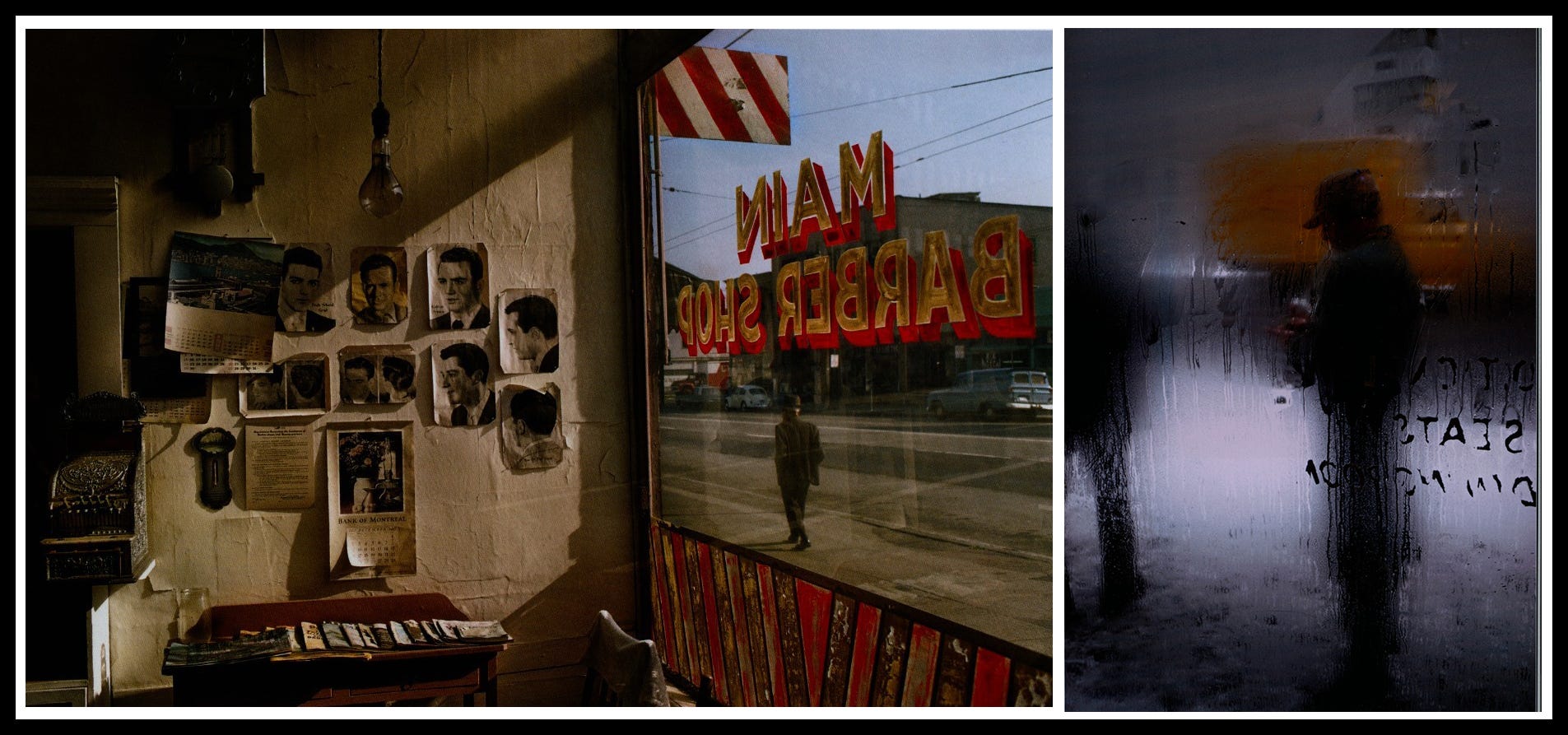
We’ll start with these two photos, each taken from the inside of a store-front window two years apart from one another.
As street photographers, both men, of course, worked with glass — storefronts, cafe windows, mirrors. What photographer working the streets doesn’t play with glass at some point? The question becomes how they each worked with glass.
Let’s start with Herzog.
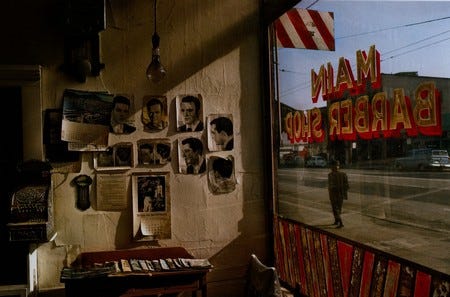
Herzog documents. He packs information into his frame. There’s seldom dead space with Herzog. The title of the photograph — “Main Barber” — is hardly necessary. From the photograph itself we know the business name, we have a hint of the working-class demographic of its customers, and a we’re offered a peek at its neighborhood and the street on which barbershop resides. The composition feels thought-out, planned. He’s composing with angles — the 45-degree shadows, the right-angled window frame. If we knew which side of the street the barbershop was on, we’d even know the time of day, given the falling shadows.
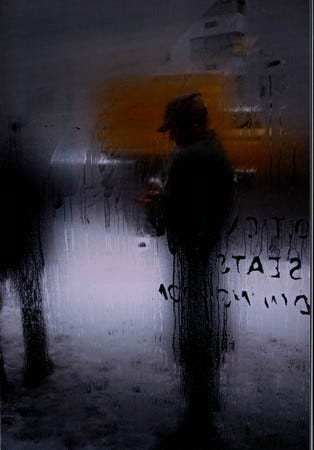
Leiter, shooting on the other side of the continent, could have cared less about information. We don’t know what kind of business he’s sitting in, he shares scant information about the street it’s on. A dark shape of a human silhouetted by the snow and red truck in the distance, and partial silhouette of another passerby in the snow, is all he gives us. The photograph’s title — “Snow” — tells us where his interest lay. He’s using the contrast of the white snow against the dark bodies to reveal human shapes. He’s not capturing people; he’s capturing their contours. And the photograph itself is shot through a filter of condensation on the glass, further obscuring everything beyond it.
Any lawyer worth their billing rate would advise me to plead guilty if I was accused of comparing Leiter’s orange to a Herzog’s apple — a photograph taken on a cold snowy day in which everything is obscured by condensation, versus one snapped on a clear day through a clear piece of glass.
The weather’s not the point, it’s the glass we need to be paying attention to.
For Herzog, the glass is an opportunity to add information to his frame while Leiter uses the glass to remove information. It diffuses what daylight there is, obscures details, and softens the shapes of the human subjects caught within it.
Look through Leiter’s catalog and you’ll see many photographs taken from the inside of a window, or looking into a window. Nearly all of them have some kind of diffuse element on the glass, if I can call it that: reflections, double-exposure effects, mirrors, condensation like this one, whitewashing.
Look through Herzog’s catalog and you’ll also see a lot of glass. Herzog’s Vancouver is filled with storefronts. His glass is clear and transparent, behind which well-defined people, objects, and cultural time-stamps are captured.
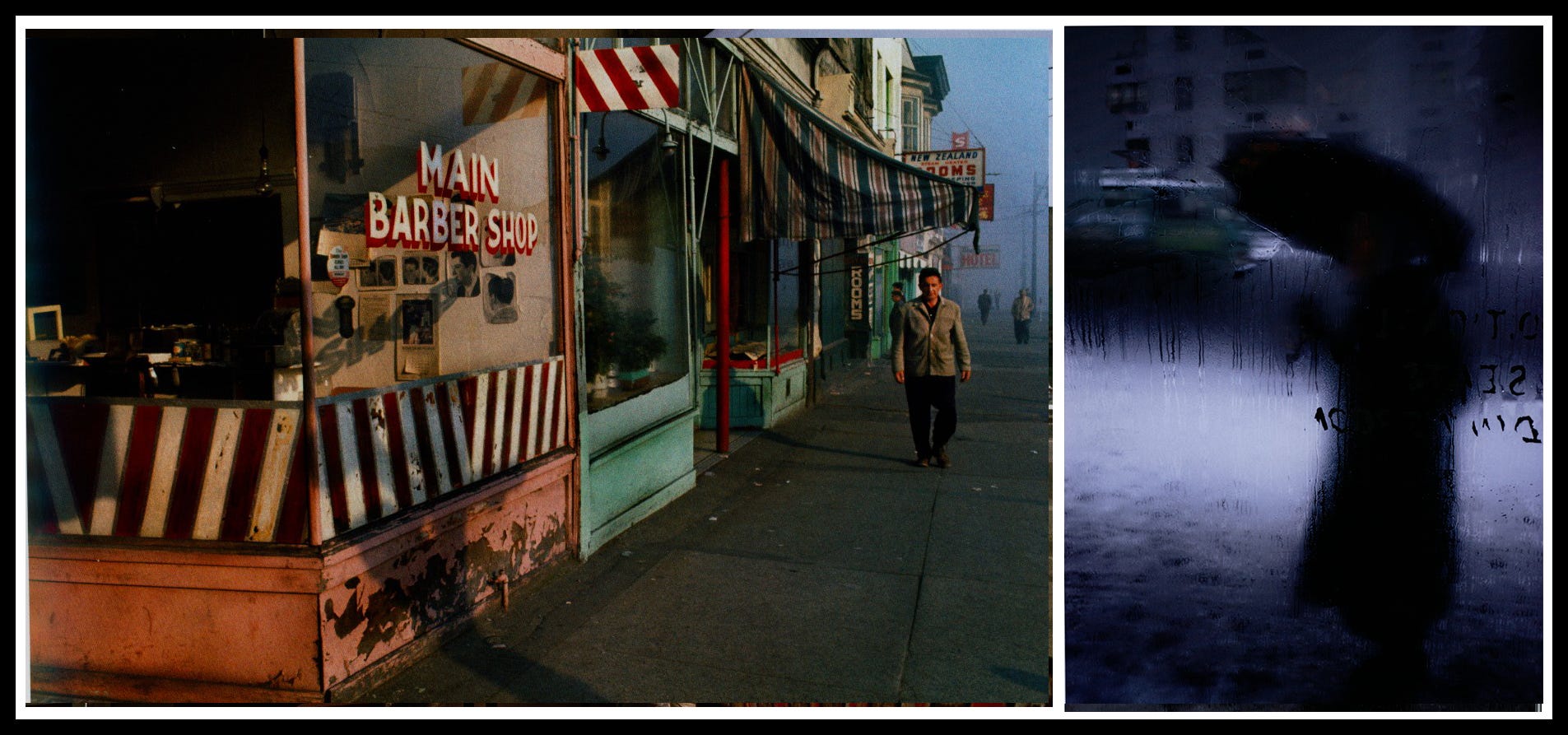
Now take a look at two variations of those photos, each taken moments later at the same locales.
In setting up the shot for “Main Barber from Sidewalk,” I can practically hear Herzog’s mind grinding through his plan: Time to move outside. Give a fuller sense of the shop and its environs.
Leiter, meanwhile, stays put, content to take advantage of the condensation and snow while there’s still enough available light to make a photograph. The same glass and condensation reveals a new silhouette, this one without the red backdrop. This second photo, “Snow Variant,” gives us no additional “useful” information. Leiter’s fishing for shapes, colors, textures. Information? Documentation? Like I said, he could care less.
That’s it for now. I’ll ferret out two more photos to look at next week as I continue my itch-scratching.
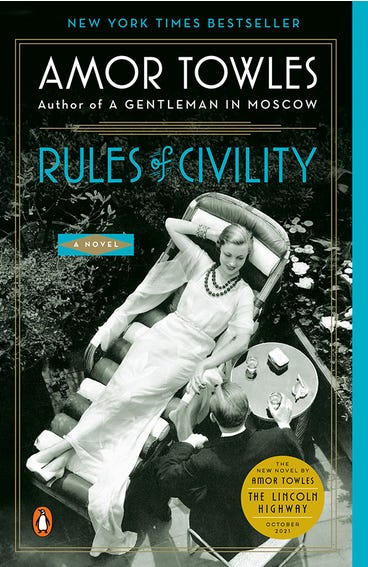
With this, Towles’ first novel published in 2011, the name-drop of F. Scott Fitzgerald in the book reviews was inevitable. Rules of Civility takes on the glitter and glamour of 1938 New York through the reminiscences of Katey Kontent, a 25-year-old woman who, in one transformative year, rose beyond the Wall Street secretarial pool where she was employed and entered into the upper echelons of New York’s high-brow society for good.
And what of this photofiction’s photographic inspiration?2
The book, told through Katey’s narration, opens in 1969 at the Museum of Modern Art where the 1930’s and 40’s subway portraits by Walker Evans are being exhibited for the first time.
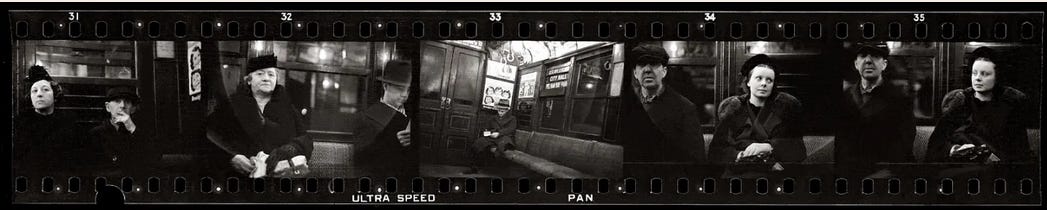
Between 1938 and 1941, Evans captured candid moments on the subway by strapping a 35mm camera beneath his coat and using a cable release to photograph unsuspecting passengers. The collection would eventually find its way to book form in 1966 with the publication of Many Are Called.
Kate and her husband are at the opening, as is Evans himself.
“In his midsixties, withered by an indifference to food, unable to fill out his own tuxedo, Evans looked as sad and nondescript as a retiree from General Motors middle management,” Kate tells us.
While most of the crowd has chosen conversation and drink over the photographs, Kate and her husband walk slowly through the hall, studying the portraits.
“Though taken more than twenty-five years earlier, the photographs had never been shown publicly,” Kate explains.
“Evans apparently had some sort of concern with his subject’s privacy. This may sound strange (or even a little self-important) when you consider that he had photographed them in such a public place. But seeing their faces lined up along on the wall, you could understand Evans’s reluctance. For, in fact, the pictures captured a certain naked humanity. Lost in thought, masked by the anonymity of their commute, unaware of the camera that was trained so directly upon them, many of these subjects had unknowingly allowed their inner selves to be seen.”
When Katey recognizes one of the faces captured by Evans in a 1939 portrait — Tinker Grey, “a twenty-eight-year-old man, ill shaven, in a threadbare coat” — she’s briefly transported back to that year. And when she sees Grey again a few moments later, in another portrait, this one from 1938, a year earlier, but this time “in a cashmere coat, clean shaven, a crisp Windsor knot poking over the collar of a custom-made shirt,” the novel’s framing is complete. Rules of Civility takes us through the year of Kate’s rise in fortune and Tinker Grey’s “riches to rags” regression (or — spoiler alert! — the progression of his spiritual and emotional life.)
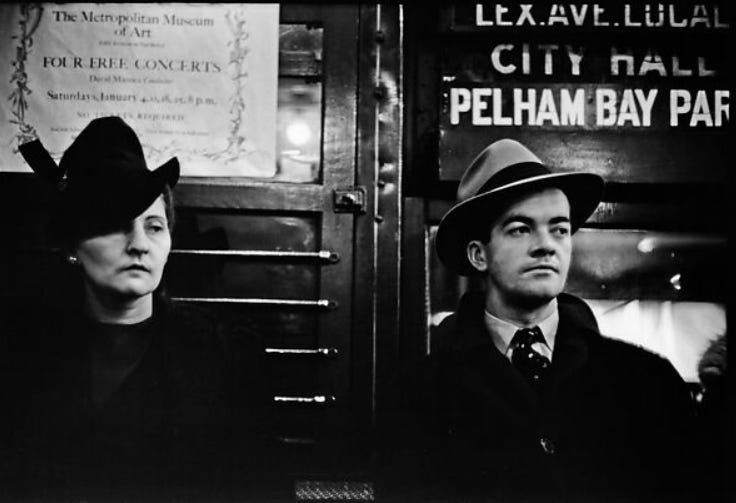
Towles prefaces each of the four sections of the novel with one of Evan’s subway portraits — the one above is from the book’s “Springtime” section.
I’d not heard of Towles until my friend and fellow Substacker Janet Brown introduced him to me. It’s a fabulous period piece and a pretty remarkable first novel.
And not to put any one particular Substacker on the spot who may have read everything Towles has written, so I’ll put this out there for anyone who’s read Towles: a Franklin Roosevelt dime for your Civility thoughts in the comments?
If a Missive isn’t shared, was it actually wirtten?
Yes, Vancouver has a beautiful location, nestled between the waters of the Pacific and the snow-capped North Shore Mountains, but the city is an unsightly mess. It’s got a skyline of dozens of unimaginatively designed apartment complexes, many with high vacancy rates, and owned mostly by absentee Hong Kong investors. The city’s invitation to Hong Kong millionaires back in the day brought needed $$ into the city’s coffers, but at the expense of its character and sense of community.
“Photofictions,” a name gifted to my by fellow Substacker George Slade, is my small but growing list of literature that was inspired by or about photography.
Comments
Nothing yet. Say the first thing.
Sign in to join the conversation.