
In last week’s Missives, I looked at how Saul Leiter and Fred Herzog, two of the pioneers of color street photography, used glass — the kind found in windows and storefronts — in their work. The superficial similarities of these two artists who shot on opposite ends of the continent from the mid-1950s to the early 2000s intrigued me enough to look a bit deeper at each of their works. Last week it was glass, this week it’s frames that I want to look at, how they each used physical frames in their environs to frame their shots.
Monday Missives (formerly Six Degrees of Missives) is my Monday newsletter devoted to words and photography on whatever subjects within six degrees of photography come to mind during the week. My posts the rest of the week will be more pics, less words. I promise.
Let’s start with Herzog, the straighter of the two.
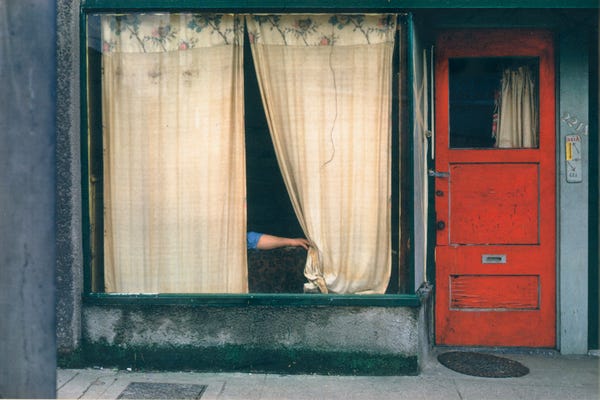
In the short weeks that I’ve familiarized myself with Herzog’s work, I’ve found a handful of photos that have hopscotched their way up my all-time favorites list, this being one of them. There is so much about this photograph that I love: its working-class “soul;” the distressed surfaces; the red pop of the door against the more muted tones of the curtains and building; and the human touch of invitation(?), curiosity(?), fear(?), anticipation(?), hope(?) that the extended arm brings to the photograph.
Where Leiter was a painter with his Leica, Herzog was a carpenter with his. So much of his work is plumb and square. Herzog transformed door frames, windows, and walls into the framing for his compositions. Like a good carpenter, he measured twice and shot once.
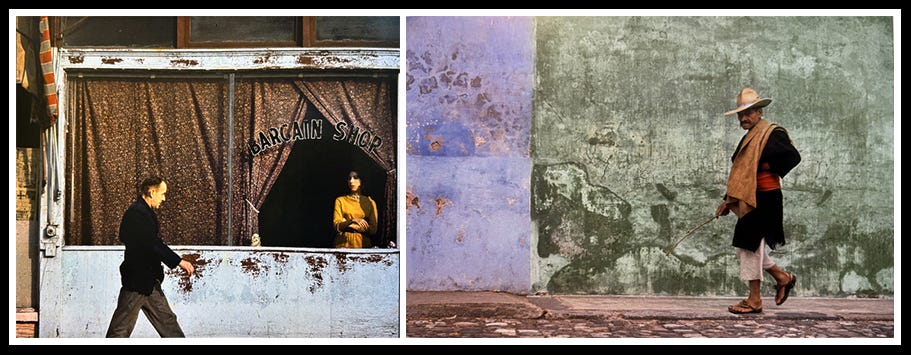
And Herzog liked to fish. A lot. Once he found the framing in which he wanted to capture his humans, he squared up his camera and patiently waited for his catch to stroll by.
Of course this isn’t all Herzog did. Look through Modern Color and you’ll see pages of unframed compositions. But with those that are framed — and there are plenty — you’ll see a squared-up precision in the angling and cropping. And in virtually every photograph, you’ll see a squared-up intention. Herzog didn’t play with dutch angles or anything resembling. He played it straight.
Not to be overly reductive, but this all makes sense, doesn’t it? That a medical photographer by profession — whose job it was to produce images that conveyed the story of a patient’s ailment with clarity — would bring this sense of precision to his street work?
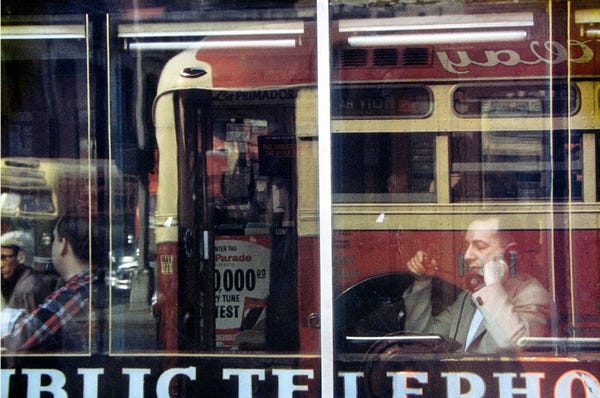
A window frame, right? Squared-up a la Herzog, no? So far so good, but here we are again, as I discussed in last week’s Missives, experiencing Leiter’s layers. A frame full of distractions. Text, street reflections, and multiple frames within the frames create those distractions, so much so that the question becomes, What’s the subject? Neither clarity nor literal were in Leiter’s street vocabulary.
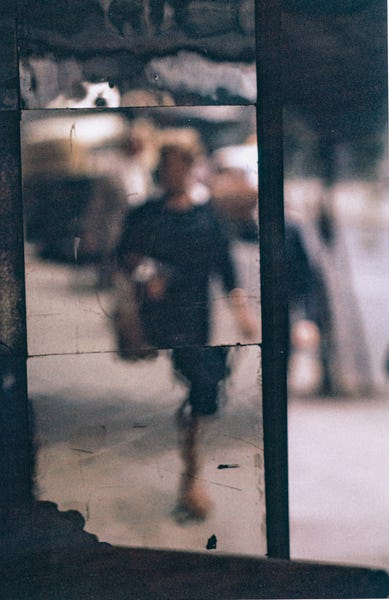
Leiter could go near-plumb when he wanted to. But again, with obfuscation.
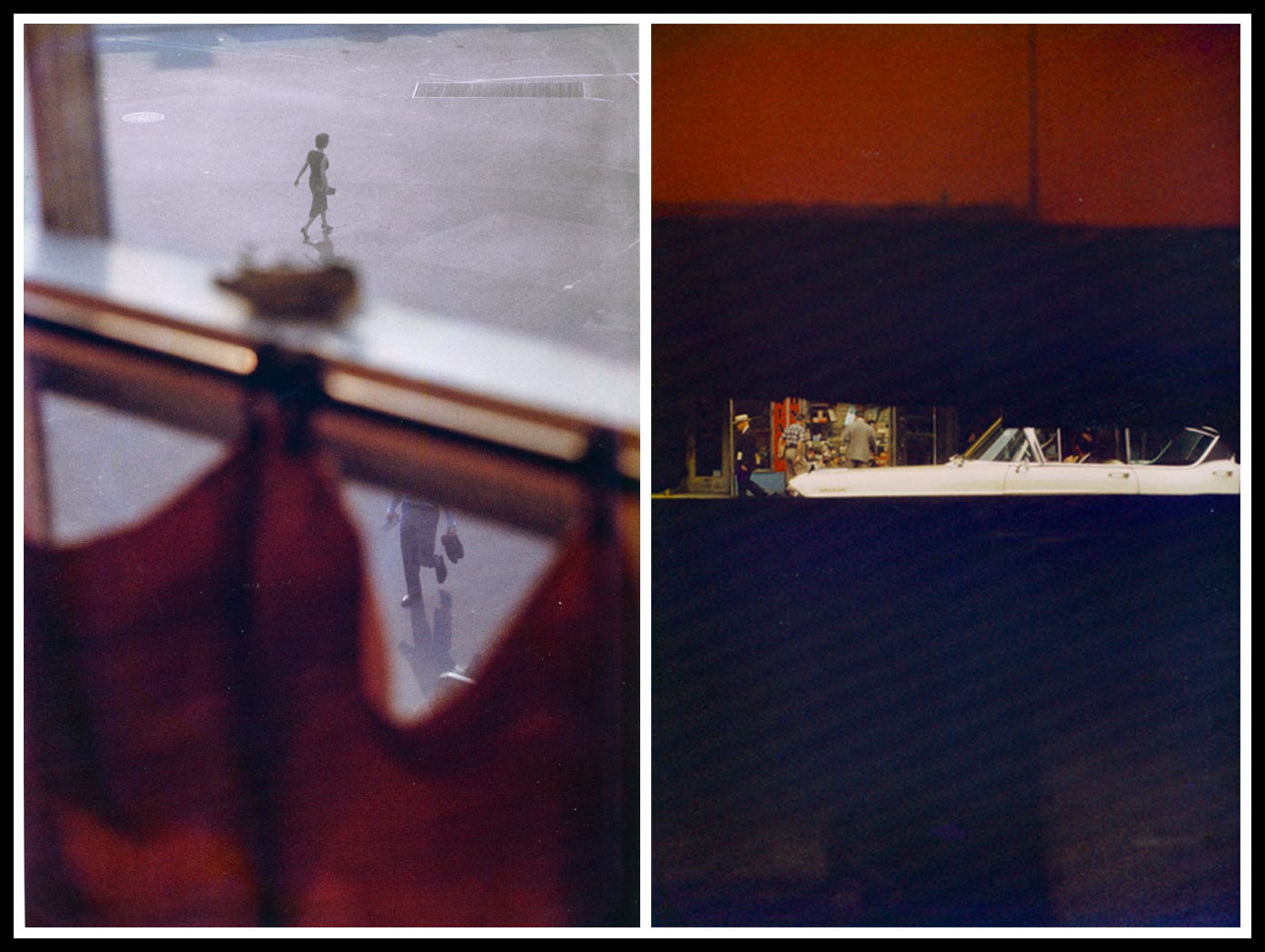
Here’s Leiter’s preferred framing, in my eye. Found framing. Framing that takes work to find. Framing that abets his need to see what no others saw and to break the rules of composition. Leiter, a painter by inclination and training, had little use for rules.
I have one, maybe two more Herzog-Leiter explorations in me. Obviously I’m not a critic. Leiter’s been dissected longer than I’ve been alive. I can’t type my way out of a post-modernist box of romantic wet tissues. (Yuck. Sorry.) I look at these photographs as if I were looking through my own viewfinder. What I see is what you get. It’s all I know how to do. And I’m finding it a lot of fun, and hugely insightful.
The opening essay to Geoff Dyer’s book, The Ongoing Moment (2005) traces photographers over seven decades who turned their focus on blind people. Dyer starts with Paul Strand's 1916 photograph of a blind woman with a sign reading "BLIND" around her neck, and moves through a long line of photographers — Walker Evans, Diane Arbus, Robert Frank, and more — who kept Strand’s conversation going with their own versions of the blind.
As photographers, we should study our predecessors. Artists of any genre should absorb their predecessors, even if to discard them. Maybe not consensus on this idea, but close? Hard-core rebels do their own thing, mentors be damned, but at some point we all have to rely on what our predecessors have left us.
Spending time with Herzog’s and Leiter’s street work forces me to take a much closer look at my own work. I’ve taken a lot of photos of a lot of glass. Storefronts especially. I bet a lot of us have, photographers or not. At some point, we need to study what others have done. That’s the sage advice at any rate.
But what I don’t hear very much is the advice for photographers to read. As in books. Short stories, poems, novels. I assume documentary photographers must read, or YouTube news clips. But I don’t know that I’ve ever been advised by any book or essay on photography to expand my vision through fiction or poetry. The advise must be out there, but I haven’t been given it.
Once upon a time I taught poetry to very young elementary school kids. That experience led to me take this photo a few years back.
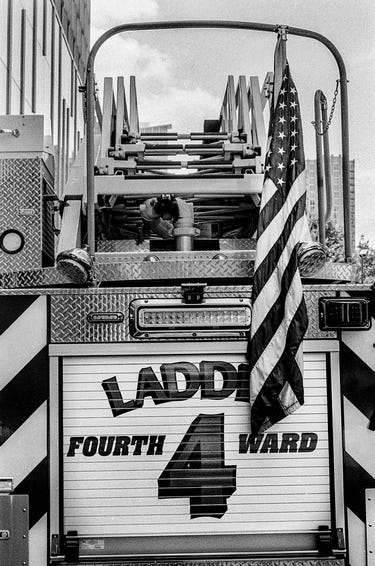
I don’t know that I would have invested one of my film exposures on this shot if I hadn’t taught poetry to those kids.
William Carlos Williams, in his book-length poem Paterson, wrote, “No ideas but in things.” Much of his poetry spoke to exactly that: things. One of his poems that I brought to my elementary school kids was “The Great Figure.” You can see why it would work well with young kids.
Text within this block will maintain its original spacing when published
"The Great Figure" by William Carlos William
Among the rain
and lights
I saw the figure 5
in gold
on a red
firetruck
moving
tense
unheeded
to gong clangs
siren howls
and wheels rumbling
through the dark city.
So of course my eyes were attracted to that fire truck on the side of a downtown Charlotte street.
Here’s the famous rendition of Williams’ poem from Charles Demuth in 1928, the original being oil on cardboard, now in MOMA’s permanent collection:
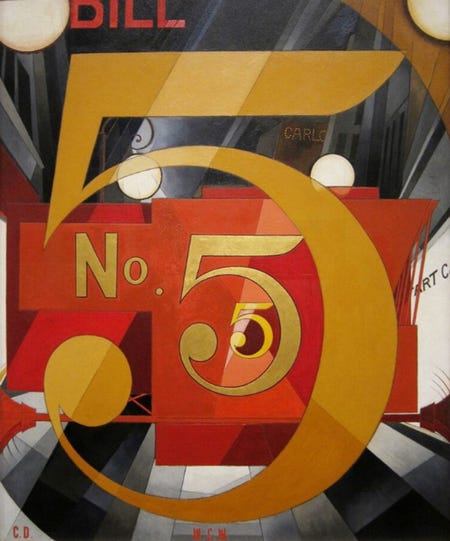
It’s a good combo to share with kids, Williams’ poem with Demuth’s painting. And it’s a good combo to think about in general. And play with. Looking at photos, YouTubing photographers, isn’t the only way to expand our visions. There’s this thing called literature that can do the same.
If a Missive drops into a newsletter but isn’t shared, does it say anything?
Comments
Nothing yet. Say the first thing.
Sign in to join the conversation.