
NEW YORK – ‘Tis the season! … No, not the Christmas season. It’s application season, particularly for American universities. Which means I once again work with a couple of unique clients: Chinese high-school students, whom I Zoom-coach remotely – from Manhattan to China – with their Personal Essays.
I first entered the world of College Counseling in 2016, not long after moving to Beijing. I was open to new experiences, and soon took this on as side-gig – after realizing I could adapt my entire toolkit of International Journalism skills, strategies and storytelling styles to the unique challenge of application essays. Especially, once I spotted the greater degree of difficulty that international students face. Then, devised some skills and strategies for how any international student can overcome these challenges.
That’s why I’ve created this Special Edition #4 and inserted it here: to present the special skills and strategies that students need to craft persuasive, impactful Personal Essays, which we should pack with core messages, credible evidence, relevant context and humanized storytelling. That’s how to separate ourselves from the ocean of applicants, competing for those precious seats and beds at American universities: we must prove our competitive-advantage, our value-added and that we’re “the right fit.”
Every student applying to US universities is required to write many of these essays, starting with the Common App essay, and continuing with the Supplemental Essays for each specific university. As a keen observer for several years now, my sense is that beyond a student’s grades, scores, activities, etc., these essays are so important for humanizing the student as a real person. Though it’s impossible to know if any one essay is the deciding factor, enabling a student to gain admission to that university – since no school Admissions acceptance letter ever states that specifically.
Still, I imagine it's truly a deciding factor – especially for borderline students. Based on their data, they could get in, or be rejected. Now let’s read their essays, to hear their story – and learn more about their authentic selves. To answer the essay-writing challenge, overall, I apply some of the skills and strategies outline in Chapter Five: What Audiences Need. In short, I believe each essay should “open a window” onto the student as a real person, revealing how their heart and mind work – with introspective self-awareness to explain why exactly their mind thinks, and their heart feels, as they do.
That said, geography, nationality and culture matter in the essay-writing, as they would in any form of Global Communications. When they write, a young American applicant appeals to an audience of Admissions Officers who are largely fellow Americans. Between communicator and audience, there’s presumably no reason to even acknowledge the mutual understanding of the broader American cultural context. For foreign students, however, the challenge escalates: their context is fundamentally different.
Imagine an essay in which a student rebels against parental pressure to study Physics – simply because “They’re good at it” – and instead decides to pursue Biology, which is the subject they actually love. Risking the wrath of parents may seem typical to us, but courageous in other cultures.
Similarly, how can we appreciate a foreign student’s independent thinking and outside-the-box actions, unless we as a reader empathetically learn that they may have been raised in a society that discourages both? Or, what if another foreign student is impassioned about an emerging social issue or marginalized community in their homeland, yet we already take for granted the same issue, because it was mainstreamed here long ago? Like gay and lesbian rights. Or the feminist cause. Or sexual health. Etc.
Context matters, as I learned from my 20 years in Foreign Reporting, writing stories from 30 countries – mostly in Eastern Europe, Central Asia and Southern Africa. Context may deliver much greater impact on our target-audience – or much less. That’s just one way in which I adapt my Journalism and coach clients to maximize their impact on the target-audience of Admissions Officers: as I tell foreign students, view your essay-writing as not only a form of strategic communications, but international storytelling. Always keep in mind, you’re not striving to impact a local audience, but a foreign audience. They need context.
That’s why with my Chinese students, for example, I preach the need to tell A China Story. I even cite the benefits of that approach, for a university that values diversity and seeks a multicultural student-body. When humanizing ourselves, where necessary, insert enough relevant context to make our essay accessible to the reader. Such context may be historical, cultural, traditional, economic, etc.
Just as Chapter Five of my toolkit explains how to engage a foreign audience, my applicable skillset for how to identify and illuminate relevant, compelling context is described in Chapter Twelve: MJ’s Filters & Polishers, Part I and Chapter Thirteen: MJ’s Filters & Polishers, Part II. Even Chapter Fifteen: Interviewing Skills & Strategies describes how to chart an individual’s “Darwinian evolution,” while Special Edition #3 presents my Fork in the Road storytelling strategy, which can guide students to reveal how a momentous event in their life became a turning-point that spurred positive impact.
With all this inter-relatedness and cross-application in mind – and with Personal Essay season upon us – I created this Special Edition #4, for my Global Communications Toolkit. It combines four essays I wrote while still living in Beijing, yet my skills and strategies resonate today. The first two essays, written in later 2016, grew out of the first batch of Chinese and international students I coached. Step-step, I guided them through my skills and strategies to generate their most persuasive, impactful essays. This new method led to the coaching and training I did in 2017 as a “Senior Essay Specialist” for PrincetoNow Education Services Inc., a college-counseling firm in Shenzhen.
The remaining two articles below turn personal, as I not only wrote them in teacherly-travelogue style, but from the perspective of a father: they followed the Fall 2019 tour of 10 US campuses I took with my own two sons, as the older one mulled to which schools he’d apply. I packed both essays with lessons-learned and paternal wisdom. Later, I was proud to have the two published in Beijing Kids Magazine.
*****
Show, Don't Tell: Why Concrete Evidence Is Crucial to a Convincing Personal Essay
BEIJING - With the application season heating up, it's important for the International students who apply to top American Universities to think from a Strategic Communications perspective to understand what exactly our target-audience is looking for in your Personal Essays – and why exactly they seek that. In this case, our audience are the Admissions Officers – their school’s first line of defense, trying to identify who’s the “right fit” for their classrooms, campus and communal life. And to weed out those who aren’t.
Because they serve as smart, savvy, skeptical gatekeepers, they won't be satisfied with empty words, but instead demand proof that we mean what we say: stories that "humanize" us, "open a window" onto our heart and mind, illuminate our passions, bring to light our authentic selves, and so on. In that case, we should deliver what I call a "lawyerly" argument: a strategic, persuasive message; backed by concrete, credible evidence; folded into a compelling, humanizing story. The key is credible evidence, because it’s the only chance to overcome audience skepticism. Yet what if we lack such evidence? As I'll show in this commentary, it's not too late for us to start "creating facts on the ground."
*****
It’s a typical weekday in China, but on this morning I’m back in school, surrounded by an unusual crowd: eight of the sharpest teenagers you’ll come across.
Turning to my right, I’m about to start in on a bespectacled young Asian woman we’ll call Sherry. She’s a student at one of the best international schools in Beijing, whose University Counselors have invited me in to help coach their college-bound seniors.
Particularly this group, described as “high-flyers” by one of their counselors: Sherry and the classmates assembled before me, I’m told, each possess the grades, scores and ambition to apply to the prestigious “Ivy League” schools of America.
Each teen, though, must clear a substantial hurdle: Write a “Personal Essay” for The Common Application, followed by university-specific Supplemental Essays. These must be persuasive enough to impress, first, that university’s Admissions Officer, then its Admissions Committee.
While the Common App offers five essay options, regardless of which you choose, this audience wants to read a good story about you – a story that reveals your passions.
So, I’m talking to these teens about my essay strategies and techniques – derived from my Foreign Correspondent career – to produce effective, convincing essays through their own international storytelling: “humanize” yourself in this faraway land, but back it up with “evidence” that proves you’re passionate enough to study Subject X at University Y.
*****
To drive home my point, I’m about to lay out a real-life scenario for Sherry and her mates: I’ll role-play as an Admissions Officer, reading through a stack of top-notch applicants. In this scenario, all have stellar grades, stellar scores, stellar extra-curriculars.
How to distinguish yourself? To separate yourself from the competition?
Sherry, then, is the Guinea-pig.
What would you like to study?
“Psychology,” she tells me. “Criminal psychology. Criminology.”
Whoa! Serious-minded stuff. But I want to draw out much more. I sense she may have a good story to tell.
Why that subject? How’d you become interested in that? And why should I believe that you’re now so committed to this subject?
Last year, she explains, a classmate’s paper about the psyche of a mass murderer had sparked her curiosity about how his pathology had developed. (It turns out, the classmate is here – and surprised and pleased to learn that she’d inspired her friend.) Was the killer born this way? Was it nature or nurture? How had parents and childhood shaped him?
So you were curious. And then what?
“I began to read articles and books about psychology.”
For class? For a grade? Or on your own?
“On my own.”
She’s so motivated, she even spends her precious free time reading serious psychology?
And then?
“I began to write down my thoughts and opinions, as commentaries.”
Again, on her own? Just because she was ... inspired to?
And what do you do with these writings?
“I publish them on my own blog.”
My heart skips a beat.
You mean, you created a blog – just to publish your writing? Then certainly don’t call it a “blog”! This is much more serious. You’ve created your own website!
This is brilliant stuff. More important, she’s begun to convince me that she feels passion for the subject. Assuming she has the necessary grades, scores, and so on, what university Psychology program wouldn’t want this serious-minded young woman in their classroom?
*****
Today, after more than 20 years as a foreign correspondent, reporting from 30 countries, among the many principles I’ve embraced along the way is this: Say whatever you want, print whatever you want, but you’d better back it up with facts. That is, if you want to be taken seriously – especially by a smart, sophisticated, but skeptical readers.
That’s always my target-audience. With the Personal Essay, they’re yours, too.
One student I’m currently coaching is a Chinese 17-year-old in Shanghai. Rick, we’ll call him, initially told me he wants to study chemistry at a U.S. or Canadian university. To become a scientist? No, he answered: a small-town teacher. Especially of disadvantaged kids.
Ohhh. So what’s the connection between chemistry and that sort of teaching? And do you have any evidence to convince me that you’re so passionate about teaching?
Rick goes on to tell me how three summers ago, he left the comforts of his Shanghai home to volunteer as an English teacher in rural Taiwan – teaching Taiwanese children from broken homes. He found it gratifying, but wanted to try it again the next summer – to test if how much he really enjoyed it. So he went back. Then, returned this past summer, too.
As we say in journalism, three of anything makes for a pattern, a trend. And Rick has clearly established a track-record. I knew his three summer experiences could supply plenty of storytelling material, just waiting to be unearthed. For example, searching for a possible way to open his Personal Essay, I asked him for one profound moment or lasting impression from this past summer, as he interacted with the kids, that had reinforced in his mind: Yes, I want to work with kids like these one day – and to make a meaningful difference in their lives.
Again, we want a relevant anecdote, strategically chosen to illuminate your passion.
Still, why chemistry? It turns out, Rick realizes that Education is a subject he can only really study as a Master’s degree. First, he needs to specialize in some area. Thus, his interest in science, specifically chemistry. Not only has he been a member of his school’s Chemistry Club for several years, but this summer he also volunteered in the laboratory of a Shanghai chemistry professor. Again, great potential for storytelling anecdotes and insights.
I’m learning more about Rick, and aspects of what I describe as What makes you tick? – in your heart, in your mind. Why exactly does he want to do this? Why exactly does he care about this? More than what he feels, why exactly does he feel what he feels? And so on.
Moreover, we now need to stitch it all together with a coherent, overarching argument. I hatch one for Rick: I want to study Chemistry, but it’s actually the first of my two-stage plan to eventually become a school teacher, doing meaningful work for kids who need a helping hand.
Then, back it up with facts, the relevant evidence, to illuminate his Journey of Self-Discovery: how and why he first became inspired; key moments along the way that, step by step, further fueled his interest; how it turned to passion; leading up to this very moment, a crossroads in his life, where for some reason, heading West is the right decision for him.
*****
Your turn now: you tell the Admissions Officer you want to study biology, or business, or fashion design, or mechanical engineering, or architecture.
No. Show them, don’t tell them.
Do you have concrete evidence at this point, like Rick and Sherry?
Take some time to yourself, away from family and friends. Turn off your phone, and think to yourself: What are my priorities? What are my passions? And why?
Now, what evidence do you have to prove this passion?
After I recently explained this to another group of students in Beijing, I ask one young guy what he wants to study, and where. His reply: acting, at New York University. Quite a prestigious program, with high standards for applicants - presumably, only accepting those who've already demonstrated their talent.
So I ask this student, Have you acted before? No, he hasn’t. “It’s my dream,” he says.
Even as the words spill out of his mouth, he seems to now realize how absurd it sounds. No need for me to point that out.
Instead, I try to encourage him: If I were you, I’d immediately go volunteer to join any theater production on campus. Minimally, to create a few “facts on the ground.” Also, to test yourself: Is this really what I want to study? Am I ready to commit four years’ of tuition and effort to this?
But that’s a more extreme example. I’ve also recently coached students who told me they wanted to be an architect, a fashion designer, and a product designer. I asked each: Have you designed anything of your own? Each said yes. Then show me, don’t tell me.
I urged each to create a website for themselves: as a platform and showcase for their work. Post your sketches, or photos of your designs! Even step-by-step, how you created something from scratch, to illuminate your creative process. You could even go one step further: Write a companion piece, explaining the inspiration for your creation.
Why? For several reasons. First, again, this concrete evidence of your enthusiasm delivers that message directly to the brain of your reader, the Admissions Officer.
Second, whether you’re a native English-speaker or non-native English-speaker, this showcases your writing skills. Especially if you’re the latter, the Admissions Officer will want to know: Can you write clearly enough? And keep up with our writing assignments?
Third, the mere presence of your own website sends another message: you’re a serious-minded young person. In fact, if you plan to enter any such field or industry, you’ll likely need to market yourself and showcase your “products,” eventually. So why not start now?
The best part is, you can do all this from home – even while in your pajamas.
Likewise, as Sherry has done, you could follow the latest trends in your profession of choice: devote a few hours on a Saturday or Sunday morning to writing your thoughts, opinions, analysis of what you read – 300, 400, 500 words. Post it. Do it again the next weekend. Then, the weekend after. You’re building a body of work – proving your passion.
Or, as Rick has done, you may want to get outside to produce concrete evidence. If you’re interested in medicine, go knock on some doors this weekend, and see if you can volunteer every Saturday or Sunday morning at a local hospital or health clinic.
If you’re interested in biology, or engineering, or business, follow the same strategy: call up a local laboratory, or factory, or company. Offer to do anything: answer phone calls, fetch coffee, whatever. Just to be “on the frontlines” of your preferred passion, to observe what it’s really like, to gain some experience – and create a few more facts on the ground.
But buy yourself a nice journal, and bring it with you: jot down impressionable moments, lessons learned, and so on, plus your thoughts, feelings, opinions, analysis. Again, this may make for compelling, convincing evidence to sway an Admissions Officer.
One sharp student countered: Doesn’t this look too obvious, that you’re doing all this activity just as you’re applying to universities? Good point. Maybe! But what’s the alternative? Entering the courtroom, empty-handed, or lacking sufficient evidence, could kill your case.
Instead, it’s not too late to make as lawyerly an argument as possible, backed by persuasive evidence – and presented as a good story. You have too much riding on this.
*****
Where Marketing & Storytelling Intersect: A How-To Guide to Personal Essays for US Universities
By Michael J. Jordan
BEIJING – Emily is a student at one of China’s top universities, and she's grown passionate about marketing. Indeed, she's now applying to a prestigious American university that touts its graduate marketing program as “the leading” such education “in the digital age.”
As an American myself, I know this school can choose the cream of the crop, both domestically and internationally. But beyond stellar grades, TOEFL scores and extra-curriculars, what kind of student do you think they’d want to welcome?
My hunch: someone smart, creative and likable, who, as a graduate, would go on to make the school proud. Moreover, perhaps serve as something of a “bridge” between the world’s two greatest economies and market rivals: the United States and China.
So, when Emily tells me she is now also interning with the Beijing office of a premier American PR agency – to promote another big-name U.S. product entering the Chinese market – I zero in on that experience for her Personal Essay: Let’s show you as smart, creative ... and already helping to build this “bridge.”
We hammer out a “curtain-raising” anecdote to open her Essay, then explore what inspired Emily's passion for marketing – and why. We’ll stitch it all together as her Journey of Self-Discovery narrative: what led to this decision, applying to this school.
*****
Much ink has been spilled about the college-application process. Especially, one of the most important parts of the process: the Personal Essay. If we assume an applicant’s grades, test scores and outside activities are on par with the competition, this Essay is one area where a student can distinguish themselves from the others.
Perhaps you’re thinking: That’s easy enough. Just write about myself! But from my perspective – as a longtime Writing Coach and Storytelling Specialist – it’s much trickier than that. You must also weigh the psychological, particularly the marketing dimension of a “winning” Essay. It requires serious strategy to convey, through only written words, a convincing argument embedded within a colorful “story,” to sway your audience that you’re ideally suited for their school: first, a University Admissions Officer, then the Admissions Committee.
This is a particularly daunting challenge for foreign students – especially those I’ve begun guiding through the Essay-writing process from my new base in Beijing: smart, young Chinese applying to either undergraduate or graduate programs.
In this article, I’ll explain my new marketing approach to Essay-writing; in Part II, I’ll detail my storytelling methodology: what I call Your Journey of Self-Discovery.
*****
Let’s start from the assumption: the West’s leading universities do indeed want to attract some of China’s best and brightest. Sure, diversity is important for the most progressive universities, part of the overall “Internationalization” of higher education: they want students from around the globe – just as they want to create more opportunities for their homegrown students to venture out into the world.
But beyond “diversity,” two simple words: China matters. For Western schools, China matters in terms of the massive English-learning market – and the potential to expand their brand into The Middle Kingdom – but also in pure strategic terms: it’s the world’s second-largest economy and emerging global superpower.
For U.S. universities, specifically, China is now the country’s key economic, diplomatic and military rival: it’s in the American self-interest to build as many “bridges” as possible to China and to the Chinese people themselves.
U.S. President Barack Obama has acknowledged as much. During Chinese President Xi Jinping’s September 2015 visit to the United States, Obama announced a plan for 1 million young Americans to learn Mandarin over the next five years.
In short, Western universities want, even need, Chinese students. In reasonable numbers, though. On the flip side, can you imagine how many Chinese are applying for each of these openings? Easily hundreds, if not thousands.
I grasped this even before I moved to China, during my teaching stints in Hong Kong over the past six years, is the sheer number of mainland Chinese who dream of study abroad. For those whose middle-class parents have saved, yet still have relatively modest means, it may be Hong Kong or Australia. For others, perhaps Europe. For the majority – especially the affluent – America remains the promised land. My guess is not all are superior students – or committed to academia. Some may just want to get the heck out of China ... and boast the financial means to do so.
Countless other young Chinese have been conditioned, even programmed, to get the best grades, the best scores – by hyper-competitive parents who may start their children with tutors when as young as 5 or 6. Then, parents may grow ever more fanatical about their kids falling behind, so keep them working with tutors into every evening, through every weekend, up through university admission.
This is not only a byproduct of China’s survival-of-the-fittest economic environment, but also of the (recently lifted) one-child policy, which led many parents to fret that this one child would care for them when frail and elderly. So, maximize their educational and earning potential. Yet this bodes poorly for happy, well-adjusted individuals ready to embrace the Western collegiate opportunity.
*****
The University Admissions industry is surely aware that legions of less-than altruistic young Chinese or substance-less robots are also banging on their door. I can only imagine how they’ve developed finely tuned filters to weed out the less-serious from more-serious candidates applying from The Far East.
Among the more-serious, then, imagine this scene: a stack of applications from young Chinese, seemingly all with good grades, from good schools, with good enough TOEFL scores. How to pluck the more appealing candidates from that stack, placing them in a much smaller stack – who may then be interviewed via Skype?
The common wisdom is that the Admissions Committee wants to learn about the real you. They want you to share a story that brings you to life – even opens a window onto what “makes you tick”: in your heart, in your mind. Storytelling that effectively illuminates your passions and inspirations, your principles and values.
This is where the psychological and marketing components come into play, I believe. Admissions officers don’t want just any kind of storytelling. They want a relevant story. Meaning, directly connected to them: who they are, their identity, what they offer, why they do what they do, where they’re heading in the future.
Your Essay objective, then, is to do more than reveal to the Admissions Officer that you’re a likable, interesting person – persuade them you’re ideally suited for their school. You want that reader of your Essay to nod their head, and think: Yes, this is exactly the kind of young person we want at our school – and representing us.
*****
Now that we consider the reader’s psychology – and empathetically imagine ourselves in their shoes – let’s mull how to effective hit our target. Enter, the marketing dimension. Or, as I put it, Where Marketing and Storytelling Intersect: Ten Steps to Writing a Winning Personal Essay for Top Western Universities.
I myself am no “marketing expert,” per se. But during my two decades as a freelance foreign correspondent, I’ve come to appreciate the role marketing plays in my own work. After all, I’ve continually had to “sell” my story ideas, and the stories themselves that I’ve reported and written from 30 different countries.
My audience, initially, is not the smart, curious, online, potentially global readers – instead, it’s the editors who serve as gatekeepers to the platforms upon which I hope my stories will be published and read. Those editors primarily seek interesting or important stories – or, ideally, both interesting and important stories.
So, like any entrepreneur, I realized I had a “market” – the editors and publications – for my “product”: my ideas and stories. Even more, I have my self-interest: to sell my product. My market, too, has a self-interest: to consume interesting, even important stories. What I seek is our overlapping self-interest.
If I want to succeed, then, I’d better study my market, to clearly understand what products my audience will consume – and in what form. Market research.
The same holds true with Personal Essays. The university market demands a quality product: smart, enthusiastic students. Well, you also have a product to sell: yourself. If you hope to successfully hit this overlap of your self-interest and theirs, you can’t do it randomly, with form-letters. The first step must be Market Research.
*****
For University X, devour as much of its website as possible: the University, in general; our targeted program, specifically. Create a Word Document in which to save web addresses and webpages. We may need this file often; better to have relevant links and research at our fingertips, rather than surf the Web each time.
Moreover, as I advise students, in our Personal Essay, we may strategically name-drop a reference, here or there – then hyperlink to it. This shows an Admissions Officer we know exactly who they are. Remember, their “bullshit-deflector” will be cranked high, keen to separate pretenders from contenders.
Specifically, we’re searching for facts that reveal more than Who We Are and Our Mission. If we read between the lines, these are also clues about the sort of like-minded students they seek. They want students who are a strong match, right?
For example, one Chinese student of mine applying to a U.S. pre-med program read online how this school considers itself “obsessed” with science, and welcoming of “unconventional” thinkers. She felt she fit the bill. So this might be one winning point she’d cite in her Essay: backed by a concrete example – an illuminating anecdote – show her own “obsession” with science, or “unconventional” thinking.
Now that we’ve done significant market research, familiarizing ourselves with this target-audience – and their “product” preferences – we shift the focus to ourselves: brainstorming how to adapt and sell our “product” to this consumer.
*****
https://www.linkedin.com/pulse/lessons-college-admissions-10-schools-days-father-son-jordan/
July 10, 2019
By Michael J. Jordan
BEIJING - I'm so pleased that Beijing Kids magazine has just published the second of my two-part essay on the lessons I learned about the university-admissions process - while touring top American schools with my own two sons. Unlike Part One, which was more travelogue, this piece focuses more on Boston University, as a case-study. It also includes much more of my own analysis as an application-essay specialist, coaching foreign students from my base in Beijing. Particularly, how I adapted my MJ Method skills and strategies- which I apply to ALL forms of written and verbal communications - and apply it to international students writing the Common App essay, as well as school-specific Supplemental Essays.
[The following is Part I of my travelogue/case-study, full of lessons-learned and guidance for how college-applicants - especially foreigners - can persuasively "market" themselves to Admissions Officers. For Part II, click here.]
By Michael J. Jordan
Feb. 6th, 2019 – We’ve just arrived in Amherst, Massachusetts, and head straight out to dinner with a second-semester freshman at Amherst College – one of America’s oldest, finest liberal-arts schools.
“Sarah,” as I’ll call her here, is the daughter of an acquaintance, and kindly offered to share her insights into Amherst – with my son. Soon to be 17, he’s visiting American colleges for the first time, to explore which ones he’ll apply to this Fall. Amherst is one of 10 he’s arranged for this 10-day journey. It's not just the two of us: we’re joined of this road-trip by my younger son, who's 14, and my closest college friend, whom I’ve known 32 years.
This young woman tells us how much she enjoys her academic major, courses, professors, classmates, friends, dorm, social life and campus activities. She contrasts the advantages of Amherst's small student body – class-size, faculty-student ratio, and getting to know your teachers as true mentors – with certain social disadvantages, such as seeing the same people, day after day. Especially, if you wish to avoid someone. That's hard to do here.
My son is listening intently – engaged, curious and asking questions. What I don’t yet realize, though: in his mind, he’s already crossing Amherst off his list! In fact, after we bid farewell to this freshman, my son tells me that he wants to leave as soon as possible. Even to skip the next morning’s orientation and campus-tour. I’m stunned. And irritated. I just drove us two hours, from Boston, to get here! But I’ll soon realize: He’s right.
*****
I’m more than my son's father ... and chauffeur. Among my gigs in Beijing, China – where I’ve lived since 2015 – I specialize in University Admissions, as an Education Counselor and essay-writing coach who guides some of the countless thousands of Chinese students who dream of studying in America. I've helped dozens of them get into top schools; most recently, I was pleased to hear that for one young woman I coached, her strategically written essay helped her land a scholarship to the UK's Hult International Business School.
Yet with many top U.S. universities now filling 20% to 30% of their ranks with foreign students, I’ve spotted a unique writing challenge they face with their Personal Essays, which American applicants don’t. Foreigners are separated by vast “distance” – not just geographic, but also cultural. This requires just the right dose of context, to connect with readers. This makes their essays another form of International Storytelling.
To help them bridge this distance, I’ve developed my own method, which is derived from the skills and strategies of my two career specialties: International Journalism and International Communication. (For examples of how I apply my MJ Method to all forms of writing and speaking, especially to foreign audiences, feel free to read here.)
That said, it’s one thing for me to advise, from afar, any Chinese student – or foreigner living abroad, like my son – on how to craft a persuasive application essay. Namely, how to identify their own values, then a specific college’s values. Next, how to hone a strategic message, support it with concrete evidence, and fold it into a humanizing story that’ll convince an Admissions Officer that you’re “the right fit” for them.
At this moment, though, I'm experiencing a new sensation: to sit in the audience, absorb a school’s orientation and campus-tour, observe how it impacts my son, then share my insights with you as a parent, too. That’s what I’ll do with the essay below [as well as in Part II]: it's a hybrid that blends scholarly case-studywith journalistic travelogue - as part of my overarching efforts to share relevant advice with a wider audience.
*****
Because I’m wearing these two hats – as both a parent and player in the university-admissions business – that helps to explain how I’ll now handle my son’s urging that we cut short our Amherst visit. “Let’s leave in the morning, before the tour,” he says. I can’t believe the absurdity of it. But I drove us so far to get here! Why not at least hear what they have to say – and look around their lovely campus?
With lawyerly precision, he replies: “What’s the point? I don’t even want to apply here.”
I press for more. Why wouldn’t you apply here? For two key reasons, he explains.
First, he now has broader context. Amherst isn’t the first stop on our tour. We’d just visited four stellar schools in Boston, like Boston University and Tufts University. Boston is not only one of America’s greatest cities, but also home to a huge, vibrant student population. From there, we drove two hours due west, along an uninspiring highway, to reach rural Amherst: which is itself a quaint but sleepy town.
Suddenly, a new reality has hit my son: Location is important to me. He’s lucky enough to have already lived on four continents, in his young life. (From New York to Slovakia, in Central Europe; down to Lesotho in Southern Africa; then out to China.) While we haven’t always lived in a booming metropolis, he wants to immerse himself in urban energy.
The second issue, it turns out, just emerged during our chat with the second-semester freshman. At some point, she'd admitted: Amherst doesn’t facilitate many internship possibilities for students. For my son, that’s another strike: he’d heard from the Boston universities of all the exciting, off-campus internships(some paid, others unpaid) they arrange for students. In the city. Suddenly, internships are another of his priorities.
Indeed, this detail could become a selling-point, when each school asks the inevitable “Why us?” essay question, which they typically want you to answer within 250 words. My son could cite, with specificity: Your internship opportunities, like XXX and YYY, appeal to me because they may help me fulfill my dream of ZZZ. Fill in the blanks.
No doubt, Amherst would deliver top-notch academics. Yet, it’s not enough to overcome his two other priorities: location and opportunity. So, my irritation with him quickly passes.
In fact, I no longer wonder if this is a “wasted trip” to Amherst. Choosing the ideal university for him is so crucial, because it means four years of his life. As his father, my priority is that he spends those years as happily as possible. That means, he must identify for himself which school is truly “the right fit” – and why. It now occurs to me: step by step, my son’s learning more about himself, too – and which combination of factors are the right fit.
*****
This was just one of many revelations from our 10-day road-trip, which I want to share with you here – regardless of whether you’re a student or parent; whether you're Chinese or American; whether you're a university counselor in China, or Admissions Officer in the U.S.
On the one hand, this trip illuminated how “the right fit” cuts both ways: just as students should seek the right fit – or at least, the best possible fit – our tour illuminated how universities also telegraph to students who among them is “the right fit” for their school.
As I’ll show in Part II of this essay, the schools subtly communicated to us the traits of an ideal candidate: from intellectual curiosity, academic appetite, entrepreneurial spirit, diverse interests and communal leadership, to passion, passion, passion – for what you care about.
As one Admissions Officer at Tufts University put it, during our orientation session: “You should be just as passionate about your minor, as you are about your major.”
A student tour-guide later added: “You can stop any student here, ask about their major, what they study, or what they do on campus, and they’ll go on and on. Everyone is so passionate about what they do, it’s infectious. It makes me want to do what I want to do, even more.”
During this trip, though, I was no longer a detached observer or essay-writing coach, but a parent trying to solve the riddle of how to help my son into the school of his dreams. Moreover, I imagined myself in your parents’ shoes – or if you were in my son’s shoes.
That’s why I wrote this essay: to show I don't “just talk the talk, but walk the walk” – and preach the same advice to you, as I preach to him. The second part of this essay chronicles more of our lessons-learned, from the 10 schools we visited, over 10 days, in early February 2019. (Time to the Chinese New Year, when my sons were off for a school holiday.)
This remainder of this travelogue is not only packed with my observations and insights, but also some brainstorming of what you – and he – might write in essays for your preferred schools, to persuade an Admissions Officer that you're truly “the right fit” for them.
As always, my objective is to demystify what can be an intimidating, essay-writing process.
*****
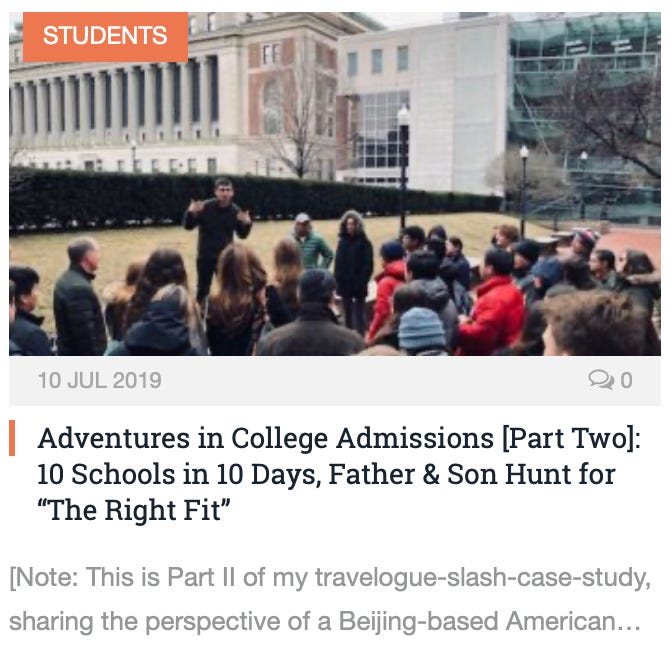
[Note: This is Part II of my travelogue-slash-case-study, sharing the perspective of a Beijing-based American father and essay-writing specialist. It's full of lessons-learned and guidance for how college applicants - especially foreign students - can persuasively "market" themselves to US Admissions Officers. Click here for Part I.]
By Michael J. Jordan
BOSTON – Before I chronicle more of our road-trip, be forewarned: this travelogue, overall, is a ringing endorsement of America’s elite universities. Without a doubt, they offer some of the highest-quality education in the world. With this travelogue, though, I aim to be fair. So, let me also air my overarching grievance about these schools: their cost.
On the one hand, I wholeheartedly recommend a US education for my son -- who'll soon apply there -- as well as for any foreigner courageous enough to study abroad. International applicants seem to agree: the US remains their #1 destination, by far.
The Chinese, in particular, embrace the benefits: over the past decade, they’ve leap-frogged others to become the largest community of international studentsin American universities, comprising well over one-third of the 1 million now stateside. (Moreover, the Chinese lead the way among the growing number of foreign students enrolled in US high schools.)
Today, they continue to apply in large numbers, though their overall enrollment has slowed. Experts largely attribute this to the anti-immigrant tenor of the Trump Era. (In 2017, I wrote a column about the range of contributing factors, soon after Trump was sworn in.)
Educational quality aside, though, there's the galling price-tag for this education. During our 10-day road-trip, we visited Boston University; Tufts University; Brandeis University; Babson College; Amherst College; Brown University; Columbia University; New York University; Swarthmore College; and, lastly, the University of Pennsylvania.
We heard average costs of US$50,000 for tuition, every year, plus $20,000 for accommodations and other necessities. After four years, you’ll fork out some $300,000 for that degree, which is basically a piece a paper that you’ll frame and hang on a wall.
As a parent, I try to process this jaw-dropping expense. But I'm unable to, frankly. I’m far from upper-class, but rather a divorced father of three who mostly freelances for not-for-profit universities, media and other organizations. On the other hand, as an American who hasn’t even lived on US soil since 2006, I can’t help but wonder: Is this investment worth it? Sure, try to attend the best school you can. But at what cost? How many years of debt?
Moreover, is this cost even necessary – for an undergraduate degree? Will it make a substantive difference, in the real world of the modern American workplace? Would it gain my son – or your child – a foothold in the best internships? A leg up over competing students from other universities? Access to even better experiences, and professional contacts, that may lead to a decent first job, post-graduation? In the field of his choice? With a survivable salary? (For rent, firstly, but also to pay off any college debt he’s incurred.)
Or, can we avoid this pricier path, altogether? To (slightly) reduce this burden, would it be better for my son (and his brother and sister, down the road) to attend a terrific, but less prestigious – and less expensive – public or private university? Study hard, and maximize your opportunities, then compete for a job that way? Later, if truly impassioned about a subject, then shell out the big bucks for an elite Master’s degree?
On our tour, each school’s representatives were quick to reassure parents like me that there are seemingly so many chances for “needs-based” financial assistance. At some places, even a chance at “merit-based” scholarships – for deserving students. The Admissions Officers often made it seem as if $50,000 were just the official cost, or a starting-point: For your child, though - believe me - we’ll arrange to make it much less.
We'll soon test out just how generous they are with the aid. It must be noted, however: financial aid is only available to American students. International students pay full tuition. That helps to explain why so many schools now welcome so many foreigners: over the past decade, most have doubled or tripled their enrollment. More than a vital revenue-stream for universities, foreign students reportedly injected $42 billion into the US economy, in 2017.
After hearing several schools reassure us of lower costs, I had an epiphany about the handful of Chinese parents we encountered on our tour, at every school we visited: Will your child’s tuition indirectly subsidize my child’s tuition? Yes, probably. For their part, though, Chinese parents appear to already accept their end of the bargain: $300,000 or so for a degree that’ll help their child – as well as their family – grow roots in America.
*****
So, money. That’s my lone grievance, really. Otherwise, I was genuinely impressed by the intellectual atmosphere and energetic vibe at all 10 schools we hit. Each was identified by my son’s University Counselors - at his international school in Beijing - and he himself arranged all the campus visits. (I pitched in a little, like coaching him on how to write a compelling cover-letter/email, to introduce himself to them.)
While Amherst was the only school we skipped out on [see Part I, to understand why], we explored the other nine as thoroughly as possible, within our tight schedule. At each, we absorbed a formal introduction and campus-tour. At most, we also grabbed a bite or sat for a hot drink – to soak in more community life. And now, finally, I resume the travelogue.
*****
How to decide which schools to visit? With such limited time, my son and I agreed that it’d be wiser to focus our college-tour on a few urban areas, and not “spread ourselves too thin” – driving maniacally through too many cities.
We started in New York City, because my family has long lived in its greater metropolitan area. I grew up in northern New Jersey, a stone’s throw from Manhattan. Two decades later, after living in Hungary for six years, I returned to the US with my Hungarian wife - that's why both our sons were born in NYC. (So, they're kinda-sorta "New Yorkers," though they've both already lived on four continents in their teenaged lives.)
With the city as our anchor, we settled on a target-trio of Boston, New York and Philadelphia. While my son was keen to check out some big-name schools, my objective was much more than to merely hit the schools that most appealed to him. (He’s intrigued by a far larger swathe of primarily East Coast schools.)
Instead, I wanted to offer him a tasty “sampler platter” of American-university life itself. My son is actually a dual-citizen, of both the US and the European Union (courtesy of his mom). With that, he’s mulling the option of attending university in Europe – where tuition happens to be more reasonably priced. In this “competition,” though, I prefer he choose America. Not just for family reasons: If a kid’s interested in International Business, why not study – and grow roots – in the world’s largest economy?
With Chinese New Year having begun, my two sons and I flew from Beijing to New York, arriving Saturday night. We enjoyed the first half of Sunday with family. By late afternoon, my old buddy joined us, and we set out on our journey: toward Boston. Our first visit was scheduled for the next morning.
Boston, too, holds sentimental value to me. Though I feel as if I’ve never lived in the city, I was in fact born there. (My sister, too.) Specifically, in Cambridge, as my father pursued his Post-Doctorate degree in Organic Chemistry at Harvard University. I only spent my first two years of life there, until Dad launched his academic career in New Jersey, as a Chemistry Professor at Rutgers University – one of America’s oldest and finest state schools. Nearly 50 years later, he’s become a Rutgers institution.
As we grew up in suburban New Jersey, all the Boston-area universities were popular destinations for our peers. To my ear, Boston University had a solid reputation: in high school, as I dreamed of working as a serious sportswriter, BU’s journalism program was a leading candidate.
*****
First up on our college-tour, then, is Boston University, where we’ll learn three crucial lessons about “the right fit” for schools – and for you. Pertaining to: 1) diversity; 2) flexibility; 3) critical-thinking.
BU happens to be the largest of the 10 schools we visited, with 18,000-plus undergraduates and 14,000-plus grad students. BU also happens to be home to one of the largest foreign-student populations in America.
The size of student body is relevant, because as we drive through BU, then walk around, the school is unmistakably urban. Its campus is woven into the cityscape. Immediately, I’m smitten with all the old, elegant, red-brick buildings, whether for classrooms or student housing. As we’ll soon hear, “We want you to feel, as we do, that you’re a citizen of Boston – and member of the Boston community.”
Then there’s the school itself. Before we flew out of Beijing, I’d been in a rush to finish my work; honestly, I hadn’t done much of my own homework about the schools we’d visit. That’s why I’m now caught off-guard when BU informs us of their most famous alumni: The Rev. Martin Luther King.
As an undergrad, the legendary human-rights leader studied in BU’s venerable School of Theology. My mind wanders to MLK: at a time of hyper-partisanship in Washington, when political life is woefully lacking courageous leaders, I marvel that BU produced one of our nation’s greatest heroes.
At the Admissions Office, we and a dozen or so families are shepherded into a small auditorium. Up on the narrow stage, two people await us: A young man, who turns out to be an Admissions Officer, and a younger woman, who’s dressed like a student. She is, in fact, a "student-ambassador" to visitors like us.
Speaking of first impressions: it’s one thing for the stylishly-dressed Admissions Officer to have both ears pierced. More striking is his black nail-polish. That’s a bold statement by the school itself; it’s unimaginable that our roomful of parents and students will miss this detail.
The statement? That BU is a liberal, tolerant, open-minded school: Are we the right fit for you? If such values are meaningful to you, too: do you have concrete evidence, through personal experience, to prove they’re truly meaningful? If so, you should highlight this when answering their 250-word Why Us? essay, which they word as: What about being a student at Boston University would most excite you?
The Admissions Officer opens his talk with a breaking-the-ice activity: “Who thinks they’ve traveled the farthest to get here?” Up front, one young fellow with his parents, speaks up: Lima, Peru. My son raises his hand, which pleases me: Beijing, he says. For a second, I think he’s “won” this survey.
Behind us, though, others call out. In rapid-fire: Hong Kong! Shanghai! Shandong Province!
I smile. The Chinese are here! As I’ve learned from working and living in China, there’s no parent in the world more serious about their child’s education, than the Chinese parent. Quite a few Chinese are already in America – building (human) bridges between the world’s two-largest economies. Now we’re face-to-face with many more, banging on the door.
During our tour, all the Chinese we encounter are also seizing upon the Chinese New Year break. Yet they symbolize something more about China: they have the means for such a trip. Or, if they can’t truly “afford” this luxury, these parents prioritized this trip for their child – for some interesting reason.
At Tufts University, for example, we chatted with a Chinese mother and son, as the teen toted around a Georgetown University water-bottle. They’d just come from Washington. I was impressed. Then, a few days later, we bumped into the same friendly duo in New York. At Columbia University.
*****
Back at BU, the Admissions Officer has now made us well aware of how diverse we are. But for him, this is much more than an ice-breaker, to (successfully) warm us up. In fact, it’s his entry-point to spotlight a core BU priority: “We value the diversity of students, as well as the diversity of thought.”
I turn to my son, who’s nodding and smiling. He likes the notion of “diversity of thought.” To me, though, this two-pronged meaning of “diversity” is immediately reflective of BU values – and offers great potential fodder for your Why BU? essay. Even the Admissions Officer’s outward look suggests that when it comes to diversity, including a wide range of accepted lifestyles, BU doesn’t just “talk the talk” -- it “walks the walk.”
Again, imagine how you’d answer that 250-word essay for BU, or for any other school. As I coach my students: take the time to think about – deeply and introspectively – the real you. What makes you authentically you? What do you care about? What impassions you? And why, why, why? Why exactly do you think what you think? Why exactly do you feel what you feel? Why exactly do you believe what you believe? And so on.
Let’s say you feel that “diversity” is one of your defining character traits – whether it’s your embrace of, appreciation for, or curiosity about, diversity. (Or, perhaps all three?) In terms of your broader Strategic Communications and Effective Messaging, you should probably rank this trait among your most persuasive selling-points – whether it’s in your application essays, Skype interviews, CV, cover-letters, or in anything else that builds your own brand, and promotes what you’re “selling.”
In this market of American universities, when you find a consumer that specifically seeks out a product like you, how effectively can you convince them of your comparative-advantage and value-added, over other products? Can you mold a persuasive message, support it with credible evidence, and fold it all into a compelling story – to humanize yourself? That’s the stuff I teach and train others to do.
For BU, go ahead: Don’t just tell them you share their value of diversity. Show them.
*****
Now the BU student-ambassador weighs in: she’s an inspiring young black woman who jokes that she’s from a corner of rural Georgia where there are “more chickens than people.” Now a senior, she tells us how she started out Pre-Med, yet wound her way toward a History major – and a minor in African-American Studies. That minor degree is significant, as we learn how BU has nurtured her political awareness and activism. This included an internship in the Massachusetts Statehouse, where she learned how policy is produced.
Again, her own nurturing process speaks volumes about the school’s values. Do we match your values? More revealing, though, is her journey from one major to another, which she’s about to explain.
But first, some relevant context: BU offers students more than 300 “programs of study.” But they don’t require or oblige you to declare your precise, preferred program, before you arrive on campus. Instead, you can start out as an Undeclared major.
“And that’s OK,” the Admissions Officer tells us. “You can apply to a specific school within BU, then decide on your major later.”
Illustrating this flexibility, the young woman describes how she entered BU with dreams of becoming a doctor. But a tough Chemistry course soon punctured her ambitions.
She switched to International Relations. But this wasn’t the right fit, either. “I was confused, and felt a little lost,” she says. Until, an adviser sat her down for a chat. “She asked me: ‘What about International Relations attracted you?’ Even I wasn’t sure. Then she went through the full course-list – to identify which courses appealed to me the most. We noticed: they were all history-based courses.”
That’s when she became a History major: “BU gave me the space and time to figure it out.”
The Admissions Officer chimes in: “We want to make sure that every student finds their passion – and engages in that passion.”
I mention this “flexibility” issue for two reasons. First, because it sounds like an ideal option for many students. Especially, teenagers like my son. Imagine how much pressure that is, to place on a pair of young shoulders: asking a teen to state with (at least the appearance of) conviction, I want to do XXX with my life.
Second, this signals another potential essay, underpinned by a powerful message. Every school will also ask you to write a short essay that answers: Why Study This Major?
When I coach a student who worries they lack a clear-cut vision of their future, I offer two options: Either “Bluff your way through it” – which I don’t recommend. Or, “Turn a negative into a positive.”
For example, if the reality is that you find several topics intriguing, but can’t settle on one, we massage the message into something like: My intellectual curiosity spans so many topics, from XXX to YYY to ZZZ … That said, to prove you actually exert intellectual effort in these areas, you must produce concrete “evidence.” Or else your smart but skeptical audience – the Admissions Officer – won’t be convinced. They'll think you're bluffing.
Now, connecting dots to a school like BU, which offers you the “Undeclared Major” option, that’d work perfectly fine. You’ll clearly explain why exactly you’re declaring yourself Undeclared … for now. So, you could continue your messaging with: That’s why I’m so pleased to learn of BU’s ‘Undeclared Major’ option, because I know that your school will give me the time and space to discover my true passion …
*****
Lastly, the third lesson-learned at BU: about critical-thinking. Despite BU’s size, they say they maintain a 10-to-1 ratio of students-to-faculty. In these smaller, more intimate classes, you not only get to know your professors well, but also won’t be able to avoid their scrutiny.
Our student-ambassador cites one memorable example, involving her Professor of African-American studies. In class one day, he called on her, to contribute her opinion to the discussion. She went on to state what she thought. The professor wasn’t satisfied, so he pressed her for more: “But why do you think that?” Her reply: “Ummm, because I do.” To which he responded: “That’s unacceptable.”
She was struck like a lightning-bolt. This professor was pushing her to think more deeply, about why exactly she was saying what she was saying. That moment left a lasting impression, as it inspired her to improve herself. “Today, he’s not only my professor,” she says, “but my mentor and friend.” He’ll soon write her a recommendation-letter, too.
As I sit and listen, I’m smiling. As a teacher, these are precisely the sort of critical-thinking skills I teach my students. As a parent, I want my son to have professors who’ll similarly push him to sharpen his mind. And as a coach, this is another element of “right fit”: BU prioritizes critical-thinking, as a skill that must be cultivated among today’s youth.
If this value mirrors yours, can you actually prove it? Again, with a molded message, backed up by believable evidence, wrapped into a memorable story about you – all of it aimed at convincing BU that you’re truly an ideal candidate for them.
It's not just BU, of course. The same strategy holds for any university: show them, don't just tell them, that you're “the right fit” – for each other, in fact.
Comments
Nothing yet. Say the first thing.
Sign in to join the conversation.