
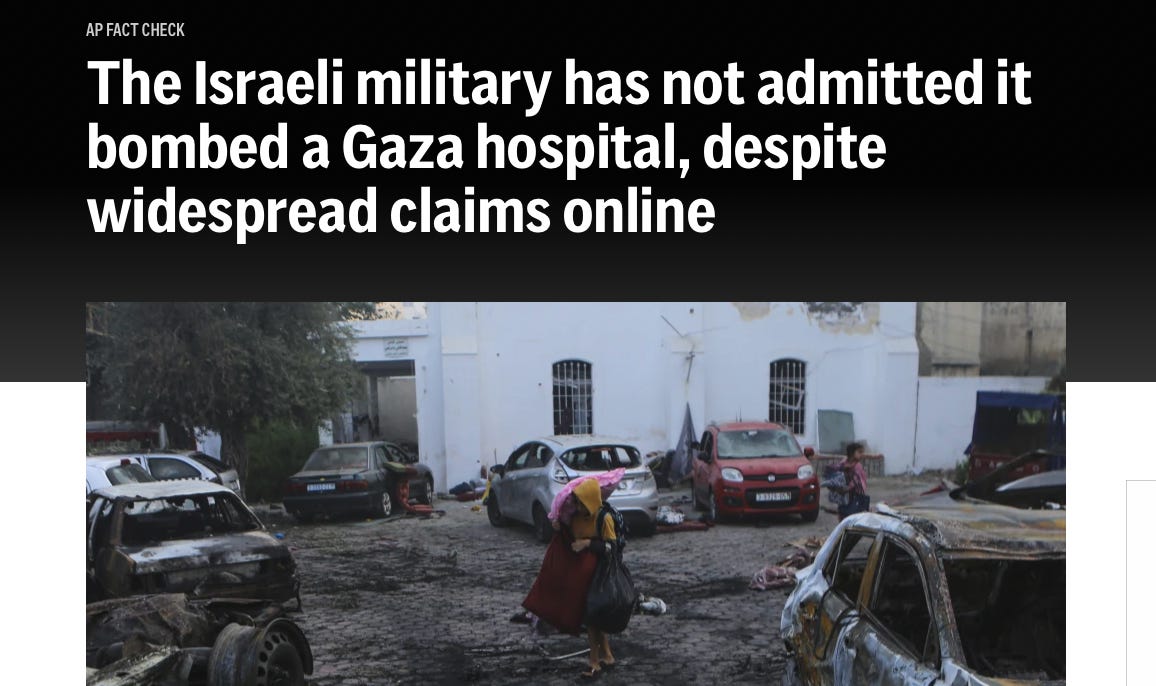
NEW YORK – It’s time to pause from publishing my weekly chapters for this newsletter, to revisit another past essay that – in light of the horrific bloodshed in #Israel and #Gaza – is timely and relevant for all of us today: #disinformation, #FakeNews, #propaganda and our need for greater #MediaLiteracy.
In the essay below, I’ll equip you with a handful of my critical-thinking skills to distinguish between more-credible and less-credible sources of information. Even skills for how YOU can become a credible content-creator. I wrote this essay back in 2017, while living in #China, as Donald Trump became a daily source of disinformation – from the White House. I then crafted and presented these skills at a public lecture in #Beijing, then to students at my kids’ international school.
In 2021, once back in New York, I shared these skills amid the wave of #COVID disinformation – in two courses I taughtat Long Island University in #Brooklyn, entitled Journalism, Social Media & You. Much of the focus then was on a popular new term in public discourse: #ConfirmationBias.
WebMD defines this psychological phenomenon as: “The human tendency to only seek out information that supports one position or idea. This causes you to have a bias towards your original position because if you only seek out information that supports one idea, you will only find information that supports that idea. This is in opposition to doing more comprehensive research that would expose you to opposing ideas.”
In short, if you were, say, anti-Israel and pro-Palestinian before the Oct. 7th terrorist attack, you’re predisposed to believe news that exonerates Hamas and blames Israel. If you were pro-Israel and anti-Hamas, you’re predisposed to believe news that exonerates Israel and blames Palestinians.
It’s often those folks who, already hardened in their views, pounce on the latest disinformation – and share with others. As Media Psychology Prof. Jason Ohler once put it: “Confirmation bias is Fake News’ best friend.”
That said, there are still individuals in the middle, who may be swayed one way or the other; and all the youth now developing their critical-thinking skills – and new to this age-old Middle East conflict. With those two cohorts in mind, I present this essay, which lays out the argument for us to: 1) introspectively assess our biases; 2) skeptically consume any news; and 3) identify which sources are most credible.
As for my Global Communications Toolkit, while last week I published Chapter Thirteen: MJ’s Filters & Polishers, Part II, next week my flow of weekly chapters will continue with Chapter Fourteen: The Psychology of Interviewing.
*****
(Oct. 17th, 2017: Last month in Beijing, I was honored to be a panelist at an event co-sponsored by the Yale Club of Beijing and Penn Wharton China Center: on the epidemic of #FakeNews. In this #PostTruth Age of Trump, I emphasized why we need "Media Literacy for Youth." As a Foreign Correspondent and Communications Consultant who's also taught journalism on four continents, I've written this essay to share my tips for how our children can protect themselves when they surf and consume both traditional media and social media.)
By Michael J. Jordan
BEIJING – See the words above, purportedly uttered by U.S. President-Elect Donald Trump? I recently came across this quote while still stunned by the Trumpian triumph over decency in the Nov. 8th elections. I sorely wanted to believe this was a “smoking gun,” confirming Trump as our modern-day P.T. Barnum, widely credited with the line: There’s a sucker born every minute.
One problem, though. The People magazine quote is a hoax. For some reason, I wanted to see the original, rather than immediately post it to Facebook or re-Tweet, as others might have. So, I Googled: Trump + People Magazine 1998 + “dumbest group of voters”.
Among the first links is from The Annenberg Public Policy Center, of the University of Pennsylvania. (None other than Trump’s alma mater!) The APPC debunked the quote one year ago, through its FactCheck.Org project: That’s a bogus meme, they concluded.
That set me straight, at least. But then I pondered the hundreds, if not thousands, who seized upon the quote and disseminated it widely. (Like this guy.) Then the thousands, if not millions, who read it. Then, the countless kids who may read it today. Or, in the future.
Ugh. This is just one tiny example of today’s fog of information, misinformation and disinformation – and from “my side” of America’s great political divide, no less.
Whether you sit on The Left, The Right, or somewhere in the middle, you couldn’t ignore an election campaign filled with bias (real, perceived and fabricated); conspiracy theories; unsubstantiated rumors; pure propaganda; fact-free promises; false accusations; etc.
And in the month since, one of the hottest topics has been the too-little-too-late revelation about “fake news” – and how pervasive and influential it truly is. Like malarial mosquitoes, it infects Facebook, Google and Twitter – and perhaps helped swing this election. Such "computational propaganda" is also accused of swaying Britain's stunning Brexit vote.
This daily barrage of “post-Truth” reality is tough enough for a fellow like me to handle: I’m a media-member for a quarter-century, who also teaches journalism, and commands quite a finely tuned dung-deflector. What really concerns me are the most vulnerable among us: the children. Innocently surfing the Internet, intellectually unarmed to protect themselves.
Yet, beyond bemoaning this scourge, and calling on Facebook and Google to crack down on fake-news infiltration, we need more public guidance on how to protect ourselves. Immediately. Especially, our youth. (Here’s one crusader I found, plus a Teen Vogue editor who accuses Trump of “normalizing deception” and advises her readers to “regain control of the truth.”)
That’s why my new cause célèbre is to advocate for a renewed focus on “Media Literacy for Schoolchildren.” More than a one-off lecture or classroom discussion, I think it warrants a full-semester course. (Farther down, I offer my own how-to guide to consume media.)
The best part of this? It’s a bipartisan issue. If there’s one thing that every parent can agree on is, regardless of political preferences: We all want our children able to distinguish “fact from fiction.” After all, would any parent admit, “Yes, I want my child to be brainwashed”?
Beyond parents, it’s in everyone’s self-interest that our youth possess sharper critical-thinking skills – particularly when consuming media – to make wiser decisions in the future.
However, a new Stanford University study exploring the “civic online reasoning” of nearly 8,000 kids suggests “a stunning and dismaying consistency. Overall, young people’s ability to reason about the information on the Internet can be summed up in one word: bleak.”
I can’t think of a more urgent issue, for this plague won’t leave us soon. In fact, it may grow worse, says one in-the-know commentator. Check out how that bogus story about Hillary Clinton as ringleader of a child-sex ring spurred a gunman to invade a Washington pizzeria. Or how a fake-news bit reportedly prompted a Pakistani leader to threaten Israel with a nuclear strike.
Or how Trump tweeted in 2012 that climate-change is a hoax perpetrated by China. (Which China denies!) Or more recently, when our incoming Conspiracist-in-Chief claimed as fact that several million votes were illegally cast in the election – without one iota of evidence.
How’d his enablers respond? “It’s his right to express his opinion,” said Vice President-elect Mike Pence. “I don’t know if that’s not true,” said Chief of Staff Reince Priebus. “It’s possible.” Translation: in Trumplandia, stated “fact” dissolves into “opinion” – and anything is possible.
Meanwhile, I regularly read Trump supporters in Comments sections react to each new conspiracy theory with that absurd prove-it’s-not-true formulation. To younger, or less-developed minds, this sure sounds plausible. But it’s just as impossible to prove that negative as it is to prove, say, that space-aliens did not vote for Hillary. The Media Literacy lesson here: To those who hurl an accusation, the onus is always on you to convince us with facts.
To be clear, by advocating for Media Literacy, I’m not inventing the wheel. Surf online, you’ll find a slew of educators and activists promoting a field that the National Association for Media Literacy Education defines as: The ability to access, analyze, evaluate, create and act using all forms of communication ... Media literacy empowers people to be critical thinkers ... and active citizens. It’s reportedly been endorsed by the American Academy of Pediatrics, American Psychological Association, National Council of Teachers of English, and others.
“A growing number of schools are teaching students to be savvy about choosing and believing various information sources, a skill-set educators label ‘media literacy,’” the Wall Street Journal recently reported. “However, fewer schools now have librarians, who traditionally taught research skills. And media literacy has slipped to the margins in many classrooms, to make room for increased instruction in basic reading and math skills.”
Regardless, I believe a more extreme form of Media Literacy is needed. The perpetrators of this dark “post-Truth” epoch we’ve entered – some of them allegedly steered by Moscow, with others craven profiteers – are preying upon our widespread media illiteracy, wreaking immeasurable damage to our democracy. And in the process, driving us all a bit batty.
The conservative radio-host Charlie Sykes made a remarkable admission this summer. The right-wing media’s relentless bashing of mainstream media has “created a monster,” Sykes said. “We’ve basically eliminated any of the referees, the gatekeepers. There’s nobody. At a certain point you wake up and you realize you have destroyed the credibility of any credible outlet out there. And I am feeling, to a certain extent, that we are reaping the whirlwind at that. And I have to look in the mirror and ask myself, ‘To what extent did I contribute?'”
Confronting this monster, we must inject our youth – who as you read my essay may be surfing online for a homework assignment, exploring a socio-cultural-historical topic, and wade into heavily politicized muck – with more than the healthy dose of skepticism: Don’t believe everything you hear, or read online. As in, expect the truth, but cast occasional doubt.
Instead, we should flip this paradigm upside-down. To groom our kids to be vigilantly anti-gullible, the wiser starting-point may be: Believe nothing you read or hear ... until that source of news, information or opinion proves itself credible and deserving of your trust.
Keep in mind, I’m not proposing a means to make American kids smarter. Sure, that would be ideal. But more pressing is to make kids more skeptical and sophisticated about what they consume, how they consume it, and cognizant of those dark forces lurking out there.
This approach is modeled after my own journalistic skills, accrued over two decades as a reflexively skeptical, suspicious, sometimes cynical Foreign Correspondent. They’ve served me well, enabling me to produce savvier, more sophisticated coverage from 30 countries.
Broadly speaking, everything I teach today – whether Journalism or Communications – can be categorized as “humanized, fact-based storytelling.” The humanized part means interviewing real people, to illuminate and personalize any real-life issue or situation.
The fact-based portion means that whatever my assertions, I back it up with concrete evidence. My aim is to persuade you – my smart, curious audience – that what I write is true. Or, if making an argument, I want to convince you that my point is valid, if not correct.
Since I respect my audience’s intellect, I invest the time to research and persuade you. In contrast, purveyors of “fake news” and floated conspiracies reveal great disrespect for their audience: they assume, correctly, that few will question the story, or demand credible facts.
Now, as I unearth most of my “evidence” today from the Internet, I see how online fact-gathering – and even the most basic information-consumption – requires a modicum of “Media Literacy.” So, when I teach students or train professionals, I emphasize the need to sleuth for concrete facts and compelling evidence. Particularly, from “credible” sources.
At what age, then, should Media Literacy begin? Even my daughter, who’s almost 8, recently searched online for a class project about the Natural Wonders of the World; she could have stumbled into a one-sided, even fact-free, God-not-science debate. Meanwhile, as a huge Taylor Swift fan, watching her music videos, my daughter could easily scroll down to the comments and find more than fawning fandom – falsehoods spread by “haters,” too.
Certainly, though, Media Literacy is needed for kids my sons’ ages: 14 and 12. At their prestigious international school here in Beijing, teachers already assign them to “follow the news” and research online for class assignments. The faculty also leads all students through an “E-Safety” course: warning them of the dangers of computer viruses and online creeps. That’s a good start, but doesn’t go nearly far enough – into the realm of content.
My 12-year-old just had an actual God-creationism-versus-science-evolution assignment for Humanities. And when news recently broke of Fidel Castro’s death, my 14-year-old hit me with the following “fact”: Hey, did you know that Castro survived 638 assassination attempts?
My reflexive response: Says who?
Suddenly, he recalls my earlier tutelage. Oh yeah, I remember: According to whom?! I read the story on the BBC website.
Well done, son. But this is a teachable moment, so I press him further: How does the BBC know this information? Who’s their source? Who could even “know” a specific number of how many times Castro “survived” assassination attempts? It can only be the Cuban government.
So, I caution him: As the audience, should we trust a tightly-controlled Cuban propaganda machine that’s operated for half-a-century? Could they have an incentive to exaggerate this assassination figure? To impress their own people? Or others around the world? About how many times they fended off the CIA, or dissident threats to Castro’s “revolution”? And so on.
I finish with: Go check the BBC story again. I sure hope they didn’t present it as a “fact,” but cited the source of that number. If not, be skeptical! And if they didn’t, I’d be disappointed.
It turns out, the BBC didn’t present the 638 plots as a fact, but qualified it as a “reported” figure. Still, the BBC failed to cite the source of this figure. (Did they do so because they sensed that attributing it to the regime in Havana might undercut a titillating story? Hmm.)
Finally, on to my own brief, how-to guide to Media Literacy. This is the foundation for any curriculum that I’d develop: first, for how to consume all media and information; second, for how to generate “media” of a high standard to which we should now hold other resources.
Note: as an educator, I believe it’s important to practice what I preach. That’s why with several of the tips below, you’ll notice how I’ve also employed above, in this very essay.
When consuming media:
1) Says who? When they state a “fact,” are they transparent about the primary source? Do they attribute directly to that source, and “give credit where credit is due”? As with the Trump-Republicans quote atop this essay, then the Castro-assassination issue, it’s essential that youth learn to reflexively respond to any presented fact by questioning: “Says who?”
2) How transparent? One ex-CIA deception expert refers to the "validation void" that signals fake-news. With whatever you read, is there a hyperlink to the primary source, embedded within the story? If not, is it at least accessible? If you have the time and determination, can you track down and verify this “fact”? As with the Trump quote, I searched and easily found it debunked.
3) Are they credible? This is a tricky question. Just as with the definition of terrorist – where one man’s “terrorist” is another man’s “freedom-fighter” – who seems “credible” and “believable” to me, may be “biased” and “unreliable” to you. Still, just because a source touts itself as “fair and balanced,” doesn’t mean they truly are. Today, we should work hard to identify trustworthy sources of information. Two ways to do this, at least:
4) Who’s against them? When you come across an unfamiliar source – whether a media platform, NGO, or anyone else – spend a few minutes to plug their name into various search-engines, to see how other sources you consider credible view this source. If they’re “controversial” or “perceived as XYZ” – whether those labels are true or not – it’s still relevant context for you to know they’re viewed controversially or perceived a certain way. Like attaching an asterisk. You’re free to be a fan of Breitbart News, but where folks like Trump call them “conservative,” others view them as the tip of the “alt-right” spear.
5) Who’s with them? It may also be worth your time to dive deeper into their website, reading the About and History sections, even the Partners and Donors sections, if they have them. Sponsors and bedfellows may reveal a lot about where the true loyalty lies for any media-platform, NGO, etc. Especially if you can follow the money – and who bankrolls them.
6) How consistent? Sources of news, information and opinion should work hard to earn our trust. In fact, we should demand that they work hard to do so. That means we want more than just one credible report on their site, because that’s part of the strategy: mix in the real with the fake, to blur the lines. Once they consistently demonstrate reliability – establishing a solid track-record – only then should we hand over something as valuable as our trust.
7) Shades of grey. Don’t be swayed by those who generalize, over-simplify and paint a broad-brush. It’s rare in life for situations to be purely black-and-white. Seek nuance. For example, the voices who rail against “the liberal, biased mainstream media.” Or proclaim: “We can’t believe anything in The New York Times.” Sure, major media make mistakes. And, sometimes display bias. But dismiss them completely? That’s not just silly – it’s dangerous to democracy. So ask yourself: “Why does this source want me to dismiss the other side, entirely?” By delegitimizing the watchdogs, or any voices of criticism, it could be that they’re aiming to win your heart and mind – but not for altruistic reasons. Which leads to a last tip:
8) Monopoly on truth. A first-cousin to tip #7. Beware anyone who claims they alone should be trusted: “Don’t believe them, only believe us.” Even the Times’ slogan – All the News That’s Fit to Print – is itself a lofty conceit (“Really? All the news?”) to be taken with a grain of salt. Yet even when a credible source has worked to earn your trust, remain vigilantly skeptical of what you read and hear. Apply each of the steps on a daily, case-by-case basis – as I do.
When generating media:
1) Establish your own credibility. As I tell my Student-Journalists: With all due respect, you’re a nobody. Heck, I’m a nobody, too. We write something, post it online. But why should anyone believe us? That’s why we must work hard to earn our audience’s trust – especially, if we want them to return to us again. This is our name, our reputation. What could be more important? So, several steps to establishing our own credibility:
2) Show, don’t tell. I believe in nothing more fervently than this principle. Whatever we write, whatever point we make, back it up with “facts,” in the form of concrete evidence. Even if it’s “only” a 140-character tweet. Credible proof can persuade a smart audience.
3) Transparency. Ideally, you cite “credible” sources. But again, your perception of credible may differ from my perception. Rather than quibble, though, let the reader decide. How? Be transparent with your information and attribute it to a specific source. As I did above by quoting the Annenberg Public Policy Center. The University of Pennsylvania is an Ivy League school, after all. However, I’ll let you, the reader, decide if they’re credible enough.
4) Hyperlinks. How transparent? In the old days, pre-Internet, it sufficed to write: According to XXX, ... With online media today, though, the most persuasive, most transparent way is to hyperlink to that specific webpage. This is also “reader-friendly”: if they want to read the material for themselves, or learn more about the subject, you’ve made it easy for them. Again, with the Trump-quote hoax, I hyperlinked directly to the Annenburg report. In fact, I’ve grown used to hyperlinking the hell out of my stories – as you see throughout this essay -- and urge others to do the same.
5) Invest the effort. When writing, it surely is time-consuming to research for all these facts and hyperlinks. Yet it makes a deep, positive impression on our audience. (In this Essay, for example, I could’ve simply asserted “disseminated it widely” and “we need more guidance” – and maybe that would’ve been enough for you. But I went ahead and researched both, found examples, hyperlinked to them. Did it further convince you?) This track-record of reliability we create paves the way to credibility. So, yeah, I think it’s worth the effort.
6) Qualifying terms. When citing sources, orally or in writing, today I liberally use words like allegedly, reportedly, purportedly, and so on. I don’t know, beyond a shadow of a doubt, these are truly facts. I didn’t do the original research, for example; I’m typically citing those who did. Or, with an accusation, the accused hasn’t been convicted in a court of law. In your case, too, you only “know” something because you heard it or read it somewhere. Likewise, when someone says what they think, or feel, or believe, we never know what they truly think or feel or believe – only the fact that they “said they think X,” or “said they feel Y,” or “said they believe Z.” So, to cover your ass – or “CYA,” as my editor often harangued me at my first newspaper job – use these qualifying terms. Yet all of this is also for the sake of accuracy.
Here’s one last example, combining several of my tips. Above, I could’ve simply opined that “nothing” is being done for Media Literacy in America – if I were lazy and unfairly polemical. Instead, I researched. Then, rather than merely tell you a movement exists, I showed it, with hyperlinked evidence. Then, that subtle phrase: media literacy was reportedly endorsed by three organizations. I found each quoted on the website of a seemingly credible source.
Should I take this website’s word for that endorsement? In a worst-case scenario, what if they’re lying? CYA! Well, for this essay, am I ready to research and confirm if each of the three actually endorsed Media Literacy? Tough call. If I were writing this piece for a serious mainstream client – and if this were a critical issue – I might. Instead, I wrote this for myself.
So, my compromise was a subtle short-cut: insert the term “reportedly” – then hyperlink to who reported it. (Just as the BBC could have done with its Castro-assassination piece.) The message to you, dear reader: It’s not me who says they endorsed it, but them.
Sadly, I don’t expect either the U.S. lawmakers in charge, nor the new incoming Secretary of Education, to be receptive to redoubled Media Literacy efforts. There will always be certain forces, across the spectrum, with zero self-interest to get “the facts” out – or nurture a citizenry that demands them. To be fair, this is not a uniquely American phenomenon. Which leaders anywhere want their populace to insist on greater transparency and accountability? Those who seek power, want it. Those who hold power, don't.
So, Media Literacy falls to individual parents, schools, teachers, community groups and NGOs. Yet this, I believe, is a patriotic, bipartisan cause worth fighting for. It may not work for every kid. But desperate times call for desperate measures. We each need our own finely tuned dung-deflector.
As our noble Constitution reads: We the People. Let’s not reduce it to: We the Sheeple.
Up next ... Chapter Fourteen: The Psychology of Interviewing
*****
Comments
Nothing yet. Say the first thing.
Sign in to join the conversation.