
As I often tell my students, in storytelling, you’re free to take whatever approach you wish – to tell your story. But only if you’re very confident that your audience will stick with you and read to the end. After all, that’s our goal, right? After spending hours, days, even weeks on a story, we hope it’ll be consumed. Fully. Not just the beginning. Or half of it. The entire story. That’s the ideal.
In US journalism, there’s a time-tested style to “hard news” stories, called The Inverted Pyramid. In this chapter, I’ll briefly explain that approach – and provide a few of my own examples.
Yet, the bulk of this chapter focuses on something else. Throughout my career as a freelance Foreign Correspondent, reporting from 30 countries, hard-news wasn’t my forte. Instead, as illustrated in previous chapters – like Chapter Six: The Flourishing Freelancer and Chapter Eight: Touched by Terror – I've spent much of my career writing what some might dismiss as “softer” feature stories.
A more accurate description of my preference, though, is that they’re News Features: a fusion of hard and soft. My features are generally broader, deeper and evidence-driven. Humanized with colorful detail. Yet they always include a newsy hook, too: a storytelling element within the story that identifies something happening today – and delivers a compelling argument for the audience to consume it now.
With that in mind, this chapter focuses on my own unique, news-feature style, which I developed over time: The Diamond Story Structure. Not only did I apply it to virtually piece of my own journalism, but over the years adapted it to all forms of message-driven, evidence-based, non-fiction content – this includes everything from strategic storytelling in Corporate Communications, to building your own personal brand (as I’ll show in Chapter Twenty-Eight) to even university-application essays (as I recently showed in Special Edition #4: Apply My Toolkit to Write a Persuasive Personal Essay).
Moreover, as I’ve done throughout the skills-centric portions of this book, I’ll walk you through the writing process, explaining each step along the way: from preparing for the writing, to actually producing it. More than story structure, though, I’ll share with you my techniques for how to open your story, how to pick and choose the most necessary elements, and how to become “your own first editor.” Lastly, I’ll provide concrete examples – from me and my students – to illustrate The Diamond in action.
The Inverted Pyramid
This isn’t a journalism book, specifically, so I won’t dwell too much on the Inverted Pyramid – which is the most traditional, and still most popular, style in all of news reporting. I’ll only describe it here as a point of reference, to show how it compares and contrasts with my Diamond.
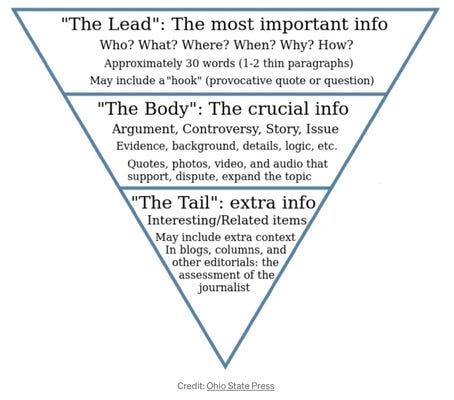
In short, the Inverted style is called such because the story’s flow mirrors the shape of an upside-down pyramid: we cram the most vital information into the first one, two or three sentences. Then, lay out the remaining elements in descending order: from most important to least important.
This was particularly crucial during the days of the telegraph, when the audience relied on urgent dispatches from around the world. Over time, editors who had to fit stories into tighter spaces, customarily cut from the bottom up – where less-important details were presumably buried.
By “most important” details, I’m referring in general to the vaunted 5 W’s & H of any news event or situation: Who, What, When, Where, Why and How. (Moreover, as I noted in Chapter Four: What Editors Want and Chapter Fifteen: Interviewing Skills & Strategies, the more serious-minded media should include deeper content that explores what I call the 6th W of journalism: Why exactly?)
The rationale for this Inverted approach is just as compelling today – in the digital age of fast-paced, 24-hour news-cycles – though for slightly different reasons: Summarize the news quickly and efficiently. Don’t assume the audience has time or interest to read until the end. Hit them with what matters most, up high. If you’ve read news for years, you’ve noticed how much shorter some pieces are.
Moreover, there’s still the practical appeal: If a publication suddenly finds itself with limited space, it’s quicker and easier to cut from the bottom up, rather than to tighten and streamline the entire story, throughout the text – which is far more time-consuming. (I speak from both sides of this process.)
I learned to write in this Inverted Pyramid style as part of my own journalism education, back at the University of Missouri. (As described in Chapter Two: A Journalistic Journey Begins.) It wasn’t just in journalism class that I honed this skill, but also while serving as a stringer for the Associated Press, covering the school’s football and basketball teams. The AP, and news-agency brethren like Reuters, AFP and Bloomberg, are prime purveyors of this clear, direct, get-to-the-point approach to news-reporting.
After graduation, I had many more real-world opportunities to practice this style in my first newspaper job, while reporting for The Hemet News from 1991-92. That daily paper was published every afternoon, so our deadlines were mid-morning. I’d cover, say, a City Council or School Board meeting at night, report to the newsroom early the next morning, typically between 7 and 8, then pump out one or two stories about that meeting, under deadline pressure, by 10 a.m.
It was a terrific skill for a young reporter to learn. Whether it was a civic meeting, or emergency for the local Police or Fire Department, I’d open my story by identifying the most salient details of the 5Ws & H. Next, insert an insightful, meaningful quote from one or two prominent players in this mini-drama. Then, include a bit of background context – to explain its origins and evolution.
I recall our Editor, Perry Flippin, always reminding us of this need for at least one or two lines of relevant context: “Even if a reader is just passing through town, staying in a motel, and picks up our paper over breakfast, they should be able to follow your story and understand what’s going on.”
After the summarizing intro, insightful quote, and broader context, we shift to the less-necessary details, in descending order – from more-important to less-important. That’s the formula.
From Southern California, I moved to Northern California to report for a weekly newspaper: Neighbors – the community supplement of the esteemed daily, The Sacramento Bee. In terms of writing style, this was quite a change: no longer a need to write breaking-news, on a daily deadline. Instead, with a weekly deadline, I’d write in a style “with legs” – meaning, the article could last longer.
This included more context about the story’s Big Picture, explaining to readers why it matters, with less focus on a specific, time-sensitive event. Instead, that event would generally be the “timely hook” – or reason for why to explore this issue now. This way, a reader could read the article any time during the week, learn about the issueexplored, and draw out deeper value than a daily story.
From Sacramento, I relocated to Budapest – where I’d write almost exclusively in a more news-feature style. In fact, with a few exceptions over the years, I basically went two decades without using the Inverted Pyramid. Then, in late 2014, after relocating with my wife and kids to the Kingdom of Lesotho, in Southern Africa, I suddenly found myself amid an attempted military coup. For many months, I served as Lesotho’s lone foreign correspondent, reporting for Agence France-Presse, or AFP.
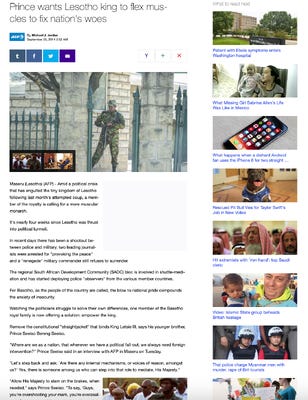
The French news agency primarily uses the Inverted style, and mostly wanted that from me: I filed regular dispatches to update their global readership about this ongoing crisis. I’ll explain much more about my role in the Lesotho drama in Volume Two of this Global Communications Toolkit. But for now, here’s a trio of examples from my AFP coverage – to illustrate the Inverted style:
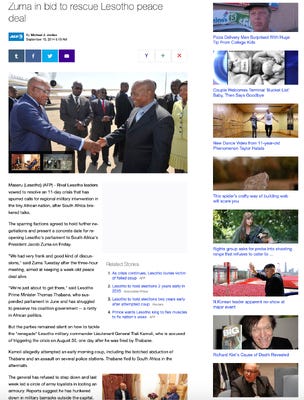
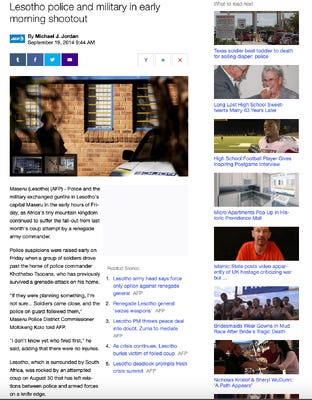
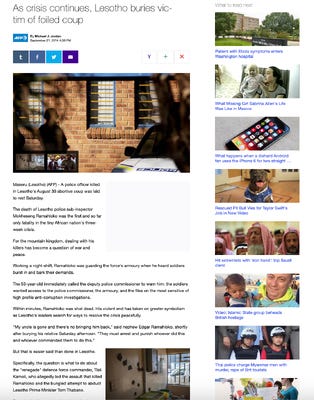
Plus, a featurized news story - after I interviewed the Prince of Lesotho:
Convincing Readers to Scroll
Beyond my daily-news coverage for The Hemet News, I wrote a number of Features and News Features for the paper. Yet, it was really in late 1995, once I began reporting for the daily Christian Science Monitor (as described deep in Chapter Three: My Big Break), that I’d hone my News Feature writing. It wasn’t by choice, but out of necessity – to satisfy my editors, who preferred broader, more meaningful, value-packed stories when informing CSMreaders about various corners of the globe.
The point here is about how to open such stories. Back then, newspapers were still printed on broadsheet. One challenge was to convince readers to read a story that might be broken in two: if it started on one page, then continued on another. You’d risk losing too many readers in the process.
For example, I’d occasionally produce a story that my editors deemed interesting or important enough to publish it on … the front page. Whoo-hoo! That’s a big deal, in the world of daily journalism. Center stage. Prime real-estate. However, I recall one editor cautioning me with this caveat:
Michael, we’re going to publish your story on tomorrow’s front page. But of course, we can’t run your entire story on the front page. We may only publish the first 100, 150 or 200 words out front, in a box. Then we’ll run the rest of it inside, on Page 7. Your challenge is that once they read your first part out front, then hit the line that says “Story Continues on Page 7,” yours should hopefully be interesting enough, and written well enough, that the reader will want to jump with you – inside to Page 7.
Yet, why exactly was jumping to Page 7 so important? First, as I said from the outset of this chapter, if we spend hours, days or even weeks on a story, we surely hope that at least some readers will read the entire piece. Second, what else was on Page 7, besides our article? Advertisements! Yes, there was a financial motive, too. How else could the paper’s Ad department charge clients to advertise on Page 7, unless they could convince them that readers would actually read Page 7? How to craft a story so compellingly, that readers jump? My editor offered some guidance:
Open by writing about a person in a colorful, interesting and humanizing way. Next, let’s see a quote from them, to hear their voice. Then, a line of transition to connect dots between this person and your broader story. Lastly, explain The Big Picture: what your story’s really about. The core issue that gives the reader a reason to keep reading. That’s three to five paragraphs, with about 50 words in each. No more than 200 words, total. Hopefully, that’s enough to persuade a reader to jump – for the rest.
The guidance was brief, indeed. I had to figure out quite a lot for myself – as I’ll soon explain. But before I do, you may wonder: How’s this guidance relevant to the kind of storytelling we aim for today, online? Who even reads newspapers anymore, smudging their fingers with the ink of newsprint?
Great question! While the printed newspaper is near-obsolete, newswriting is not. While so many publications are exclusively online today, reading habits remain fickle. If anything, the research suggests that they’ve worsened in the modern era: due to the busier lives we all seem to lead, coupled with the greater amount of media that competes for our attention, it fuels a shortening of our attention-span. (More on that below, when I explain the challenge of how exactly to open our story.)
While it’s true that we no longer must convince readers to “turn the page” – and dirty their fingers – content-creators face a near-identical challenge today: how to persuade a reader to press that tiny “scroll” button on their phone or laptop? Substantial research suggests that most readers won’t scroll downward. If they’re bored or confused, they’ll bounce away within minutes. If not sooner.
Like my front-page story above – which started in a box, then jumped – on our laptops, the first full screen of text typically totals 100 to 250 words. How to persuade readers to scroll? We can’t twist their arm, or otherwise force them. Nor can we promise: If you patiently muddle through this swathe of dull content, there’s more interesting stuff below. Really! Would you keep reading? It’s doubtful.
So, like the challenge I faced all those years ago: can we open our story, pull in the reader, then make it so interesting that they willingly scroll to the next screen? Then the one after? And the next? In response to this challenge, we’ll soon look at my preferred Diamond story structure, which I posit gives us the best chance to achieve our scroll-to-the-end objective. But before that, here’s one more strategy.
Where to Start?
By now, we should have a much clearer of what our story could, even should, look like. How it might flow, from beginning to end. But how to open it? Perhaps we’re feeling a bit intimidated, about where to begin, with what content. Or maybe we’re on the other end of the spectrum: so excited to start writing, with what we think is a brilliant way to open – we just gotta start writing right now.
To either extreme, I say: Just a minute. Take a deep breath – and a step back.
Let’s say our notebook or journal, or our laptop or IPad, are “filled” with our notes. From our research, we compiled plenty of facts, details, dates, numbers, expert insights, historical context, etc. (On how to collect this, review Chapter Twelve: MJ’s Filters & Polishers, Part I and Chapter Thirteen: MJ’s Filters & Polishers, Part II.) From our interviews, loads of quotes, thoughts, feelings, opinions, anecdotes, observations, etc. (For how to extract this, review Chapter Fifteen: Interviewing Skills & Strategies.) We have so much to say. We’re ready to write. From the top! Right? Wrong.
When younger, I suffered from what the two-time Pulitzer-winning author Jon Franklin dubbed the “spaghetti” effect, in his classic guide Writing for Story: like a serpentine noodle, our writing meanders from here to there, lacking a clear flow or objective.
Why’d my writing … spaghetti? Simply put: my disorganized thoughts led to disorganized writing. I’d write and rewrite, cut and paste, shift sentences and paragraphs, up and down.
After repeating the same mistake, over and over – and wasting countless hours, even days – I realized how much wiser it’d be for me to first run through a series of exercises to sharpen my focus: on the one hand, for the angle of my story; on the other, to organize all my material to support that angle.
Today, with my own book, one of my main objectives is to demystify the entire process for you. I’ve thought through what I do, when I do it, why exactly I do it, and how exactly I do what I do. Then, share that with you, to mirror my method. Or, to pick and choose which techniques work best for you.
That’s why I’ll now lay out my five-step, pre-writing ritual, which I myself followed before I wrote this book – even before writing each chapter. Prior to writing a single word, I must:
1) Craft a storytelling strategy.
2) Mold a core message.
3) Sketch a detailed outline.
4) Organize my notes.
5) Filter my material.
I promise you, it’s not as time-consuming as it sounds to complete each step. The upside is: the benefits far outweigh this investment of time. Not only will it ease the pressure on our mind – as if the storm-clouds suddenly clear, to reveal a bright, blue sky – but we’ll see our writing flow more fluidly.
The Pre-Writing Ritual
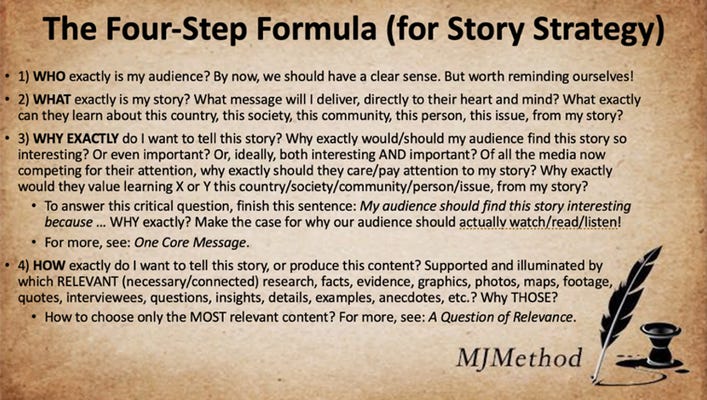
It all starts with a strategy, which means returning to my essential Four-Step Formula. This may seem repetitive, as I already detailed the formula in multiple chapters, most recently in Chapter Twelve: MJ's Filters & Polishers, Part I. But back then, the strategy was mostly theoretical and abstract. A general road-map to visualize our challenge. Since then, we’ve compiled significant research, conducted interviews, and so on.
Now, though, the approach is subtly different. We’re getting ready to write – and put meat on the bones. So we now use this formula to strategize how exactly to bring our story to life.
While we initially speculated and drew assumptions about the direction in which our story might go, that original angle has now been either reinforced, slightly altered, or dramatically revamped. That’s fine! Let’s always be flexible about possible changes – and keep an open mind for potential surprises.
At this point, though, what’s most important is to sharpen our focus as much as possible. Again, if we proceed without it: disorganized thoughts lead to unfocused writing – like serpentine spaghetti. Which will cost us hordes of readers, who’re unable or unwilling to make it past the first few paragraphs.
With that in mind, let’s revisit my Four-Step Formula, to apply a clearer, more specific vision of what exactly our story is. If nothing else, reviewing our original strategy should refresh and reinforce the most resonant “core” messages. (More on that in a second.)
As always, the process must begin with considering our audience: The Who. Who exactly they are, why exactly they would or should read this, how exactly they might benefit from consuming our content, why exactly that might be beneficial to them, etc. Again, this is a form of Strategic Communications. The most effective way to hit our target? Envision our audience with crystal-clarity.
One Core Message
Logically, you’d think that the writing of a story should start at … the beginning. Not so fast. We must first iron out the true focus of our story – then wisely choose an intro that best reflects our focus.
Let me explain. With my writing, as I accumulated experience, gained more confidence, taught it to others, and in Africa even applied my International Journalism storytelling style to my new career in Global Communications, I adopted a new mindset: Unless it’s for Dear Diary, my content is always aimed at an audience. But aiming to do what? To deliver positive impact, of some sort. (Recall the many categories of impact I laid out on my Communications Ladder, in Chapter Five: What Audiences Need.)
Thus, we should not only view this endeavor as another form of Strategic Communications, but of the need for persuasive messaging. Or even a convincing argument. Especially if we hope to not just better inform and educate the audience, but spur a change in attitude or behavior. Or to spark action.
Over time, I matured journalistically in other ways. For many years, I was admittedly quite delusional. I hoped – and believed – that if I spent hours, days or weeks on a story, it might be so impactful on my audience, they’d remember nearly every word of it. Ridiculous. When was the last time you read and remembered all the key elements of an informational or educational product online?
Now I know better. Realistically and reasonably, we should hope that our audience remembers one core message from our piece. There’s simply too much media out there, bombarding our audience, every day. That’s why we should consider ourselves fortunate – and our efforts, successful – if we’re able to break through this din and actually register impact on a single audience-member.
Let’s look at the positive, though: our one core message, presented persuasively, can deliver deep, lasting impact. If that’s our ultimate goal, let’s mold one heckuva potent message, as the crux of our story. Here’s one of my filters to identify this core message:
*What’s the one essential thing our audience must learn from this content? What exactly should be the lasting impression, imprinted in their subconscious? Why exactly that? What, then, is this core message? Why exactly that? This demands our peak critical-thinking skills. Make an air-tight argument!
Here’s another filter. To help visualize our challenge more clearly and tangibly, imagine that tonight we watch a movie, read a book, or go out to a show. Tomorrow, a friend asks us: What was it about? We could probably – quite naturally – boil it down, summarizing it in one sentence. Maybe two.
That’s a core message, too: the lasting impression.
Now a third filter – and my favorite. To identify our core message, we think it through backward. Let’s say an audience-member one day reads, watches or listens to our story. Imagine them the next day – or even one week or one month later. If they’re able to remember one thing from our story, what exactly should that one thing be? What’s that core message? Justify it, too: why exactly that message?
We must link this to the broader challenge – again, appreciating how much media is competing for our audience’s attention: for eyeballs and clicks. Half the battle is how to attract them to our content, then convince them to stay a while. (Or as described above, convince them to scroll down.)
That’s why, from high up in our story, we clarify what exactly our topic is – and why exactly it’s interesting. Or important. (Or ideally, both.) What can they learn from us? What’s The Big Picture of our content? Once the audience stays, we work to deepen the impact. With a finely tuned core message.
To defend our decision-making, here’s a specific filter to whittle and polish our core message into the most meaningful, impactful and memorable message possible:
*XXX [insert our core message] should be the core message of our content, because … Why?
This should sound familiar, as it’s nearly identical to the third step of my Four-Step Formula:
*Why exactly should our audience find my story interesting enough to actually consume?
*Let’s answer: They should find it interesting, because … Why exactly?
The difference is, while my Four-Step Formula acts as a road-map, guiding us throughout the process of collecting storytelling material, we’re now at the writing stage. Let’s weigh all the material we have in hand, then hammer out a clear, compelling and convincing core message to steer us through the writing. Again, remember the alternative: if our content bores or confuses, we’ll lose our audience. Fast.
By the way, our core message can contain more than one point. Or multiple prongs, packed into one message. For example, one issue in China that I explored intensively was air pollution and environmental protection. (I referred to this in Chapter Thirteen: MJ’s Filters & Polishers, Part II, where I describe the Communications-Storytelling training I led in Beijing for Chinese environmental activists.)
With the air as toxic as it then was in China, I imagined the foreign audience wondering: Do the Chinese even care about the environment? In response, my core message for that training was two-pronged: Not only do a) more Chinese care about it, but b) more are now doing something to protect it.
If our audience consumed the project, I’d want them walking away with that lasting impression.
Moreover, the core message we craft serves another purpose. It should become the North Star of our writing and storytelling, guiding most of our crucial decisions: choosing a relevant introduction; relevant context; relevant details; etc. (I’ll explain this farther down, in A Question of Relevance.) In fact, all the facts, details and quotes we choose should be somehow inter-related with that core message.
Here’s more on how exactly to identify our core message. One technique I embrace and preach to my students: Use ourselves as a test-audience. Let’s say we’ve just finished an interview and left the interviewee. On the way home, our mind may be filled with thoughts and feelings about all we just heard. Or, let’s say we just finished all our researching and reporting. Our head is swimming with detail.
In either scenario, let’s take a walk. Think to ourselves for a few moments. Or as I often describe it: place a finger on our pulse, to gauge our own level of excitement. What was the most interesting thing I just learned? Or the most important thing? Maybe the most meaningful or memorable thing?
I trust our instincts in this regard, believing that we’re a smart, curious person – with a lively mind. Our brains often serve as natural filters, instinctively distinguishing between more significant and less significant details, messages, etc. What’s the first thing that leaps to mind? Or second? Or third? That indicates something: it registered deeply enough, left enough of a lasting impression, for a reason.
Now consider: If XXX made a deep impression on us, isn’t it possible that it’ll leave just as deep an impression on our smart, curious audience? Perhaps! Again, let’s polish according to the filter above: What’s our message? Why exactly that message? Why exactly do I think it’ll resonate with my audience?
On the other hand, what if we can’t go for that walk to ponder our freshly unearthed storytelling material? What if our material in-hand isn’t nearly that fresh? It can happen for whatever reason that we allow our material to grow cold. Then, return to it much later. I’ve done it countless times.
Two options here. First, looking back, what was the lasting impression left by the content? What do we remember about it? If we remember certain elements, by definition they’re “memorable” – recalled for some interesting reason. What exactly made it so memorable? Why exactly do we think we remembered it? Is it so memorable, it’s worth sharing with others? Even to wrap our story around?
On the other hand, if too much time has passed, and we don’t recall much from the original material, we should certainly refresh our memory by reviewing it. Then, follow the same self-test: Close our notepad (or walk away from the computer), go for a stroll and mull what was memorable.
Let’s never forget our broader objective: Wouldn’t it be great if we ourselves can produce a truly memorable story? All these intellectual exercises – to identify a core message – lead us in that direction.
A Detailed Outline
An outline? Nooooo! I know, I know. Most of us loathe them. I myself was once allergic to them. But let’s get over it, please. Part of my evolving wisdom over the years is how a rough outline – which I’ll later expand into a more detailed outline – forces my disorganized mind into more organized thinking.
Even with that said, there are still times when I exuberantly (but foolishly) launch into the writing. Then, hit a roadblock: Where do I go from here? In this direction or that? I’ll choose a new direction, but soon hit another pothole. Or, my writing starts to spaghetti – as described higher up. In other words, I always regret the occasions when I venture forward and write without a roadmap.
Instead, an outline enables me to map out my thoughts – on the page, so I see it all. Now I can visualize the beginning, the middle, the end, rather than juggle it all in my head: how exactly I’ll pull in my audience, how I’ll keep them consuming, where I’ll take them from here – and why, why, why.
Sometimes, I’ll devote a day to “writing.” Yet, I may actually spend it with two hours, four hours, or more, mapping out a rough, but broad outline. Gradually, I turn it into a finely detailed outline, full of Roman numerals, alphabet letters (capitalized and lower-case), numbers, bullet-points, and so on.
Sometimes, each line is just a few words, or a full sentence or two. However, the process often inspires so much detailed thought – and detailed writing – that when it comes time to write, I can essentially copy-and-paste these sections into my rough-draft. Then, I stitch it all together, seamlessly.
The point is, by the end of my first writing day, I might ask: So what “writing” did I actually do? Perhaps not as much as I’d hoped or imagined. But my mind is now at peace – as I’ve poured my thoughts onto the page. I’ve mapped out the entire narrative journey, enabling the writing to flow.
You may wonder about how to structure your outline, beyond the “beginning, middle and end.” What makes my process of outline-sketching easier, as you’ll soon see, is that my Diamond Story Structure is itself a skeletal outline, which I often follow. In general, all we have to do is fill in the blanks.
Organizing Our Notes
Earlier, I described my five-step pre-writing ritual: 1) craft storytelling strategy; 2) mold core message; 3) sketch detailed outline; 4) organize notes; 5) filter material. It’s now time for the last two.
Imagine a 1,000-piece jigsaw puzzle, still in the box, of Planet Earth: so many hues of blue, white and grey, all of them different sizes and shapes, curves and angles. To assemble the puzzle, we wouldn’t pull out of the box one piece at a time, then search for its precise place in the broader puzzle, right?
No, we’d need to survey the full scope and inventory what we have to work with. That’s why I pour out all the pieces, scattering them onto a table, making sure they’re all flat and right-side up.
It’s basically the same way that I imagine our storytelling elements. On my laptop, I might have one or more massive files, filled with articles, reports and other research I downloaded. (Including the website address for each bit, to later hyperlink.) The file is packed with much of “evidence” I’ll insert into my story: great data from credible sources, insightful comments from credible subjects, and so on.
Meanwhile, in my writing journal or notebook, I’ve jotted notes and quotes from my interviews with subjects, as well as my own thoughts, feelings, analysis, observations, etc. – from before or after those meetings. This material can serve as either more evidence or humanizing detail. Or both.
In other words, it’s like I have 1,000 pieces of a puzzle, scattered here and there. How to pour it out? In the past, I’ve leafed through notepads and journals, numbering pages, as if pages of a book. I’d create my own Index, or Table of Contents, then go page by page, circling and highlighting the most interesting and important content on each page. Then, type that into my laptop, in a new Word doc.
Likewise, I’d go through my massive computer file of research, highlighting in colors the most interesting and important materials, which I consider including in my story. At the same time, I flip back and forth to that new Word doc, noting what those highlights are – and where they’re located. Or at least I identify key words, with which I can quickly search the document and find their precise location.
Similarly, if we’ve filmed or recorded audio, of course we’d time-code where exactly the most meaningful parts are, and describe what they are. But we never know: something that at this moment seems less meaningful, may soon be desperately needed to fill a hole, answer a question, buttress an argument, or serve another purpose. That’s why we should itemize and inventory as much as possible.
Yes, all this can be quite time-consuming. If we’re writing up a piece that’s relatively short and easy, this note-organizing step may be unnecessary. However, if we’re working on a sizable, significant project, which requires days or weeks to complete, organizing is worth the few hours we invest. This is especially true when applying all those notes to two, three or more separate pieces of content.
I speak from experience when I say that one of the worst feelings is the panic or frustration of flipping through pages, or scrolling through files, hunting for a specific note or quote, wondering: Where the hell IS it? Such efficiency in note-organizing can be more calming – and psychologically healthier.
A Question of Relevance
Back to my jigsaw-puzzle analogy. Here’s what makes our storytelling-puzzle even more complicated than the ordinary jigsaw: let’s say that only half our pieces actually belongs in the final puzzle. The rest are extra – and may distract us – until we learn how to recognize subtle clues that they don’t fit into our final puzzle. That’s why our next task is to weed out which details belong, which don’t.
How to separate out which storytelling elements are valuable, even essential, to our polished product? By thinking through the relevance of each: how exactly, and why exactly, they’re necessary for our story. Relevance is a core concept for me. In Chapter Thirteen: MJ’s Filters & Polishers, Part II, I wrote of the need to identify relevant research, relevant subjects, relevant locations, etc. In Chapter Fifteen: Interviewing Skills, I explored the most relevant questions to ask our relevant subjects.
I now apply the same principle to my writing, which I frame as: A Question of Relevance. By now, we’ve refreshed our objective and hammered out a crystal-clear focus of what exactly our story is – and why exactly our audience may want to consume it. Along with that, we should also have a clear, refreshed sense of which storytelling elements is now most relevant to that story.
Again, everything in our notes is essentially either facts, details, anecdotes or quotes. Of course, we can’t include all of it in, say, a long article or documentary film – unless we’re the boss. Or publishing our own publication. And don’t care much if the audience actually consumes the entirety of our words. (An editor once scolded me for what he labelled a notebook dump: industry jargon for the intellectually lazy act of pouring everything into a story, with no selectivity of whether it deserves to be in there.)
In reality, we all deal with limits of space. That means we must wisely pick and choose our content. What stays, what goes? It’s not just a question of the most interesting, important or meaningful material, but the most relevant – with a clear connection to, even necessity for, our piece.
How, then, to choose only the most relevant material? Once again, I’ve created a one-sentence filter for this crucial decision-making. For each fact, detail, quote or anecdote we mull, let’s answer:
*This fact, detail, quote or anecdote is relevant for my story, because ... Why?
Finish that sentence. Make the case. Justify and defend our storytelling decisions!
On the bright side, this filtering process is for our own good: just as writing too much, or running too long, may mean we lose our readers or weaken the impact of our words, writing less can be more meaningful, even more impactful. As the 19th-century American humorist Mark Twain famously wrote to a friend, while apologizing for his long letter: “If I had more time, I would have written less.”
For that reason, though some of us are afraid of writing longer pieces, I’ve sometimes found it more challenging to write, say, a 300-word piece, than a 1,000-word. Likewise, while I once dismissed Twitter and its 140-character-limit (later raised to 280) as terribly superficial, I now appreciate that it requires great skill to pack a serious, meaningful message into fewer characters. Or fewer words.
That’s why I encourage my students: The more selective and discerning we become about which words, sentences and paragraphs we write – and which facts, details, quotes and anecdotes we include – the more effective we’ll be as writers and storytellers. Simply put, relevance makes us better writers.
Welcome to The Diamond
We’re finally ready to write – and to apply so many of the elements discussed in this and previous chapters. That means it’s finally time to introduce my Diamond Story Structure – which has been a part of my professional writing ever since I created it: nearly 20 years ago, once I dissected my own writing style, to teach it to others. That’s when I thought through why exactly I do what I do.
When it comes to my Diamond, though, I can’t claim credit for the entire concept. The wheel had already been invented. All I did was embrace, adapt and enhance it with a few key components.
It was the venerable Wall Street Journal newspaper that long ago developed this news-feature formula, which evolved into an industry standard. Most notable for its colorful, humanizing introduction – known in the business as an anecdotal lead – the WSJ style is actually comprised of four parts:
1) The story opens with an anecdotal, descriptive, or narrative lead (a specific example).
2) The nut graf (slang for core “paragraph”) follows the lead – and generally explains it.
3) The body of the story is comprised of supporting information (quotes, facts, developments).
4) The ending includes another anecdote or description of the people/person featured earlier.
My Diamond Story Structure is admittedly similar, especially at the beginning. I’ll explain each of my elements below. But to summarize, the reason I call mine a Diamond is because it opens “small” – with a humanizing anecdote – then widens to what I call a Big Picture. This shows how the intro is actually a symbolic, illuminating example that “opens a window” onto the broader issue or trend. (You may recall that I explained how to open a window in Chapter Twelve: MJ’s Filters & Polishers, Part I.)
The Diamond is now opened wide – resembling the top half of a brilliant, double-cone diamond. Next, the second half includes my innovation, which I described in Chapter Fifteen: a swathe of content that dramatically lays out our story’s Darwinian origins & evolution. From this relevant backstory, my structure narrows again, to finish with a peek into the crystal-ball: Where does this story go from here?
Again, in line with all the principles described above – for how to pull in a reader, then convince them to scroll down for more – I’ll open colorfully, but still strive to deliver value to my audience, aiming for them to learn something from my content. (Just as I’m striving to do here, with each chapter.)
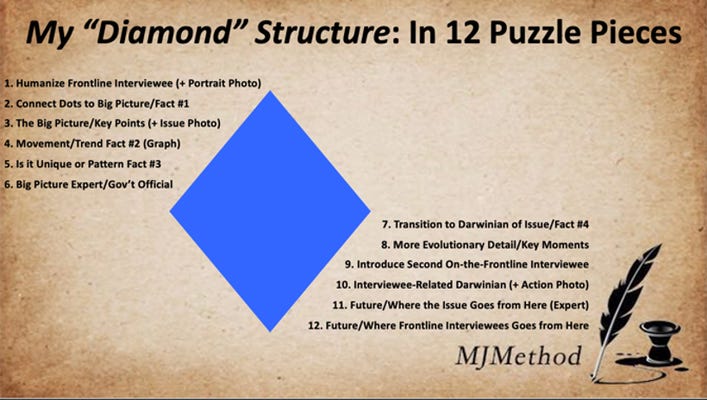
In fact, I divide my Diamond into 10 distinct parts – as the diagram shows:
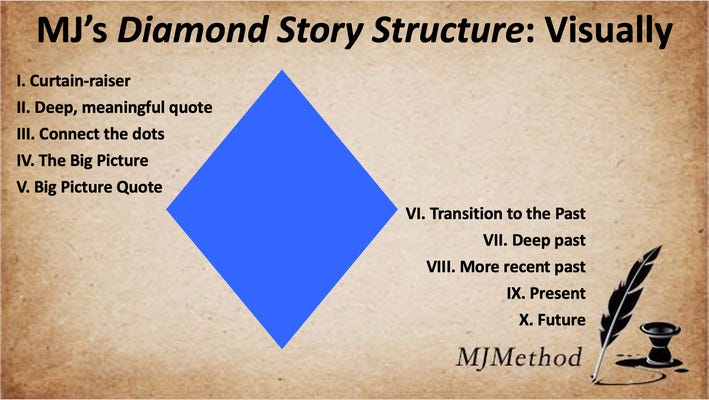
To me, the order makes logical, then chronological sense – and ultimately an audience-friendly approach. In detail, I’ll now explain not just how the Diamond works, but why exactly it works so well.
The Curtain-Raiser
Again, writers must “work hard” to grab the busy, distracted reader’s attention. Then, pull them in – and even give them a reason to stay. So, why should they read from the top, all the way down? Indeed, they may only give us a few seconds or sentences. If bored or confused, they’ll soon bounce.
If you doubt that, let’s consider our own reading habits: How patient are you, when reading a writer’s words? Go ahead, test it yourself. That sort of empathy should help us grasp the challenge.
With that in mind – and since most of us “love a good story” – let’s open with a scene-setting or curtain-raisinganecdote to immediately draw the reader into our story with some “color” or drama.
I call it a Curtain-Raiser. How’d I come up with that visual? Again, I adapted from an existing term: in journalism, a curtain-raiser introduces, say, a series of stories. Instead, I visualize it more specifically. Imagine sitting in a movie theater, in the middle of a large, ordinary shopping mall. While munching our popcorn, the lights dim, the curtain rises (or parts). The film’s director wants us, in a flash, to immediately forget our surroundings – and to escape on a visual journey, through the silver screen:
It’s night-time … and snowing heavily … a car is driving, slowly, with headlights on, along a deserted rural road … We immediately wonder: Who’s in the car? Where are they going? And why?
If done well, we’re instantly sucked into the drama. And engrossed. This is exactly what I hope to do with each of my Curtain-Raisers: quickly, effectively suck in my reader.
Here are the four steps to writing an effective Curtain-Raiser:
1) Show someone – a main character, even in the first sentence, to immediately humanize our issue.
2) Show them doing something – some sort of action, drama, movement, to grab our attention.
3) Whatever we show them doing, ensure that this action is somehow relevant – again, clearly connected to the broader story that we’re about to tell our audience.
4) A deep, meaningful quote – so we can now hear their voice; thoughts, feelings, opinions, etc.
In short, we present someone interesting, doing something interesting, for some interesting reason. Yet, this mini-story is much more: not only should it shed light on what exactly the issue is, but also illuminate the type of people affected by, or involved with, the issue we’re exploring. (In Chapter Fourteen, I described who exactly we might find On the Frontlines of our story.)
Indeed, what makes this anecdote “symbolic” is: while it appears to show a single individual, who themselves may be very interesting – our story isn’t really about them. It’s what exactly they represent about the broader issue. (In Chapter Twelve, I explained our Search for Symbolism.)
It’s important to note that this vivid snapshot does not necessarily have to be recent: it could’ve happened in the deep past, or sometime in between. Likewise, this event can be something that we personally witnessed, or that someone describes for us, in detail – so we, and our audience, can “see” it.
The point is, not only should this anecdotal-lead humanize the issue, by opening a brief window onto one of our central characters, but it should also serve as our first form of concrete, credible evidence: it subtly “shows, doesn’t tell” the audience this issue is real, affects real people, and so on. (In Chapter Five: What Audiences Need, I explained why exactly it’s important to show-not-tell.)
Again, since we “never get a second chance to make a first impression,” these few sentences of introduction should be some of our best storytelling. Let’s “paint a picture” with lively detail, and choose verbs and nouns that are precise, but potent.
But again, this mini-story is actually just a literary device: It’s a microcosm that should illuminate and illustrate the broader story. Then how to wisely choose an appropriate, strategic Curtain-Raiser? That’s why, as I explained above, before even starting to write, we should really remind ourselves of our Core Message, and what the broader story is that we’re spotlighting.
From there we should choose a person, and their related action, which best reflects/represents/symbolizes the broader story. That’s what I mean in Step #3: It must be relevant.
For example, one of my Chinese students wrote about new policies that China was implementing to encourage and train more disabled Chinese to join the workforce. Why does this matter? In terms of “hooks” (Chapter XX), China is not only the world’s second-largest economy and its most-populous nation, but also reportedly home to the world’s largest community of disabled people.
In this case, my student opened with a young disabled Chinese, working in a bakery. After interviewing the man, and recording his story, my student opened with three sentence:
*First, briefly described how before, the young man didn’t work, but was instead at home, inactive and unproductive, bringing sadness to his family.
*Next, briefly, how the activism of one community organization – which advocates for equal access for the disabled, in education and employment – helped him.
*Then, how he’s now earning money for himself – and for his family.
How I opened this book’s Prologue: with an illuminating Curtain-Raiser of my epiphany, when I realized how my International Journalism skills could be adapted and applied to Global Communications.
I also recall one example of an “irrelevant” curtain-raiser, from early in my teaching career. At Long Island University in Brooklyn, I’d created a Sports Feature-Writing Course, and one of my students was profiling a star LIU tennis player. One angle was how hard-working this player was, rising early for lengthy practice, before the start of the school-day.
My student was prepared to observe one early-morning practice, then interview the player. But on the scheduled day, it rained. So, the interview shifted to the tennis coach’s office. I should note that one of my lessons for students was to “describe your surroundings,” from the front-line of a story. On this occasion, my student took that too literally: his curtain-raiser described details of the coach’s office.
“But how’s that relevant to this hard-working tennis student?” I asked.
My student replied: “I don’t know. But that’s where I did the interview.”
Not good enough. We brainstormed a more relevant introduction – to match the actual story.
It took me years of life experience to accrue this perspective, but I now see potential symbols all around us. As I’d tell my Chinese grad-school students, even within our classroom, each of you symbolize something – and could be a Curtain-Raiser to illustrate various stories, such as:
*The growing number of journalism programs in China.
*The growing number of English-language academic programs in China.
*The growing number of Chinese women entering journalism.
*The growing number of Chinese women postponing marriage, to pursue advanced degrees and greater career opportunities.
Heck, I myself could symbolize:
*The growing number of Western professors teaching in China.
*The growing number of foreigners living and working in China.
*The growing number of foreigners with families living in China.
A Deep, Meaningful Quote
I noted earlier that the Curtain-Raiser contains three steps. Actually, there’s actually a fourth: A deep, meaningful quote from our subject. Or, from someone close to them, speaking about them.
Why’s this quote so important? Quotes are valuable “real-estate” in a story; especially the first one. I already explained in Chapter XX why humanizing content is itself a Communication Strategy, because of its potential to touch our audience’s heart, and perhaps positively impact them. The added step of including their “voice” might enable the audience to care even more – and deepen the impact.
So, after we’ve spent the first few sentences humanizing someone, the quote reinforces and deepens the impact, allowing the audience to hear from our subject, directly – speaking in their “real voice.” More specifically, this quote should help explain why exactly this Curtain-Raiser is significant.
We should never quote them spouting dull, dry, superficial facts; not only will they come across as almost robotic, but it will come across as so boring, we risk losing our readers. Like, “Then I began to work for the bakery.” To be clear, I’m not saying that we should ignore those facts; let’s paraphrase them, transforming their words into our own words – but present it much more briefly and concisely.
Instead, we should dig deeper to explore what “makes them tick”: in their hearts, in their minds. What inspires or motivates them to do what they do? And why? Their hopes, dreams or fears. Their thoughts, feelings, emotions, opinions, analysis, etc., about a situation or about their circumstances. (For more, revisit Chapter Fifteen: Interviewing Skills and sections like What Makes Them Tick.)
This is what I mean by deeper, more meaningful quotes. Why exactly they do what they do (or did what they did); why exactly they say what they say; why exactly they feel what they feel; why exactly they think what they think; why exactly they believe what they believe.
Just as the Curtain-Raiser is itself a form of evidence, this quote strengthens a story’s credibility – it signals to the audience that we apparently made the effort to interview an actual person. Moreover, if we’ve taken the time to skillfully draw out a compelling quote, that may also encourage the reader to keep reading, as it sends a message to their brain: This is what makes my story below so interesting.
If the quote is one to three sentences long, then this Curtain-Raiser-plus-quote should measure four to six sentences, total. That’s just 50 to 100 words.
Connect the Dots
This line of transition serves two crucial functions. By “connecting dots,” I mean insert a line that links the Curtain-Raiser with The Big Picture – explaining the relevance of the former to the latter.
This differs slightly from the “connecting dots” described in Chapter XX, in that there …
In this case, while a deep, meaningful quote helps explain the Curtain-Raiser’s significance, we now need a line of transition to explain more explicitly what our introduction represents or symbolizes.
What does it show our readers about the broader issue we’ll soon explore? Is this person’s story unique? Or part of a broader pattern or trend? Why or why not? (See Chapter XX for more.)
Let’s be very clear, even precise. Are they one of hundreds, thousands or millions?
Following the example above, this Chinese bakery worker is … one of XXX [number] of disabled Chinese workers who are now entering the workforce for the first time …
Or: He’s one of XXX whom Organization XXX has helped overcome challenges like XXX ...
Or, if some like him are receiving assistance, but most are not, we could accentuate the contrast: Unlike XXX millions of disabled Chinese long ignored in their homes, he’s one of XXX who …
Crucially, don’t forget to hyperlink to the source of this number: transparency in our research will build trust, credibility and believability among our smart-but-skeptical audience. (More to come, later in this chapter, on the need for Four Hyperlinked Facts.)
This connect-the-dots sentence serves another vital purpose, as a critical juncture, about 100-150 words in. Imagine, we’ve raised the curtain of our story by spotlighting one individual. Then, a quote either from that person, or about that person (uttered by someone else).
What signal does that send to the brain of our audience, about what the rest of the story is about? A reasonable reader would conclude this is a “simple” feature: The story’s about this person.
Then comes the dot-connecting line of transition, to clearly communicate this isn’t specifically about this one individual, but what they actually symbolize: She’s not alone, but one of 23 women who …
The audience receives the message: This isn’t merely a straightforward feature about one individual, one organization, or one program. That intro was simply a device to hook the audience and “open a window” onto a broader, more meaningful issue.
The Big Picture
So now we arrive at the heart of the story: The Big Picture. This is the section that should clearly explain to our audience what the broader story, the greater significance. This is also where we can more or less copy-and-paste our response to the “Why exactly” portion of my Four-Step Formula.
This section can include numerous possibilities, as described in Chapter X5X? For example:
*Why exactly is this story, or person, or situation so interesting or important? Or, ideally, both?
*Why exactly does this story matter? Why exactly should the audience care?
*What are the unique, Big Picture “hooks,” about this person, country, company, region, etc.?
*As I’ll explain in Volume Three, China’s greatest hooks … Lesotho’s latest test of demo
*What does this story “say” about Country XXX? What “window” does it open onto that society?
*Is this situation unique, or part of a broader pattern or trend? Either way, how so? And why?
*Is it part of a broader trend in this country, this part of the world, or even globally? Or unique?
*Is it part of a broader trend historically, for this community or country? Or something new?
*What’s the movement today? Is this situation getting better, getting worse – or stagnating?
*What’s the timely hook, for why they should pay attention today? What exactly is new?
*What, if anything, is being done about this situation? (Perhaps aiming to improve it?)
A Big Picture Expert
For any answer provided to these questions, again, we should hyperlink to a credible source for those facts. Otherwise, why should our audience believe us? We’re not experts, after all.
Speaking of which, to support and strengthen our argument, we should now attach to the Big Picture what I call a Big Picture Quote: a deep, meaningful insight from a credible, reputable Big Picture activist, expert, official, observer, analyst, scholar, commentator – someone like that.
Imagine, in our Curtain-Raiser, we shared the mini-story of someone either affected by, or involved with, some situation. We assume they can clearly see their own reality. But perhaps they have “blinders” on, or are preoccupied with their plight, which prevents a clear view of The Big Picture: how their situation may be similar or different from hundreds, thousands, or millions of others, elsewhere.
Or, even if they can see that, they probably won’t be able to comment credibly or authoritatively about that. Yet now that we’re laying out our broader argument of The Big Picture, we want to “work hard” to convince our audience that what we’re saying is really true. That’s one reason why we present our evidence transparently, hyperlinked to credible sources.
Another form of evidence, though, is the voice of a reputable expert. Someone who’s able to figuratively “take a step back,” to see The Big Picture, and can help clearly explain to our audience how exactly that curtain-raising mini-story fits into the broader trend.
Moreover, to express their thoughts, feelings, opinions or analysis about why exactly the issue matters, why the audience should care, and so on. This form of evidence not only helps persuade the audience that this issue is real, but is interesting enough to further persuade readers to keep reading.
I should note: this person may be a domestic expert, with plenty of experience addressing the issue to their own people. But they may not have much, if any, experience in speaking to a smart-but-skeptical foreign audience. Especially, to explain domestic matters. This requires patience on our part.
Listen closely. Imagine ourselves, empathetically, in the shoes of our foreign audience – which may never have actually been to this country we’re exploring. Is the expert explaining it clearly enough? Again, one objective in our international storytelling or global communication is to make our content accessible enough to a smart, curious, but even non-expert foreign audience.
If we detect that our Big Picture expert isn’t communicating in an “audience-friendly” way, then let’s guide them there, politely and respectfully. For example, I’ll say something like: “How would you explain this to a foreign friend, who’s curious to understand what’s happening here?”
Or, more personally: “Can you explain it to me even more clearly, as a foreigner who’s not so familiar with the on-the-ground-reality? If I understand it clearly, I can explain it to my audience clearly.”
Ideally, we speak with this person directly, interviewing them in person or via video. However, if for some reason we’re unable to do that, then, minimally, we should do sufficient research online to find someone of that stature who’s written a report on the topic, or been quoted elsewhere by others, etc.
Then, we copy-and-paste their most relevant and meaningful words, to support our argument. Oh, and we hyperlink to the web address where we found it; again, to be transparent with our evidence.
One additional note: It’s sometimes appropriate to cite as a top government official as a leading “expert”-authority on our issue. Needless to say, it can be tough for us to cut through the bureaucratic red-tape to arrange an interview with such an official. Or, it may take more time than we can spare.
Here’s a simple remedy: Search online for where that official has spoken publicly about this issue. Then, copy-and-paste their most interesting insights or opinions about it, directly into our story. But be sure to identify where exactly we found it, and hyperlink to that source: As so-and-so official wrote in a 2019 Ministry Report … Or: As so-and-so official told Chinese state media earlier this year …
To Scroll, Or Not to Scroll?
By now, the laptop-reading audience has hit the bottom of our first full screen of text. If we’ve written a strategic, illuminating Curtain-Raiser, then connected the dots to our clearly identified Big Picture, we’ve given our foreigner an effective overview of what our meaningful story’s about.
This is something of a “make or break moment,” yet we’ve also created a win-win for readers.
Indeed, they’ve already learned something from this faraway land: about an interesting person, amid an interesting situation, living in an interesting place, tackling an interesting issue. Within 200 or 250 words! Requiring just two or three minutes of their precious time. That’s some serious storytelling, right? Nary a word wasted, nor sentence irrelevant. All of it justified. That’s quite an achievement.
At the same time, we’re now giving the audience a choice: scroll down to read onward, or turn elsewhere. We want them to stay, of course. Hopefully, our writing style and why-our-audience-should-care part have been compelling enough that the reader – who, again, is very busy, with so many other online-reading options and time-consuming obligations – decides to read to the end.
But if they don’t, because they must bounce elsewhere, at least we’ve executed our mission. We touched them, somehow. Maybe, registered impact. Perhaps they’ll thank us, in their own way: they may return to our website, or look for our name in the future – to enjoy more of our stories. After all, earning audience trust, and establishing our professional credibility, is a gradual, step-by-step process.
On the other hand, if for some reason the reader is riveted by our content, decides to stay, and presses that magical “scroll down” button, where do we take them from here?
Transition to the Past
If they stay, why do you think they will? They aren’t obliged, or forced. But do so of their own volition. Which to me can only mean: they find our story interesting enough; or have begun to care about our characters; or about the issue. For whatever reason, they find it worthwhile to scroll down.
In that case, I think we should now explain the backstory: the how and why this situation came to be. Again, we assume our audience is smart and curious. If they’ve stuck with us this far, they deserve to a more thorough exploration, that plunges beneath the superficial, to unearth the root-causes.
How to get there, though? With writing, it’s like chauffeuring a passenger. We shouldn’t jerk them to the left or right, or go flying over speed-bumps, but transport them smoothly, comfortably.
With that in mind, we should think up another one-line transition – this time, into the past. Why? Because we study history, to better understand the present – and to anticipate the future.
So from this point, we should lay out the rest of our story chronologically – the entire Darwinian timeline of relevant content – starting with a sentence that links us into the past. Following the earlier example, something like: This is far different from how Chinese have traditionally treated the disabled...
Or, more simply: But it wasn’t always this way …
On the other hand, if this is continuation of a longer trend, we could transition to the past with that: This situation today actually continues a longer tradition (or “historic trend”) … MORE EXAMPLES?
The Relevant Back-Story
Now we become a “Darwinian Storyteller”: background context is the only way to tell a story deeply and meaningfully. China’s air didn’t become heavily polluted overnight, nor did Lesotho suddenly experience political violence. To capture the relevant history, feel free to review the Darwinian section in Chapter XX. But to briefly summarize, we should now explain our story’s “origins and evolution.”
First, the origins, or what I also refer to as “the deep past”: Where exactly our story “begins,” and why exactly it begins there. Then, the evolution, or “the more recent past”: How the situation changed over the years, how it evolved historically, and why exactly it evolved the way it evolved.
Again, without this relevant history, our storytelling will be superficial. The reader won’t grasp the complexity. That’d present the story as too black and white – lacking the shades of grey, the nuance – while we instead should be striving to be more serious and responsible storytellers.
Throughout this Darwinian section, we should support whatever we write with more evidence: concrete facts and figures, if we have them. But don’t just write it as “Then this happened, then that happened.” We’re not court-stenographers, simply recording events. Explain why they happened. And why they were significant events. Especially, why exactly they’re relevant to the evolution of this issue.
Again, we must also attribute our information to a primary source, since we ourselves aren’t historians – and hyperlink to it. At the same time, don’t forget that this is narrative storytelling! Bring the content to life. More than dry data, sprinkle in illuminating anecdotes and meaningful quotes from subjects, whether we interview them personally or find them quoted online.
Certainly, we should indicate which is which for our audience. Something like: During an interview, so-and-so said … Or, if found online: As so-and-so told the New York Times in March 2020 …
How to choose which is the most relevant and necessary context? I have a filter for that, too:
*This piece of context is relevant and necessary, because ... WHY exactly? Finish that sentence.
Next, from the “more recent past,” we wind our way back to today: “the present.” If we’ve done an adequately effective job of selecting relevant context, the light-bulb of comprehension should now flicker on in the minds of our audience: Ah, now I understand how this situation came to be!
Let’s further deepen their knowledge of the reality today: What exactly the situation is, why exactly we are where we are. Again, blend in facts, details, anecdotes, quotes, attribution, hyperlinks.
From the present, we spin our story forward: into “the future.” Remember, we’re not in the prognostication business. However, if our audience has stuck with us this far, why do you think they have? I assume it’s because they care about this story, for some reason: the people, the situation, etc.
With that in mind, they may want a sense of “Where might this story go from here? Where might this issue go from here? Where might this person go from here? Why exactly in that direction?”
While we personally aren’t predicting the future – for we ourselves aren’t experts – the real people affected by this issue, or the officials/analysts/experts/activists involved with it, are presumably wondering about the future of thissituation. After all, they’re “on the frontlines” of it.
For example: In which direction will this situation go? Do you think it’ll get better, worse, or stay the same? Paraphrase their answer – which is “what” they think – in our own words. Then, depending on their response, ask the follow-up question: Why exactly do you think it’ll get better/worse/stay the same? What, if anything, can be done? Or should be done? Why exactly do you think so? And so on.
One of them most common mistakes I see from my journalism students is that after maintaining their neutrality and invisibility throughout the story, at the end, they for some reason feel compelled to come up with their own conclusion at the end. Sometimes with a first-person formulation along the lines of: Hopefully, this all works out for the best. Who’s hoping for the best? The writer.
In response, I’ll holler at my students, either: You’re not an expert! Or, Keep your voice out of it!
Instead, I suggest we employ a much easier, more effective storytelling device: Since we opened with one character, let’s close with that same person. In journalism, we call that “Coming full circle.”
We quote our subject’s deep, meaningful thoughts, feelings, emotions, analysis, opinions – providing our audience with a sense of what the future might hold for this person, and others touched by this issue. Now, let’s give them the last word, too. Quote-endquote. The End!
Four Hyperlinked Facts
As underscored throughout this book, to positively impact our smart-but-skeptical foreign audience, it’s essential that we provide credible, verifiable evidence – and present it transparently.
I see no limit to how much evidence we can provide to make our “lawyerly” argument. However, I’ve identified a minimum amount of evidence with which we should infuse our Diamond.
Indeed, my storytelling structure is underpinned by four core facts, which I hyperlink for my audience. I don’t mind repeating myself on such critical matters: the reason we do this is to earn the audience’s trust and build our professional credibility – by providing proof that what we say is true. They simply click the link, and verify the evidence for themselves.
Moreover, it’s a gesture toward being “audience-friendly”: If anyone consuming my content wants more information on this topic, I helpfully offer direct links to my primary sources and research.
Here, then, are the four hyperlinked facts that I view as the bare minimum:
1) The fact that … connects dots between our Curtain-Raiser and The Big Picture, which proves that this person, in this situation, is not unique, but “one of XXX number.” Again, to show they’re part of a broader pattern or trend. Or, alternately: they, or this situation, is truly unique, compared with others. In which case, we must prove that, too, by attributing that claim to a credible source.
2) The fact that … shows what the “movement” is in this situation: upward, downward or stagnating? Over a period of two, five or 10 years? Says who? Visually, this may also be an ideal spot to insert a data graph, to enable our audience to “see” the movement. (Include analysis of why this trend matters; why it’s important; what it says about the country from which we’re reporting; and so on.)
3) The fact that … shows if this pattern or trend is unique to the city, town, village or organization from which we’re reporting, or if it’s part of a broader trend in this country, across this region, or around the world, etc. (Then, quote an expert explaining why it’s unique, or a broader trend.)
4) The fact that … explains the relevant historical context, within the Darwinian back-story. We ourselves are not historians or experts on this topic. Which is why we must hyperlink to those who are.
To be clear about where exactly these four hyperlinked facts fit, I’ll overlay them atop the 10 visual parts of the Diamond, creating what I call the 12 puzzle-pieces that comprise the entire Diamond:
Is Your Content Clear?
It’s been a long, grueling journey, but imagine we’re finally approaching the tail-end of our story. Now typing the very last paragraph … the very last sentence … the very last word … Period. The End!
Are you finished? No, you only think you’re finished. You may be excited to upload it, publish it, publicize it. Or, ready to send to a colleague, editor, producer, or someone else.
But as I caution my students, you’re not truly finished. You’re only 95% of the way done. The last 5% is now about what I call quality-control – polishing your story, until it sparkles. Or, put another way: this is about your degree of “professionalism.” How seriously do you want others to take you?
On a micro-editing level, we should proofread our own writing. I’ll get to that, in a moment. But even more important, does our content make sense? To you, perhaps. But to others?
For this, we need a test-audience, whether real or imagine. Whether in person or virtual. In the U.S., I learned this as The Pub-Stool Test; in China, I modified it to be The Tea-House Test. Chapter XX
Here’s how it works: Imagine that we meet a friend, after a long day – in a pub or café. Or, since we’re writing for a foreign audience, let’s imagine meeting a smart, curious foreign friend. They ask, “So what’s the big story you’re working on?” We tell them. Most of us are natural storytellers. The first words out of our mouth should at least start to spotlight what’s so interesting about our story.
Now, let’s read their reaction. Our audience, remember, already suffers from short-attention span, and faces many other temptations from competing media. If they’re bored or confused by anything we say – or impatient, as well – we have a problem. They may give up and bounce elsewhere.
Or, instead of an imagined activity, a real-life exercise: If you’re a student, find a classmate; if a professional, find a colleague. Ask for 5-10 minutes of their time, to please read, watch or listen to whatever we’ve produced. Gauge their reaction. Study their eyes, for signs of boredom or confusion.
Ask if they were able to follow our flow, comprehend our content. We should even test our partner: “What do you think the point is of what I’m trying to say?”
Identify wherever a problem lies. Then get in there, right away, to fix it.
Proofreading as Professionalism
An essential rule of writing: Everyone needs an editor. Even the greatest writers need a reliable pair of eyes, to read through for both clear comprehension and spotless text. Just above, I wrote about comprehension. But I now refer to grammar, punctuation, formatting, and other unsightly mistakes.
However, not everyone has an actual editor. (At this moment, for example, I’m a one-man operation with this book.) So, we must learn to self-edit. Or as I say, become our own “first editor.”
I’m often working with non-native English-speakers, who hope for a bit more flexibility since they’re communicating in their non-native language. What I tell them is that, regardless of your background, no one expects us to produce a “perfect” or flawless piece of writing.
However, since ours is an “elite” audience, with higher-than-average-standards, they expect us to only publish a story that’s in what I call “the best possible condition.”
I think that’s absolutely fair and reasonable. Besides, a true professional should likewise establish that as our own standard: to only publish our writing when it’s in the best possible condition.
What if we don’t? Appearances matter. As do perceptions. With too many easy-to-catch errors, we run the risk of looking sloppy, careless, unserious, incompetent, or, yes, even unprofessional.
Even catching one, three or five mistakes can make a huge difference, compared with allowing them to slip through – and souring our audience’s mood. First, a fact-check: double-checking your notes, that it’s not millions but billions. But also with sources? Here are four proofreading rules that I follow:
1) Spell-check. I have zero tolerance for misspellings, whether you’re a native or non-native English-speaker. There’s really no excuse for it, since every computer offers this function. Pressing this little button, and running this scan, is truly the bare minimum you can do.
2) Proofread with your eyes. Read through the text, to catch the easiest-to-catch typos, grammatical, punctuation and other miscues. Hunt for the extra periods or missing periods, extra spaces or missing spaces, backward quotation marks, red-underlined words, etc.
3) Read it aloud. This is a skill developed once I began teaching non-native English-speakers, whose spoken English ranged from passable to excellent. But when I’d read their written English, it often looked a bit worse than their spoken English. I knew they could do better. So I now advise everyone, whether you’re a native-speaker or not, to read your text out loud – but slowly and deliberately, almost as if you’re a radio announcer. This way, I want you to “hear” how it sounds. Especially, what doesn’t sound quite right. I guarantee you’ll find a handful of problematic areas, whether it’s a run-on sentence that should be cut in two; a sentence in need of a pause, in the form of a comma; jumbled language in need of clarity; sentences that mix verb-tenses; word-choices that don’t quite work; and so on.
4) Proofread on the page. Once we upload our piece (for example, to our own website or social-media platform), let’s pause for a moment before we go “public” with it. How does it look, visually? Any glaring mistakes? In terms of the formatting, alignment, spaces, photos, graphics, title/headline, etc.? If it’s in the best possible condition, go ahead, publicize it.
*****
Comments
Nothing yet. Say the first thing.
Sign in to join the conversation.